
IWS Meets Achim Heine, Leica’s Head of Design
IWS: When Andreas Kaufmann invited you to shape Leica’s vision for watchmaking, after more than two decades of defining the brand’s design language, what was the greatest challenge in translating that philosophy into a mechanical watch? Was it about preserving Leica’s recognisable codes, or about rethinking them entirely for the wrist?
Achim Heine: Before answering that question, I think it’s worth going back a little further, because the story actually begins long before Andreas Kaufmann joined Leica.
When I first started working with the company, Leica was going through one of the most challenging periods in its history. It still believed it built the best cameras in the world, and in many respects it did, but the market had changed. Japanese manufacturers had reached an incredibly high technical level. Their cameras were excellent, perhaps even better in some aspects, but from a design perspective they had become something completely different. Once plastic moulding became the dominant manufacturing method, many products lost the geometric purity that had defined Leica since the days of Oskar Barnack.
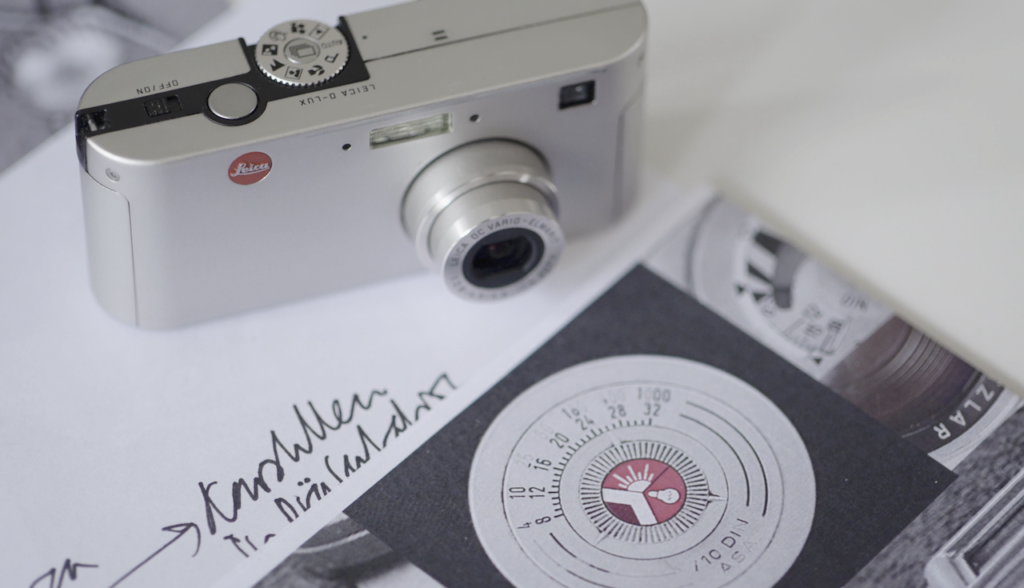
The camera that started the Leica D-Lux lineage, introduced in 2003 | Credits: Leica Camera AG
My first Leica project was the C1, an analogue compact camera. Looking back, I realised I wasn’t inventing a new design language at all. I was rediscovering one that had always been there. It felt as though Leica’s original design principles had been buried over time, and our task was to bring them back to the surface.
That project marked the beginning of a much broader journey. For years we didn’t just design cameras, we helped redefine Leica as a brand. Product design, communication design, exhibitions, retail spaces, everything had to speak the same language. One of the most exciting moments was developing what we called Vision 2005. At the time it sounded almost unrealistic. Leica was close to bankruptcy, yet we imagined a future with a digital M camera and a new headquarters in Wetzlar. Years later, almost everything we had envisioned actually happened.
Then Andreas Kaufmann entered the story. I didn’t know him before he invested in Leica, but from the beginning it was clear that he wasn’t simply buying a company. He believed in its future. He had the vision, and the resources, to invest in new technologies and to think long-term, at a moment when the company desperately needed both.
One day he called me and asked a very simple question: “Achim, what do you think about watches?” Because he loves watches.
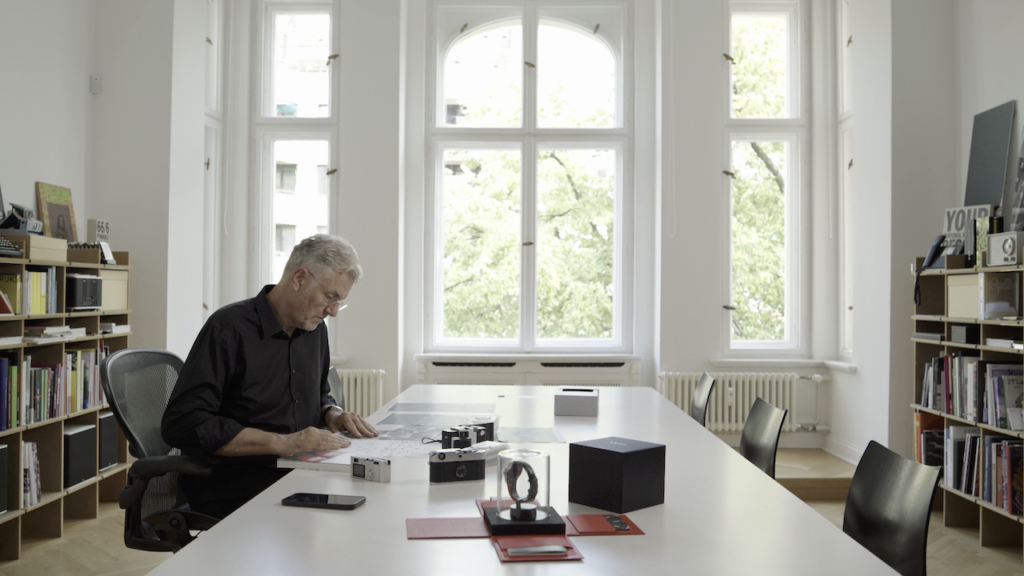
Achim Heine photographed in his studio | Credits: Leica Camera AG
For me, the answer came almost immediately. Not because of the market or another product category, but because I saw a conceptual connection. Photography and watchmaking are both built around time.
A Leica camera captures a single instant and preserves it forever. A mechanical watch continuously measures the passing of time. They perform different tasks, yet both establish an intimate relationship between people and time itself.
That immediately reminded me of something Leica had always said about its own products. Leica doesn’t build lifestyle objects. It builds instruments and I’ve always loved that word!
An instrument isn’t designed simply to be beautiful. It exists to help you perform an action with greater precision. A Leica camera is an instrument for preserving history, one frame at a time. Every photograph isolates a fragment of reality that will never exist again.
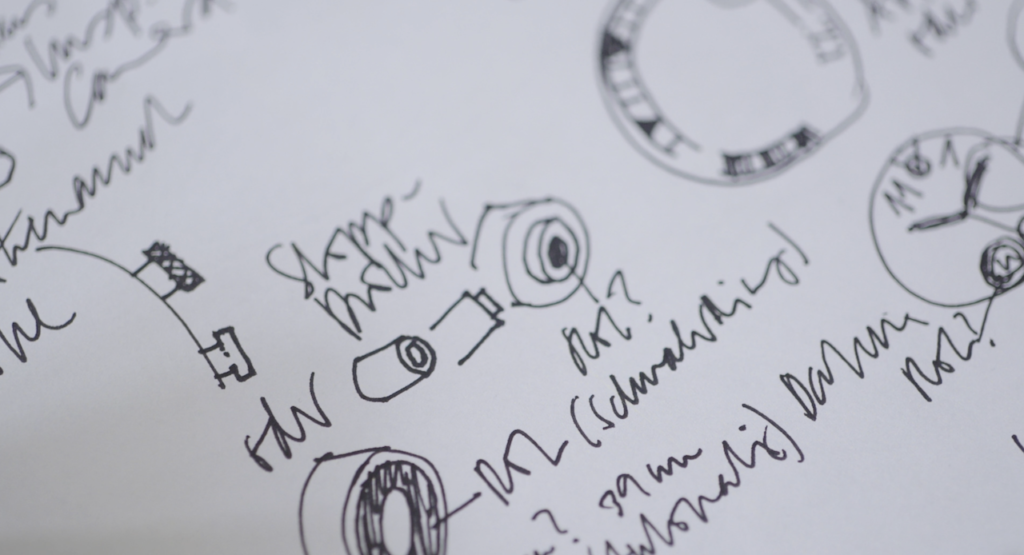
Achim Heine drawings about patented push-crown | Credits: Leica Camera AG
The real challenge came afterwards, how do you design a Leica watch?
On one side stood more than a century of Leica heritage. On the other stood the entire tradition of Swiss mechanical watchmaking. If the design moved too close to the camera, the result would immediately feel like a camera transformed into a watch. If it moved too close to conventional Swiss watchmaking, Leica’s identity would simply disappear.
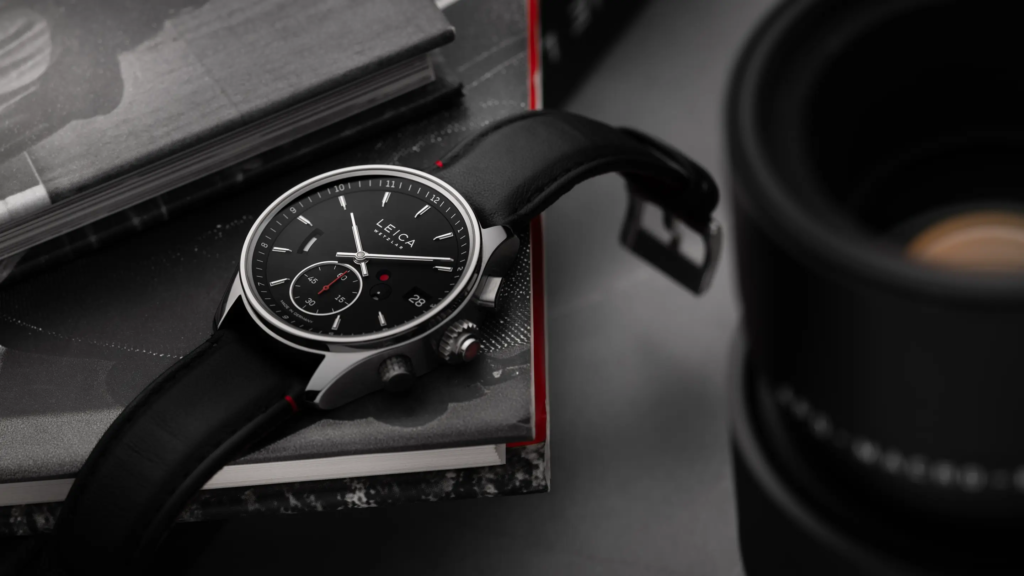
The truth, I felt, lay somewhere in between. Everything started with the Leica M because, to me, it represents the purest expression of Leica’s philosophy. Rather than borrowing its components, I wanted to capture the thinking behind them. The ambition was to create a watch that feels like an M camera: clear in its purpose, restrained in its design and deeply satisfying every time you wear it.
IWS: Photography and watchmaking share a ritual built around gesture and mechanics, creating a uniquely personal connection between the user and the object. Which principles of the Leica M system did you feel were essential to preserve when designing the ZM 1 and ZM 2?
Achim Heine: One of the biggest surprises for me was discovering just how extraordinarily complex a mechanical watch really is.
I started my career designing furniture. When you design a table, you make perhaps ten or twenty fundamental decisions. You choose the material, define the proportions, decide how the different parts come together and, eventually, the object exists. Designing cameras was already a completely different world, with hundreds of technical decisions and functional constraints. Then I started working on watches and realised they were even more demanding. Everything happens on a dramatically smaller scale, where every tenth or even every hundredth of a millimetre suddenly matters.
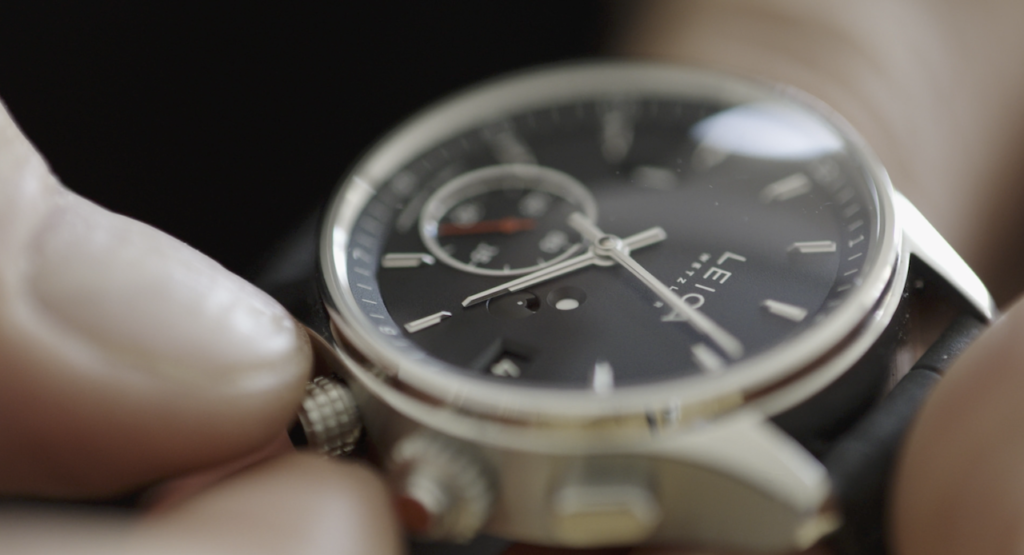
The same gestures, rituals connect Leica cameras and watches | Credits: Leica Camera AG
From the very beginning, one principle was absolutely clear. I never wanted to take the individual components of the Leica M and simply assemble them into a watch.
That would have been the easiest solution and probably the worst one. If you simply transfer recognisable elements onto a watch, you end up with something that is neither a true camera nor a true watch.
Every element had to stand on the same foundation as the rest of the brand. Every proportion, every surface and every interaction needed to express the same values people instinctively associate with Leica. The inspiration came from the Leica M, but never through imitation. I wanted people to feel the same clarity and honesty, without ever thinking they were looking at a camera on the wrist.
One of the longest discussions concerned something that, at first glance, seems incredibly simple: the logo. Everyone at Leica naturally expected the famous red dot to appear on the dial. We tried it many times, but every single attempt produced the same result. The eye immediately recognised the camera and the watch lost its own identity, becoming almost a piece of merchandising.
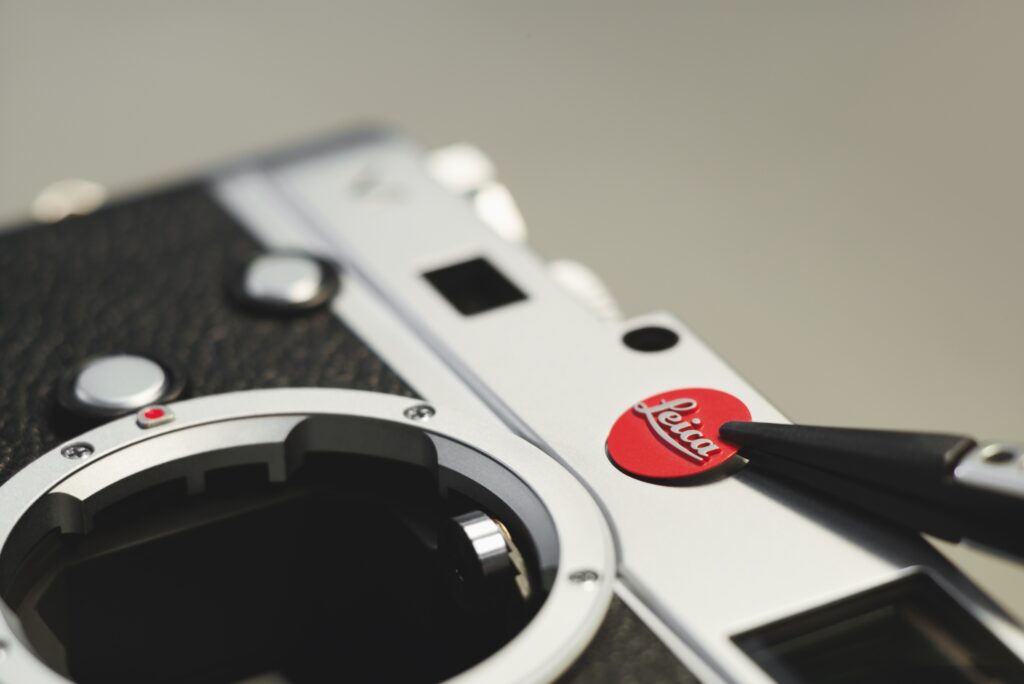
The iconic and timeless Leica red dot | Credits: Leica Camera AG
So we asked ourselves a different question: if the red dot isn’t the answer, what truly represents Leica?
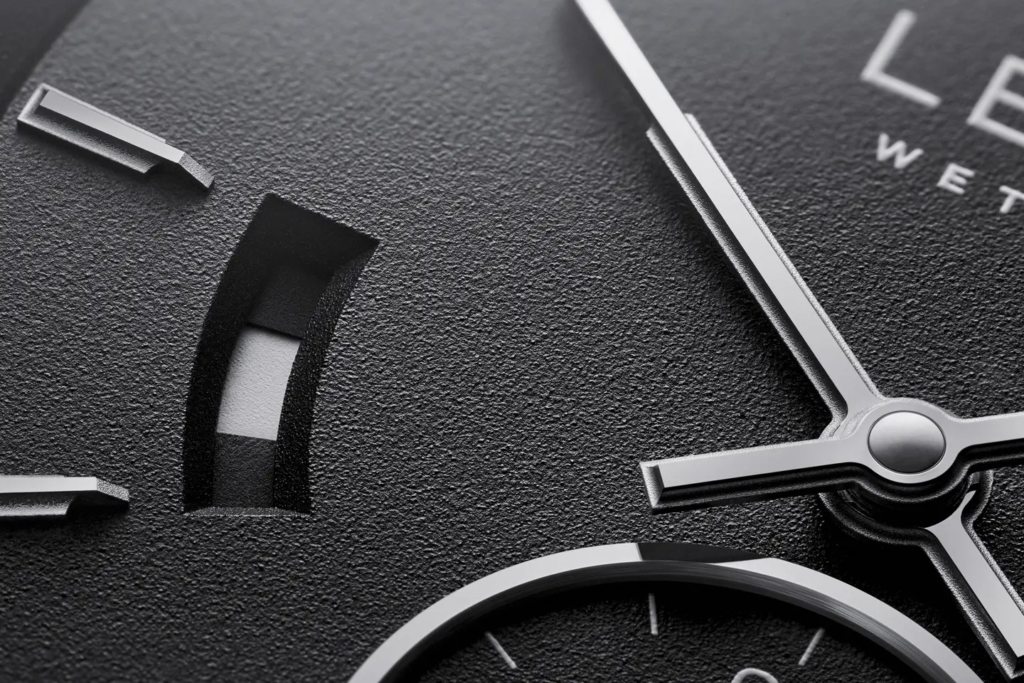
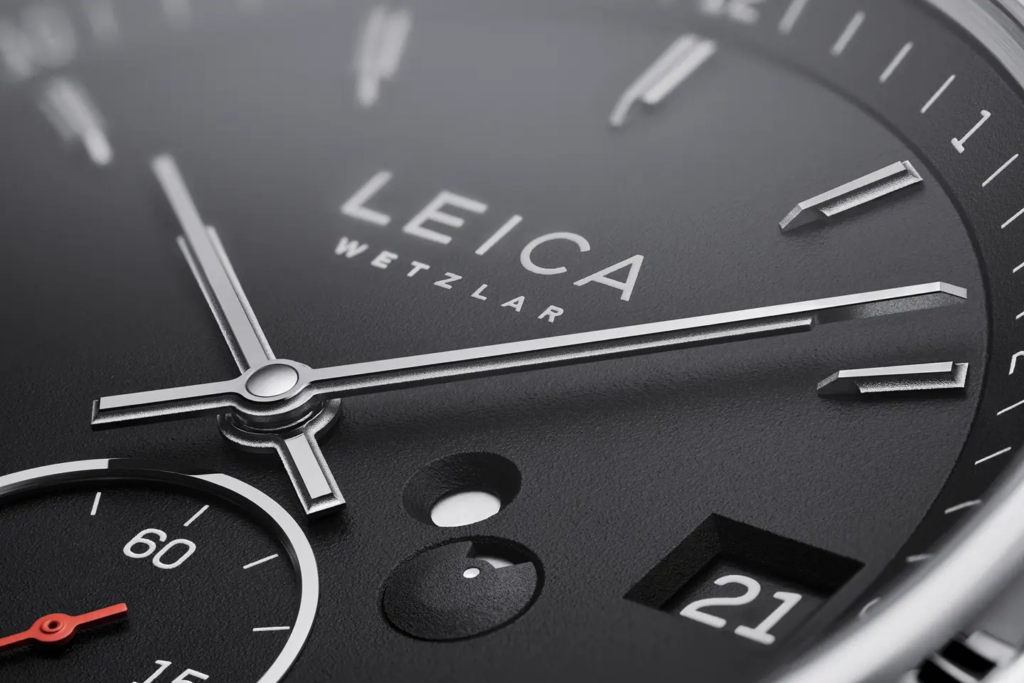
The answer came from the Leica M6. I have always loved the typography printed across the top plate of that camera. It has enormous character without ever becoming dominant. We decided to build the identity of the ZM collection around that lettering instead. The wordmark on the dial draws its inspiration directly from the historic M6 typography and even earlier Ernst Leitz Werkstätten instruments, allowing the watch to remain deeply rooted in Leica’s heritage while establishing its own personality.
The colour red, however, remained an essential part of the design, although never as a logo.
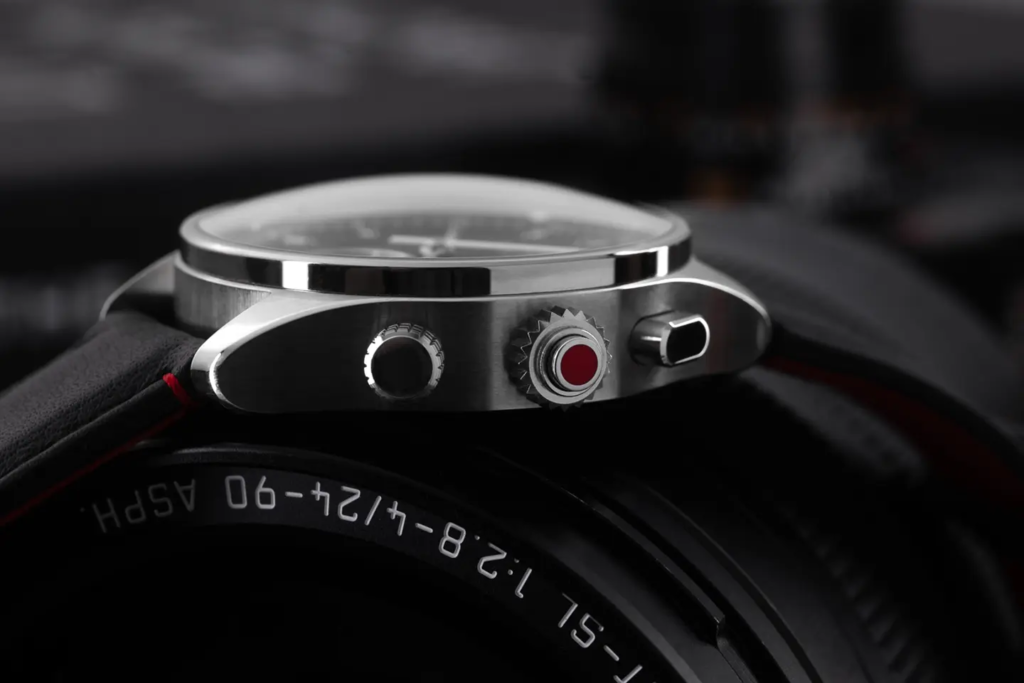
I’ve always felt that red is unlike any other colour. Green exists in countless shades. Orange shifts with the light. Red is red, it instantly signals action. You instinctively understand that something important happens there. That’s why the red insert sits inside the crown instead of becoming a Leica dot. Throughout the watch, red is never ornamental. It serves a purpose, guiding the wearer towards every point of interaction with the instrument.
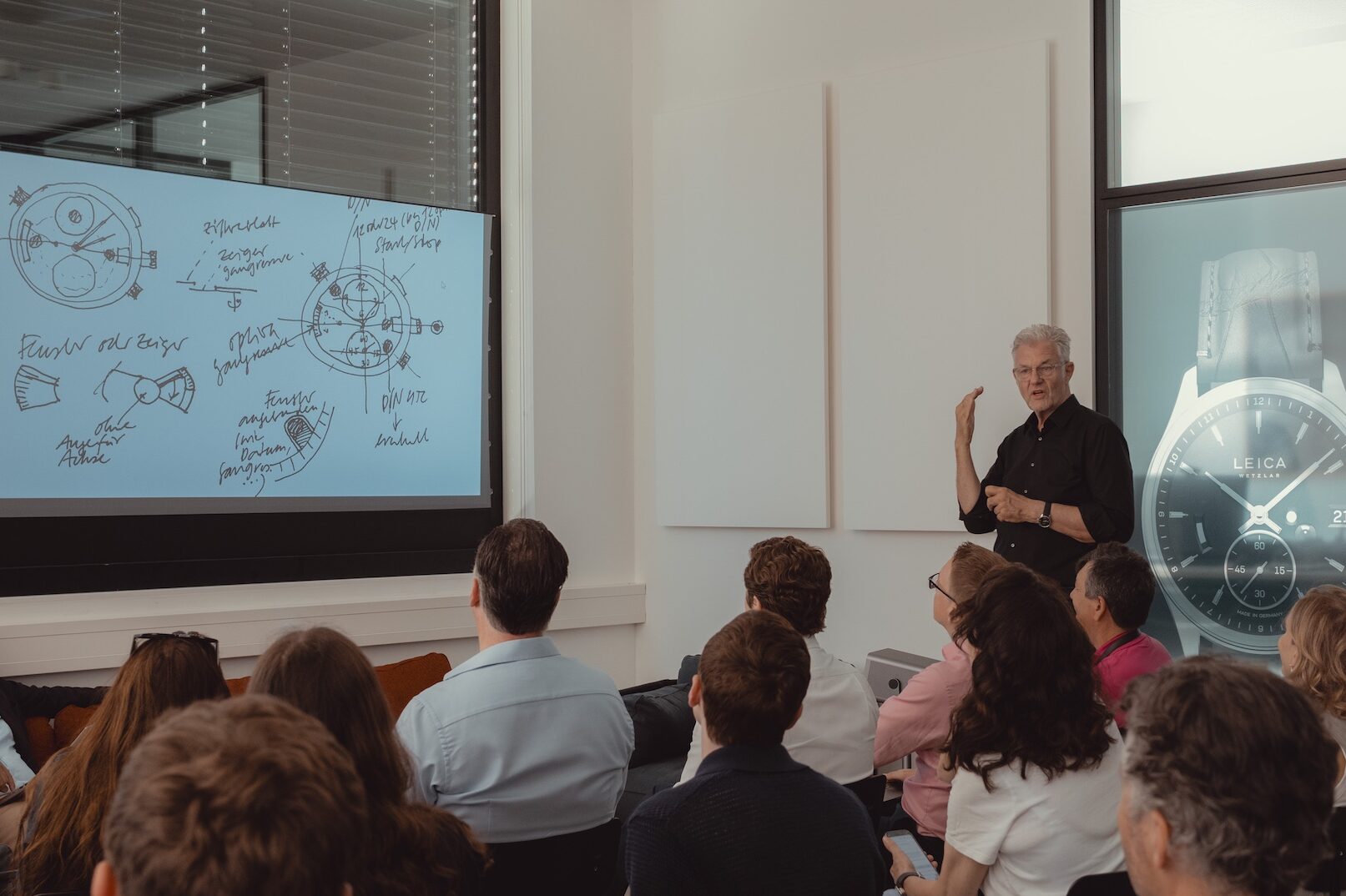
During our visit to Leica Welt, Achim Heine walked us through the process that guided Leica’s journey into watchmaking | Credits: Leica Camera AG
The same philosophy guided the patented push-crown. Instead of pulling the crown as you would on a traditional mechanical watch, you press it. Of course, people immediately associate that gesture with the shutter release of a Leica camera, but the intention was never to imitate a camera. It was about recreating the same relationship between the user and the object. Interaction itself became part of the design language.
The sapphire crystal follows exactly the same logic. Its generous curvature subtly recalls the optical presence of a Leica lens without ever reproducing it literally. The same can be said for the hands, the indexes, the power reserve indicator and the overall design of the case. Everything was transformed.
Even the case profile tells the same story. Viewed from the side, it doesn’t follow the flowing curves traditionally associated with Swiss watchmaking. Its geometry is deliberately architectural. In many ways it reminds me of looking at a Leica M from above: clean surfaces, disciplined proportions and an almost structural clarity.
That philosophy goes all the way back to Oskar Barnack. He built the original Leica in the most logical way possible. Working with folded sheet metal naturally led to clean radii, straight lines and pure geometric forms. Leica’s identity grew out of functional necessity, with every design choice serving a clear purpose rather than decoration.
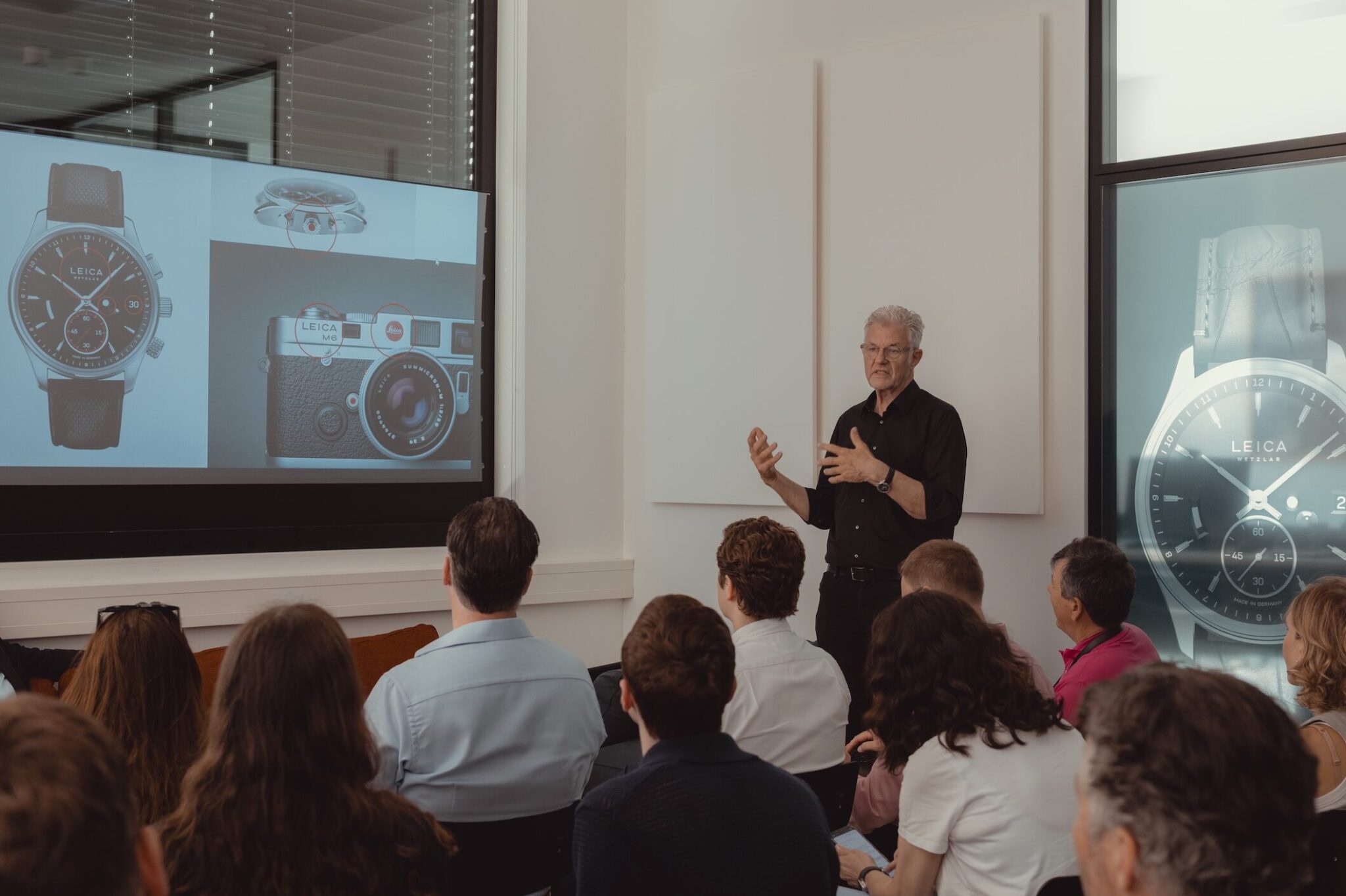
The elements and affinities between the two worlds | Credits: Leica Camera AG
That idea has always fascinated me, and it became the guiding principle behind the ZM 1 and ZM 2. I never wanted people to recognise individual references to a camera. I wanted them to recognise something much more difficult to describe. I simply wanted them to say: “It feels like a Leica.”
IWS: After Leica’s relaunch into watchmaking, what does designing “the Leica way“ mean today?
Achim Heine: People often talk about a “Leica style“, but I don’t think Leica is defined by style at all.
It’s something much deeper than that.
Style changes. It follows trends, different periods and different generations. Identity is something completely different, it has to pass the tests of time. When I design for Leica, I don’t begin by asking how a product should look. I begin by asking what Leica stands for, because every Leica product carries the responsibility of expressing more than a century of history, engineering and culture.
That’s always been my way of working. Before drawing a single line, I try to understand the company itself: its values, its technological capabilities, its heritage and, above all, the promise it makes to the people who use its products. Only then can design emerge naturally. A product should never feel as though a designer imposed a style onto it, it should feel like the inevitable expression of the brand behind it.
That’s also why, over the years, we didn’t only design cameras. We designed communication, exhibitions, corporate architecture and the entire visual identity of Leica. When you work across all those disciplines, you realise that people don’t experience individual products separately. They experience the company as a whole. Every touchpoint contributes to the same perception, so every project has to speak the same language.
Of course, every company evolves. Technology changes, markets change and customers change. We are never designing on an empty floor. There are expectations, traditions and a very clear perception of what Leica represents. The challenge is understanding how far you can move forward without losing the values that made the brand unique in the first place.
That’s why I don’t believe identity comes from repeating shapes or recognisable details. A Leica product doesn’t become Leica because of a particular line, a familiar proportion or a specific logo. It becomes Leica by expressing the same principles. Whether it’s a camera, a watch or any other instrument, people should immediately recognise the same clarity, the same honesty and the same respect for function.
Perhaps that’s simply my nature. I’m a very puristic designer. I always try to remove rather than add. Every extra line, every extra detail weakens the object instead of strengthening it. Reduction isn’t about making something minimal. It’s about ensuring that everything which remains truly deserves its place.
IWS: Great design is often about making the right compromises. If there were no technical or budget constraints, what would your ideal Leica watch look like?
Achim Heine: In a way, I have already designed it. When I developed the ZM 1 and ZM 2, I already began thinking about how their fundamental idea might be carried into another kind of Leica watch not one made more elaborate or more complicated, but one reduced to its essentials.
An idea that stayed with me came from IKEA and its motto of Democratic Design. I have worked extensively in furniture design and exhibited in Milan for many years, so I knew that world very well: companies such as Cassina, designers such as Piero Lissoni, Ettore Sottsass and Achille Castiglioni, and the extraordinary craftspeople who could turn an idea into a beautifully made object.
That idea fascinated me because it introduced something that designers don’t often talk about. Traditionally, we think about design, then we think about design and function. IKEA added a third dimension: price.
I remember seeing celebrated design pieces displayed alongside IKEA products. A chair by Cassina might cost several thousand euros, while another, inspired by the same design philosophy, could be available for a fraction of the price. They were never meant to be the same object, yet they raised an important question: who should have access to good design?
I am not suggesting a Leica for everyone. Leica has never been inexpensive, and it shouldn’t be. The materials, the engineering and the manufacturing quality inevitably come at a cost.
But if you look at Leica’s cameras, the M isn’t the only expression of the brand. There are other cameras that share exactly the same language while offering a different level of complexity. The identity remains the same, even if the product becomes more approachable.
I’ve often wondered whether that could also become an interesting direction for Leica watchmaking.
Imagine a watch that preserves everything that makes a Leica watch unmistakably Leica but with a simpler mechanical architecture. Perhaps it wouldn’t feature the patented push-crown. Perhaps some technical solutions would become less complex. The important thing is that the experience and the promise remain exactly the same.
I think that’s becoming increasingly relevant today. Mechanical watchmaking has reached an extraordinary level of sophistication, but it has also become increasingly expensive. Many young enthusiasts genuinely love analogue objects and mechanical watches, yet entering that world becomes more difficult every year.
I’d like to see a Leica watch that remains completely faithful to its values while becoming attainable for a broader community of collectors.
Accessible at the highest level but there’s an important distinction there. Accessible doesn’t mean compromising quality, it means allowing more people to experience the culture, the language and the philosophy behind the object.
Because, in the end, the perfect watch isn’t the one with the greatest number of complications. It’s the one you wear every day, the one that becomes part of your life and, one day, perhaps part of someone else’s.
A watch you can pass on to the next generation, an object that continues telling its story long after yours. To me, that’s what a Leica watch should ultimately become.
IWS: For more than a century, Leica has invited us to see time through a lens. Today, with watchmaking, it seems to be exploring a new way of experiencing it. Looking ahead, where do you see Leica’s journey taking us?
Achim Heine: I think the future should never be about producing more. It should be about producing things that deserve to exist.
We live in a world where almost everything has become digital. Our phones tell the time with extraordinary precision. Cameras can create remarkable images almost automatically. Artificial intelligence is beginning to generate photographs that never actually happened. Technically, all of this is extraordinary. But I don’t believe people are looking only for technology anymore. They are looking for meaning.
That is why I find the renewed interest in analogue experiences so fascinating. Some years ago, I became involved in the Impossible Project, the initiative that acquired the last Polaroid factory after the company had gone bankrupt. Many people believed instant film had no future because digital photography had already won. The opposite happened. Most of the people buying those cameras were young. They had grown up in a digital world, yet they were searching for something tangible, something they could hold in their hands.
We see exactly the same phenomenon with vinyl records. Streaming is more convenient in every possible way, yet millions of people still choose to listen to music on vinyl because the experience itself has value.
Mechanical watchmaking belongs to the same world. Nobody wears a mechanical watch because it is the most accurate way of measuring time. Every smartphone is infinitely more precise. People wear a mechanical watch because it represents something completely different. It represents human ingenuity. It represents craftsmanship. It represents patience. It represents hundreds of years of accumulated knowledge expressed through gears, springs and tiny mechanical components working together in perfect harmony. That is something technology cannot replace.
I believe Leica occupies a very similar position. People don’t choose a Leica simply because it produces excellent photographs. There are many cameras capable of doing that today. They choose Leica because using one changes the way they photograph: It slows you down, It makes you observe more carefully, It encourages you to become part of the process instead of letting the technology do everything for you.
The same philosophy can exist in watchmaking. A Leica watch shouldn’t compete with a smartwatch, that would completely miss the point. Its value lies elsewhere. It offers a different relationship with time, one that is slower, more conscious and deeply connected to the pleasure of interacting with a beautifully engineered object.
I think that will become even more relevant in the years ahead. As technology continues to remove friction from our lives, people will increasingly value objects that invite them to slow down. Objects that ask for attention rather than demand it. Objects that create rituals.
That, to me, is where Leica’s future truly lies. Not in resisting innovation, but in reminding us that progress should never come at the expense of human experience.
IWS: Photography captures time. Watchmaking measures it. After immersing yourself so deeply in both worlds, how has your perception of time changed as a designer?
Achim Heine: I think photography and watchmaking ultimately deal with the same subject.
Time is our life. It never stops and it moves continuously forward, whether we notice it or not.
A mechanical watch allows us to follow that continuous flow. You see the seconds passing, one after another, reminding you that time is always moving. Photography, on the other hand, does almost the opposite. It takes one precise instant out of that continuous flow and preserves it forever.
That’s why I immediately loved Andreas Kaufmann’s idea of Leica entering watchmaking. To me, the connection was obvious. Both disciplines are about time, they simply approach it from different perspectives.
One measures its continuity, the other gives a single moment permanence. In the end, they’re two different ways of helping us understand exactly the same thing.
As a designer, that’s probably what fascinates me most. We can never stop time, but through the objects we create, we can change the way people experience it. And sometimes, that’s enough to make a single moment last a lifetime.
Are you looking for the perfect gift? Explore our online store and discover the entire collection signed IWS – Italian Watch Spotter!
For all real-time updates on the world of watchmaking follow us on Instagram and visit our Youtube channel.