Rolex presents the new Perpetual Padellone!
Unveiled as a surprise outside the Watches and Wonders calendar, it brings back into the spotlight one of the most unusual and sought-after watches in the history of the Corona: the 8171, the large full calendar with moon phase display that Italian collectors simply dubbed “Padellone.”
This time, Rolex has done something even more intriguing: it has turned that nickname into the official name of a new model.
And that’s pretty much where the nod to the past ends. Inside the 39-mm case, we find a full instantaneous annual calendar, moon phases, the all-new 5-Hz Caliber 7190, and the Dynapulse escapement introduced in 2025 with the Land-Dweller. This movement is the subject of 30 patent applications, two of which pertain specifically to the new Padellone.
Seventy-seven years after Ref. 8171, Rolex is thus revisiting one of the most eccentric chapters in its history to create one of the most technically sophisticated watches in its current lineup.
Before the new Padellone, there was the Rolex ref. 8171
Let’s go back to 1949. Rolex had patented the Oyster case in 1926, and in the postwar period, it was gradually establishing the identity associated with durability, water resistance, and everyday use that would shape much of its history.
Then came the 8171 model. It featured a 38-mm round case, enormous by the standards of the time, a screw-down case back, and a dial displaying a full calendar with moon phases. The day of the week and month were displayed through two windows at 12 o’clock; the date was indicated by a central hand along a peripheral scale, while at 6 o’clock, the small seconds and moon phase display shared the same sub-dial.
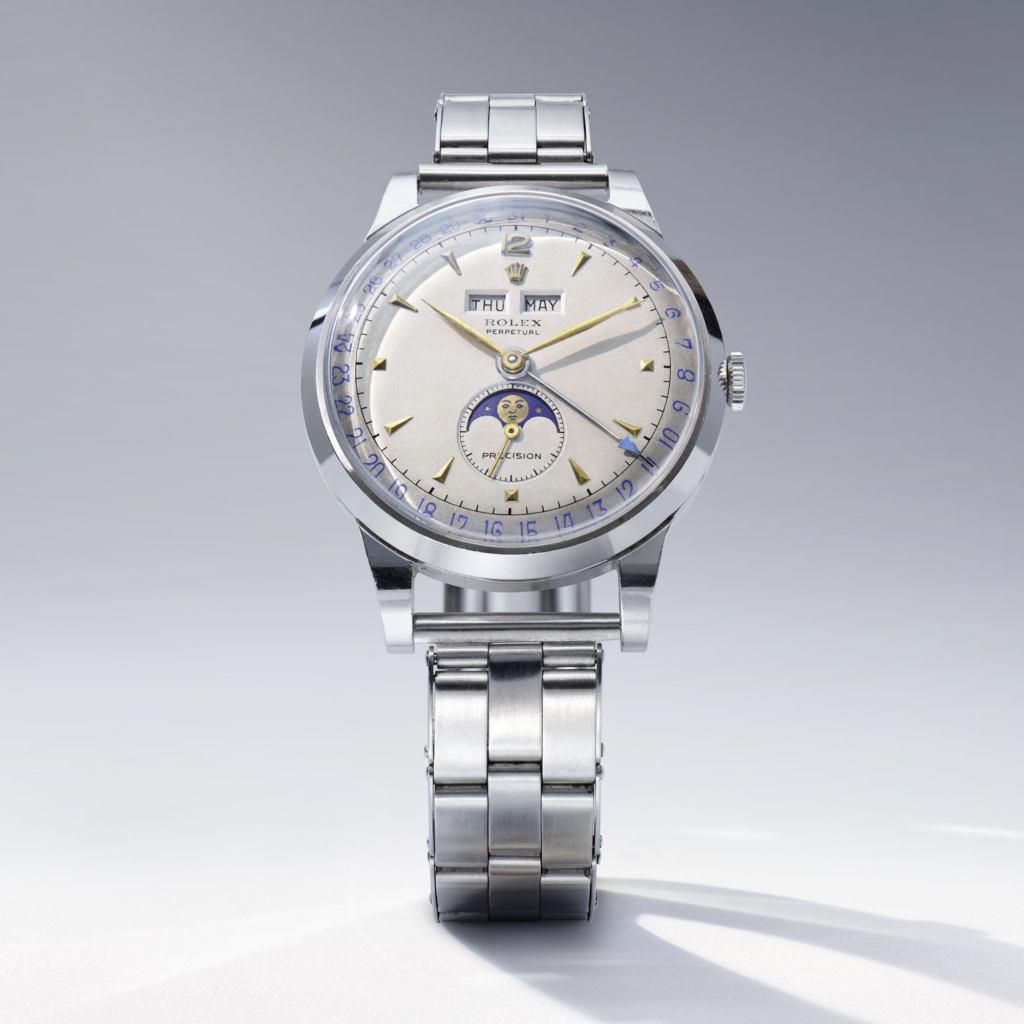
It was powered by a Perpetual automatic movement, identified as caliber A295 CPL, and certified as a chronometer. And it is precisely the wide and relatively flat case that explains the nickname coined by Italian collectors: “Padellone.”
Ref. 8171 remained in production for a very short period, generally considered to be between 1949 and 1952, and was made of steel, yellow gold, and, in extremely rare instances, rose gold. Collectors’ literature estimates total production to be in the range of 1,000–1,200 pieces, although the exact numbers and their breakdown by metal remain a subject of study.
Shortly afterward, the ref. 6062, 36 mm, with a similar configuration but this time housed in an Oyster case with a screw-down caseback.
These are the two major exceptions among Rolex watches from the mid-20th century: the only two vintage models mass-produced by the brand featuring a full calendar and moon phase display.
Then that chapter came to a close, and we’ll have to wait for the Cellini Moonphase, Ref. 50535, from 2017 to check the moon phase on a production Rolex.
Rolex Perpetual Padellone: 39 mm and three configurations
The new Padellone immediately brings back that memory, without attempting to replicate the 8171.
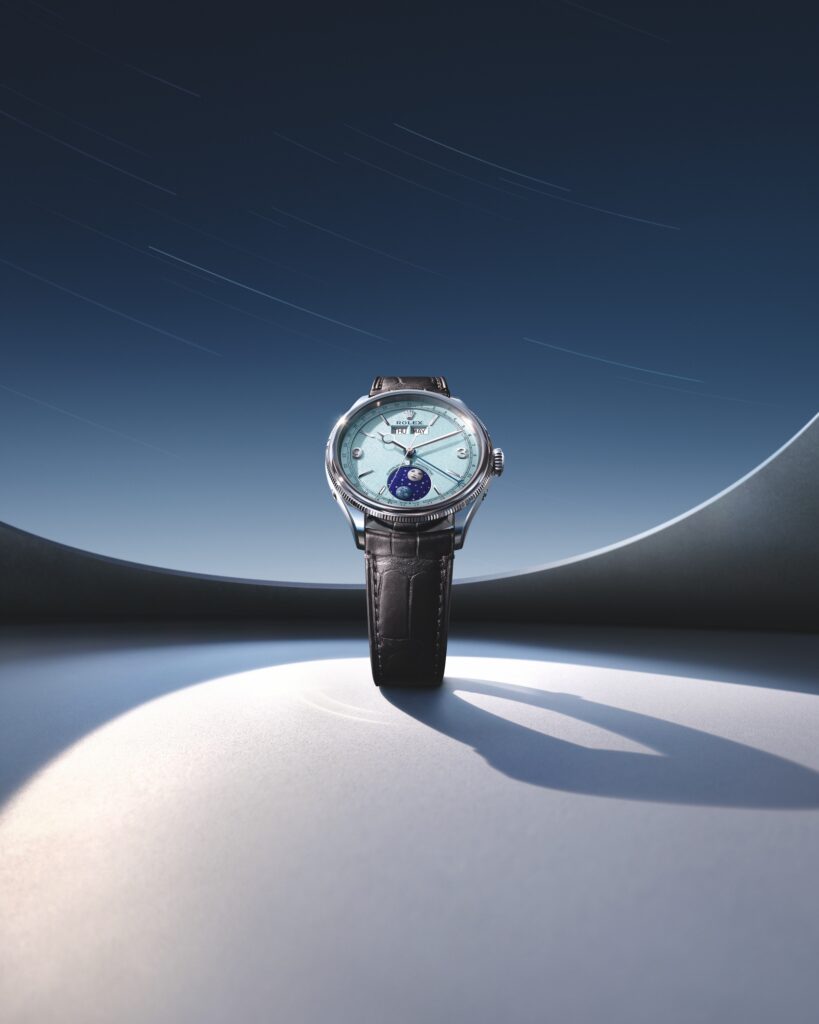
The case measures 39 mm in diameter, 12.20 mm thick, and approximately 45.1 mm from lug to lug. It is just one millimeter larger than the original.
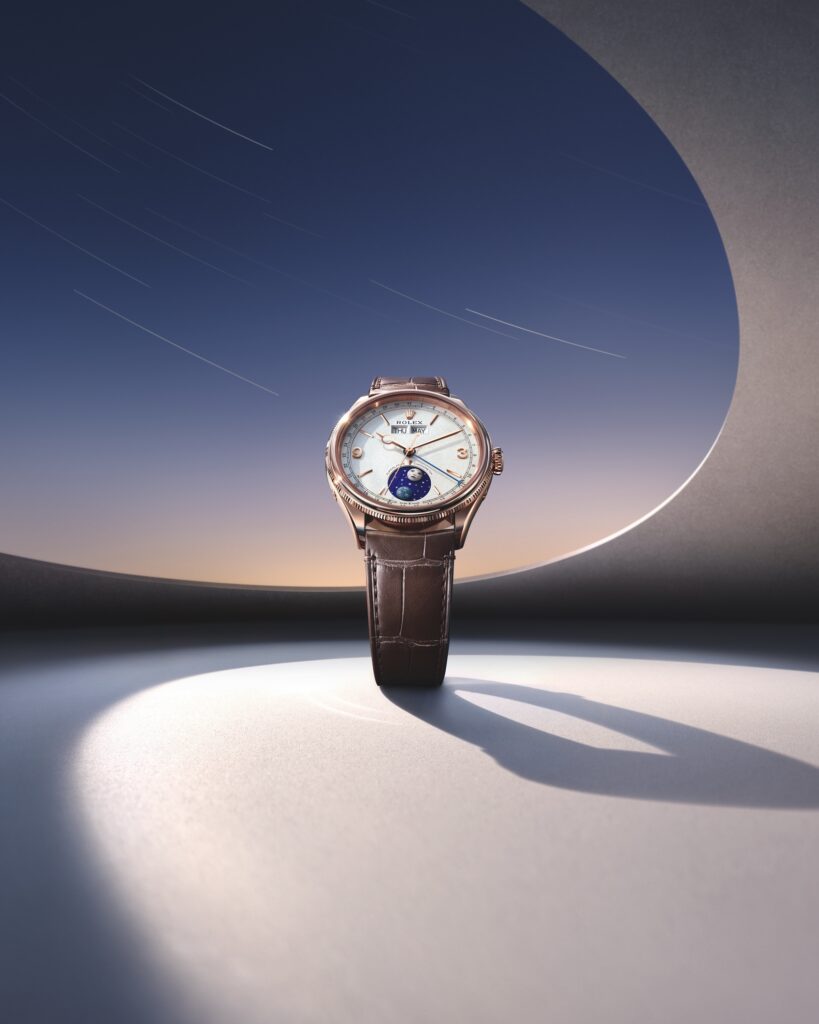
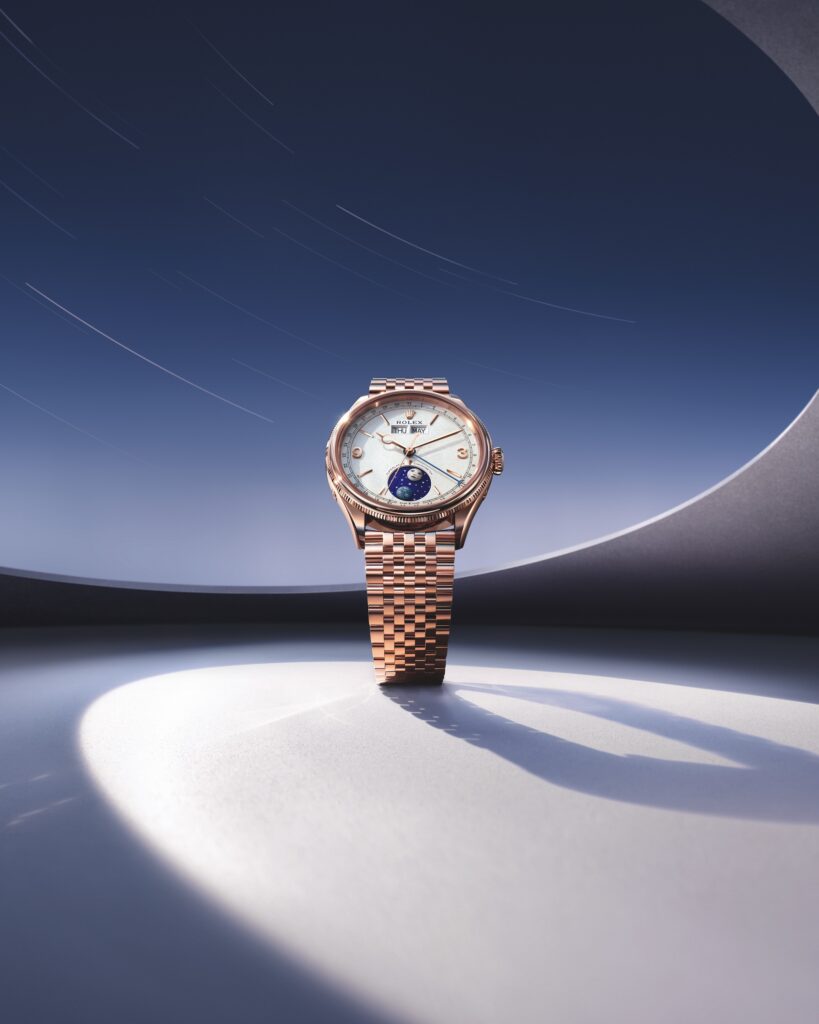
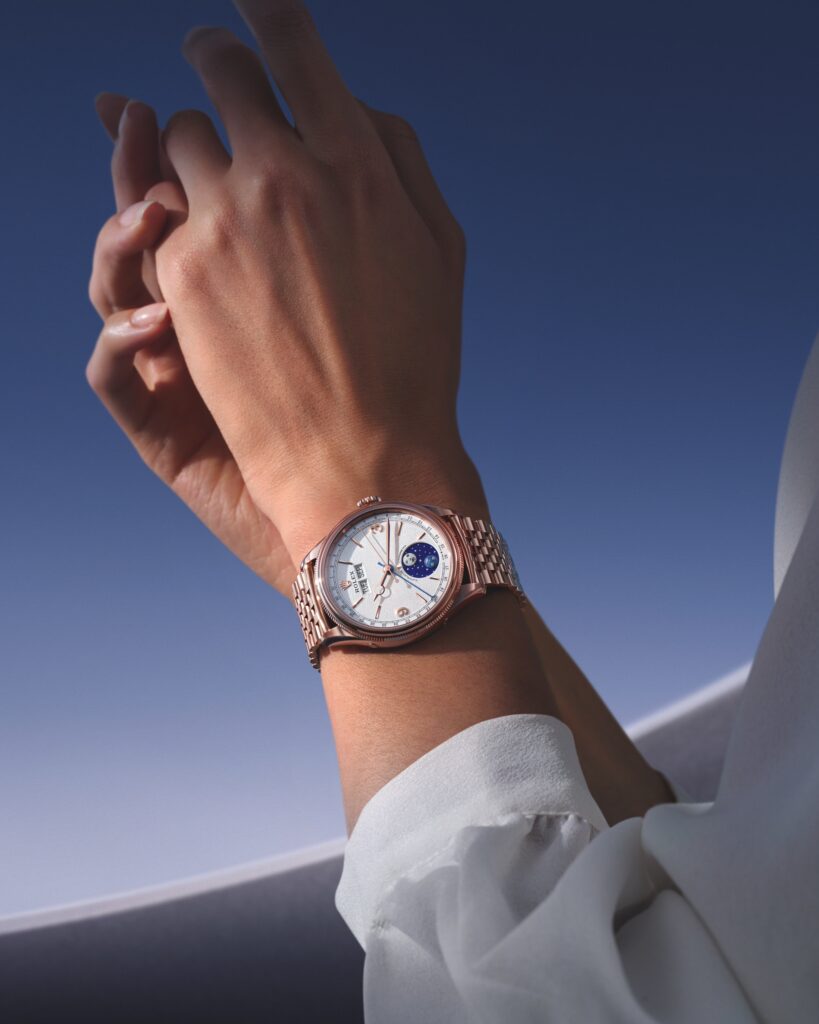
There are three initial configurations: 18K Everose gold with a brown alligator strap, Everose with a Settimo bracelet, or 950 platinum with a black alligator strap.
The design is based on the Perpetual family, introduced in 1908, featuring a domed, finely fluted bezel, a domed sapphire crystal, and a screw-down case back with a sapphire crystal. It is water-resistant to 50 meters.
There are also four recessed displays on the sides: the month at 2 o’clock, the date at 4 o’clock, the moon phase at 8 o’clock, and the day of the week at 10 o’clock.
There are four of them on the old 8171 as well. But seventy years of mechanical development separate what happens once they are pressed.
A dial we’re familiar with. Almost
The family resemblance to the 8171 becomes evident when you look at the dial. The day and month appear side by side at the 12 o’clock position, while the date runs along the entire circumference and is indicated by a slender blue hand ending in a crescent.
The Everose version features an Intense White dial; the platinum version features the distinctive Ice Blue dial that Rolex reserves for its models made of this metal.
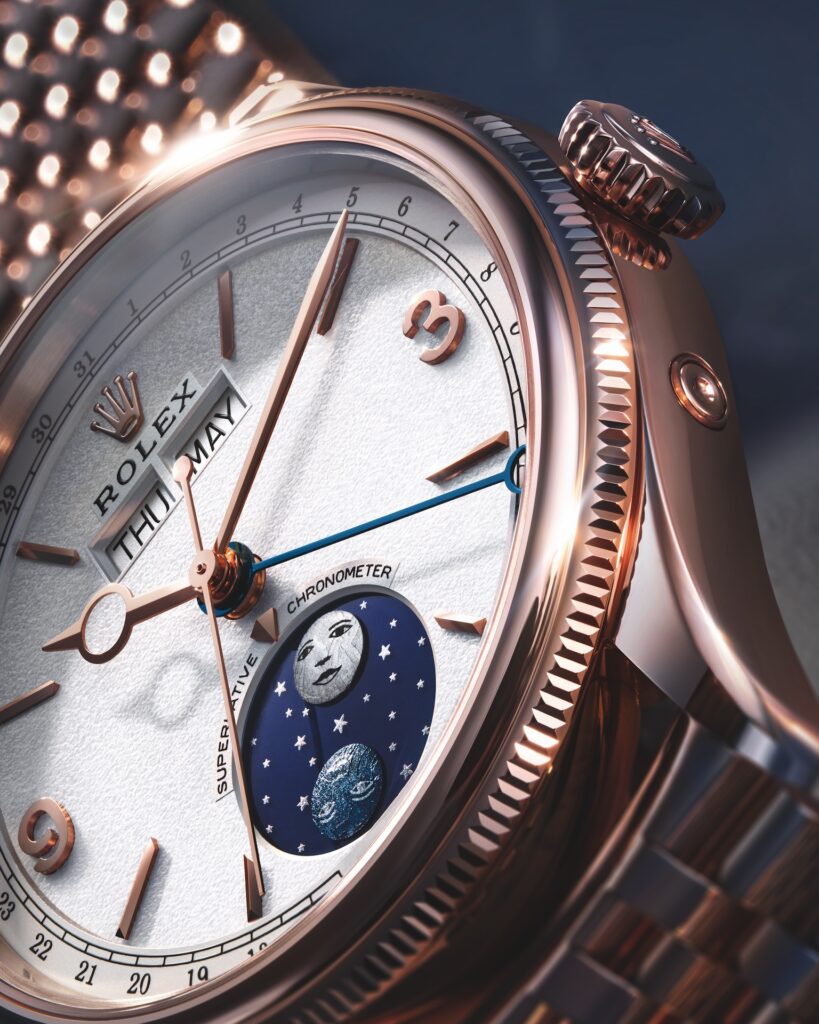
The central surface features a matte, granular finish, while the raised date scale has a finer satin finish. The applied hour markers are faceted, and at the 3 and 9 o’clock positions, two Arabic numerals appear, which also serve as a subtle nod to the ref. 6062.
However, there is one important difference compared to the historic Padellone.
The small seconds sub-dial has been removed from the 6 o’clock position. On the new model, the hours, minutes, and seconds are all centered, leaving the lower portion of the dial entirely for the moon phase display.
Rolex returns to the moon phases. And it uses a meteorite.
It is probably the most poetic detail of the watch, but also one of the most interesting to observe up close. The moon phase disc is made of blue enamel and completes a full rotation in 29.53 days, following the length of the synodic month.
Rolex depicts both the full moon and the new moon using meteorite. The full moon retains the material’s natural silvery appearance and is complemented by a black pad-printed face. The new moon, on the other hand, features a dark blue PVD coating, to which silver details are applied. The stars are also created using pad printing.
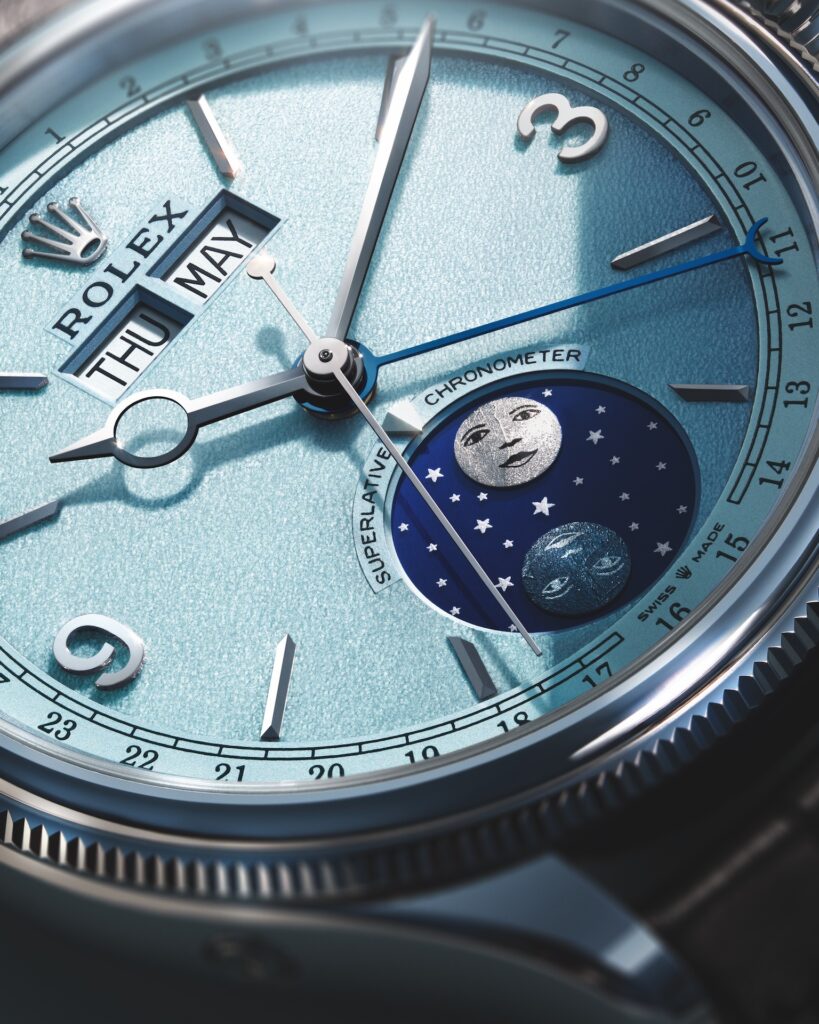
Unlike the 8171, whose moon was partially visible through an opening in the small-seconds sub-dial, here the disc is fully visible. A small triangular marker positioned above it allows the current phase to be read.
It is one of the very rare instances in which Rolex openly embraces the most evocative aspect of traditional watchmaking. And it does so without compromising its obsession with mechanical precision.
Haplos: The New Rolex Annual Calendar
Because the 2026 Padellone looks like a typical calendar from the 1950s, but mechanically speaking, it belongs to a different category.
Ref. 8171 required adjustments based on the varying lengths of the months. The new model, however, uses an annual calendar that can automatically distinguish between months with 30 and 31 days. It therefore requires only one adjustment per year, at the transition from February to March. Rolex has named the new system Haplos.
The solution is particularly interesting because of its simple design: the system uses only two additional components associated with the date mechanism, an extra drive pin and an annual lever.
Even more intriguing is the way the movement determines the current month. The calendar mechanism is integrated into the back of the month disc, which signals the duration of the current month to the annual lever.
But there is a second feature that makes this system distinctly Rolex: the instantaneous calendar. At the stroke of midnight, the day, date, and month advance simultaneously in a fraction of a second. The mechanism gradually stores the necessary energy throughout the day and releases it at the moment of the advance, keeping the three displays perfectly aligned.
This solution is also the subject of a patent application.
The Padellone thus becomes the second annual calendar in Rolex’s lineup, following the Sky-Dweller and its Saros system, but it achieves this through a completely different mechanical solution.
Caliber 7190: Behind a 1949 Dial Lies the Rolex of the Future
The 7190 caliber is the result of the technical developments that led to the 7135 caliber in the Land-Dweller, and it marks the first time the Dynapulse escapement has been featured in a Rolex complication watch with a classic design.
The Dynapulse is a sequential exhaust system, made almost entirely of silicon and designed to reduce energy losses associated with exhaust operation.
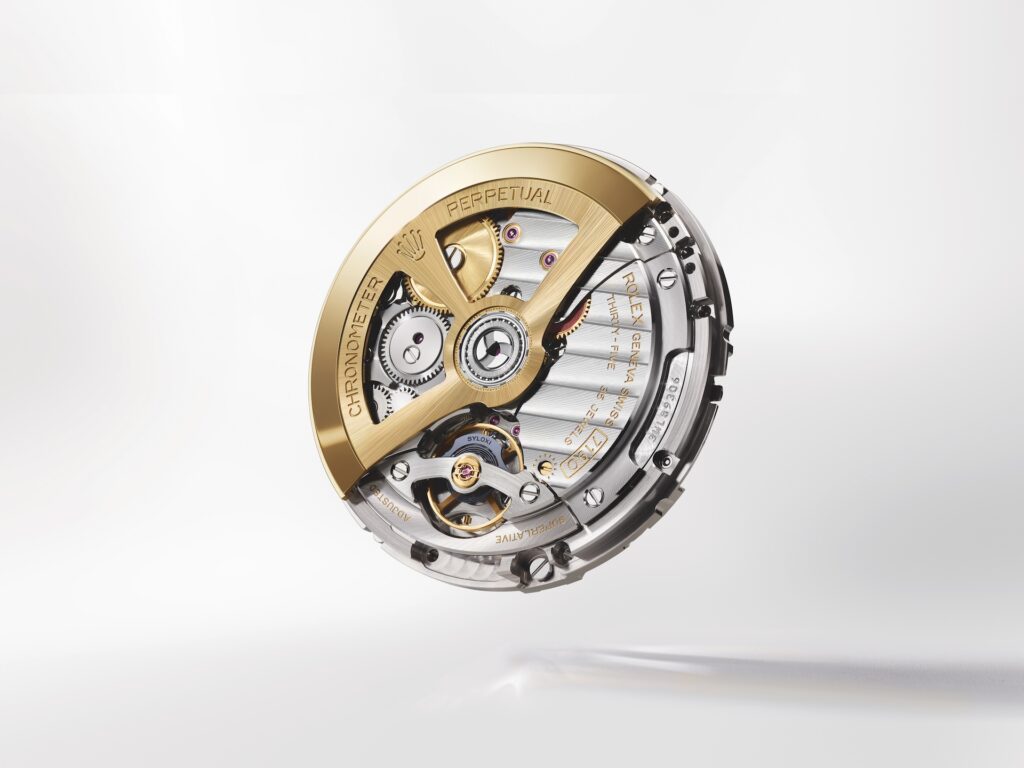
As a result, the 7190 caliber operates at 5 Hz, equivalent to 36,000 vibrations per hour—a particularly high frequency for contemporary Rolex production.
The control system also includes a Syloxi silicon coil, a ceramic rocker arm shaft, a variable-inertia rocker arm, a through-type rocker arm bridge, and optimized Paraflex shock absorbers.
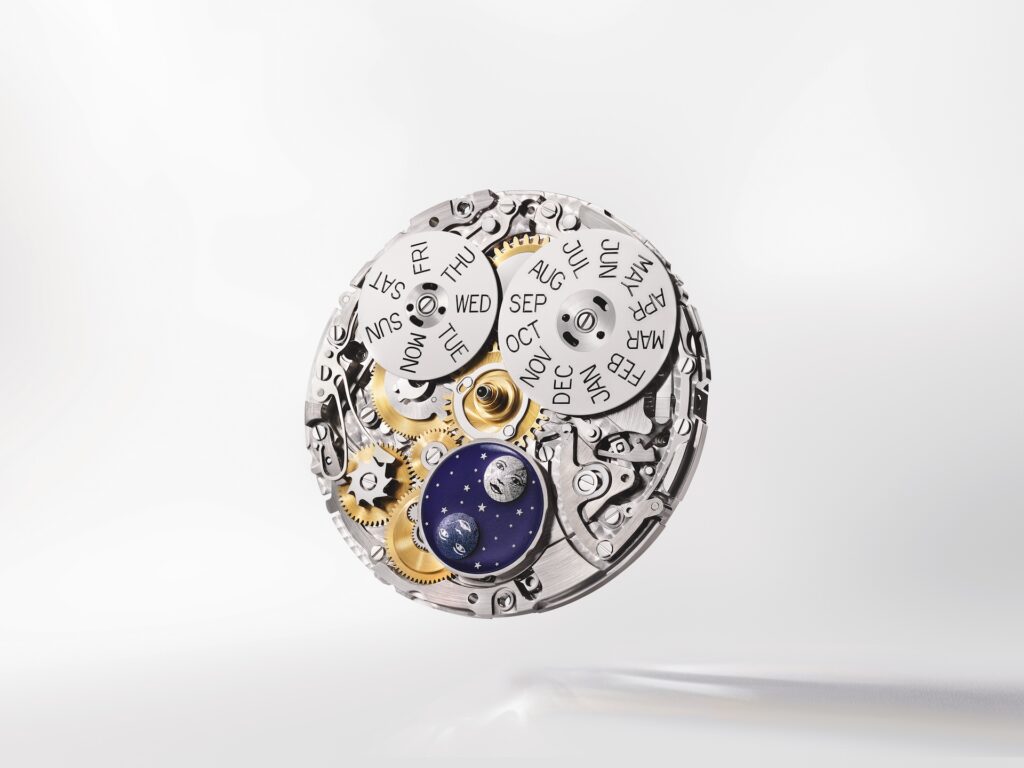
In addition to all this, the 7190 features the Haplos annual calendar, instantaneous date change, moon phases, and a power reserve of approximately 66 hours.
And there’s one figure that helps put the scope of the project into perspective: according to Rolex, the movement is the subject of a total of 30 patent applications, two of which pertain to innovations developed specifically for the Perpetual Padellone.
Behind one of the most nostalgic dials introduced by Corona in recent decades lies one of its most advanced movements.
Beyond the bottom
The 7190 movement remains visible through the sapphire crystal case back.
The bridges feature the Rolex Côtes de Genève finish, characterized by the fine, polished groove between each band, while the oscillating weight is crafted from solid yellow gold.
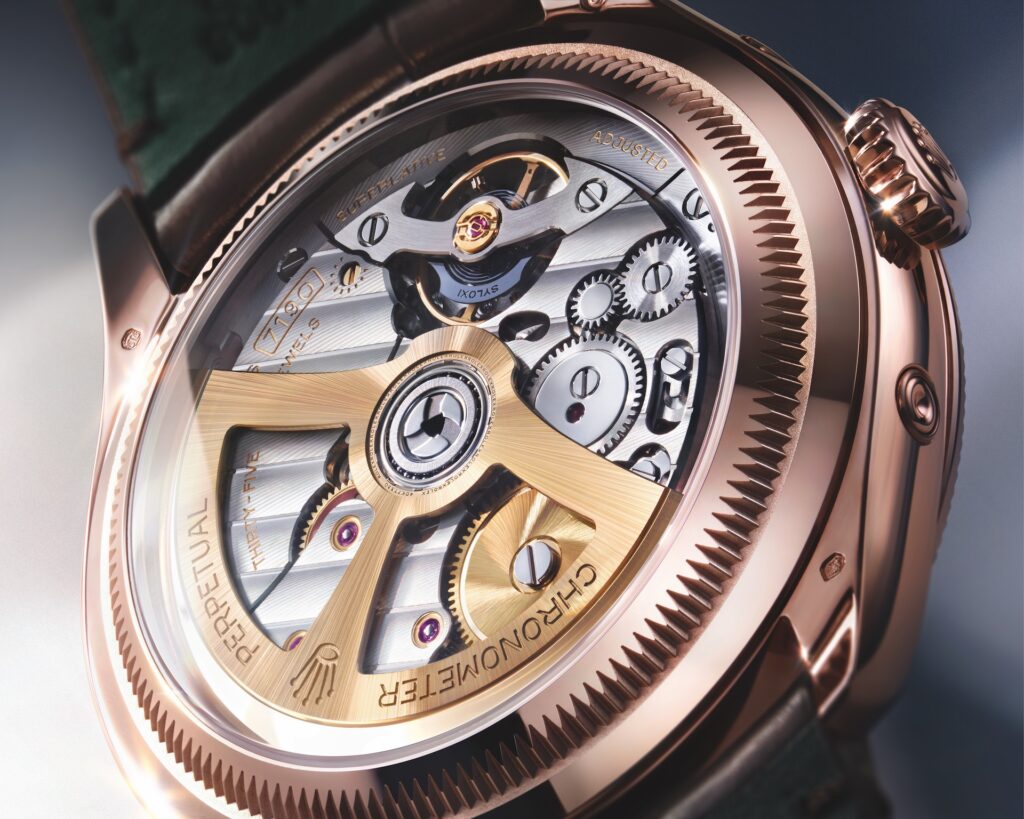
The movement naturally retains its Superlative Chronometer certification, with a stated accuracy of −2/+2 seconds per day when the watch is in a case.
Starting in 2026, Rolex has also strengthened its protocol by introducing new evaluation criteria related to resistance to magnetic fields, reliability, and sustainability.
From the Strap to the Settimo: All Prices
The ref. 53505-0002 Crafted in Everose gold, it features an Intense White dial paired with a matte brown alligator strap, lined with green calfskin and secured with a Dualclasp folding clasp.
The ref. 53506-0002 The platinum version, on the other hand, features an Ice Blue dial and black alligator leather strap.
The third configuration is probably the one that most significantly changes the look of the watch on the wrist: the ref. 53505-0003 It pairs the Everose case with the Settimo bracelet, introduced in 2025.
Seven rows of small, rounded, and polished elements, with curved end pieces connected to the case via a patented system and a hidden Crownclasp.
The listed prices are 52,500 CHF for the Everose model with a strap, 59,000 CHF for the platinum model, and 64,800 CHF for the Everose model with a Settimo bracelet, including taxes in the Swiss market.
Final considerations
Perhaps the most interesting aspect of the new Padellone is precisely what Rolex chose to restore.
The Ref. 8171 was already an exception back in 1949: large, complex, elegant, without an Oyster case, and far removed from the path that, just a few years later, would lead the Maison toward the Submariner, GMT-Master, Explorer, and Day-Date.
Haplos, instant calendar, Dynapulse, 5 Hz, meteorite, 30 patent applications. The result almost seems like a meeting between two Rolexes that we’ve rarely seen in the same room: the one from the 1950s, still capable of freely experimenting with shapes and complications, and the contemporary one, obsessed with efficiency, precision, and the industrialization of mechanics.
Perhaps the most striking detail, however, is written on the dial: Padellone. A nickname that originated decades ago among Italian enthusiasts and collectors has become the name chosen by Rolex for one of its most important watches of 2026.
It’s hard to imagine a better way to bring it back to life!
Are you looking for the perfect gift? Explore our online store and discover the entire collection signed IWS – Italian Watch Spotter!
For all real-time updates on the world of watchmaking follow us on Instagram and visit our Youtube channel.