
IWS meets Alain Delamuraz, CEO of Jaquet Droz
IWS: Alain, welcome to Milan. Jaquet Droz has chosen Milano Watch Week as an opportunity to meet collectors and present the Maison here in Italy. What brought you to Milan, and what does being part of Milano Watch Week represent for Jaquet Droz today?
Alain Delamuraz: First of all, I love Italy, and we love Italy altogether. We love the people, the architecture, the food, the wine, the spirit, the elegance. There are so many common points between Italy, globally speaking, and the art of watchmaking, and specifically Jaquet Droz. So we really feel at home here.
Because of this culture, because of the competence in art you have in Italy, there are many collectors here who can be sensitive to our art. We’re not making watches anymore. We’re making pieces of art. Every single watch is unique. We never make the same watch twice. Every time, we create a piece of art, and we know that Italian culture and Italian people are very sensitive to art.

This is why there’s such a good relationship between the people here at Milano Watch Week and us. Of course, an event like this is an opportunity to let people know who we are. But what interests us much more is developing a one-to-one relationship with the final collector, someone who’ll be able to create this piece of art together with us. It becomes a collaboration between two artists: the one who makes the piece and the one who wears it.
IWS: Jaquet Droz has radically transformed its business model in recent years, moving away from traditional distribution towards unique creations and a direct relationship with collectors. From a CEO’s perspective, how has this changed the way you look at markets, growth and ultimately the idea of success for the Maison?
Alain Delamuraz: We call this new approach Disruptive Legacy. It’s an oxymoron. You have disruption, but you also have legacy.
Pierre Jaquet-Droz was making pieces of art for kings. And when you make a piece of art for kings, without being arrogant, you don’t make something for everybody. So we decided to concentrate on the kings of today. They don’t all have crowns anymore, but for us, they’re kings.
This approach led us towards creating only unique watches. It also means that we no longer need a traditional distribution system. What we need is this one-to-one relationship with private collectors who want to participate in creating the object of their dreams.
But when we speak about Disruptive Legacy, the legacy is extremely important. These are our roots, our heritage, and they give legitimacy to the brand. At the same time, respecting the master, the professor or the father doesn’t mean doing exactly what he taught you to do. If you do that, you copy. And in art, if you copy, you die.
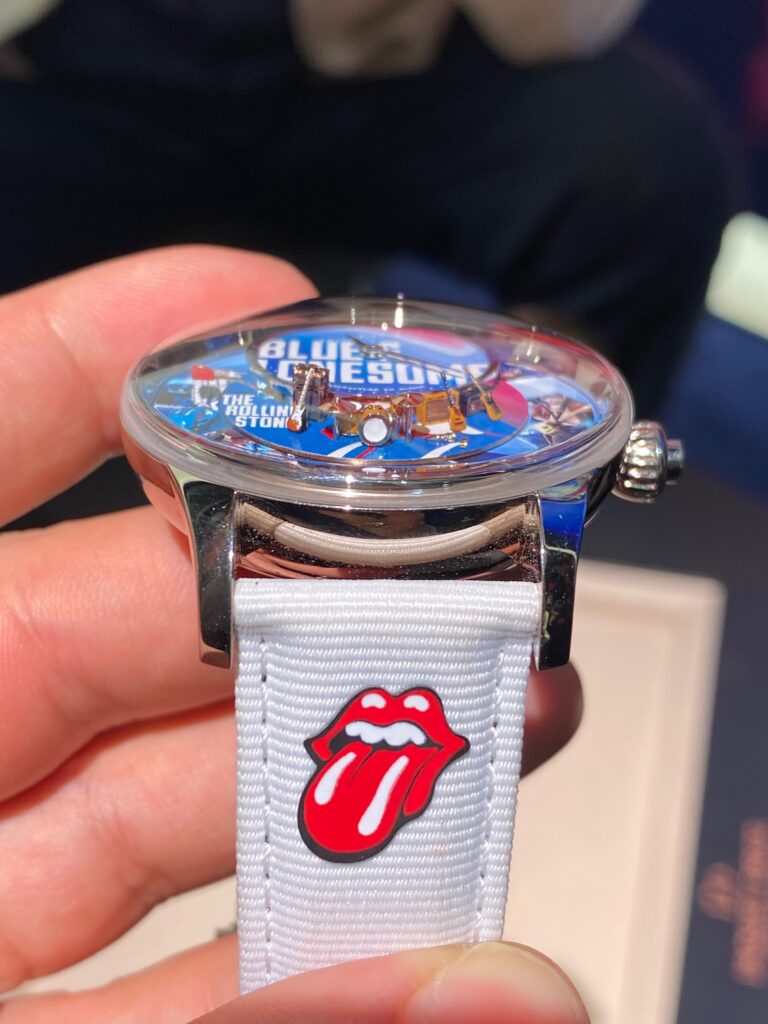
The idea is to take inspiration from the past, but to disrupt it. We don’t want a revolution, because that would be too strong. But we don’t want a normal evolution either, because that would be too slow. Disruption, for us, is positive. It respects what came before, but it puts new spices in the sauce. You need to wake things up a little. You can’t always do the same classical things. You have to respect the past, while finding a way to surprise people, artists and artisans alike.
It takes time for this approach to be understood and respected. In the beginning, when we explained the concept, people said, “You’re crazy.” But once they studied it, they said, “It makes sense.” At least for a brand that’s nearly 300 years old.
To know where you want to go with such an old brand, you must remember where you come from. Victor Hugo expressed this idea beautifully: the future is a door, and the past is its key. You must remember where you come from to know where you’re going. But you must also reinvent yourself and challenge yourself every single day. That’s our philosophy.
IWS: Looking ahead, what is your vision for the next chapter of Jaquet Droz? And where do you believe there is still unexplored territory for the Maison?
Alain Delamuraz: Every step has to be higher and more complicated. I often say to our artisans and artists: “Take the time to lose your time.”
Because when you have something to deliver, the natural tendency is to focus entirely on the work in front of you: you engrave, you paint, you complete the piece and you deliver it. But fortunately, we’re not always under the pressure of delivery. We also need time to reinvent and create.
The métiers d’art can be very old, but just because they’re old doesn’t mean we have to practise them in exactly the same way. You can reinvent them. You can even invent new arts.
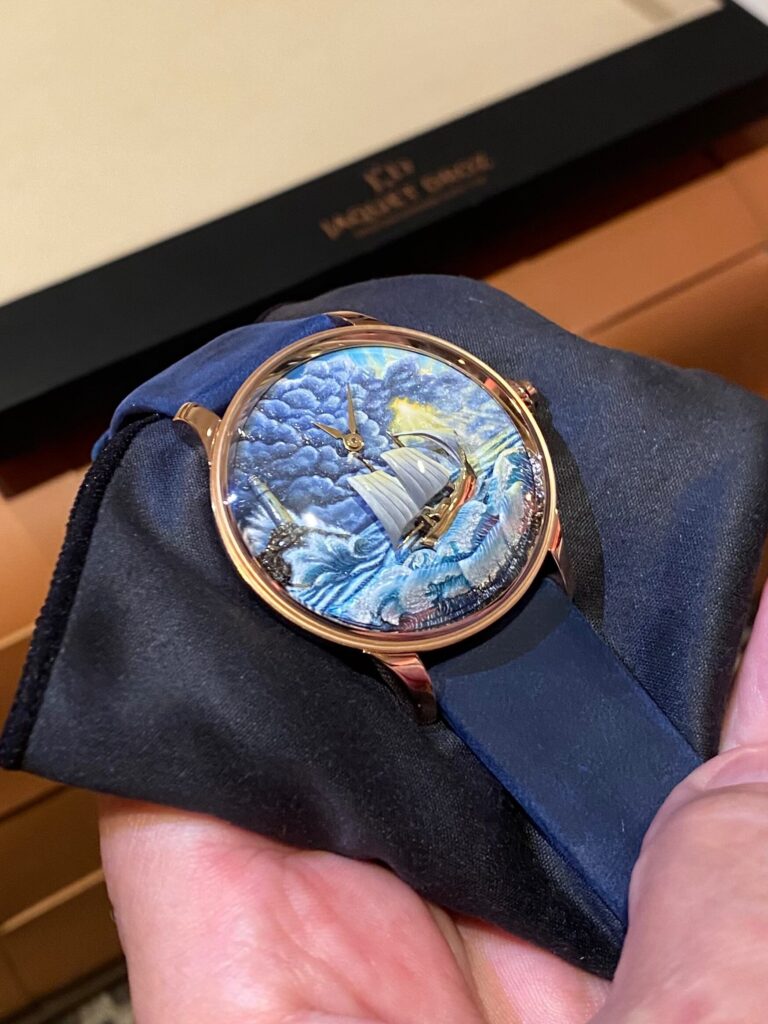
Take enamel. Enamel is like glass. It’s transparent. But traditionally, it’s applied onto a surface where you don’t really experience that transparency. My dream would be to put enamel on a sapphire case, so that you could actually see the transparency of the enamel. We’re studying this kind of idea, something that’s never been done before.
This is what we constantly need to do: not only deliver, but create, research new approaches, reinvent and modify métiers d’art that may be centuries old. We have the legitimacy of history, but we must also have the credibility of a new approach.
IWS: You are also a collector. If you could choose or imagine a watch that described you, and perhaps what you want to achieve in the watchmaking world, what would it be?
Alain Delamuraz: That’s a tough one. Probably my dream would be a watch capable of bringing many different cultures together.
At this moment in the world, everybody is fighting for their own approach, and that creates a difficult situation. I don’t necessarily want to call it a “freedom watch”, but I imagine something in which you could find the religions, cultures and arts of many different countries together.
There’s an example that has always fascinated me. It’s not Jaquet Droz, but at Blancpain they created a watch with the Chinese calendar. On the same watch, you had the Gregorian calendar and the Chinese calendar, two completely different ways of calculating time brought together in a single object. For me, that was a fantastic connection between two completely different approaches.
This is the kind of thing I find meaningful: bringing cultures, and perhaps even religions, together around the same interest, through one common object. When you understand that it’s possible to have a common interest, something changes. When you separate interests, you destroy everything.
We need common interests. And perhaps watchmaking can also look towards other arts, not by asking for help in a direct sense, but in a more philosophical way, bringing different métiers and cultures together again.
IWS: If an enthusiast or collector came to you here in Milan with a completely blank page and asked you to create something that could only be Jaquet Droz, what would you want that conversation to begin with?
Alain Delamuraz: For me, creating something that could only be Jaquet Droz is one point. But what’s even more important is creating something that could only belong to him or her. We can do many things at Jaquet Droz that aren’t comparable with what others do. But I like the idea of creating something that could exist only for that particular person.
So first of all, we need to know him or her. In the past, if you were creating something for a king or a queen, you needed to know that person. Today it’s the same. We need to know the collector himself or herself in order to create something corresponding to that person, not only something corresponding to Jaquet Droz.
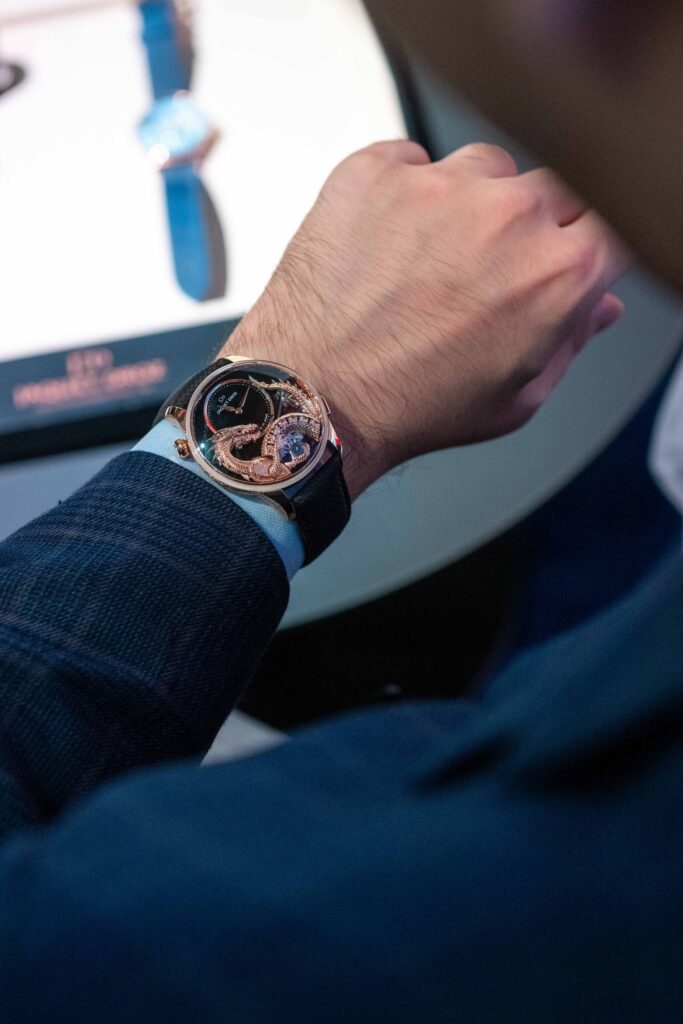
More and more, I don’t want to create pieces of art or watches that can simply be compared with other brands. Because the moment you begin with comparison, you enter into a competition. I prefer to say that we do something we’re the only ones able to do.
Some of the métiers d’art we practise are still entirely in-house and unique to Jaquet Droz. In those cases, there’s no comparison, and therefore there’s no fight. So yes, the creation has to be only Jaquet Droz. But even more importantly, it has to be only him or only her. The spirit of the final collector matters even more than the signature of Jaquet Droz.
IWS: And if we look at Jaquet Droz five or ten years from now, what should we expect? Something even more radical?
Alain Delamuraz: Fewer watches, but much more value in every watch. We want to increase the level of know-how, creativity, métiers d’art and automata, and put more and more value into each creation while producing less and less.
Quantity isn’t our target. Quality, creativity and a new approach without comparison are the target. So the future will be more complicated, more ambitious, but with fewer watches.
Are you looking for the perfect gift? Explore our online store and discover the entire collection signed IWS – Italian Watch Spotter!
For all real-time updates on the world of watchmaking follow us on Instagram and visit our Youtube channel.