
The charm of the dials “double signed” stems from a curious contradiction. Originally they were almost functional details while today they represent some of the most sought-after and studied elements of the entire watch collecting. One only has to observe the reaction that names such as Tiffany & Co., Gobbi Milano, Gübelin, Beyer or Serpico y Laino still elicit to understand how much weight an additional inscription on the dial can take on. Those “signatures” tell of cities, distribution networks, markets and business relationships built over decades. And let’s face it, they also tell of a watchmaking geography that largely no longer exists.
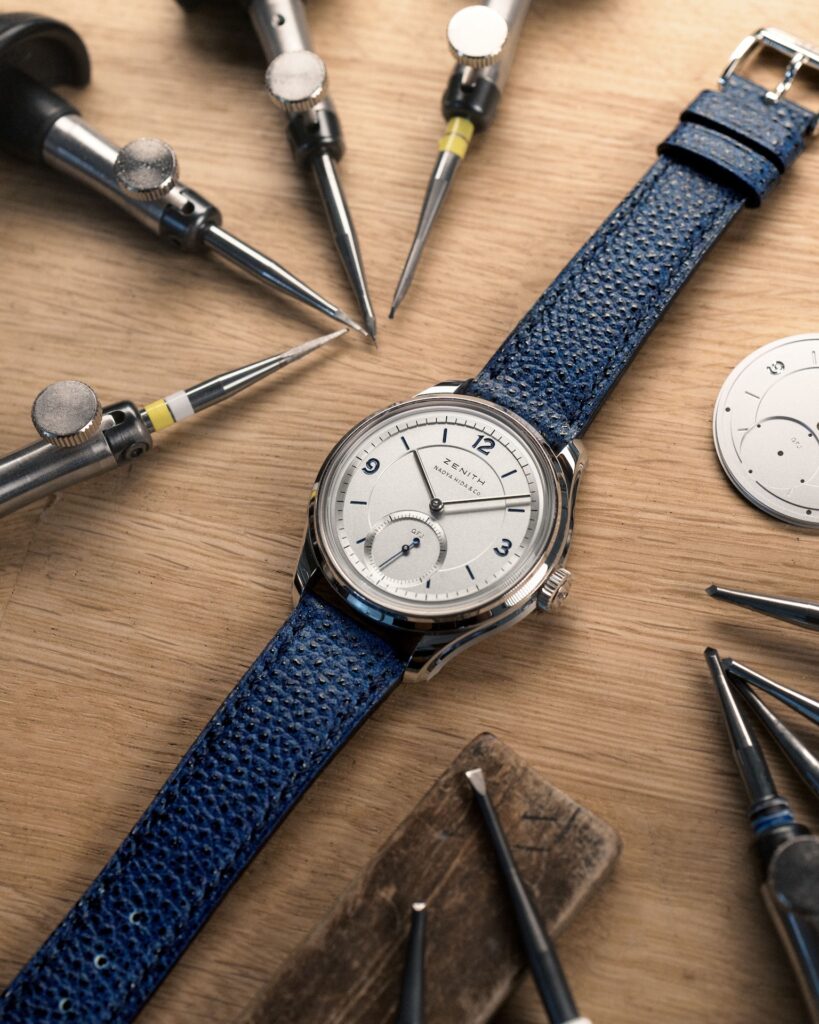
The new Zenith G.F.J. Calibre 135 Double Signed with Naoya Hida & Co. ties in with this tradition and reinterprets it in a contemporary key. In fact, the second signature on the dial does not belong to a historical distributor or jeweler but to an author. And this detail, by no means taken for granted, completely changes the vocation of the project.
The great double signatures of the twentieth century documented a business relationship. Here we witness something different. Naoya Hida does not certify the provenance of the watch. It does not indicate a specific market. She does not recount a sales network. She introduces a point of view, and the dial of the new G.F.J. thus becomes the place where two paths meet that, while developing in different contexts, share a surprising amount of common references.
On the one hand there is Zenith, custodian of one of the most important traditions of Swiss watchmaking. On the other is an author who for years has focused his research on the same decades that saw the birth of the legendary Calibre 135.
Let’s find out about this news in detail!
The contemporary significance of the double signature
Those who have been watching the auction market for at least a decade have witnessed an interesting phenomenon. The double signature has gone from being a curiosity for specialists to a full-fledged collecting category.
The reason goes beyond mere rarity. Those signatures make it possible to reconstruct the context in which a watch was sold. They tell the story of the role that certain retailers played in the international spread of Swiss watchmaking and show how different the market was before the arrival of single-brand boutiques and the global strategies we know today.
In the case of Zenith’s new The Double Signed Program, however, the additional signature serves a different function. It does not look primarily at distribution. It looks at interpretation. The presence of Naoya Hida & Co. on the dial introduces a cultural reading of the watch. It is almost a commentary written in the margin of an existing text.
The difference becomes clear when looking at Hida’s path.
Naoya Hida and the search for the classic watch
Over the past fifteen years, independent watchmaking has often associated the idea of excellence with technical complexity. Multiple tourbillons, perpetual calendars, astronomical displays, and three-dimensional constructions have dominated much of the conversation. There is nothing surprising about this. Haute horology has always used complication as a tool through which to demonstrate technical expertise.
Naoya Hida has chosen a different path. Her research focuses on a question that may seem simple but becomes surprisingly complex the moment you try to answer it: what really makes a classic watch successful?

The answer, in his case, does not come through the addition of features. It comes through proportion, typography, the way a hand touches the dial or the way an engraving interacts with light. These are all aspects that often escape first observation, yet it is these very elements that determine the character of a watch.
The Type 1, Type 2, Type 3, Type 4, and Type 5 references can be read as chapters in the same research. What changes is not only the configuration but the way each element is related to the others. The loops. The flange. The diameter of the case. The design of the numerals. The depth of the engravings. The visual hierarchy of information.
Looking at one of Hida’s creations one often gets the feeling that nothing is trying to attract attention. Yet everything contributes to the overall balance. It is an approach reminiscent of the work of some great industrial designers: the design works precisely because each element seems inevitable.
The Armoury, Mark Cho and the role of Keisuke Kano
An important part of Hida’s recent evolution is through collaboration with The Armoury and Mark Cho. To understand the new G.F.J., it is worth dwelling on two references in particular: the Type 2C-1 Lettercutter and the more recent Type 4A-2 Floating Feathers.
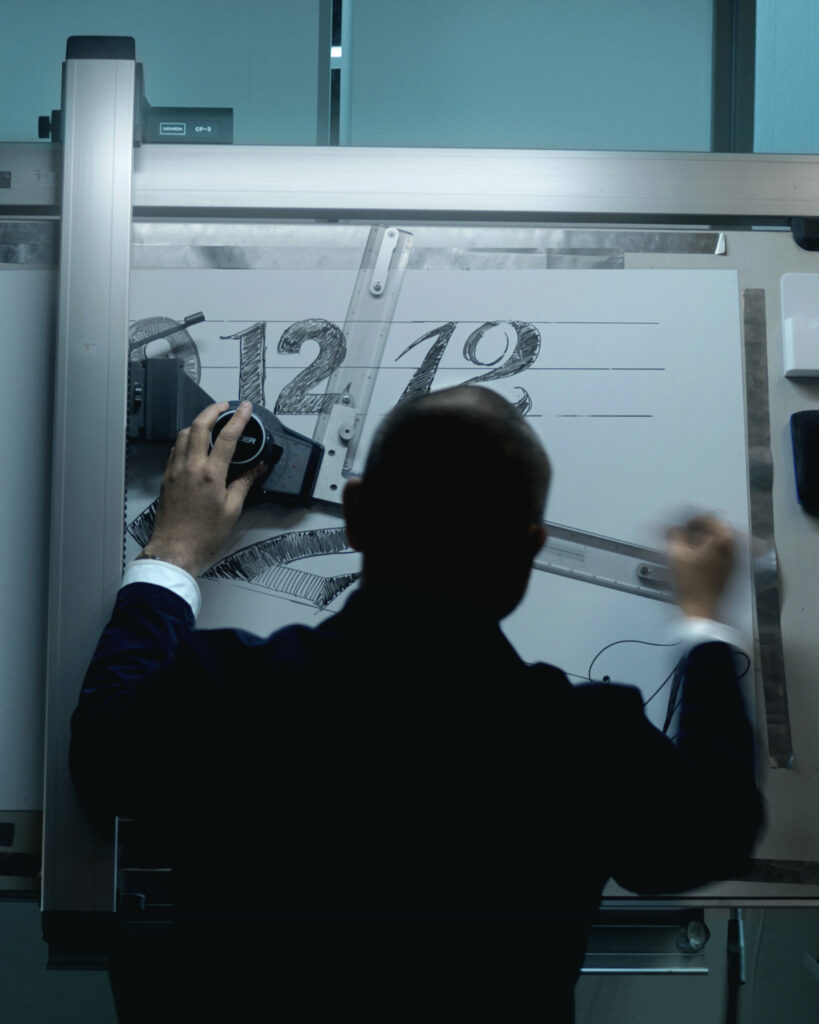
Lettercutter is often remembered for the typeface developed specifically for the project. In reality, his contribution goes beyond simply drawing numbers. The clock represents a reflection on the weight that typography exerts within a dial. One only has to look at the arrangement of the indices and the way the numbers occupy the available space to see how much the overall perception can change through seemingly minimal interventions.
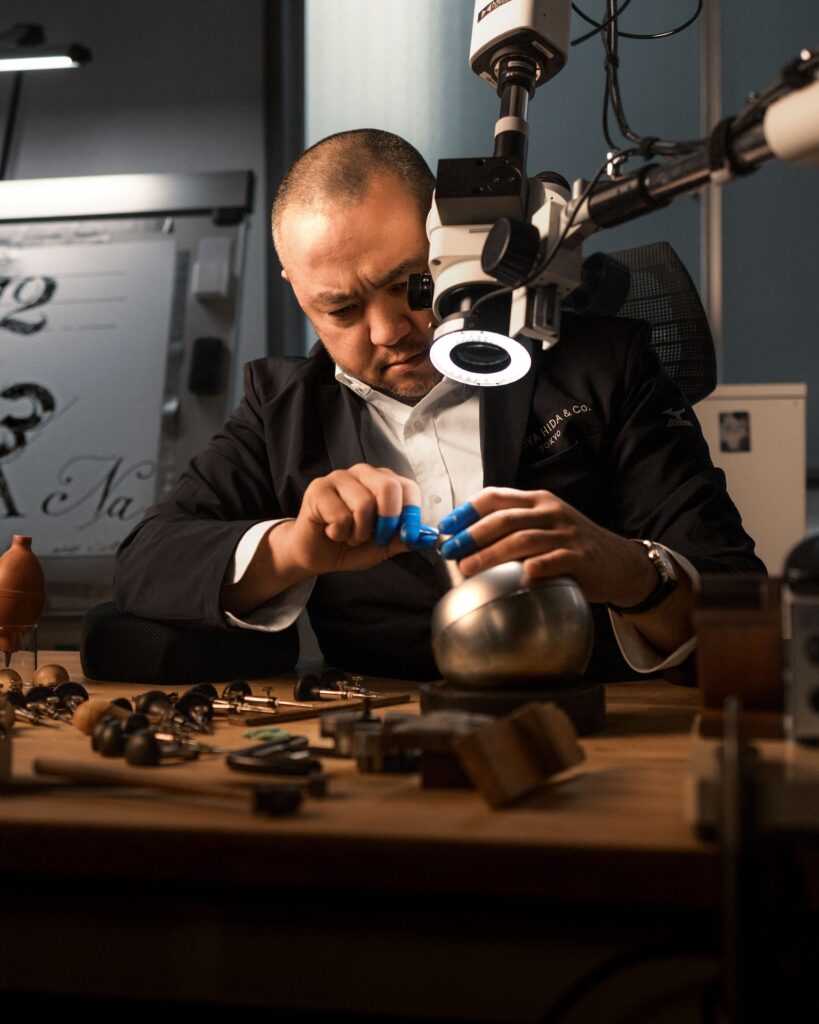
Floating Feathers takes this discussion to a different plane. Here the protagonist becomes Keisuke Kano, a Japanese master engraver who in recent years has emerged as one of the most interesting figures in the watchmaking applied arts scene. The three feathers engraved on the Argentium silver dial do not serve a practical function. They exist to explore the relationship between light and surface. Depending on the angle of observation, the dial changes, comes alive, and shows details that a few moments before seemed invisible.
It is difficult to look at that design without immediately thinking of the new Zenith.
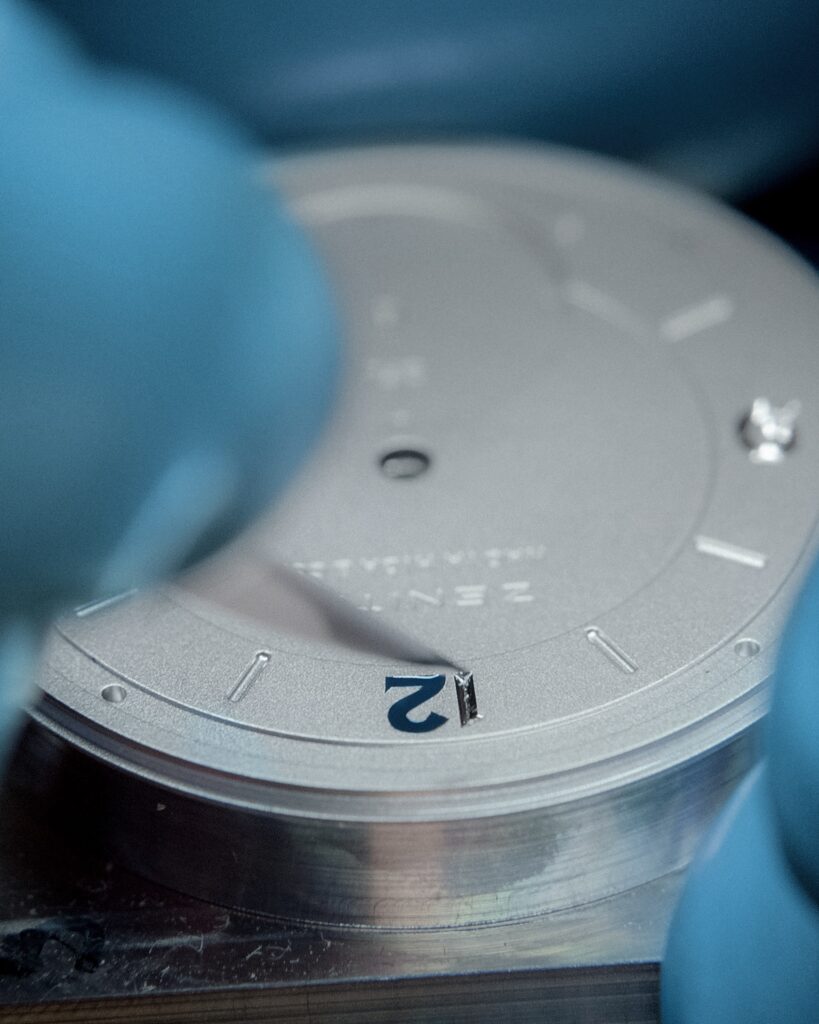
The inscriptions on the G.F.J. Calibre 135 Double Signed are in fact hand-engraved by Keisuke Kano himself and then filled with blue Urushi. This is not an isolated decorative element. It is part of a path that runs through the last years of Hida production and finds a natural continuation in the dial of the new Zenith.
The Calibre 135
While Hida’s contribution defines much of the project’s visual identity, its center of gravity inevitably remains the Calibre 135.
To understand the significance of this movement, one must go back to a time when precision was the main area of comparison among Swiss manufactures. The observatories in Neuchâtel, Geneva, and Kew-Teddington represented the apex of this system. The results obtained in chronometric tests directly influenced the reputation of brands and were closely watched by the entire industry.
When Ephrem Jobin developed the Calibre 135, the goal was clear. To create a movement capable of excelling in that competitive environment. The diameter of about thirty millimeters allows for the use of a large balance, an element considered crucial to improving the regularity of the movement.
The 135-O version, prepared specifically for observatory competitions, represents the most extreme expression of this philosophy. Between 1950 and 1954 Zenith won a series of achievements that still occupy a central place in the manufacture’s narrative.
When historians and collectors discuss the great postwar chronometric movements, the 135-O regularly appears alongside the Longines 30Z and the observatory versions of theOmega 30T2. All three belong to an unrepeatable season in watchmaking, when progress was measured in fractions of a second and when the pursuit of precision represented a true technical obsession.
And it is this obsession, after all, that is the common ground on which Zenith and Naoya Hida end up meeting.
135-O to Voutilainen
The recent history of Calibre 135 helps to better understand the significance of the new project with Hida.
For many years the movement remained confined to the role of a major historical chapter in Zenith watchmaking. A constant reference in books dedicated to chronometry, auction catalogs and discussions among collectors, but essentially absent from contemporary production. The situation changed in 2022, when Zenith decided to recover ten original 135-O movements kept in its archives and entrust them to Kari Voutilainen.
The operation is almost unanimously hailed as one of the most interesting projects of the year. Not only because of the executive quality of the end result, but because it addresses a topic rarely explored with such depth: how to bring a great historical movement back to life without turning it into a mere museum relic.
Voutilainen intervenes with the respect one would expect from one of the leading contemporary independents. The movements are restored, finished and adjusted while keeping their original identity intact. The guilloché dial, platinum case and overall quality of execution transform that edition into a kind of manifesto dedicated to classical chronometry.
Looking at the new project with Hida today, it becomes apparent how that experiment also served another function. It reminded the market that the Calibre 135 does not only belong to Zenith’s past.
It can still represent the present.
The return of 135 and the birth of the G.F.J.
When Zenith introduced the G.F.J. collection, dedicated to Georges Favre-Jacot, in 2025, the goal immediately appeared more ambitious than the Voutilainen edition.
This time it is not about restoring ten historical movements, it is about bringing 135 back into contemporary production.
The operation is more complex than it may seem. Many brands in recent years have chosen the path of philological reissue. Zenith follows a different approach. The new movement retains the elements that made the original design famous: the 18,000 vibrations per hour frequency, the large balance with variable inertia, the Breguet balance spring, and the Charles Fleck regulator, but it also introduces a number of updates necessary for contemporary use.
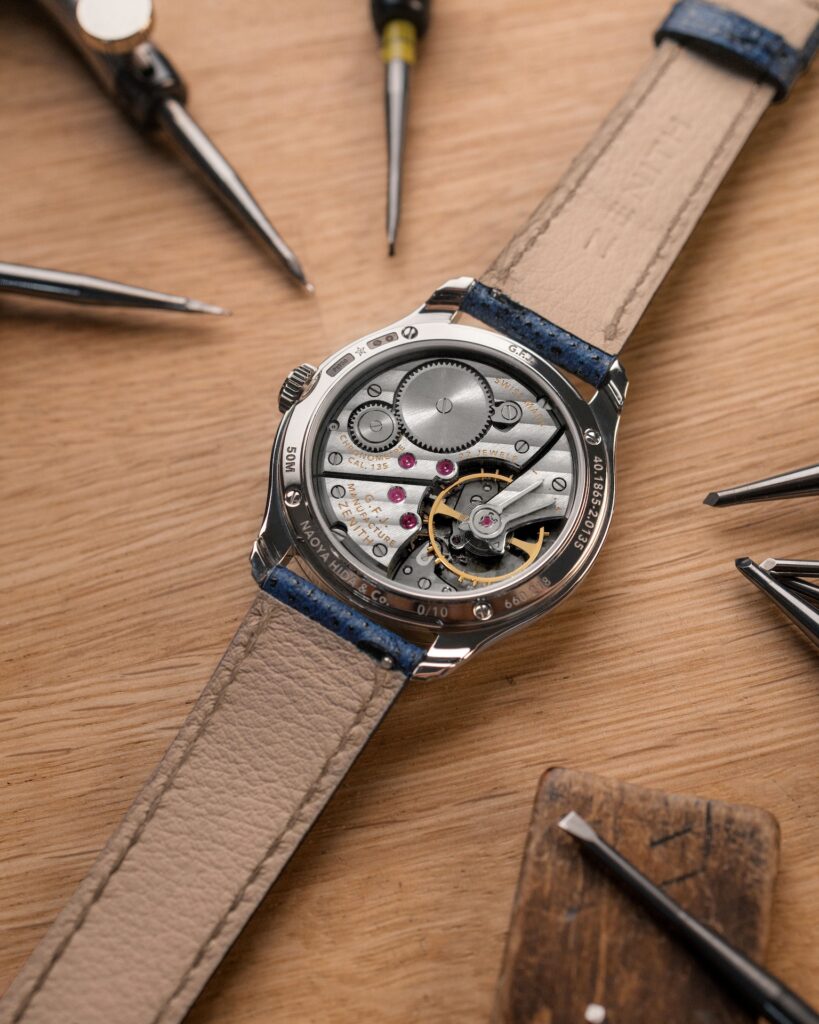
The power reserve increases to 72 hours, a stop-seconds function appears, and COSC certification ensures performance compatible with current standards. The overall impression is of a movement that maintains its historical identity without falling into nostalgia.
A difficult balance to strike.
Where you can really see Hida’s hand
Having reached this point, it becomes easier to understand what Naoya Hida really adds to the project.
The temptation would be to focus immediately on the engravings, theUrushi, or the presence of the double signature. In fact, the most interesting contribution emerges by looking at the watch as a whole.
One of the hallmarks of Hida’s production has always been the control of proportion. His references rarely seek a dominant element. No oversize numbers. No aggressive textures. No details designed to grab attention in the first three seconds.
The new G.F.J. Calibre 135 Double Signed follows the same logic.
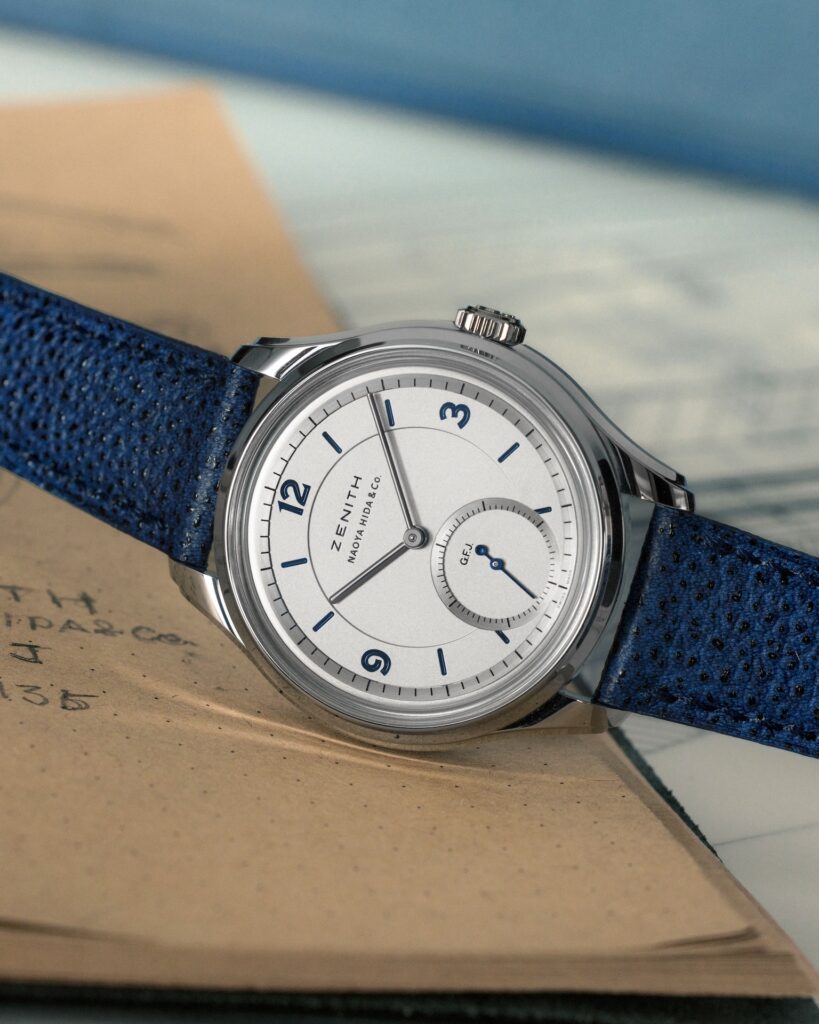
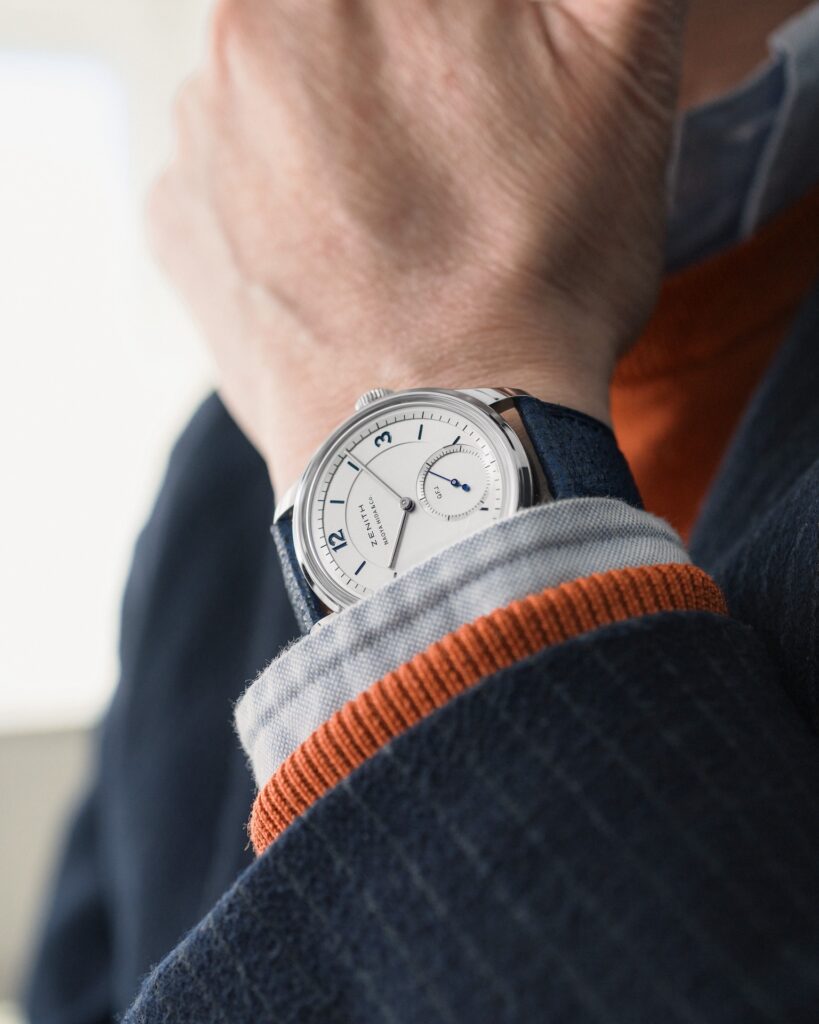
The 39.15 mm platinum case maintains the elegant presence of the standard model. The solid silver dial eliminates any superfluous effects and focuses attention on surface quality. Inscriptions engraved by Keisuke Kano and then filled with blue Urushi introduce depth without turning into decoration.
This is a difference that is especially noticeable in person. Traditional printing stays on the surface, Engraving creates shadow, shadow creates volume, and volume changes the perception of the dial.
These are minimal nuances. But it is exactly on this territory that Hida builds his language.
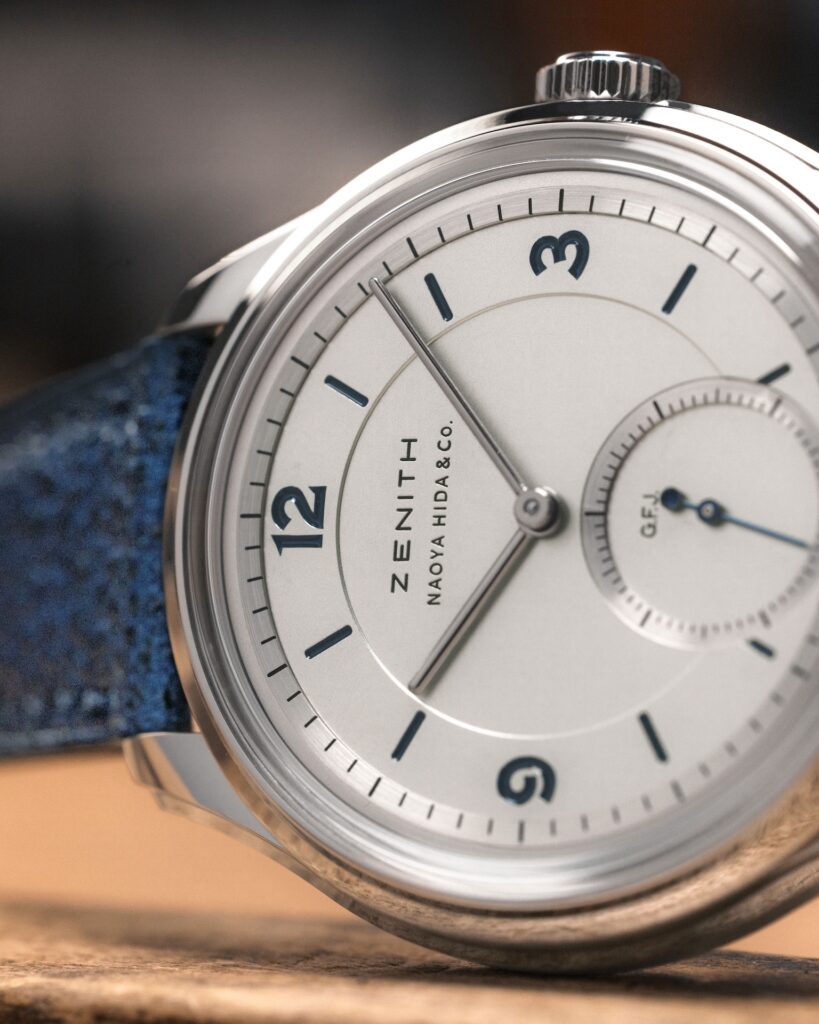
The same goes for the hands. Hours and minutes are machined from solid gold through CNC machining and then finished by hand. The small seconds hand, thermally burnished, adds a chromatic note that dialogues with the Urushi without breaking the overall balance.
Those familiar with Type 2A will immediately recognize some similarities.
A dialogue between Switzerland and Japan
The three straps supplied with the watch also participate in the narrative.
Himeji Kurozan leather, treated with Urushi lacquer, represents one of the finest expressions of Japanese tanning tradition. The Wagyu leather strap processed in Kyoto adds another nuance of local craftsmanship. More surprising is probably the presence of a denim strap produced by Kaihara, a historic name in the Japanese textile industry.
A collaboration that made sense before it even existed
Many contemporary collaborations are built around the strength of the names involved. The new Zenith G.F.J. Calibre 135 Double Signed with Naoya Hida & Co. follows a different logic.
The project works because its protagonists share the same cultural horizon.
The Calibre 135 was born at the height of the golden age of Swiss timekeeping. Hida’s entire research revolves around the study of the same decades. Zenith holds a fundamental part of that mechanical legacy. Hida continues to question the visual language developed during that period.
The presence of Keisuke Kano, theUrushi, references to Type 2A, and the design philosophy gained through The Armoury makes this dialogue even more evident.
For this reason, the new G.F.J. goes beyond the simple concept of a limited edition. The ten examples produced and the price of 58,900 Swiss francs tell of its exclusivity.
The most interesting part emerges elsewhere. In the rare moment when a major historical movement and one of the most consistent interpreters of contemporary classical watchmaking end up speaking the same language.
Are you looking for the perfect gift? Explore our online store and discover the entire collection signed IWS – Italian Watch Spotter!
For all real-time updates on the world of watchmaking follow us on Instagram and visit our Youtube channel.