
Paris, late 1990s. The watchmaking industry is experiencing a new “renaissance.” After years dominated by the practicality of quartz, mechanical watches are back in the spotlight, and sports watches are gradually taking on an increasingly central role in the market. Against this backdrop, CHANEL has also decided to write its own chapter in history. Leading the way is Jacques Helleu, the Maison’s longtime creative director. His source of inspiration, however, does not come from watchmaking.
It comes from the sea.
He is captivated by the lines of the J-Class, the iconic racing yachts that, between the 1930s and 1940s, wrote some of the most legendary chapters in sailing history. These boats were designed to combine speed, balance, and elegance in a single form. Helleu seeks to capture that very synthesis in a watch: an essential, contemporary, and instantly recognizable object, capable of standing the test of time without chasing trends.
When the CHANEL J12 was unveiled in 2000, that vision took shape around a material destined to redefine the collection’s identity: ceramic. The choice stemmed from design rather than technique. Helleu envisioned a watch built around a single material and a single color, in which shapes, surfaces, and proportions would become the primary means of expression.
Since then, the J12 has evolved without ever compromising its identity. The collection has expanded, introducing new sizes, complications, in-house movements, and innovative interpretations of ceramic, all while adhering to a philosophy that has remained unchanged over time: to perfect the timepiece without altering its essence.
But how do you create an icon that will endure for over twenty-five years without losing its identity? To find out, we must go back to the beginning of this story and retrace, one by one, the steps that transformed Jacques Helleu’s vision into one of the most recognizable collections in contemporary watchmaking.
The Origins of the CHANEL J12
In 2000, the CHANEL J12 made its debut, embodying with extraordinary consistency the vision conceived by Jacques Helleu. The first model featured a 38 mm case, an automatic movement, and, above all, introduced what would become the collection’s most distinctive feature: a highly durable black ceramic construction. At a time when this material was used almost exclusively for bezels or secondary components, CHANEL chose to make it the star of the show, using it for both the case and the bracelet and making it the centerpiece of the design.
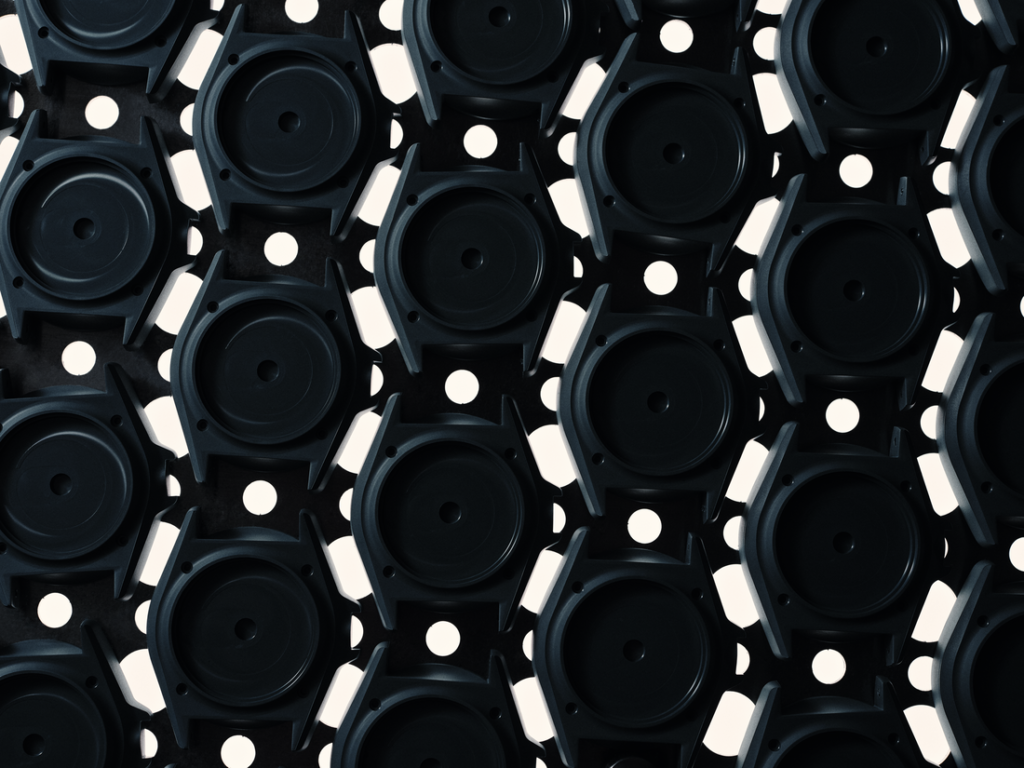
J12 case sides at the end of the injection-molding process, in the ceramics workshop at the CHANEL Manufacture in Switzerland | Credits: Chanel Horlogerie
More than just a technical choice, ceramic is a creative choice. Jacques Helleu envisioned an all-black watch, minimalist and monochromatic, in which form and material would blend perfectly. To bring this vision to life, CHANEL has developed proprietary expertise in ceramic craftsmanship over the years, a process now carried out entirely in-house at its own manufactory.
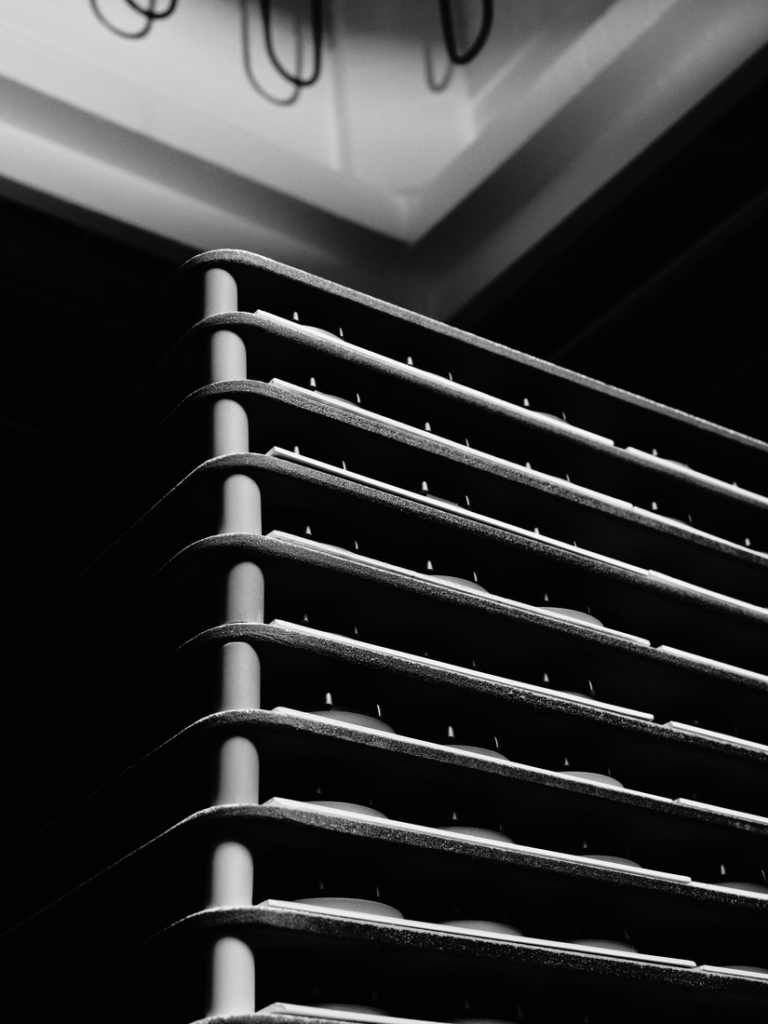
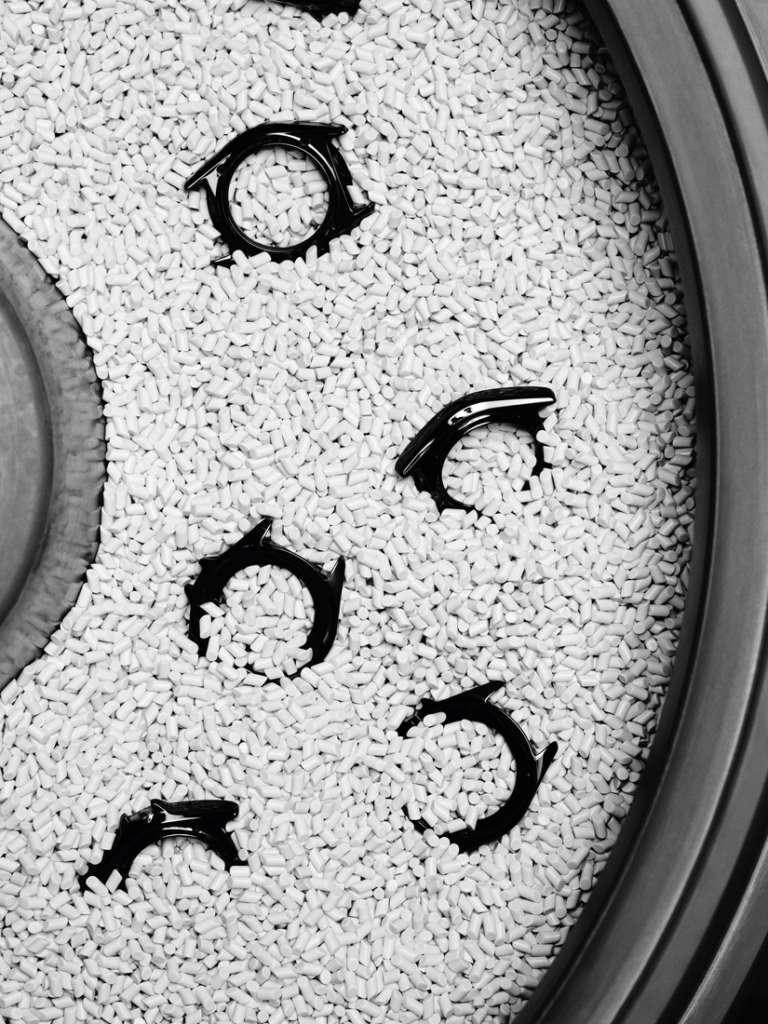
Sintering furnace, used to fire ceramic components at extremely high temperatures and to polish J12 cases | Credits: Chanel Horlogerie
The process includes the selection of raw materials, injection molding, sintering at over 1,300 °C, precision machining, and final polishing steps that give the material its characteristic visual depth and unique properties: a hardness approximately seven times greater than that of steel, a weight approximately 25% lighter, high scratch resistance, complete color stability, and a surprising softness when in contact with the skin.
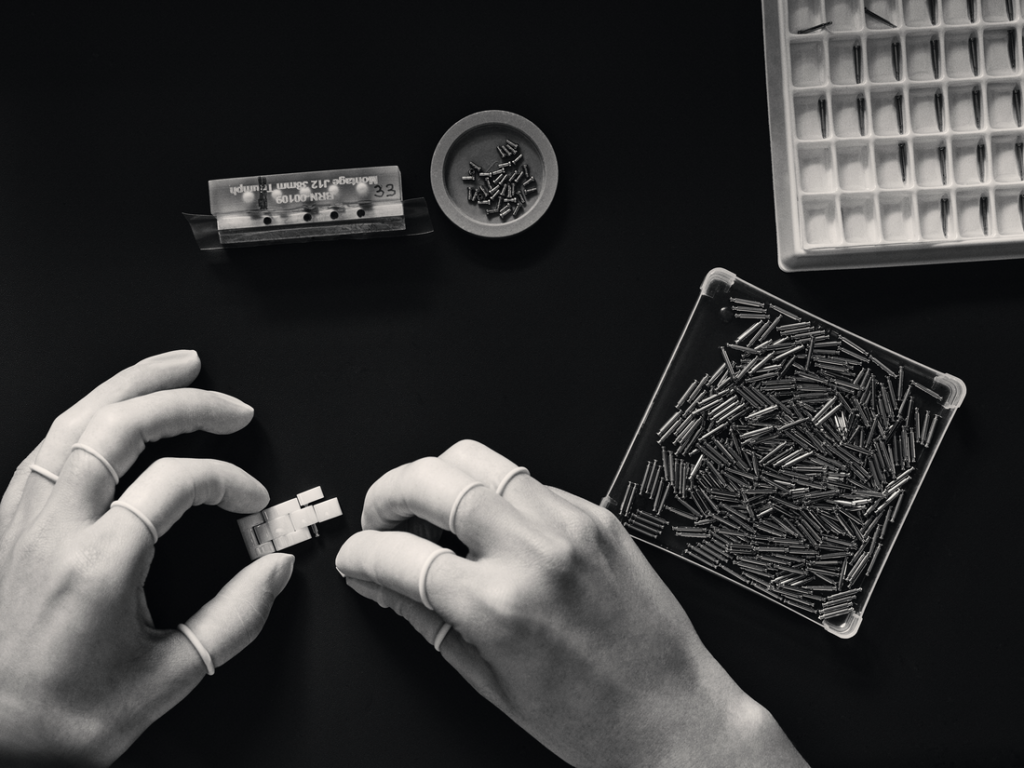
Assembly of the J12 ceramic bracelet in the ceramics workshop at the CHANEL Manufacture in Switzerland | Credits: Chanel Horlogerie
The design, too, introduces a style that is destined to remain virtually unchanged over time. The rotating bezel with its distinctive engraved numerals, the bracelet that blends seamlessly with the case, the crown adorned with a ceramic cabochon, and the minimalist dial all come together to create an instantly recognizable silhouette.
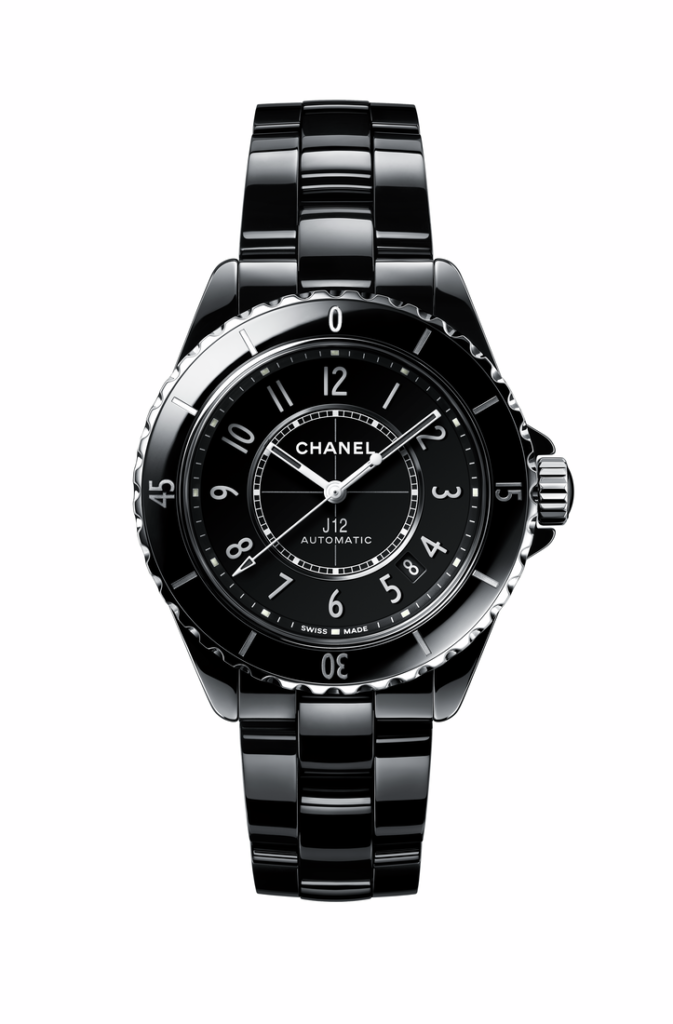
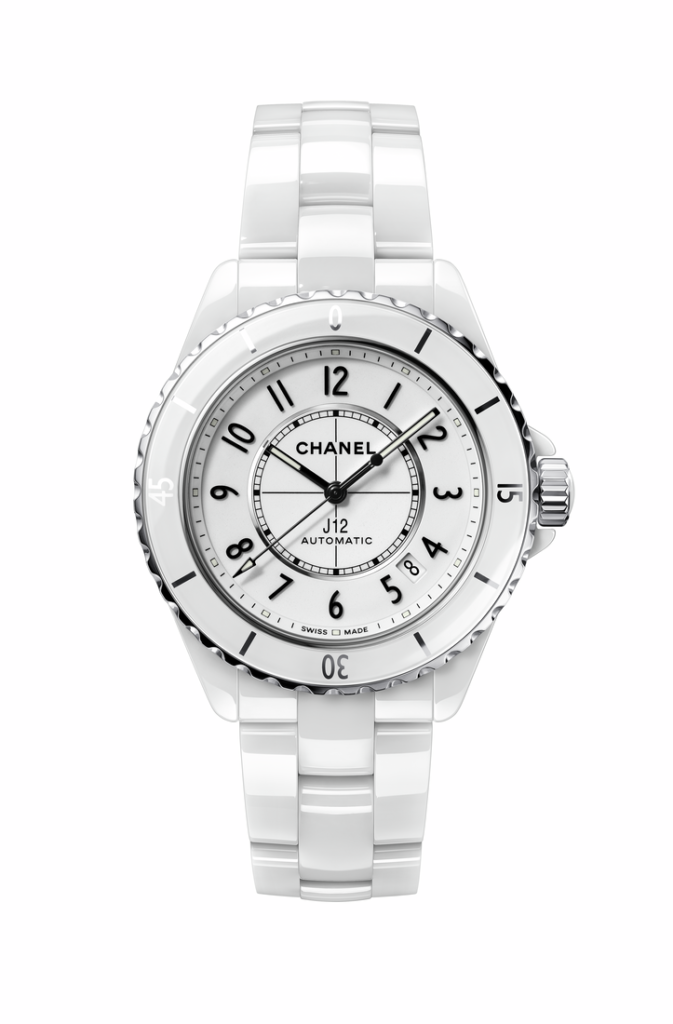
The Iconic J12 | Credits: Chanel Horlogerie
In 2003, this vision found its natural completion with J12 White . Achieving an intense, uniform, and perfectly stable white ceramic over time required years of research and development, but the result marked a new turning point for the collection. True to Gabrielle Chanel ‘s vision: Black possesses everything. Even white. Their beauty is absolute. , the Maison pairs black with a second interpretation of the same design concept, demonstrating how ceramics can become a true creative language as well as a technical material.
The Evolution of the CHANEL J12: From the Birth of an Icon to the Creation of a Collection
The strength of the design conceived by Jacques Helleu was evident from the very beginning of the J12’s history. What began in 2000 as a watch built around ceramic soon proved to be a surprisingly versatile and creative collection.
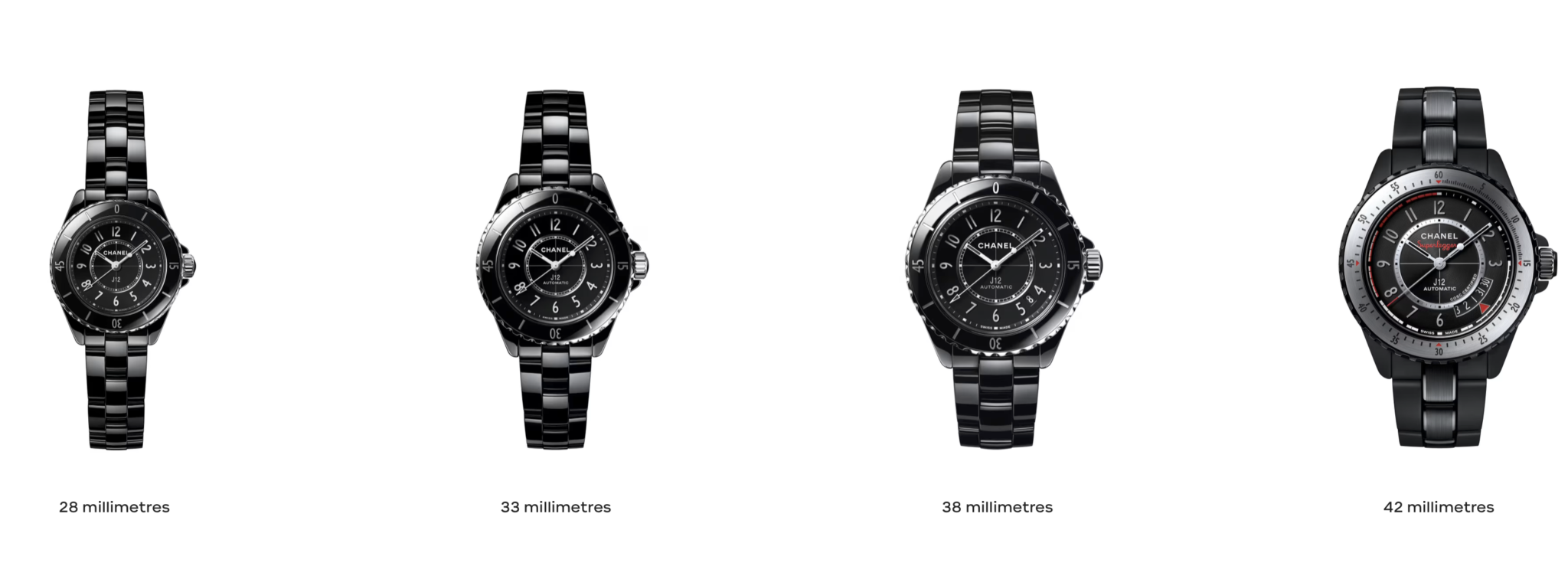
The Evolution of the J12 Collection | Credits: Chanel Horlogerie
The first innovations primarily concern functionality. With the J12 Chronograph, introduced in 2005, the collection definitively transcends the boundaries of the classic three-hand watch, demonstrating how the original design can accommodate a complication while maintaining its balance. The case is enlarged to accommodate the chronograph movement, but the proportions, readability, and continuity of the surfaces remain faithful to the design codes defined by Helleu.
During the same period, one of the family’s most original interpretations also took shape: the J12 Superleggera, inspired by the world of auto racing. The name pays homage to the historic Carrozzeria Touring Superleggera and introduces a more technical aesthetic to the J12’s design language, achieved through the combination of ceramic and aluminum.
This ability to adapt to new functions is further demonstrated by the J12 GMT, introduced in 2007. The addition of a second time zone display broadens the model’s versatility, confirming the extraordinary flexibility of a design capable of evolving without compromising readability or formal balance.
The following year, however, marked a turning point that would shape the future of the Maison. With the J12 Caliber 3125, developed in collaboration with Audemars Piguet Renaud & Papi, CHANEL took one of its first steps toward forging its own technical identity. Based on Audemars Piguet’s famous Caliber 3120 and reinterpreted with custom finishes and an exclusive oscillating weight, the movement is housed in a 42-mm case made of ceramic and gold, demonstrating that the J12 could now measure up to the highest standards of watchmaking.
At the same time, the range of sizes is also expanding. Alongside the iconic 38 mm model which is set to remain the collection’s flagship for many years to come CHANEL is gradually introducing 33 mm, 29 mm, and, most recently, 28 mm versions, powered by automatic or quartz movements, depending on the model.
Within just a few years, the J12 thus evolved from a single model into a full-fledged collection. The complications broadened its range of uses, the new case sizes expanded its audience, and the Caliber 3125 marked the beginning of a journey that would lead CHANEL to develop its own vision of mechanical watchmaking. All of this took place without altering the elements that have defined its character since 2000: the bezel with engraved numerals, the perfectly integrated bracelet, the crown with a ceramic cabochon, and that continuity between form and material that still represents the essence of the J12 today.
From Experimentation to Maturity
Having established its identity, the J12 enters a new phase in its evolution. While CHANEL had previously focused primarily on expanding its functionality and range of sizes, the following decade became the stage for an increasingly in-depth exploration of materials, design, and mechanics.
The first example is the J12 Marine, introduced in 2010. While retaining the collection’s aesthetic codes, it introduces a more technical character through a redesigned case construction, a rubber strap, a dial designed to prioritize readability, and water resistance extended to 300 meters. More than just a sporty variant, the Marine represents the most explicit return to the project’s origins, reaffirming the connection to the nautical world and to those J-Class yachts that had inspired Jacques Helleu from the very beginning.
The following year, the research once again focused on the material that had inspired the J12. With the J12 Chromatic, CHANEL introduced a special Titanium Ceramic, an exclusive formulation that gives the ceramic a sophisticated titanium-gray hue with metallic highlights.
The exploration continued in 2013 with the J12 Phantom, one of the most minimalist interpretations in the entire collection. The hour markers, bezel numerals, and dial all share the same shade as the case, reducing color contrast to a minimum. Readability is achieved through the use of volume, relief, and different finishes, creating a true exercise in minimalism.
Among the less celebrated but most significant developments from a design perspective, the J12-365, introduced in 2016, deserves a mention. It represents a true exploration of design evolution: the 36.5-mm case, the slimmer bezel, the new lugs, and the completely redesigned bracelet foreshadow many of the design elements that would later be incorporated into the contemporary J12.
During the same period, the brand also continued to grow in the mechanical watchmaking sector. Building on the experience gained with the Caliber 3125, CHANEL continued to invest in developing its watchmaking expertise a strategy that would later culminate in its partnership with the Kenissi manufacture, which was destined to become a key partner in the development of the Maison’s movements.
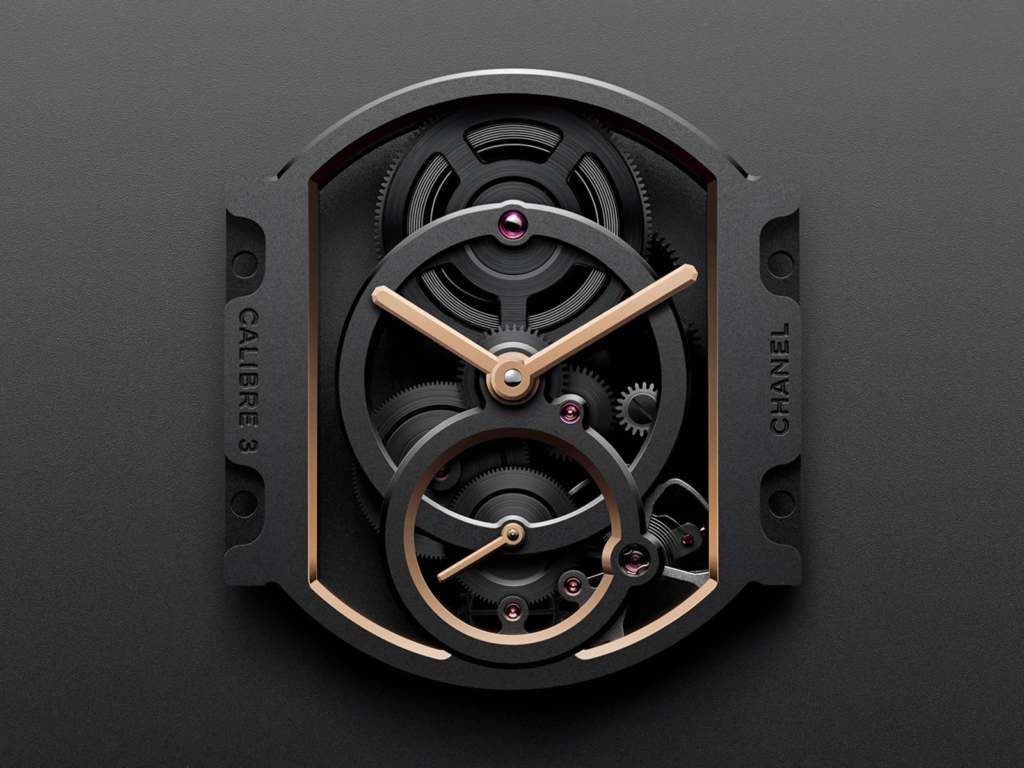
Caliber 3 | Credits: Chanel Horlogerie
A decisive milestone came in 2017 with the unveiling of Caliber 3, the first in-house movement designed by CHANEL for Haute Horlogerie. Its structure, built around bridges that evoke the geometry of a perfect circle, redefines the very role of the movement within the watch. For the first time, the mechanics are not merely the technical heart of the creation but become an integral part of its aesthetic expression. This design philosophy is destined to influence all subsequent generations of CHANEL calibers and will reach its full maturity in the major redesign of the J12 in 2019.
The Contemporary J12
While Caliber 3 marks a milestone in CHANEL’s journey toward full mechanical maturity, 2019 represents the most significant moment in the evolution of the J12 since its introduction in 2000. Nearly twenty years after the collection’s debut, the House has entrusted Arnaud Chastaingt, Director of the CHANEL Watch Creation Studio, with the most delicate task: reinterpreting the icon.
The result is a design exercise that is as understated as it is profound. At first glance, the new J12 appears nearly identical to the original model, but every detail has been reimagined to achieve an even more refined balance. CHANEL has redesigned approximately 70% of the watch’s components: the bezel has been thinned to widen the dial opening, the hour markers have been given greater prominence, the crown has been redesigned, the case has taken on sleeker proportions, and the bracelet has been completely redesigned to improve visual continuity and ergonomics.
The most significant transformation, however, lies inside the case. Making its debut is the Caliber 12.1, an automatic movement produced by the Kenissi manufacture, in which CHANEL holds a 20% stake (for high-end movements and components). Certified as a chronometer by the COSC, it offers a power reserve of approximately 70 hours and is visible through the sapphire crystal case back, where the circular skeletonized oscillating weight, designed by Arnaud Chastaingt, has become a true aesthetic signature of CHANEL watchmaking.
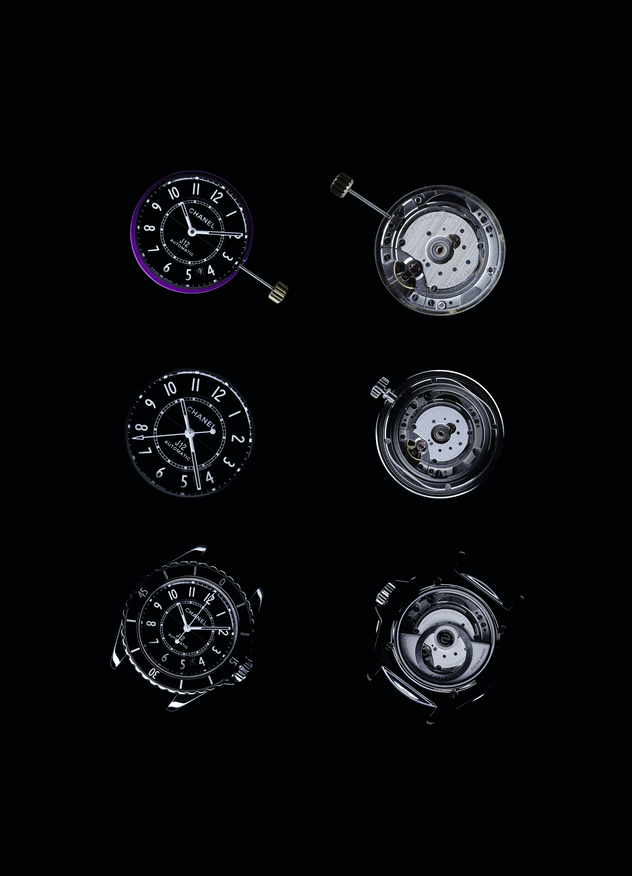
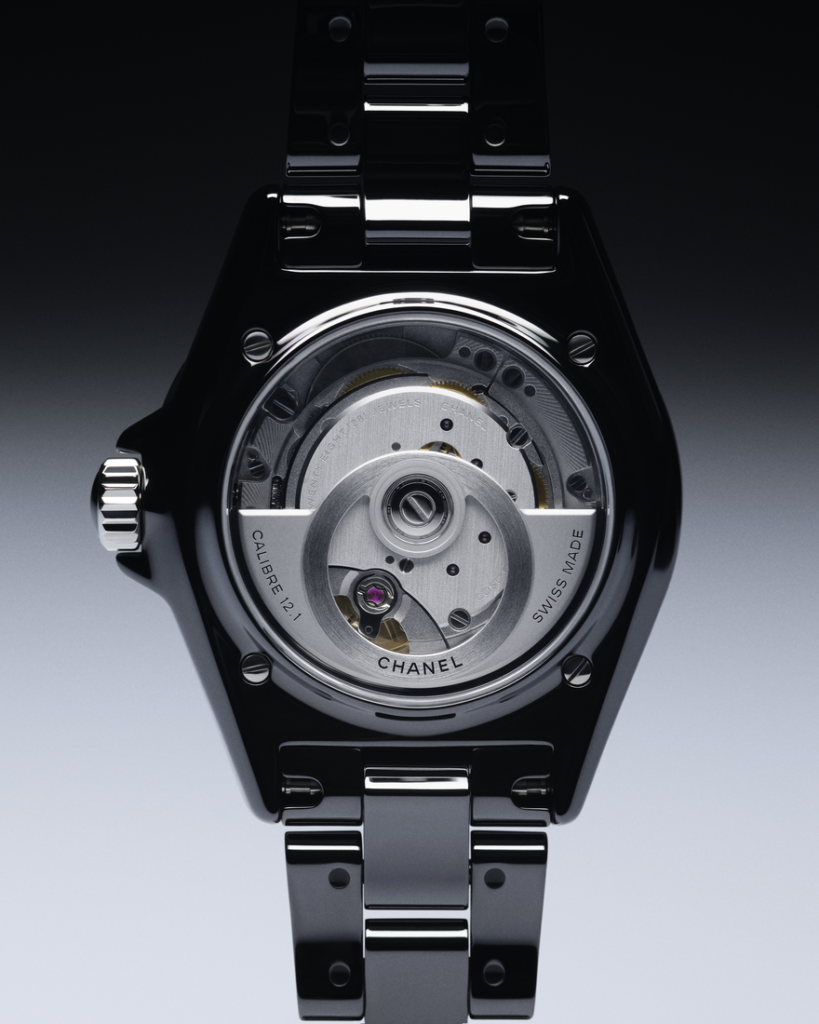
The Caliber 12.1 movement housed within the J12. Self-winding mechanical movement. Functions: hours, minutes, and central seconds; seconds stop during time setting; date display with quick-set and full-set functions. Power reserve: approximately 70 hours. Number of components: 191. Number of jewels: 28. Frequency: 28,800 vibrations per hour (4 Hz). Power source: single barrel with a slip spring. Mainplate and bridges: rhodium-plated brass with linear satin-brushed finishes, circular perlage (snailing), and diamond-polished corners. Oscillating weight: tungsten mounted on ball bearings, with a circular satin-brushed and sandblasted finish. Balance wheel: variable-inertia with shock-absorption system. COSC-certified chronometer (Contrôle Officiel Suisse des Chronomètres) | Credits: Chanel Horlogerie
The evolution continues with the Caliber 12.2. Also manufactured by Kenissi and COSC-certified as a chronometer, it retains the structure and design philosophy of the Caliber 12.1 in a more compact format, offering a power reserve of approximately 50 hours. Its arrival marks an important milestone in the collection’s history: even the smaller versions can now feature an in-house movement designed specifically for the case’s proportions.
The journey toward Haute Horlogerie reaches a new milestone in 2022 with the J12 Diamond Tourbillon Caliber 5. The first flying tourbillon developed in-house by CHANEL, it features a brilliant-cut diamond at the center of the rotating cage, transforming a precious stone into a dynamic element of the complication. This design perfectly synthesizes the two souls of the House watchmaking and High Jewelry without one taking precedence over the other.
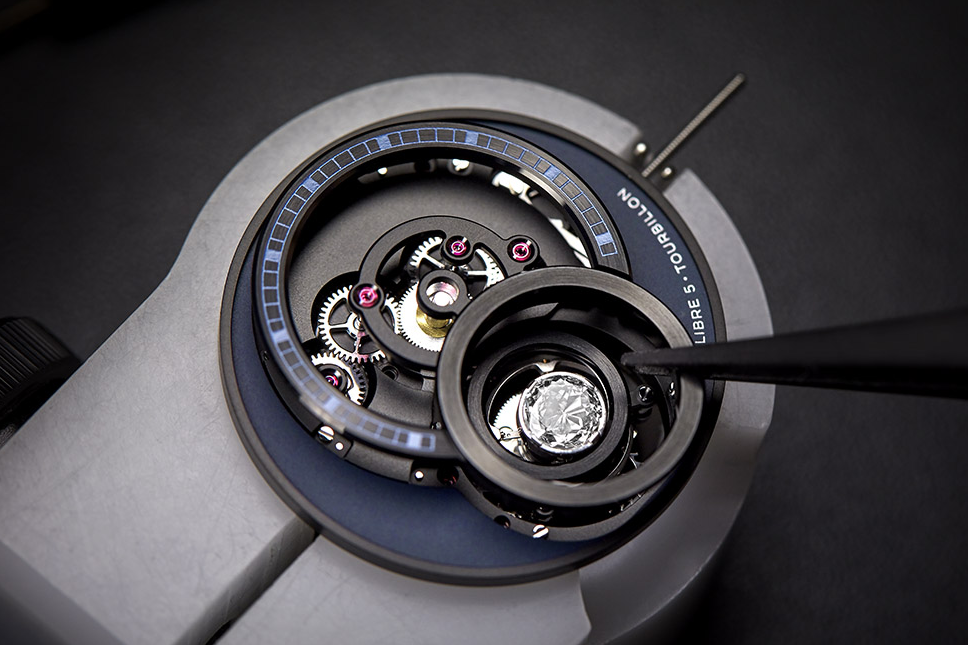
Caliber 5 | Credits: Chanel Horlogerie
After twenty-five years defined by black and white, 2025 marks the beginning of a new chapter in the history of the J12. Introducing the J12 Bleu, the result of five years of research and development conducted by the Manufacture to create a matte blue ceramic that retains all the properties that have made this material famous: scratch resistance, color stability, lightness, and comfort on the wrist. Blue, a color that has been part of Gabrielle Chanel ’s creative vocabulary since her first jersey creations in 1914, thus becomes the collection’s third signature color.
What’s New in 2026
The new models presented by CHANEL at Watches and Wonders Geneva 2026 mark a new chapter in the history of the J12, building on the two pillars that define its identity today. On the one hand, the 38 mm J12 Caliber 12.1 permanently incorporates the new J12 Bleu, transforming what began in 2025 as a series of commemorative creations into the collection’s third permanent color. On the other hand, the all-new 28 mm J12 family makes its debut, through which CHANEL explores the J12’s design language from a different perspective: that of proportions.
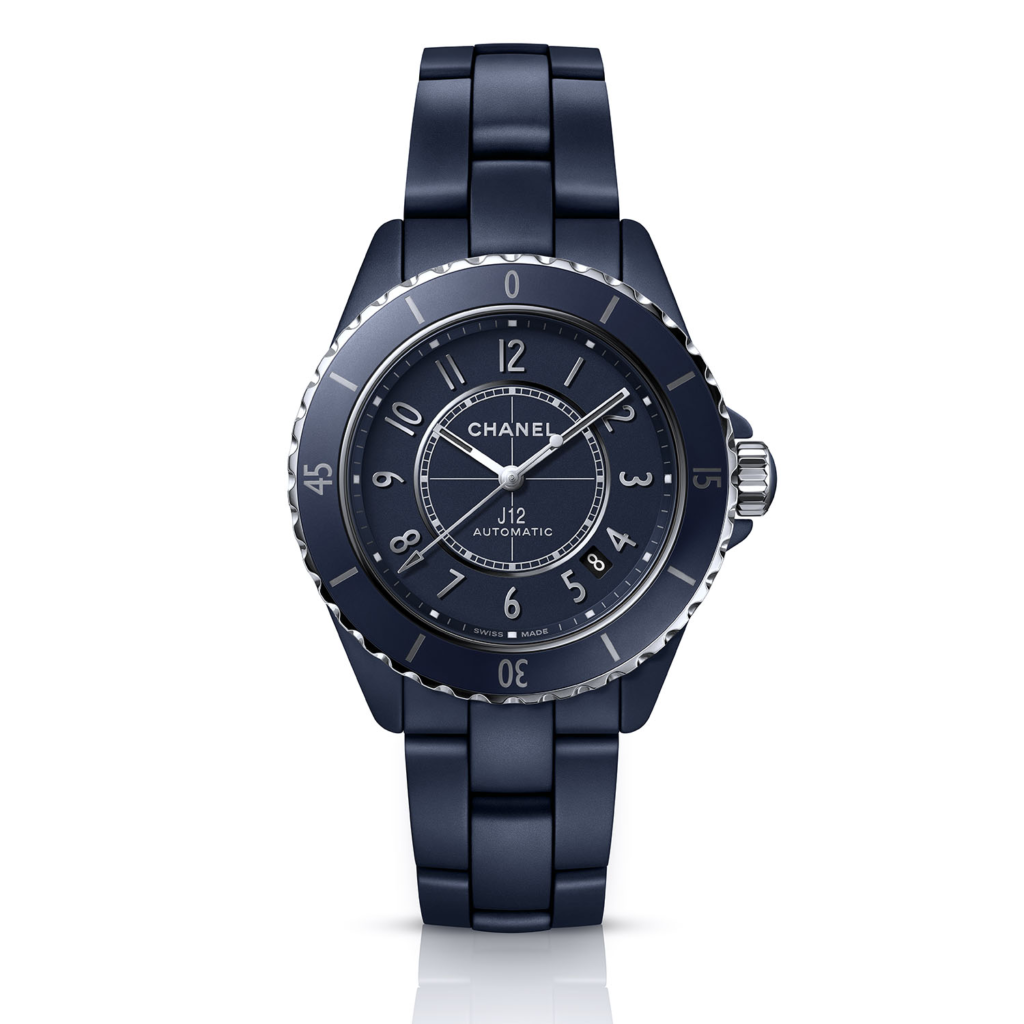
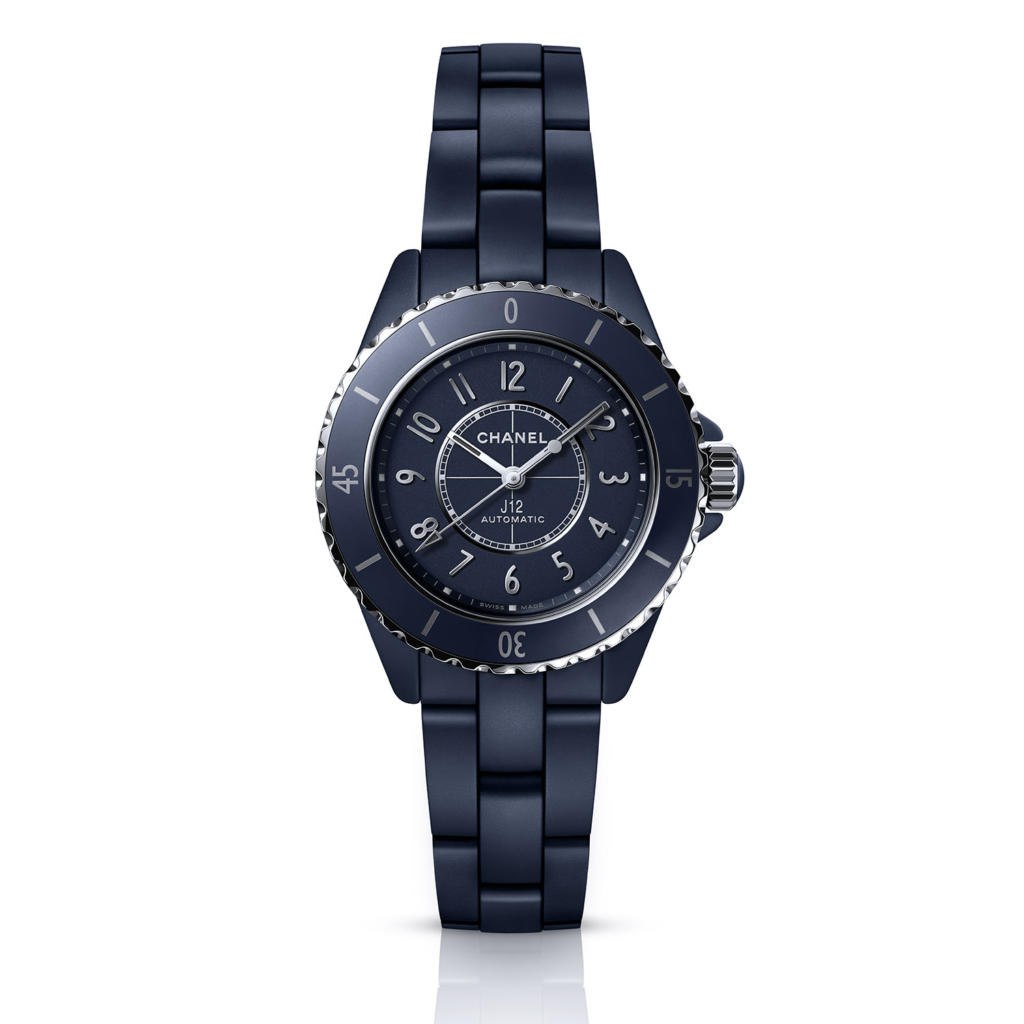
The new J12 Bleu in 38 mm and 33 mm versions | Credits: Chanel Horlogerie
The first major innovation concerns the ceramic. With the addition of the J12 Bleu to the permanent collection, black and white are joined by a third variation of this material, the result of five years of research. While glossy black ceramic enhances depth and character, and white ceramic accentuates volume and curves, the new matte blue finish absorbs light, producing an intense, iridescent hue that CHANEL sums up in a sort of motto: “Too blue to be black. Too black to be blue.” Bleu thus becomes a permanent fixture in the collection with the 38 mm Caliber 12.1 and 33 mm Caliber 12.2, completing the J12’s identity without altering its design.
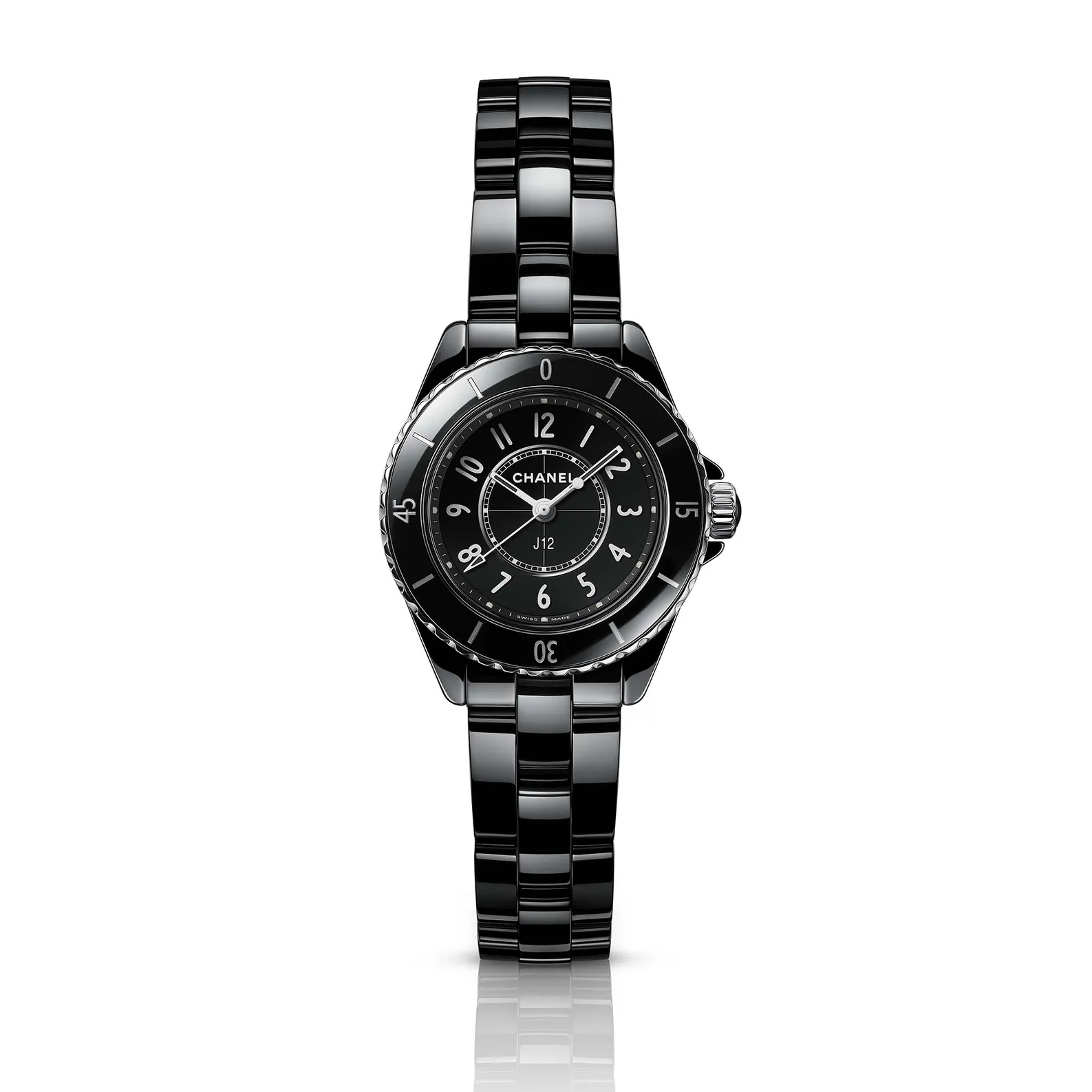
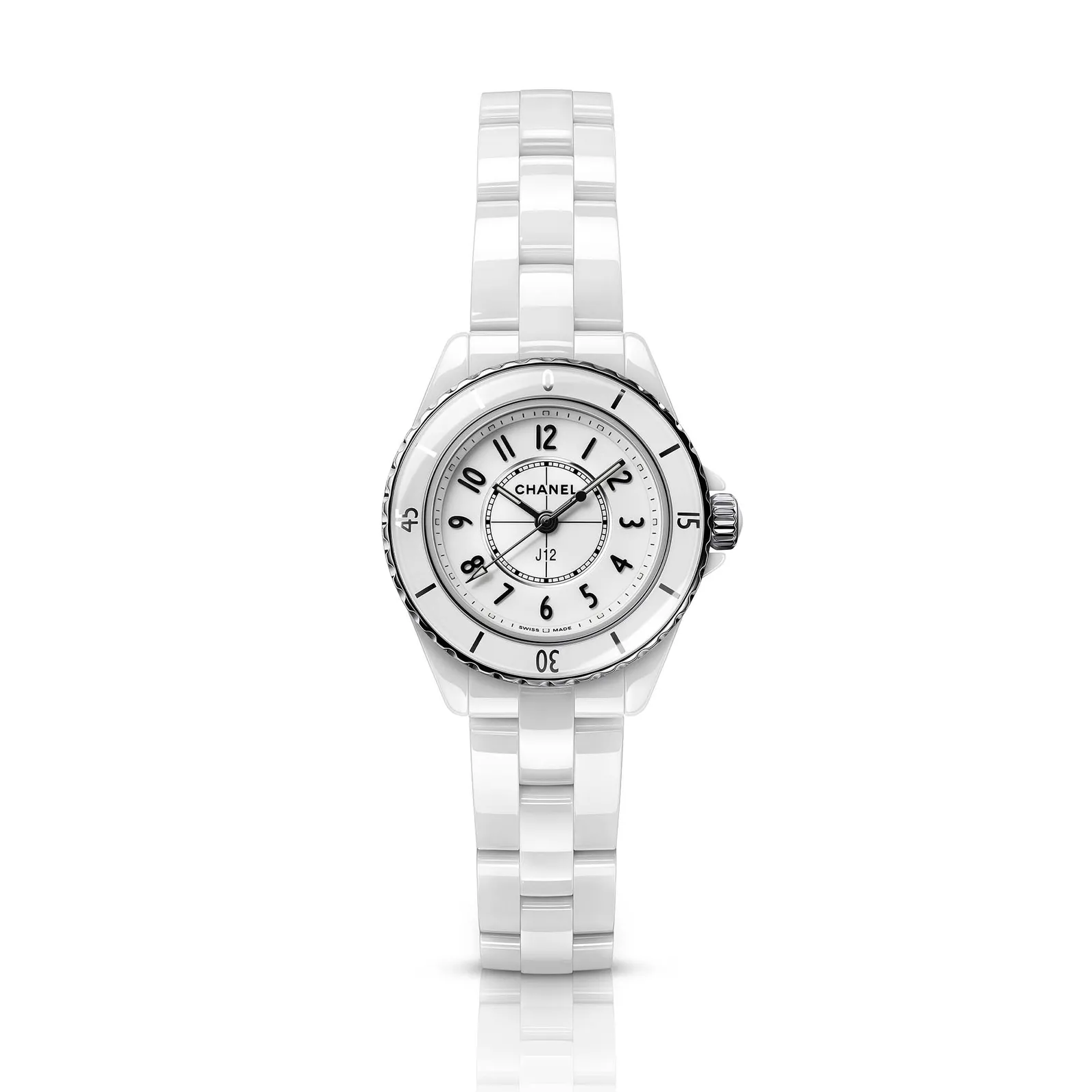
The new J12 in 28 mm versions | Credits: Chanel Horlogerie
While the Bleu chronicles the evolution of ceramics, the 28 mm J12 shifts the focus to proportions. With a 28 mm case, a thickness of just 8.8 mm, and water resistance up to 30 meters, it retains all the elements that make the J12 instantly recognizable, demonstrating how a design’s identity lies in the balance of its proportions rather than its dimensions.
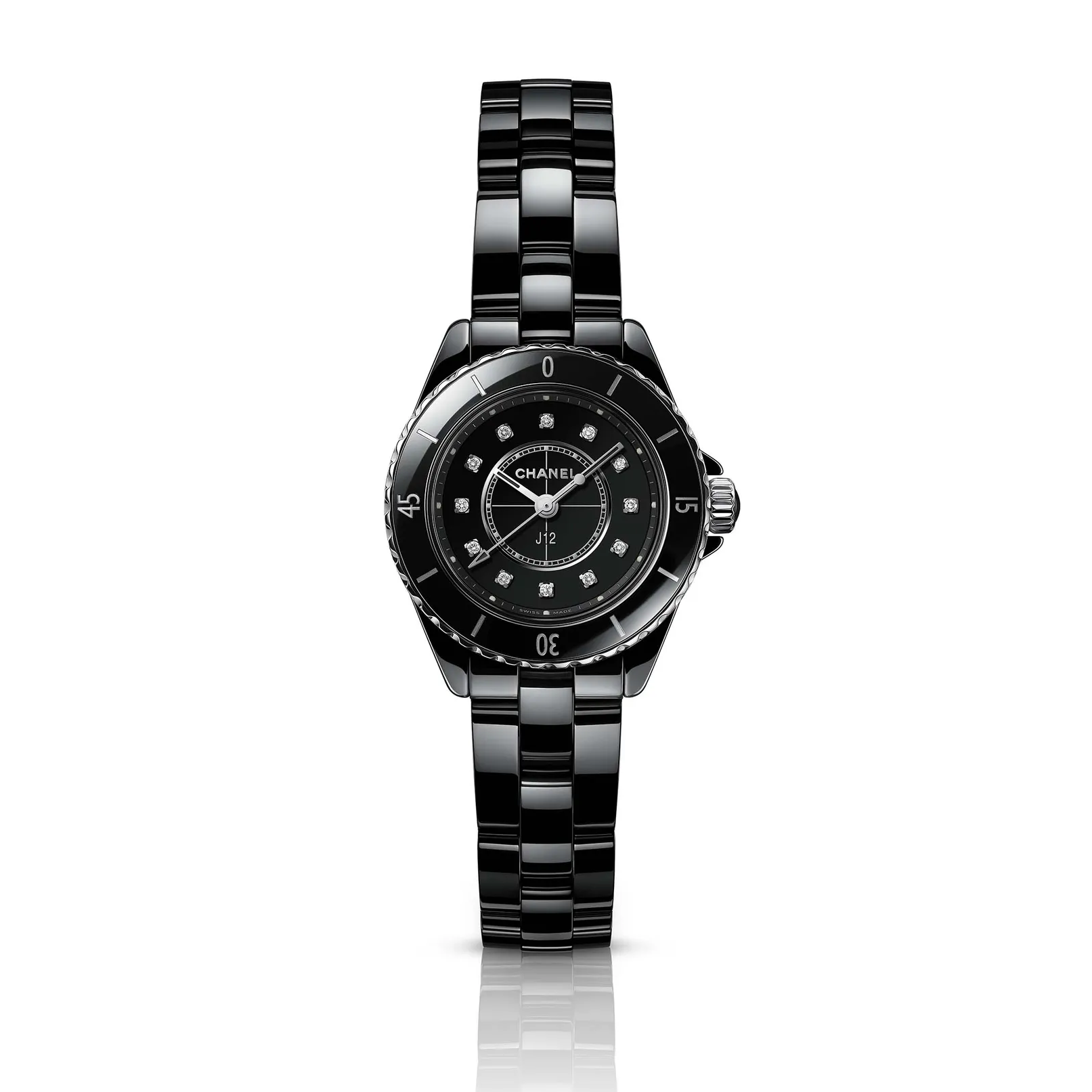
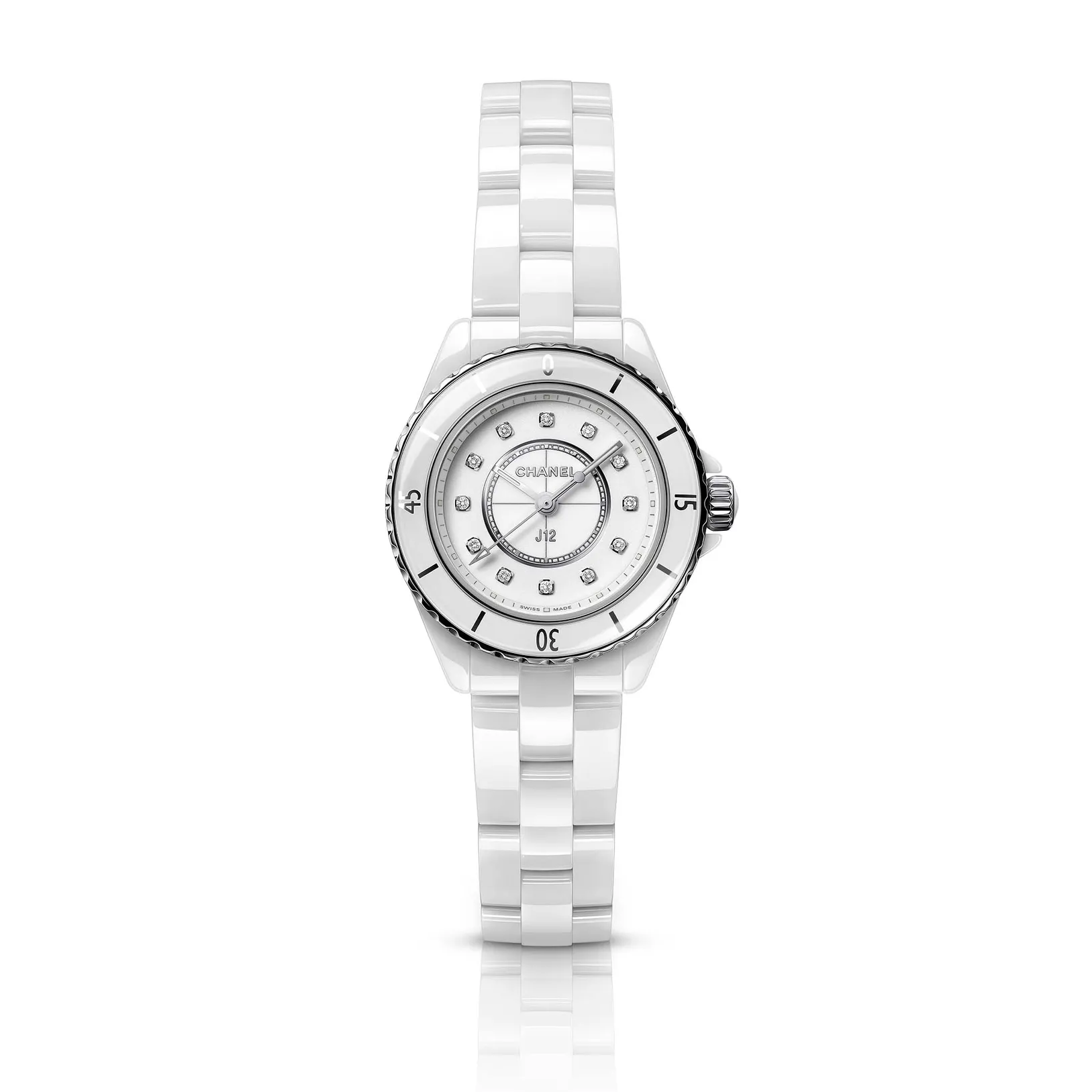
The new J12 in 28 mm versions | Credits: Chanel Horlogerie
This same philosophy is reflected in the construction of both models. In the 38 mm version, the case combines highly durable ceramic and polished steel, while the slightly domed sapphire crystal complements the silhouette without disrupting its continuity. The screw-down crown, with its distinctive ceramic cabochon, also blends naturally into the case middle, contributing to the sense of compactness that has defined the J12 since its debut. On the 28 mm model, the same principles are reinterpreted on a different scale: the architecture remains faithful to the original, but each component has been redesigned to adapt to the new proportions.
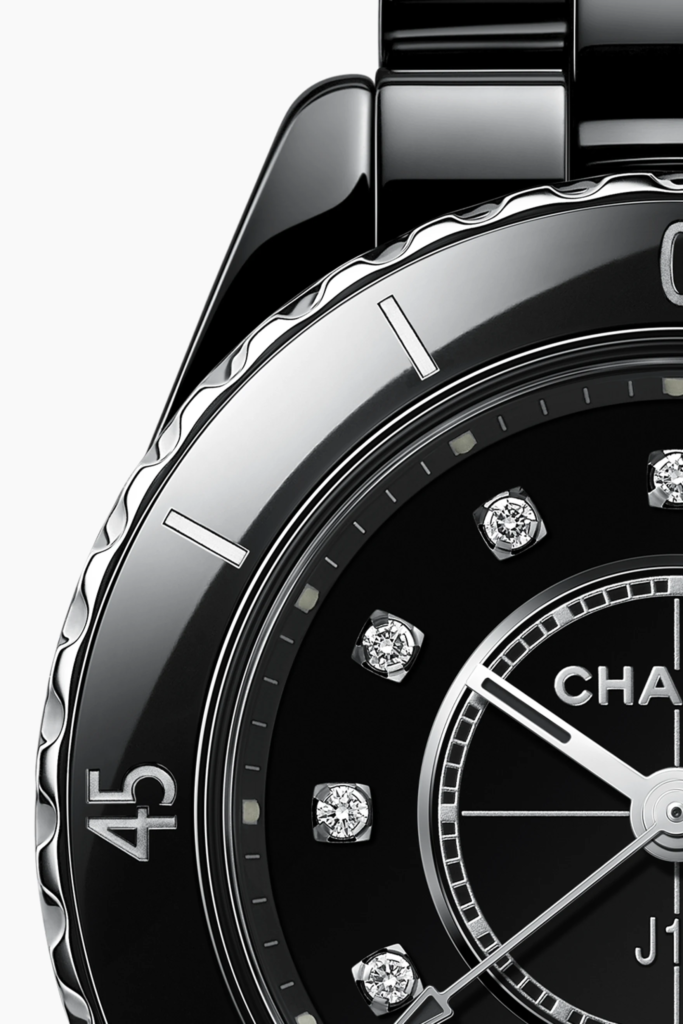
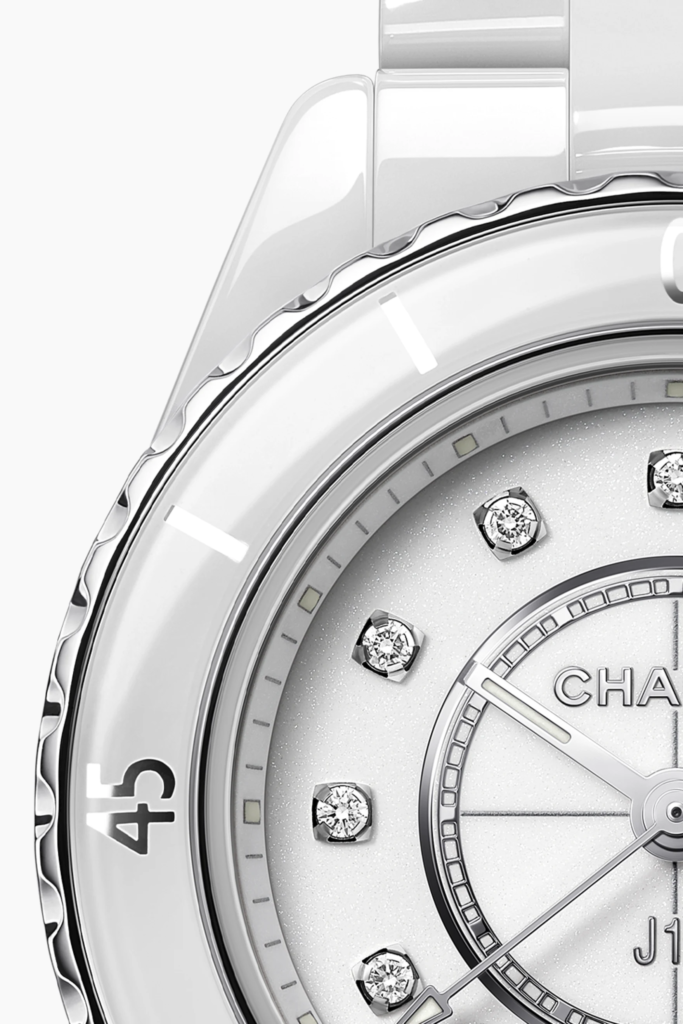
Close-up of the bezel on the new 28-mm J12 models | Credits: Chanel Horlogerie
The same approach is evident in the bezel, one of the J12’s most distinctive features. On the 38 mm model, it retains the ceramic ring with engraved numerals, enhanced by the 2019 redesign, which slimmed down its profile while simultaneously enlarging the dial opening. In the 28 mm model, however, the relationship between the bezel, dial, and case has been completely recalibrated to preserve the visual balance that characterizes the collection even in a more compact size.
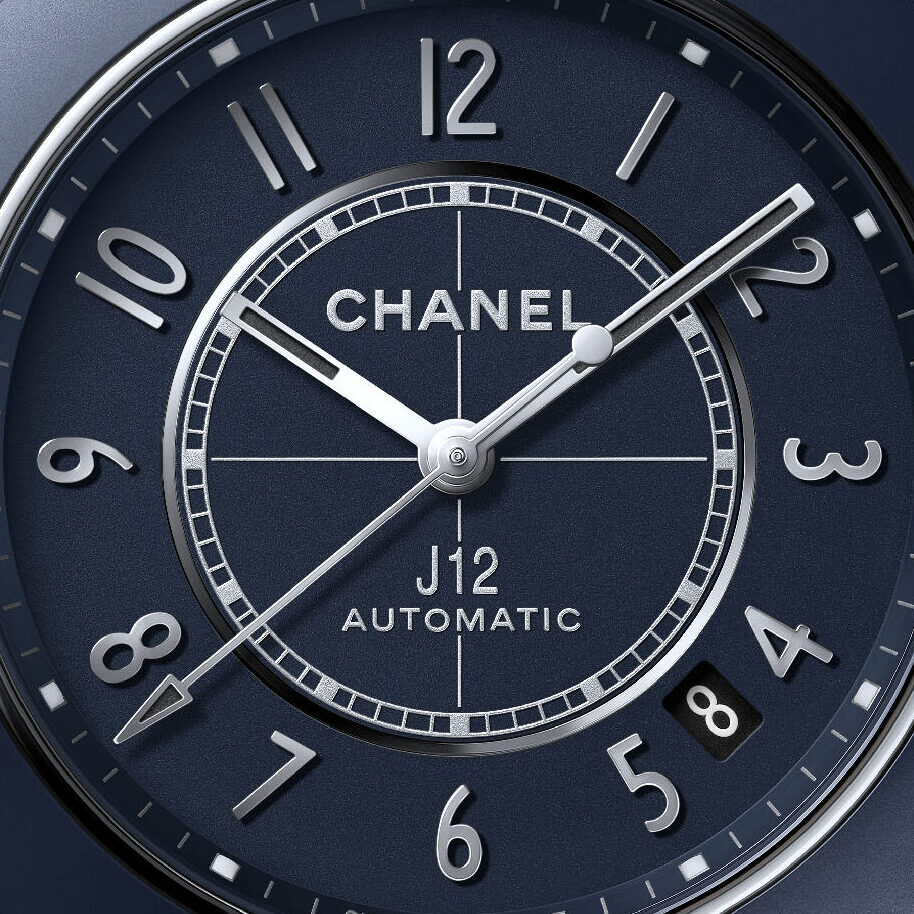
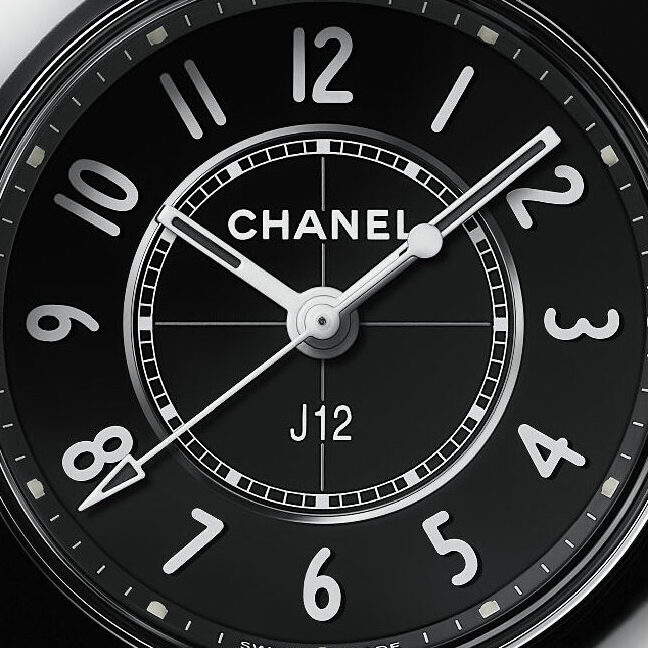
Close-up of the dial on the new J12 watches in the 38 mm and 28 mm versions | Credits: Chanel Horlogerie
The dial also reflects the same design philosophy. In the 38 mm model, the ceramic Arabic numerals, the skeletonized baton hands, and the date window at 4:30 come together to form a look that has now become one of the defining aesthetic features of the contemporary J12. The 28 mm model, on the other hand, takes an even more minimalist approach, and the date window is omitted from the lacquered dials which are color coordinated with the case to enhance its balance.
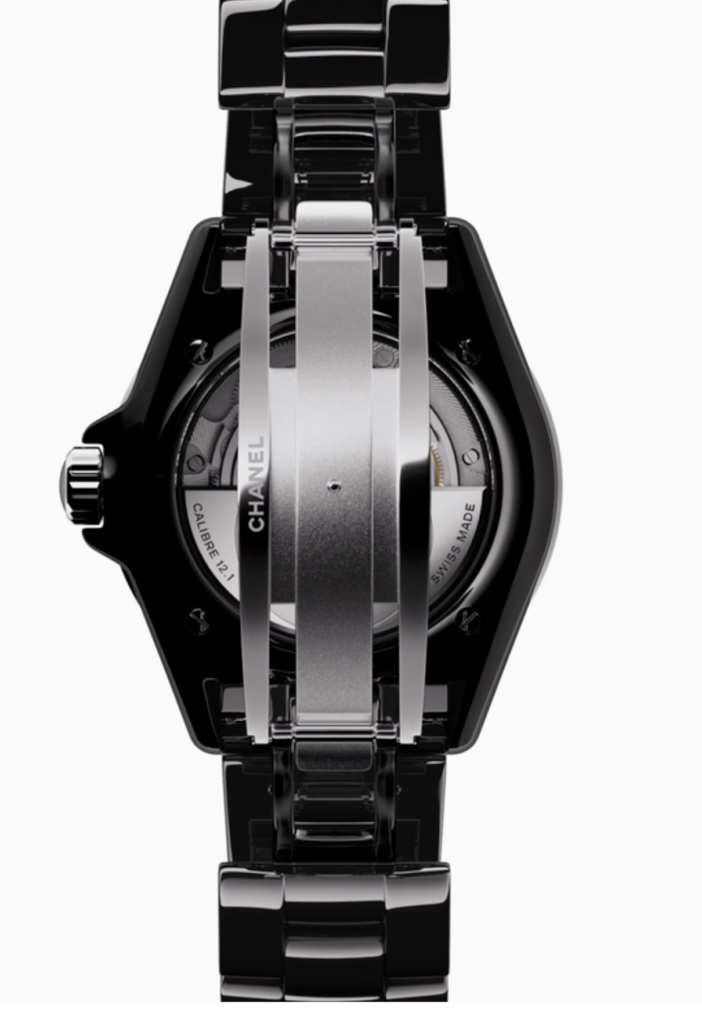
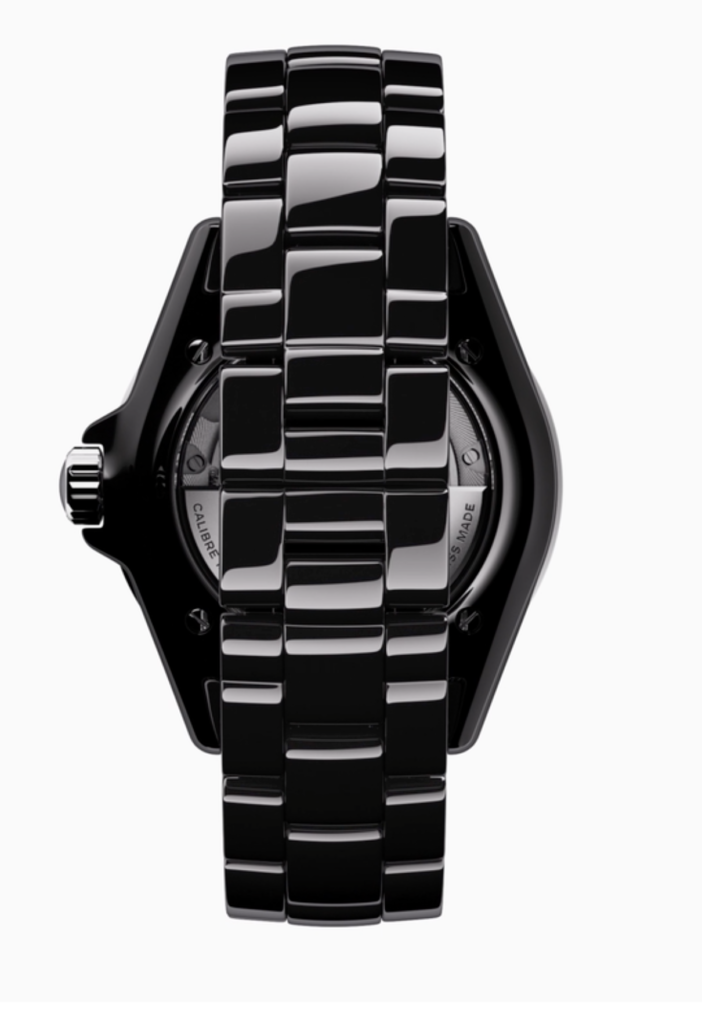
Close-up of the bracelet and patented triple folding clasp | Credits: Chanel Horlogerie
The same level of care is evident in the integrated bracelet, which has always been one of the most sophisticated elements of the design. On both the 38 mm and 28 mm models, each ceramic link is machined, polished, and inspected individually before assembly, ensuring perfect visual continuity with the case. Rounding out the design is the signature triple folding clasp in steel, designed to blend in almost completely when closed.
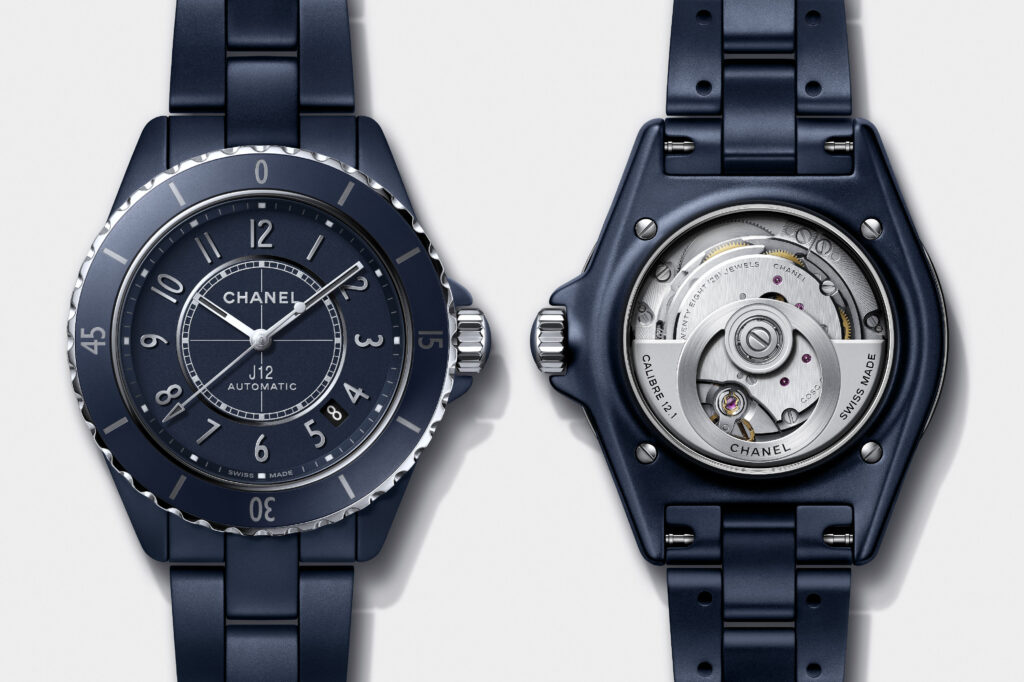
The new J12 Bleu in the 38 mm version | Credits: Chanel Horlogerie
The differences, however, lie in the movement. The 38 mm model is powered by Caliber 12.1, a COSC-certified chronometer automatic in-house movement comprising 191 components and 28 jewels, with a frequency of 28,800 vibrations per hour and a power reserve of approximately 70 hours. Through the sapphire crystal case back, one can also admire the distinctive circular oscillating weight designed by Arnaud Chastaingt. For the 28 mm model, CHANEL has opted for a high-precision quartz movement, a choice fully in line with the project’s philosophy and the watch’s proportions.
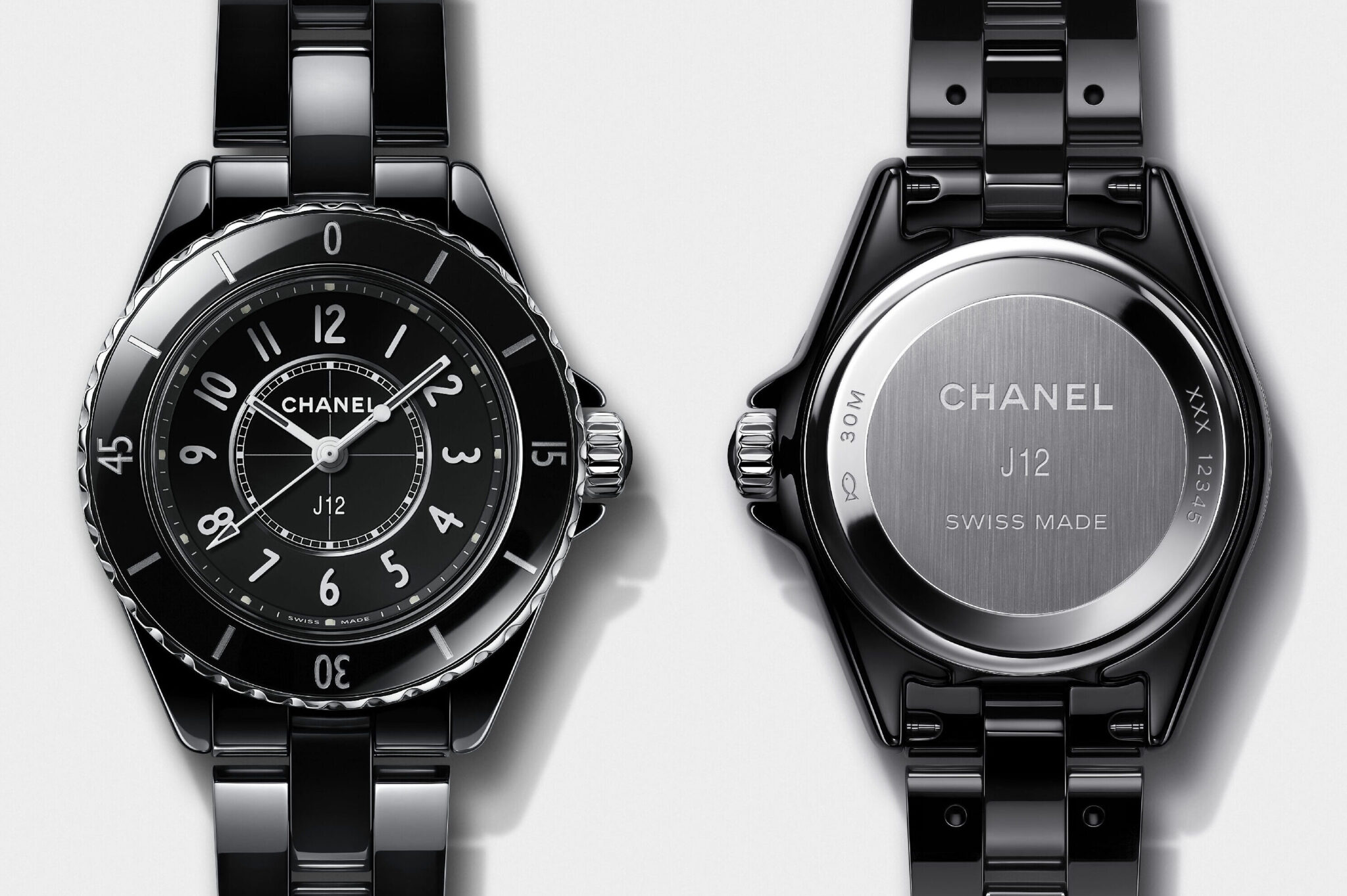
The new J12 in the 28 mm version | Credits: Chanel Horlogerie
The 28 mm model makes its debut with a diverse collection. The models in highly resistant black (H10132) and white (H10133) ceramic are joined by the J12 Golden Black 28 mm (H11057), which combines matte black ceramic with yellow gold-plated details. Rounding out the collection is the spectacular J12 Diamonds interpretation, in which 628 baguette-cut diamonds (totaling over 16 carats) transform the 28 mm model into one of the most refined expressions of CHANEL High Jewelry.
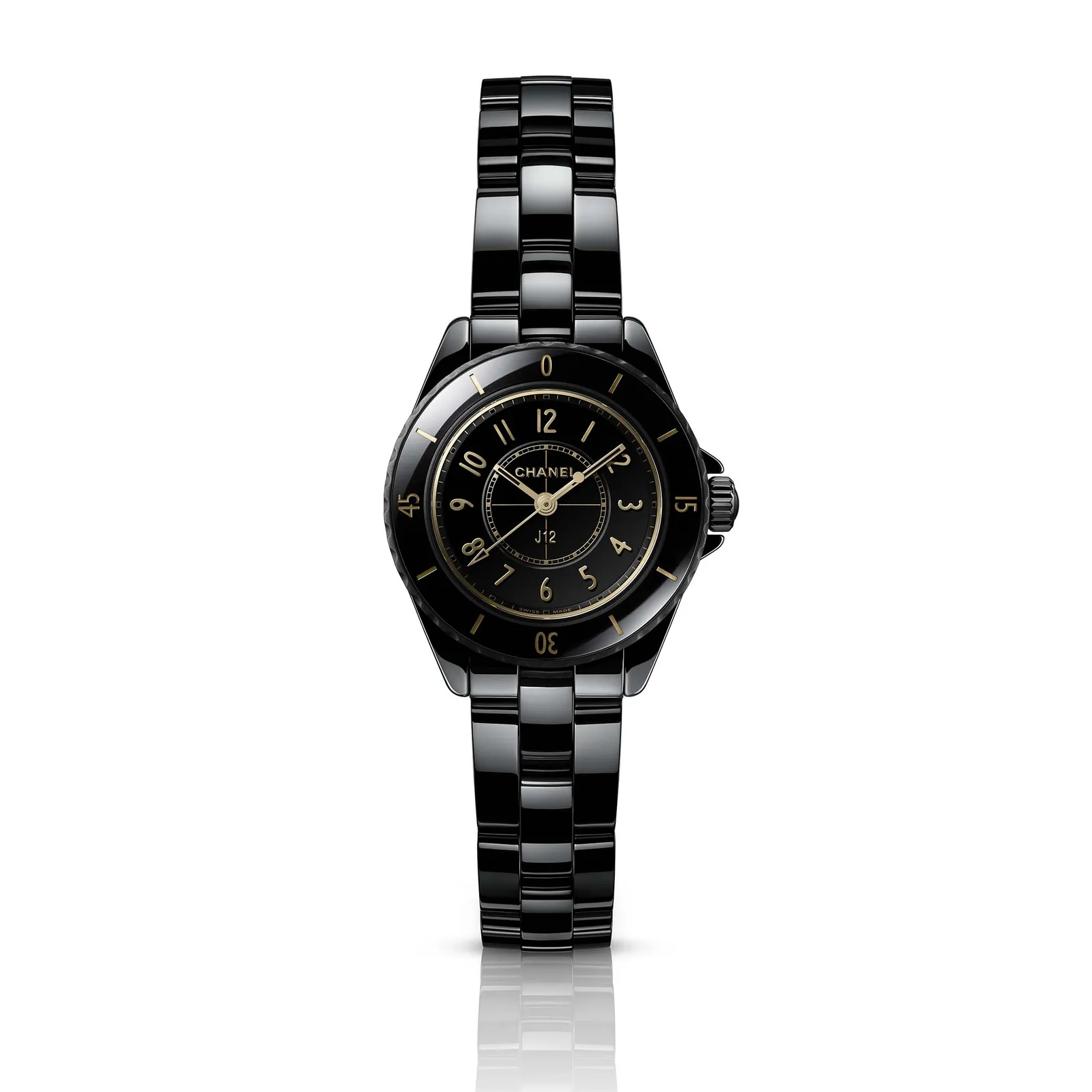
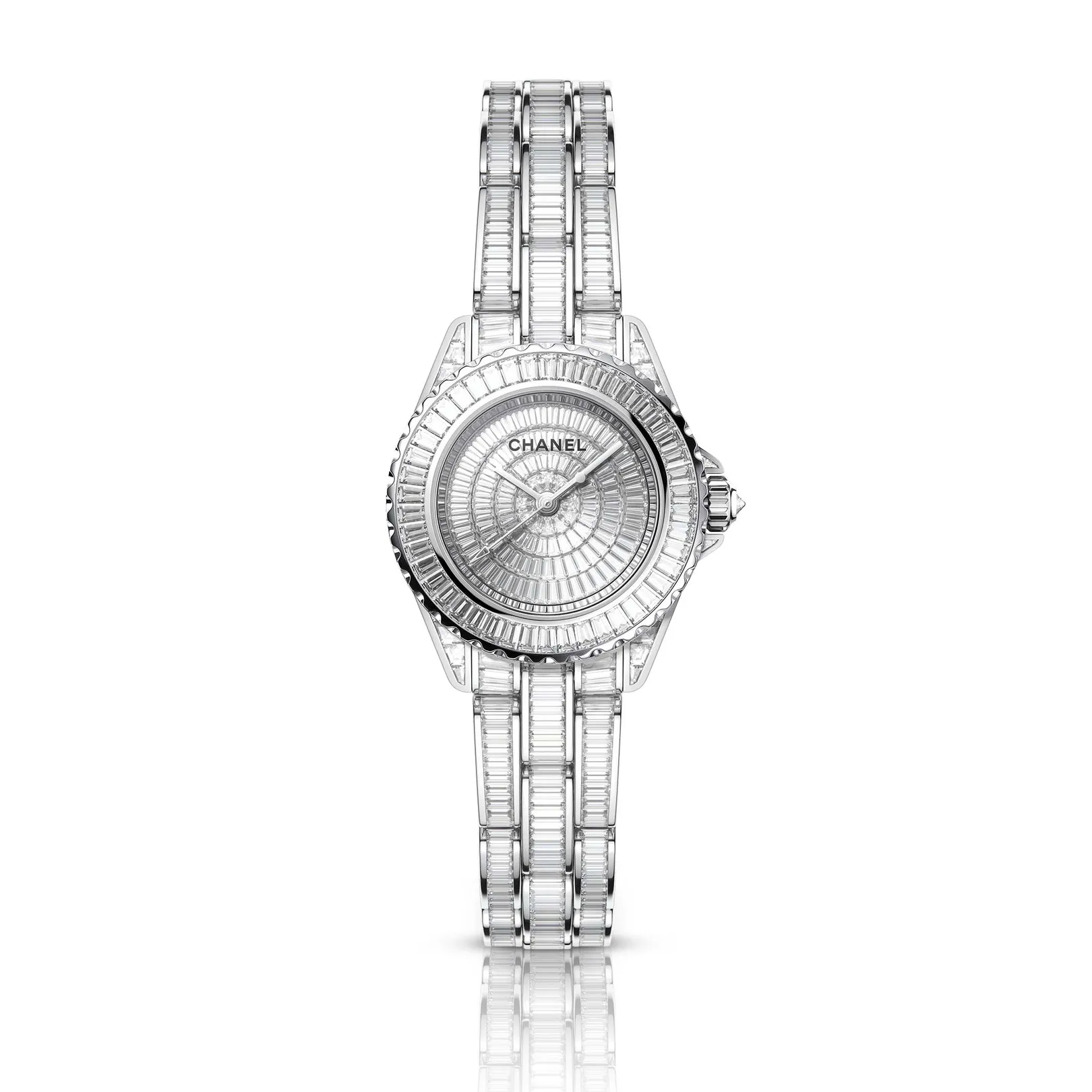
The new J12 in the 28 mm “Golden Black” and “Diamonds” versions | Credits: Chanel Horlogerie
A commitment that goes beyond the J12
The history of the J12 tells only part of the story of CHANEL’s journey in watchmaking. Alongside the development of its most iconic collection, the House has, over time, built up a wealth of industrial, manufacturing, and mechanical expertise that today stands as one of the pillars of its watchmaking identity.
The first step dates back to 1993, with the acquisition of the G&F Châtelain manufacture in La Chaux-de-Fonds, now known as CHANEL Watch Manufacture. It is here that, over the years, the House has gradually concentrated an ever-broader range of expertise: from ceramic craftsmanship to watch assembly, and on to the development of its own Haute Horlogerie creations and in-house movements.
In the years that followed, this journey expanded through a series of investments in some of the most influential names in independent watchmaking. The acquisition of a stake in Bell & Ross in 1998, followed by an investment in Romain Gauthier in 2011, stakes in F.P. Journe and Kenissi in 2018, and, more recently, in MB&F in 2024, reflects a vision that has been consistently developed over the course of more than thirty years.
Taken as a whole, these initiatives reveal a deliberate approach. CHANEL has chosen to partner with manufacturers that share a strong technical culture and a distinct creative identity, contributing to their development while fully respecting their autonomy. This collaborative model has enabled the Maison to enrich its watchmaking ecosystem while simultaneously fostering the growth of some of the most innovative players in contemporary haute horlogerie.
Our Thoughts
After looking back on more than twenty-five years of history, one thing is clear. The J12 is one of those watches that everyone recognizes at first glance, but whose complexity only becomes apparent when you stop to take a closer look.
Behind a design that has remained surprisingly true to itself lie a blend of materials research, design, mechanical development, and a vision of watchmaking patiently cultivated over more than three decades. Nothing has stood still!
This is perhaps the most difficult quality to achieve: evolving naturally, to the point where each new generation of the J12 seems as though it has always existed. The Black, the White, the most recent Bleu, the in-house movements, the complications, and the Haute Horlogerie creations all belong to the same narrative. The details change, but the core concept remains the same.
The J12 did not become a benchmark in contemporary watchmaking because of a single innovation or a specific model. It achieved this status thanks to its extraordinary continuity, which has allowed it to adapt to every evolution without ever losing touch with the intuition that started it all.
The next time you happen to look at a J12, try looking at it with a different perspective. Look beyond the black, white, or blue. Beyond the ceramic, the movement, or the technical specifications. Look at the watch as a whole.
Because it is precisely there, in the harmony between every single detail, that the vision conceived by Jacques Helleu in the late 1990s continues to live on. And this is probably why, twenty-six years later, the J12 still evokes the same feeling as it did on the very first day: that of a watch that seems to have always existed.
Are you looking for the perfect gift? Explore our online store and discover the entire collection signed IWS – Italian Watch Spotter!
For all real-time updates on the world of watchmaking follow us on Instagram and visit our Youtube channel.