
How many watch enthusiasts find satisfaction and fulfillment in the daily, ritualistic almost contemplative act of manually winding their timepiece?
Think of those moments of quiet, perhaps in the morning, after carefully choosing the watch that will keep track of your daily routine: almost intimate moments of dialogue with the timepiece itself, reserved, one imagines, for reorganizing thoughts, expectations, desires, and responsibilities.
The ritualistic nature of the gesture, the moment of intimate pleasure, and the sensory connection with the object are what Grand Seiko, with poetic charm and a sensitivity to nature, seeks to achieve in the creation of the 9SA4 caliber, drawing inspiration from the song and morphology of the lesser whitethroat.
This bird is native to the Morioka area, a city near the Shizukuishi workshop where Grand Seiko mechanical watches are produced, surrounded by nature that serves as a source of inspiration for the watchmaking process.
But what does a little bird with yellow and gray plumage have to do with winding a watch by hand?
Much more than one might imagine, but to explore this unusual and intriguing relationship in greater depth, we need to briefly examine how Grand Seiko designed the winding mechanism for the 9SA4 caliber, its first manual-winding Hi-Beat movement.
How the 9SA4 gauge works
When the crown is pulled out and turned by hand, the rotation is transferred to the movement via the crown wheel. In the 9SA4, however, Grand Seiko does not use a standard-sized crown wheel because the available space does not allow for it. For this reason, an intermediate wheel has been inserted between the crown and the system that drives the mainspring barrel. This redesign of the system reduces the number of crown rotations required to wind the watch (15% fewer than those required to achieve the same performance in the hand-wound 9SA5 caliber, which served as the basis for the 9SA4) and, at the same time, makes the mechanism more durable.
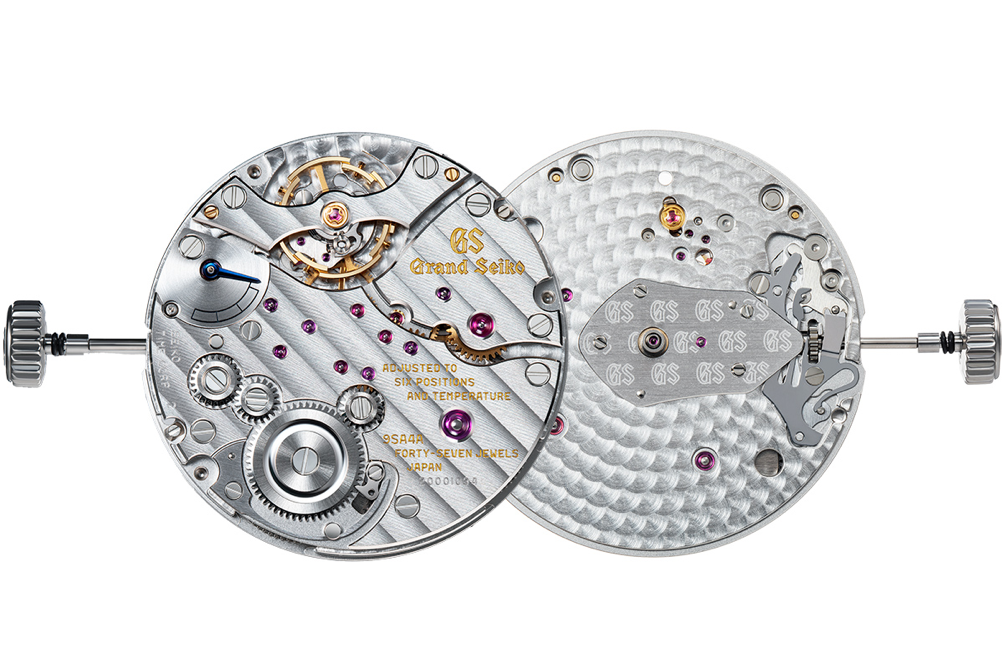
At this point, the ratchet wheel mounted on the top of the barrel —which contains the mainspring—comes into play; its function is to receive the rotational force from the crown wheel and transmit it to the barrel.
The 9SA4 movement, however, features two barrels that serve to increase the power reserve, bringing it to 80 hours.
However, this double-barrel configuration creates a very real design problem: it becomes necessary to find space for the click, the component of the mechanism designed to prevent the ratchet wheel from moving backward after manual winding.
To understand how it works, we need to take a step back and consider what would happen without it. Once wound, the mainspring stores energy that, in the absence of the ratchet, would naturally tend to be released, exerting a force that would cause the barrel to rotate in the opposite direction from that used to wind it. If the ratchet wheel could simply rotate freely in both directions, a significant portion of the energy just stored would be immediately returned to the crown, preventing it from being retained.
So, this is where the click comes into play, the component that engages with the teeth of the ratchet wheel and prevents it from rotating in the opposite direction. Its function is, in fact, to act as a true one-way stop: it allows the ratchet wheel, which is integral with the barrel’s winding mechanism, to advance during winding, but blocks its reverse rotation when the crown stops turning. In this way, it prevents the energy stored by the mainspring from being discharged backward through the winding train.
In the 9SA4 caliber, the pawl is strategically positioned between the two barrels to fill the space between them. In traditional hand-wound movements, the pawl head oscillates around its own axis, whereas in the 9SA4 it does more than that: the pawl head slides as it engages with the teeth of the ratchet wheel.

Now let’s imagine manually winding the watch: the crown turns, and with it the ratchet wheel, while one of its teeth comes into contact with the click, which must be able to yield in the winding direction, following the contour of the tooth. This is why the pawl slides as the tooth passes beneath it.
Once the tooth has passed the contact point, the click spring engages, exerting the force needed to return the click to the ratchet wheel, preparing it to engage with the next tooth. The movement is therefore a continuous, harmonious sequence: the wheel turns, the tooth pushes the pawl, the pawl slides, the tooth passes the pawl, and the spring immediately returns it to position. It is precisely this frenetic yet rhythmic movement that generates the characteristic sound of winding and the pleasant sensation of resistance from the contact between the ratchet wheel and the pawl.
The click shaped like a cutrettola
With this necessary technical introduction out of the way, it becomes much easier to understand the function and the beak-like shape of the click, which, as it moves forward and backward repeatedly with each rotation of the crown, performs a small movement that is, in every respect, similar to a bird’s peck.
The design used to create this small but essential component is rooted in the design philosophy that defines Grand Seiko: Designer Yuya Tanaka developed no fewer than four different concepts before arriving at the final “bird-like” shape, a visible result of a precise kinematic solution inspired by nature, Japanese spirituality, and the pride and spirit of the Takumi (“artisans,” “master craftsmen”).
The result of engineering research and the technical application of the corkscrew-shaped click is a tribute to the sensory satisfaction, sound quality, and tactile pleasure that every enthusiast seeks when manually winding their timepiece.
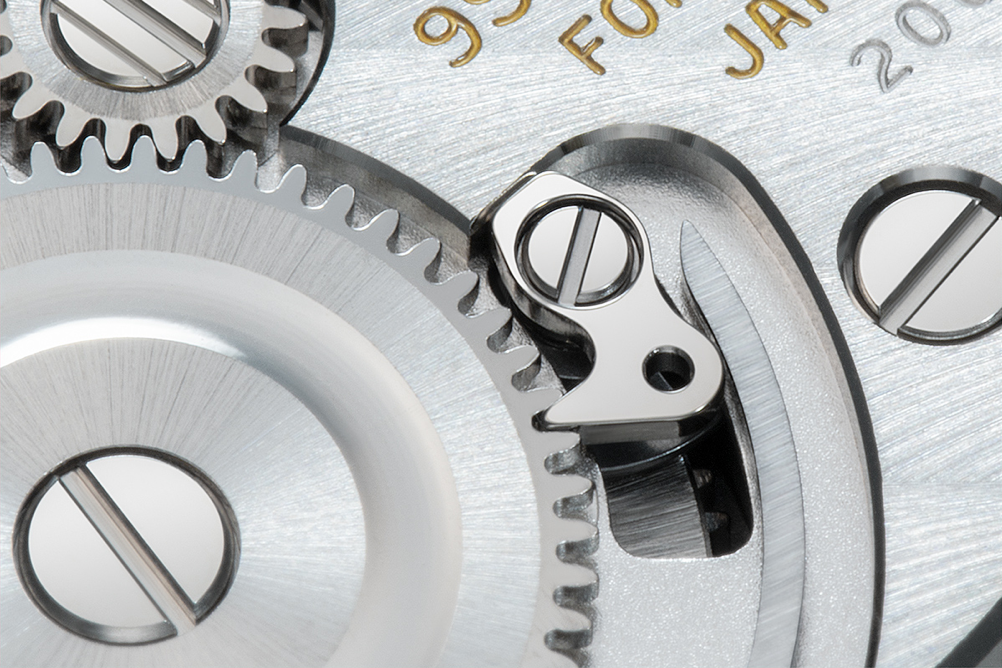
After repeated discussions, the Grand Seiko development team agrees that what makes the winding sensation truly special, though largely a matter of personal preference, is the click produced by the iconic bird-shaped winding crown, whose sound allows the imagination to transport you to the heart of a park in Japan, surrounded by a vibrant, blossoming ecosystem, the rustling of the wind, the ripples on the lakes, the fluttering of the wings of the Japanese white-eyes, and the persistent tapping of the woodpecker on the tree bark.
The Relationship Between Manufacturing and the Local Area
It is fascinating to note that, for Grand Seiko, the relationship between craftsmanship and the local region is not a secondary consideration in the creation of its timepieces, nor is it a mere decorative or design flourish; rather, it contributes, right from the design phase, to the very creation of each watch. Time is represented through nature itself light, the changing of the seasons, and the Japanese landscape. The meticulousness of Japanese craftsmanship finds its finest technical expression even in an invisible component such as the cutrettola-shaped click, which is skillfully highlighted by the open case back featured on timepieces equipped with the 9SA4 movement.
Currently, the 9SA4 caliber powers a single model in the Evolution 9 collection, available in the SLGW003 (with a white dial) and SLGW007 (with a blue dial) versions, both featuring a finely detailed design that captures the beauty of the irregular patterns found in birch bark.

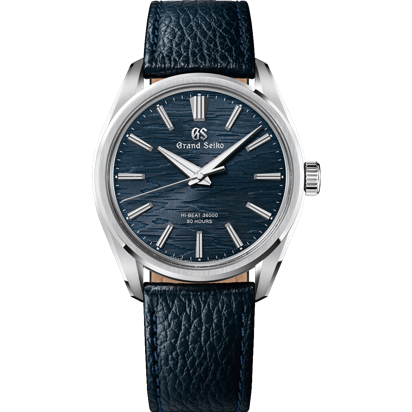
Grand Seiko, therefore, seems to be striving through these watches to recreate an entire thriving ecosystem, paying homage to the Japanese landscape in all its entirety and complexity: while the dial side depicts the beauty and irregularity of birch bark, the caseback features the vibrant Japanese bush warbler, and the bridges and mainplate bear delicate finishes inspired by the Shizukuishi River. Every component of these timepieces is finely handcrafted and assembled to pay homage to nature, which is deeply respected and elevated almost to the status of a muse for artisans, designers, and engineers.
The Allure of Grand Seiko
Ultimately, what makes the 9SA4 caliber so fascinating is the way Grand Seiko has transformed a gesture as simple yet steeped in history as manually winding a watch into a sensory experience that brings a true Japanese ecosystem to life. Thus, that small click that accompanies the winding is no longer merely the sound produced by the interaction between a wheel and a pawl, but the voice of a component that, through its movement, evokes an element of the landscape surrounding Morioka and transforms an everyday gesture into a moment of connection with the place from which that watch originates.
by Federico Neroni
Are you looking for the perfect gift? Explore our online store and discover the entire collection signed IWS – Italian Watch Spotter!
For all real-time updates on the world of watchmaking follow us on Instagram and visit our Youtube channel.