
In Jeff Koons’ art, even a seemingly simple subject can become something surprising once its scale, materials, and proportions are altered. His Balloon Dog is perhaps the most striking example of this approach: a shape that is part of everyone’s collective imagination, transformed into a monumental and unmistakable sculpture.
Bringing that same sensibility to the wrist is an entirely different story. A watch has precise dimensions, a movement that must function, materials that must be worked with, and, above all, it must continue to do what it was designed to do: measure time. This is precisely where the collaboration with Hublot becomes interesting. The result is not simply a Koons creation applied to a timepiece, but an attempt to understand just how far one can push the design of a watch without losing its mechanical soul.
The results of the collaboration between Jeff Koons and Hublot are the Classic Fusion Balloon Dog by Jeff Koons and the MP-14 Origin by Jeff Koons. The former takes one of the American artist’s most famous images and brings it to the wrist through a radical reinterpretation of the Classic Fusion’s architecture. The second, however, takes the concept much further, entering the realm of Hublot’s Exceptional Timepieces and utilizing a three-dimensional design, a movement entirely new to the Maison, and a considerable amount of precious materials to create a sort of mechanical Big Bang.
The difference between the two watches is obvious, but it is precisely this difference that makes the collaboration particularly interesting. The Balloon Dog focuses on the immediate recognizability of its form; the MP-14 Origin on its decomposition. In the former, volume takes center stage aesthetically; in the latter, it is the movement itself that generates the volume. But without further ado, let’s dive right in and discover them.
The Classic Fusion Balloon Dog

The starting point for the Classic Fusion Balloon Dog is one of Jeff Koons’ best-known works, the Balloon Dog from the Celebration series, which the artist began developing in the mid-1990s. The idea behind the work is seemingly simple: to take a fleeting, familiar object, such as an animal made from a balloon, and transform it into a permanent, monumental, and perfectly controlled presence.
The case itself has been redesigned to simulate the appearance of an object inflated with air. The diameter remains at 42 mm, but the watch’s perceived size is completely different from that of a traditional Classic Fusion. Sharp edges, flat surfaces, and sharp transitions give way to convex geometries, domed surfaces, and rounded curves. The case almost appears to have been subjected to internal pressure capable of deforming its volumes, creating that characteristic sensation of elastic tension typical of balloons.
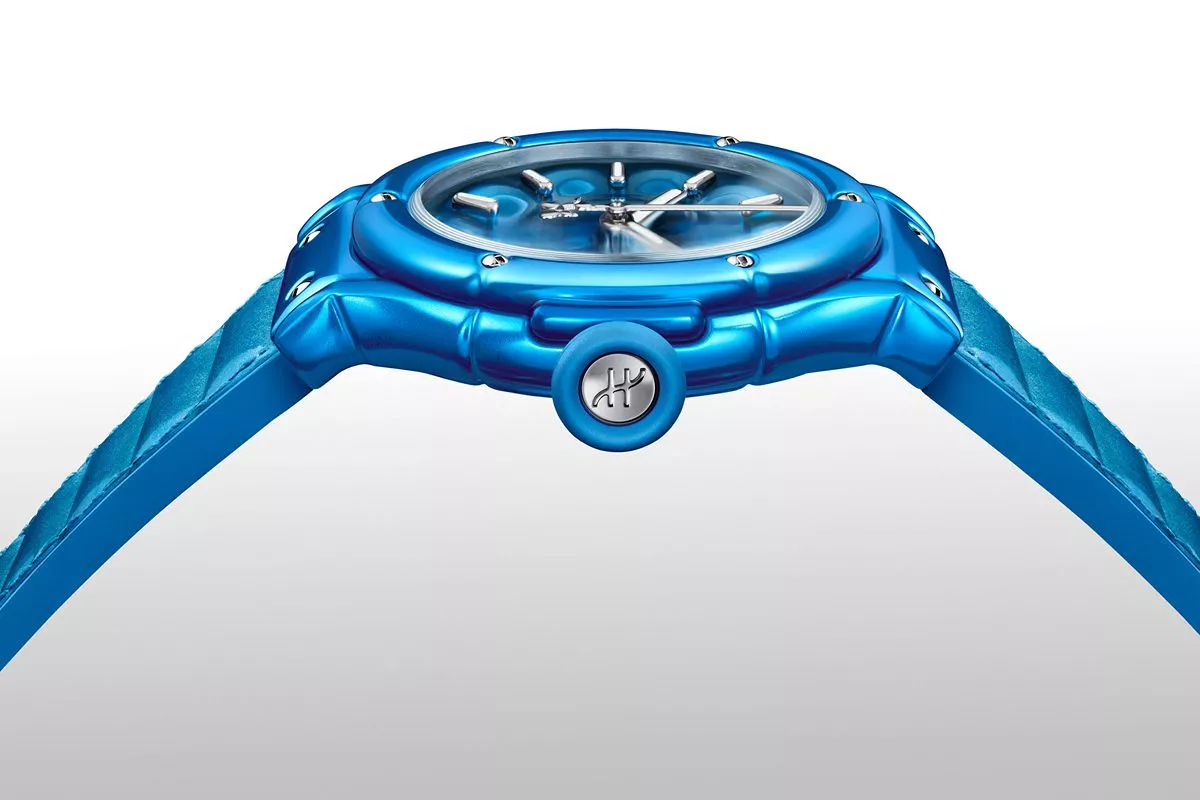
This formal design approach encompasses virtually every element of the watch. The sapphire crystal features a raised, domed surface, while the heads of the H-shaped titanium screws, a distinctive feature of Hublot’s design, have been reinterpreted with a softer, three-dimensional geometry. Even the points where the case meets the strap contribute to the illusion of a swollen volume.
The result is particularly evident in the red and blue anodized aluminum versions, two shades that are not merely a color choice, but a deliberate reference to the glossy, saturated quality of Koons’ sculptures. These are complemented by a mirror-polished stainless steel version, which directly evokes the reflective surface of the artist’s works.
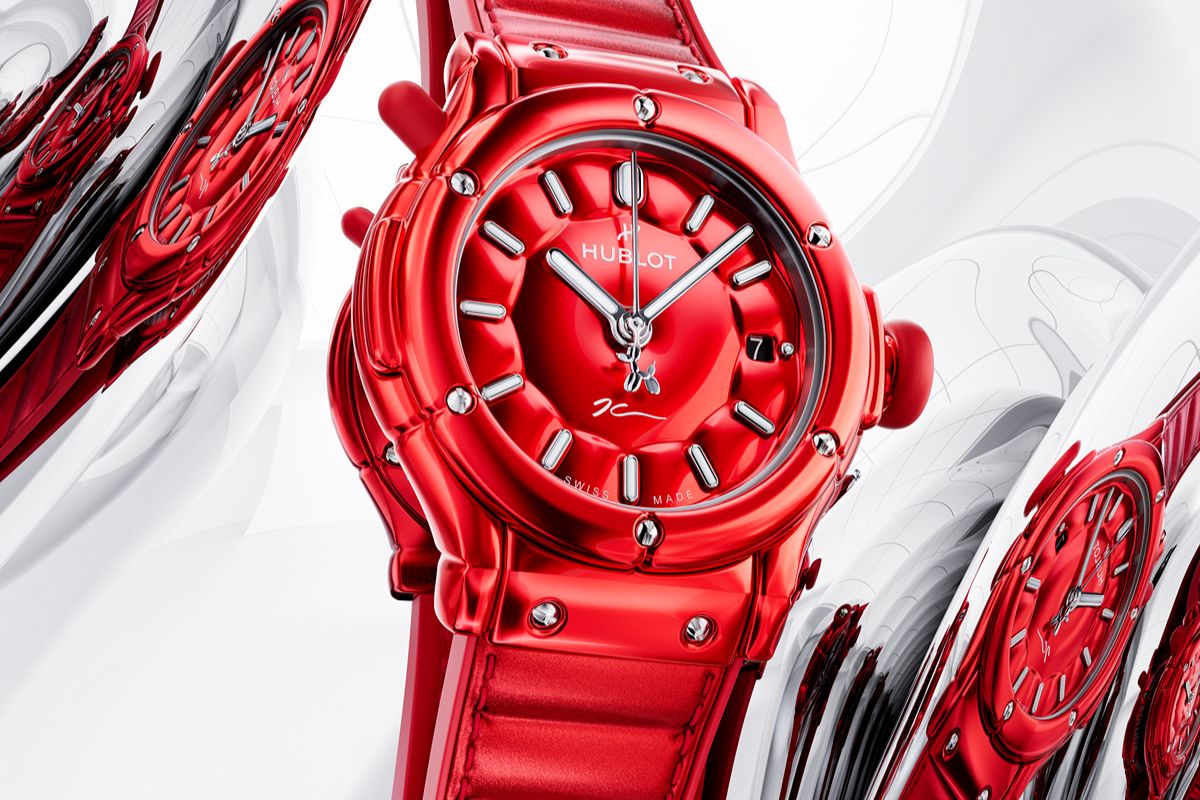
Aluminum is a technically significant choice. In addition to allowing for particularly intense colors through anodization, it enables the material to be machined in a way that preserves both lightness and geometric precision. Machining the components using five-axis CNC machines is essential for achieving the curves needed to create the “puffy” effect that characterizes the design.
On the dial, the design philosophy becomes even more evident. The surface is made entirely of anodized aluminum and features a domed structure, onto which three-dimensional hour markers coated with white Super-LumiNova are applied. The hour and minute hands are also made of rhodium-plated metal and incorporate three-dimensional luminescent inserts.
The seconds hand perhaps offers the most explicit reference to Koons’ work: the counterweight is not merely a functional element, but features a bas-relief depiction of a Balloon Dog.
Even more intriguing is the design of the bezel, which is meant to resemble the valve used to inflate a balloon. In the colored versions, it is made of anodized aluminum combined with rubber and takes on a deliberately softer, more rounded shape. At the 10:30 position, there is also a small rubber “tail,” a decorative element that directly evokes a dog’s tail.

The strap also follows this design philosophy. The base is made of rubber, while the metallic leather insert features a textured surface with a padded effect and tone-on-tone stitching. Even the stainless steel folding clasp has been reinterpreted in keeping with the watch’s design language, featuring anodized aluminum accents and curved surfaces.
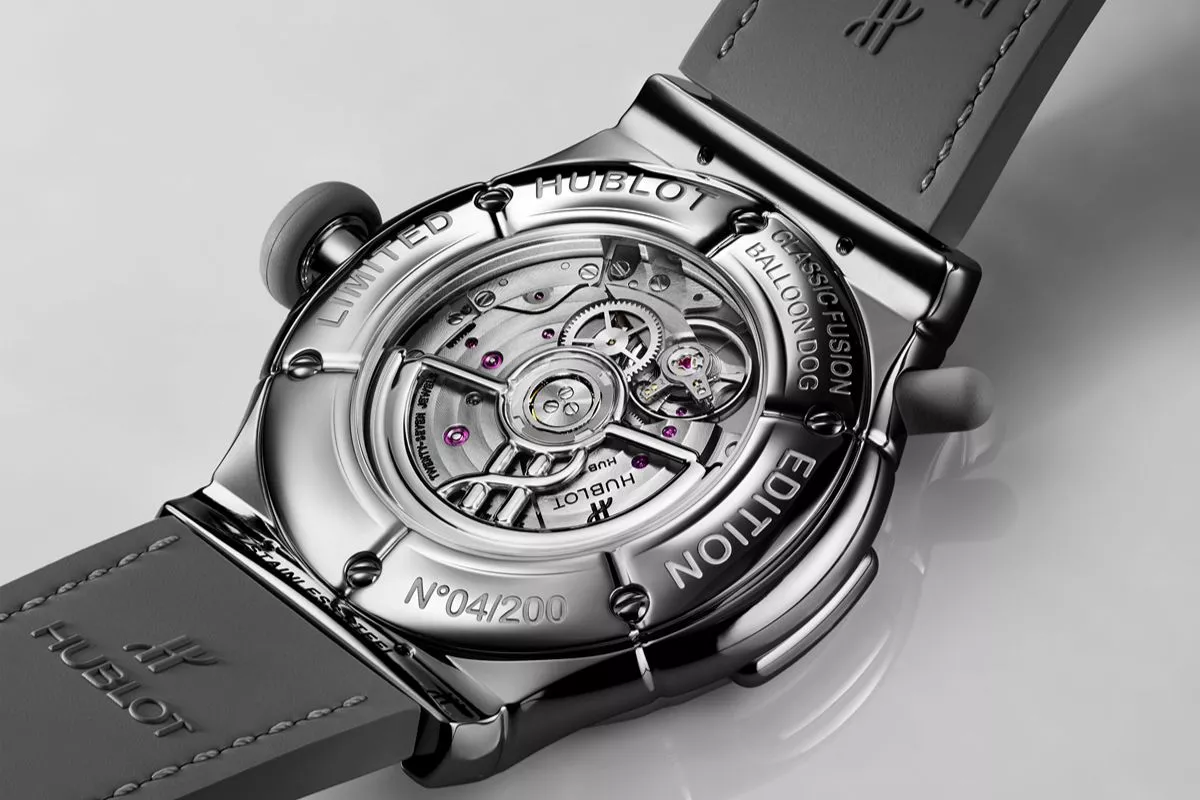
Behind this apparent simplicity lies the HUB1710 caliber, a relatively compact in-house automatic movement: 25.6 mm in diameter and just 3.7 mm thick. It consists of 185 components and oscillates at 4 Hz, equivalent to 28,800 vibrations per hour. The high frequency ensures good timekeeping stability and a smoother second hand.
The power reserve is 50 hours. The movement also features a date display at 3 o’clock, shown via a black disc with white numerals. Of particular interest is the rhodium-plated metal automatic rotor, which has also been reimagined with rounded, voluminous shapes, as if it were a mechanical miniature of the case’s sculptural design.

Only 200 pieces of the Classic Fusion Balloon Dog will be produced for each of the three configurations, with a listed price of 24,600 euros.
The MP-14 Origin
While the Balloon Dog transforms a watch into a sculpture,the MP-14 Origin by Jeff Koons attempts something even bolder: transforming the inner workings of the watch into a cosmological representation.
The project is part of the Exceptional Timepieces collection, the workshop where Hublot focuses its most radical experiments in mechanics, materials, and time display. And in this case, the technical innovation is particularly significant: the MP-14 Origin introduces the Maison’s first automatic central tourbillon.
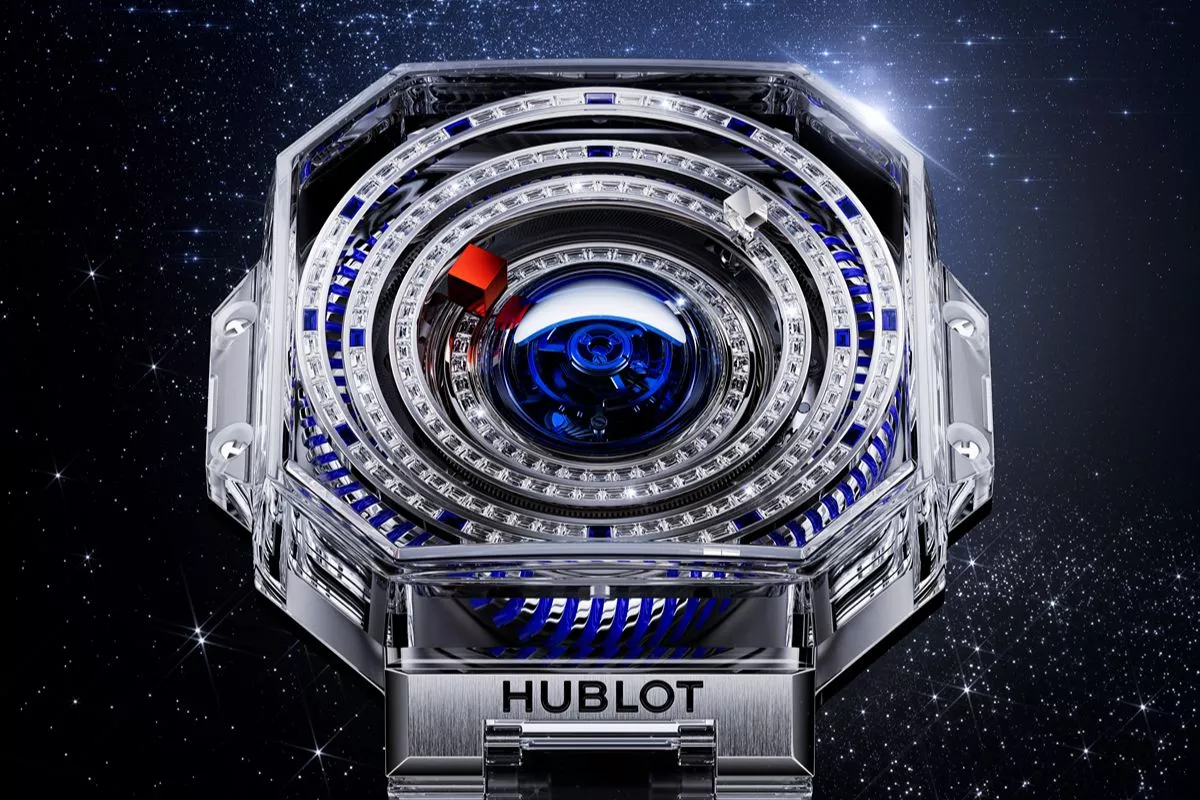
The 44-mm case is one of the most spectacular elements of the entire design. Crafted from transparent sapphire and titanium, it features an octagonal shape and is 20 mm thick. Its construction requires approximately 534 hours of work, a figure that immediately conveys the complexity involved in transforming an extremely hard and fragile material like sapphire into a three-dimensional structure of this kind.
Here, sapphire is no longer simply the material used to protect the dial or the movement. It becomes the case—a sort of transparent shell that allows you to see the internal layers of the timepiece.
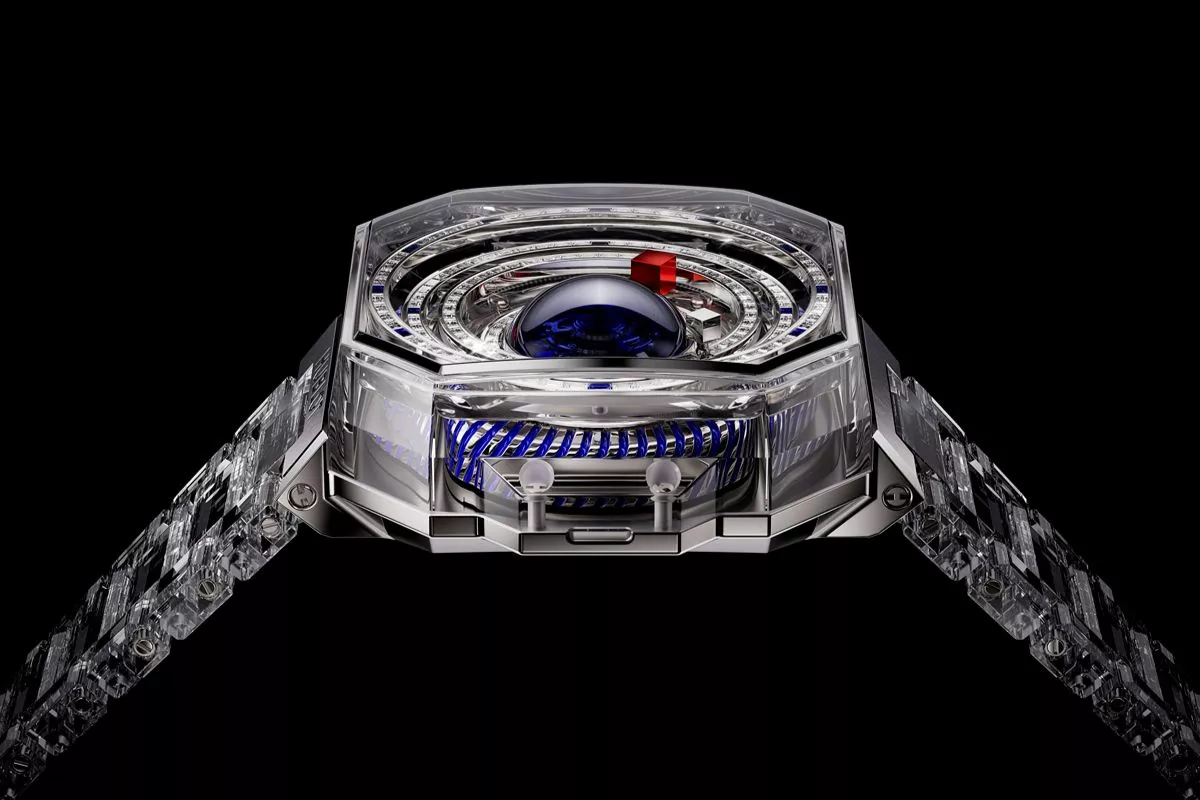
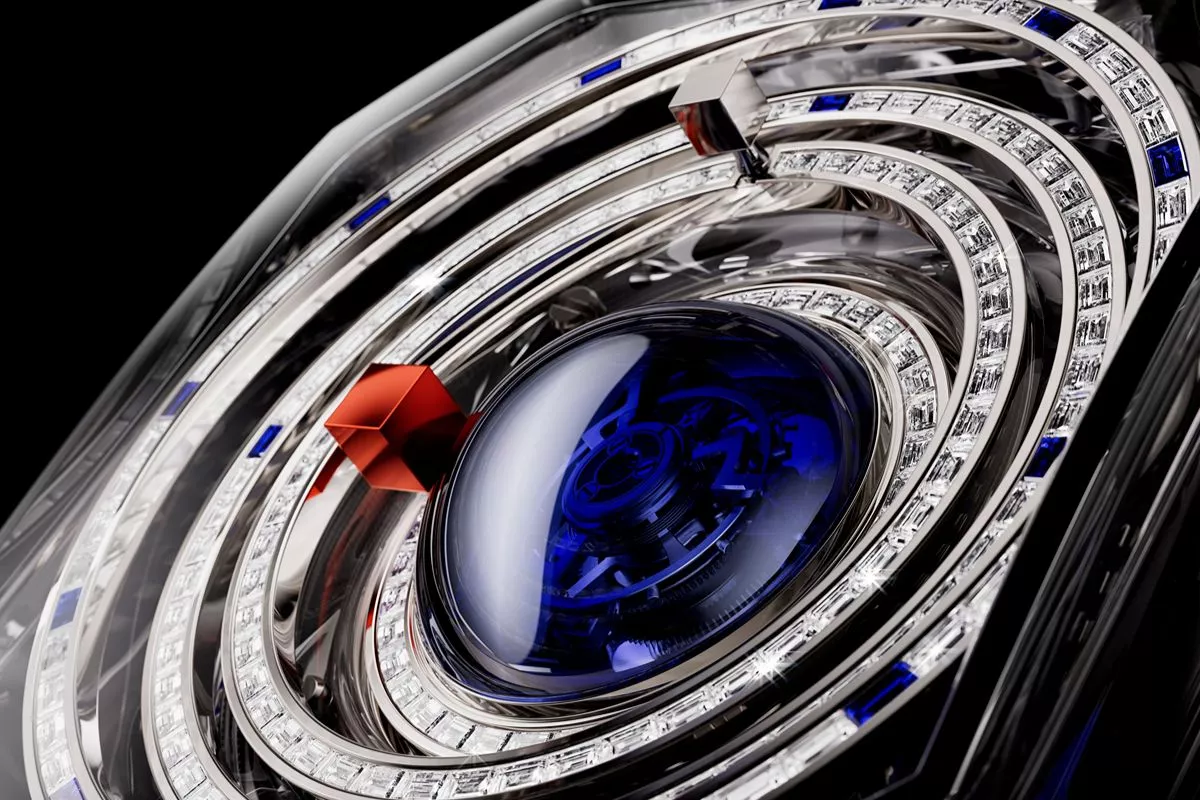
The interior features a design composed of concentric rings in white gold, embellished with baguette-cut diamonds and blue sapphires. The four rings in total feature 202 stones, with a combined weight of approximately 2.3 carats.
Two of these rings are fixed and serve as time scales. The blue sapphires indicate the hours and quarter-hours. The other two are movable and constitute the actual display system: one represents the hours and the other the minutes.
Inside, two small suspended cubes move. The hour cube is made of polished steel and coated with a translucent red paint; the minute cube, on the other hand, is made of polished steel left in its natural finish. These are not traditional hands, therefore, but three-dimensional indicators that appear to orbit inside the case.
At the center of this mechanism lies the true heart of the clock.
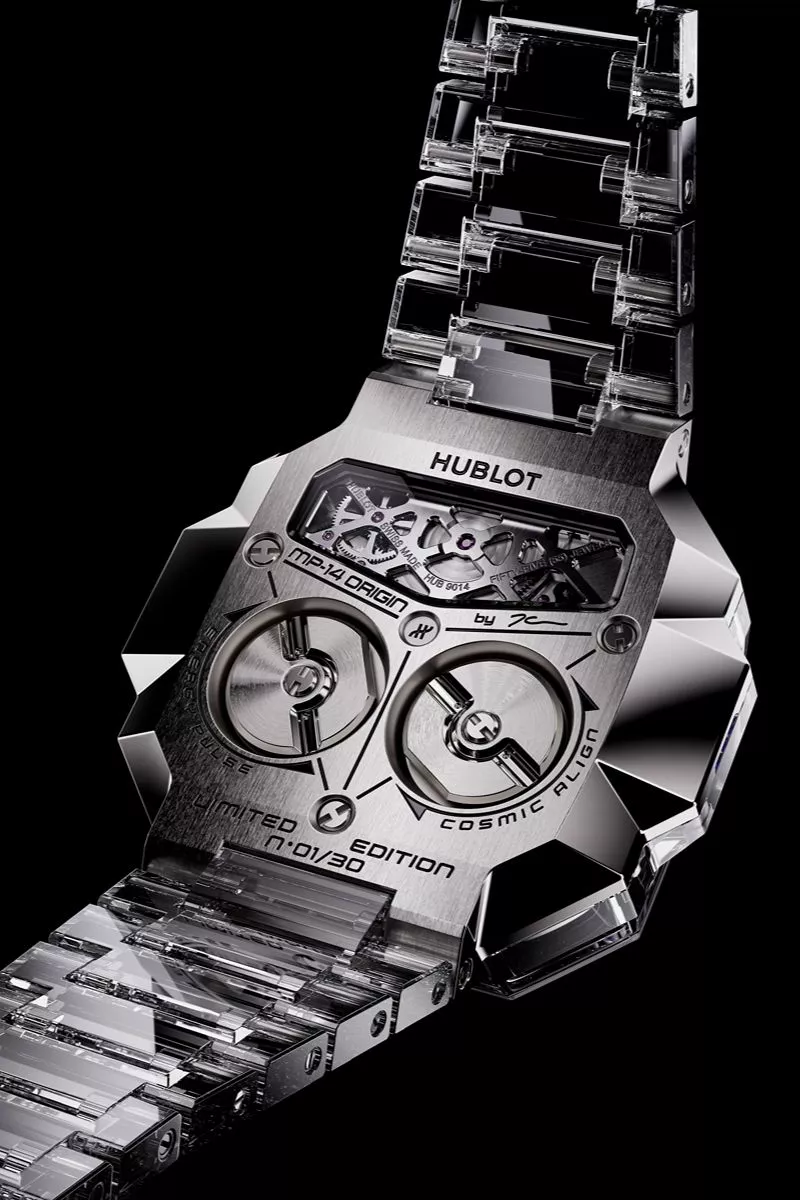
The HUB9014 caliber represents the most significant technical achievement of the MP-14 Origin. It is an in-house automatic movement consisting of 594 components, with a frequency of 3 Hz, equivalent to 21,600 vibrations per hour, and a power reserve of 60 hours.
Its defining feature is the central tourbillon. Normally, the tourbillon is positioned on the periphery or otherwise integrated into the movement. Here, however, it becomes the geometric and conceptual center of the entire system.
The tourbillon is housed beneath a transparent sapphire dome inspired by Koons’ Gazing Balls. The surface of the dome is hand-finished with a translucent blue lacquer applied by a micro-painter. The result is a visual focal point that appears suspended within the structure and from which all other elements radiate.
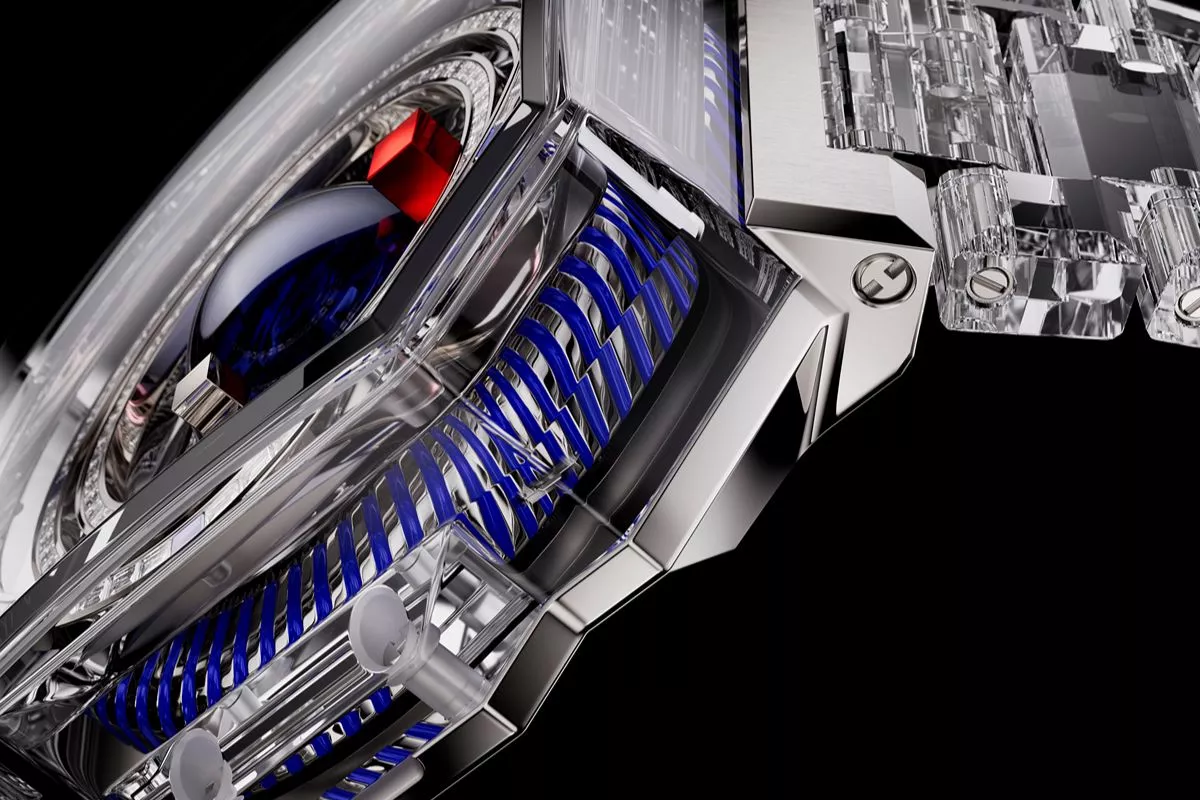
To keep this space clear, Hublot has adopted a peripheral automatic winding system. The oscillating weight does not occupy the central position normally reserved for the rotor, but rather runs along the periphery of the movement. This solution preserves the visual transparency of the assembly while ensuring the efficiency of the automatic system.
The mechanical function is thus transformed into an aesthetic language. The tourbillon is not merely a complication to be observed through the glass: it becomes the “first impulse” from which the entire mechanical universe of the watch seems to originate.
The MP-14 Origin achieves an almost theatrical presence through the way its materials are used. Sapphire, titanium, white gold, diamonds, and sapphires are not merely separate decorative elements, but components of a structure in which every surface contributes to the perception of depth.
The integrated bracelet continues this design philosophy: it is crafted from sapphire and titanium and appears to emerge directly from the case. The titanium screws maintain Hublot’s signature industrial aesthetic, while the transparency eliminates any clear visual separation between the watch body and the bracelet.
Even the crown has been hidden from view. Two concealed control mechanisms are integrated into the design, allowing for winding and time setting, respectively. Their functions are identified by the engravings “ENERGY PULSE” and “COSMIC ALIGN.”
The result is an object in which telling the time takes a back seat to the mechanical experience. The watch does not merely aim to display the time; it aims to showcase its origins.

The MP-14 Origin, limited to just 30 pieces and priced at 479,000 euros, occupies the most extreme realm of Hublot’s high-end watchmaking, where the function of timekeeping is reinterpreted through unconventional mechanical designs.
Our Thoughts
In short, two different approaches, but the same ambition: to make the watch something that does more than simply measure time. In the Balloon Dog, time takes the form of a pop art object—shiny and almost playful; in the MP-14 Origin, it takes the form of an expanding cosmic system. This is where the collaboration reaches its most interesting point: not in the simple application of art to watchmaking, but in the possibility of using the mechanics themselves as artistic material.
Are you looking for the perfect gift? Explore our online store and discover the entire collection signed IWS – Italian Watch Spotter!
For all real-time updates on the world of watchmaking follow us on Instagram and visit our Youtube channel.