
In 2025, Girard-Perregaux celebrated the 50th anniversary of the Laureato, focusing first and foremost on its proportions. The Laureato Fifty, produced in a limited edition of 200 pieces, featured a 39-millimeter case, a redesigned bracelet, and the GP4800 automatic movement, developed specifically by the Manufacture.
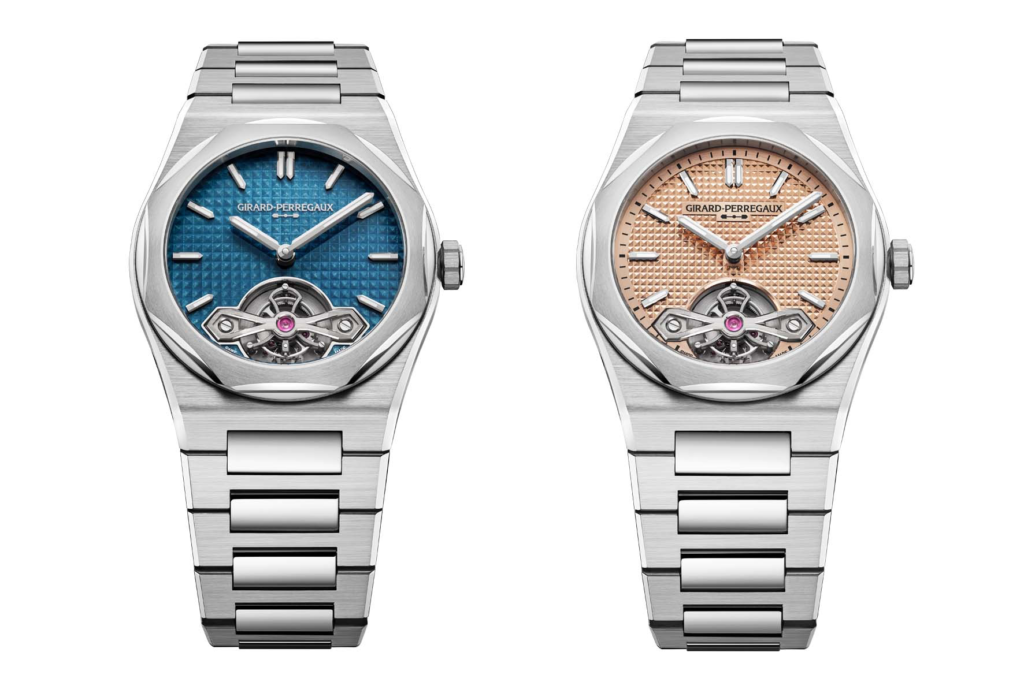
A year later, that model turned out to be less of an outlier than one might have expected: the 39 millimeter model has become a permanent fixture in the collection and now serves as the basis for the new Laureato Fifty Tourbillon Micro-Rotor, available in two dial variations: one in blue Grand Feu enamel and the other in 18-karat rose gold.
Dimensions and Case
The new model, which features a platinum and rose gold micro-rotor, brings back to the Laureato a design that is already part of the collection’s history: in 2017, the 45-millimeter Laureato Tourbillon already featured the GP09510 automatic caliber with a micro-rotor, a design element that has more recently been incorporated into the Laureato Three Gold Bridges as well.
Here, however, the design changes significantly, starting with the proportions: the case measures 39 millimeters in diameter and is only 10 millimeters thick, housing the new GP8410, an automatic movement that combines a lyre-shaped tourbillon cage with a micro-rotor made of platinum and rose gold.
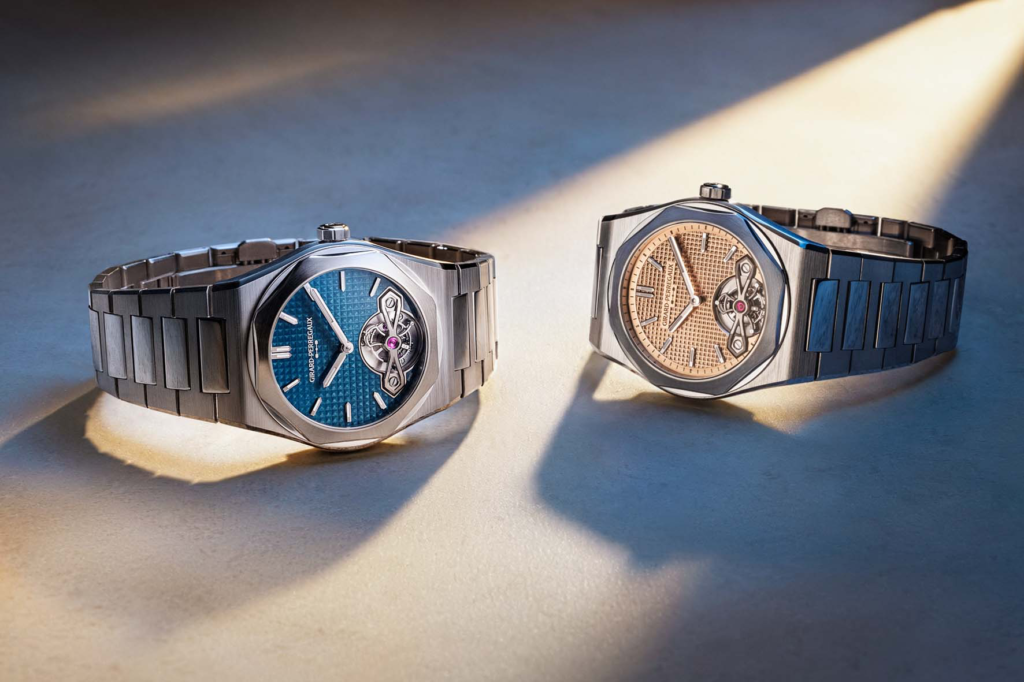
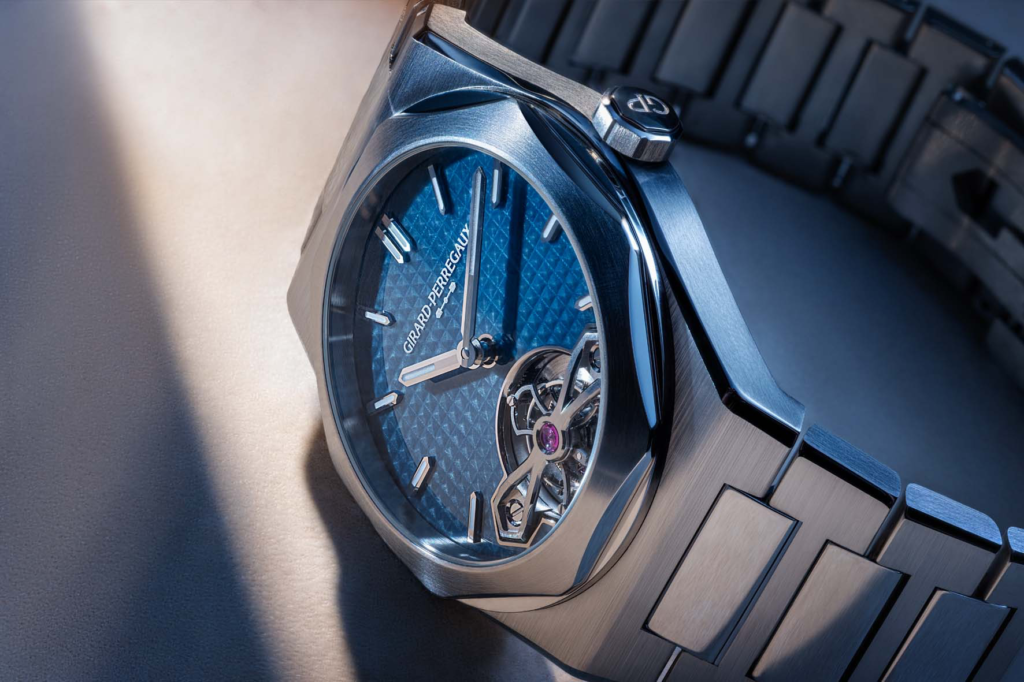
The octagonal bezel superimposed on the circular ring, the tonneau-shaped case, and the integrated bracelet remain the elements that immediately define the watch’s appearance, while its more compact dimensions bring it closer to the proportions of earlier generations.
The first Laureato, released in 1975, was, in fact, designed very differently from the large, sporty models with which the line would come to be associated in subsequent years: relatively slim and integrated, it was built around a high-frequency quartz movement and was recognizable above all for the precision of its design. A few years earlier, Girard-Perregaux had helped establish the 32,768 Hz standard, which is still used in quartz movements today.
The mechanical breakthrough came in 1995, when the third generation introduced the GP3100 in-house automatic movement; in 2003, however, the watch’s sporty character became more pronounced, with bolder proportions, while the 2016 generation clearly revived the original model’s proportions between the bezel, case, and bracelet. The Laureato Fifty, unveiled last year, seems to have marked another point of consolidation, and the new design has been well received. The subsequent introduction of the stainless steel versions further reinforced the impression that those proportions were particularly well-suited to the contemporary Laureato.
The Clous de Paris dial is available in two new versions
In the Laureato Fifty Tourbillon Micro-Rotor, the diameter therefore remains unchanged, while it is primarily the dial and the movement that elevate the watch into a realm more closely associated with the Maison’s Haute Horlogerie.
In the blue version, the Clous de Paris pattern forms the base of a white gold dial covered in translucent Grand Feu enamel, entirely crafted in-house using expertise that Girard-Perregaux traces back to the tradition of Jean-François Bautte, who was active in Geneva between the late 18th century and the first half of the 19th century and was a key figure in the Manufacture’s history. The translucent enamel allows the underlying Clous de Paris pattern to remain visible and accentuates its depth as the light changes.
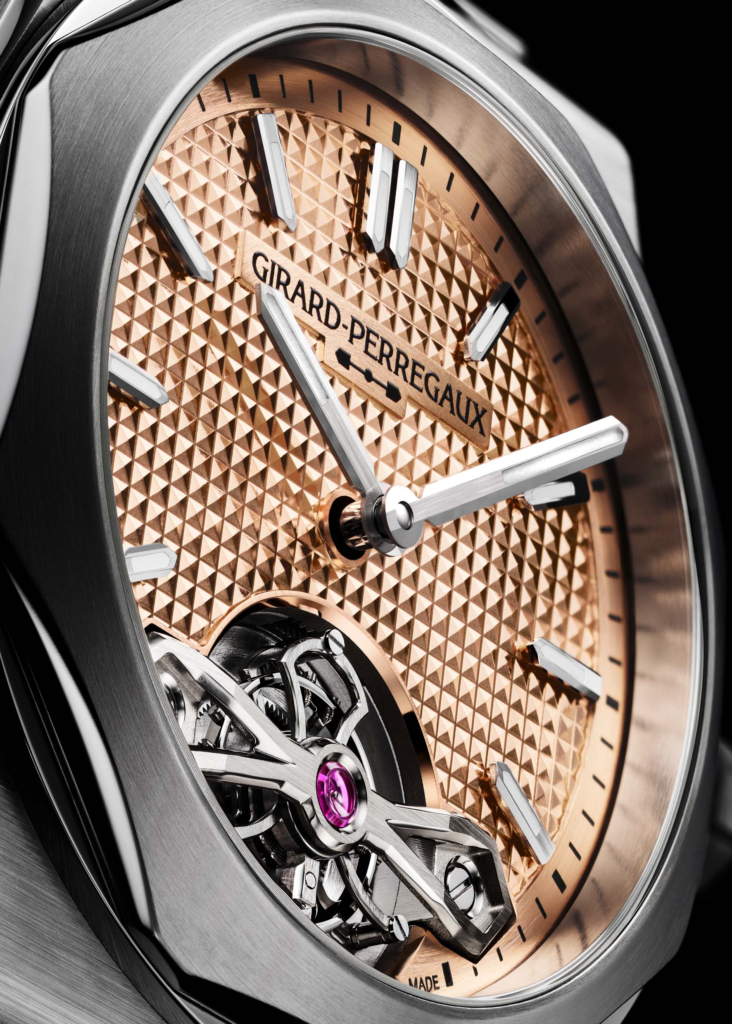
The second version, on the other hand, forgoes enamel and features an 18-karat rose gold dial, also finished with the Clous de Paris pattern. In both cases, the dial’s surface is set off by applied hour markers and 18-karat white gold baton-style hour and minute hands, featuring blue-emitting luminescent material that ensures readability without interfering with the decorative design.
The Movement: The New GP8410
The Clous de Paris pattern continues seamlessly onto the back of the watch: through the anti-reflective sapphire crystal case back, designed to reveal the entire movement, two large white gold bridges decorated with the same motif are visible, creating a rather unusual relationship between the front and back of the watch.
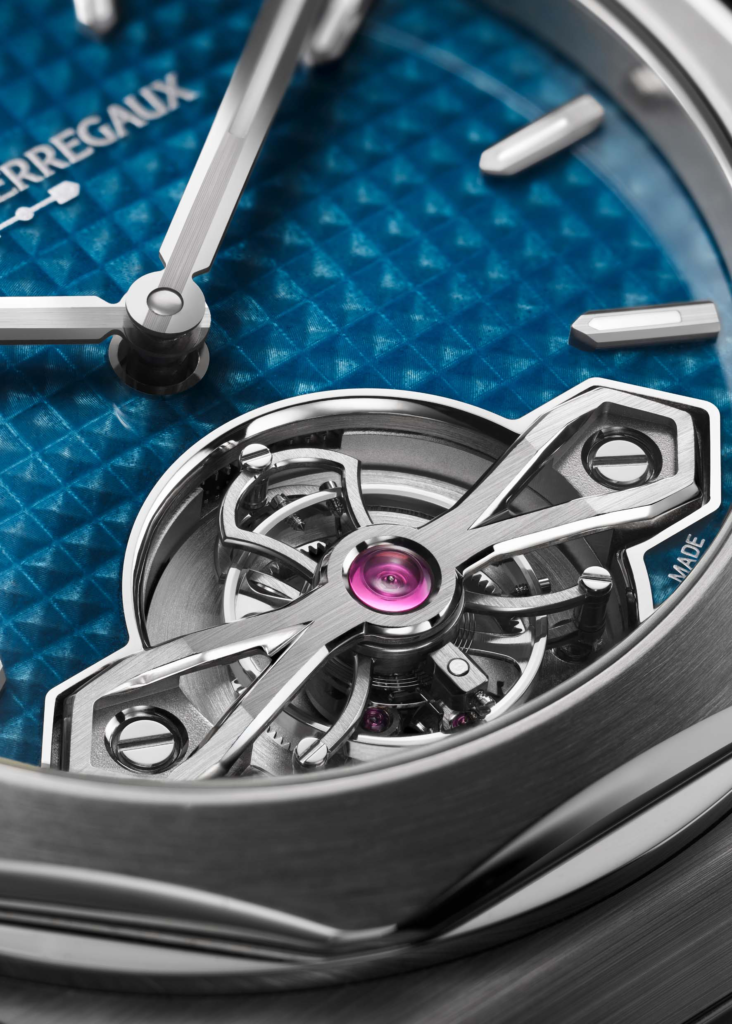
At the heart of this timepiece is the new GP8410, an in-house movement measuring 30.40 millimeters in diameter and 6.10 millimeters in thickness, comprising 207 components and 31 jewels, with a frequency of 21,600 vibrations per hour (3 Hz), and a 72-hour power reserve. Automatic winding is handled by a micro-rotor made of platinum and rose gold, whose geometry echoes Girard-Perregaux’s characteristic arrow shape and allows the winding system to integrate seamlessly into the movement’s architecture without obscuring the most interesting part of the mechanism.
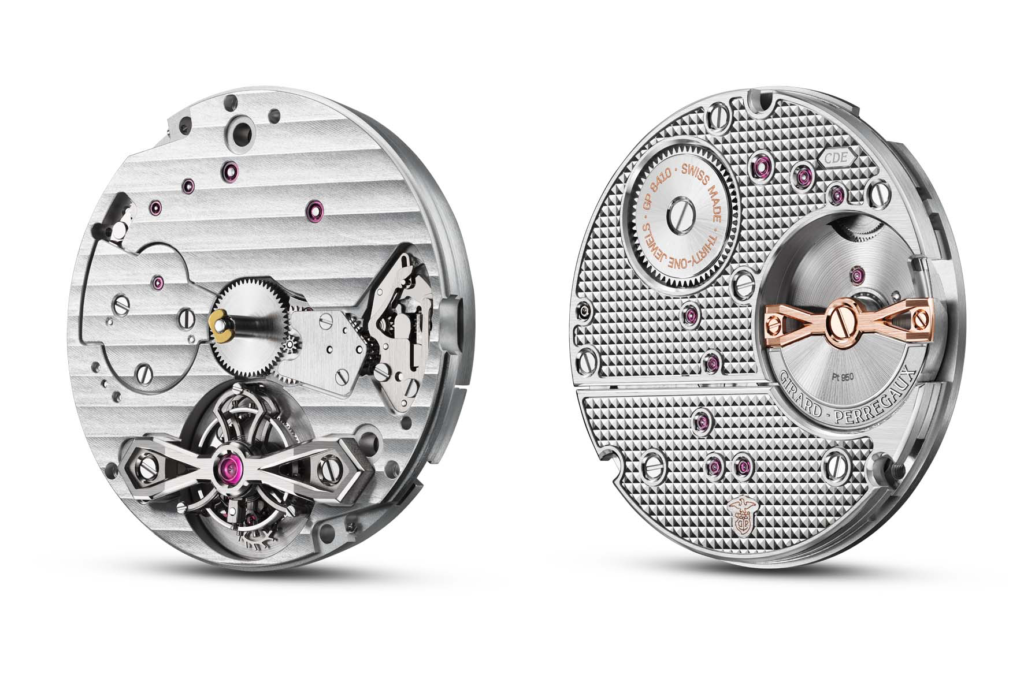
At the 6 o’clock position, the tourbillon naturally takes center stage. The lyre-shaped cage, which Girard-Perregaux has used since the 19th century, is surmounted by the distinctive arrow-shaped bridge, an element that directly references the Three Bridges designed by Constant Girard in 1867. At the time, the innovation lay in transforming a component that was normally secondary to the movement’s construction into one of its main design elements; over the decades, the bridge has become a technical and aesthetic hallmark of the brand, featured in the famous Tourbillon sous Trois Ponts d’Or and subsequently in numerous modern designs.
The new GP8410 also arrives at a time of particularly intense activity in the movement sector: Since September 2025, Girard-Perregaux has introduced four new calibers, ranging from the automatic GP4800 to the GP9620 designed for the Tourbillon with Three Golden Bridges, including the GP9530 minute repeater and the current GP8410. These projects, which vary greatly in architecture and complexity, provide a concrete measure ofthe investment the Maisonhas made in its manufacturing capabilities.
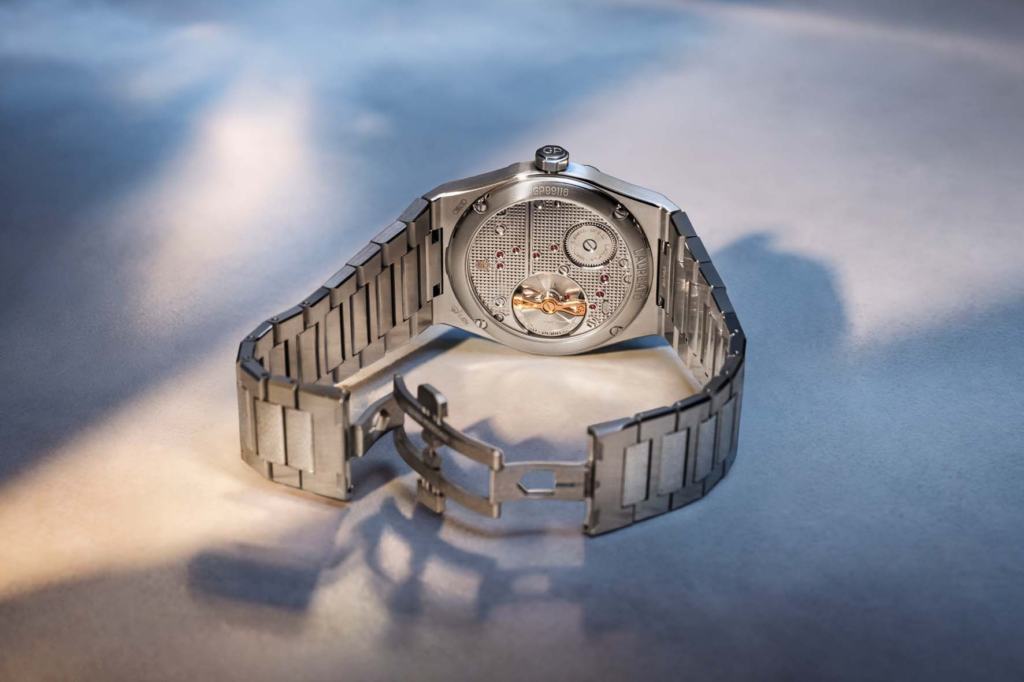
In the Laureato Fifty Tourbillon Micro-Rotor, this expertise is contained within dimensions suitable for everyday wear: the 39 millimeter diameter and 10 millimeter thickness are likely among the project’s most technically accomplished features, especially considering the presence of the tourbillon cage and the automatic winding mechanism.
The integrated stainless steel bracelet, redesigned for the Fifty generation, features a triple-fold clasp with micro-adjustment of up to 4 millimeters. The case is finished with anti-reflective sapphire crystal on the front and back and is water-resistant to 50 meters.
Will the 39mm Laureato Fifty be Girard-Perregaux’s new flagship model?
The new Laureato brings together many of the specialties in which Girard-Perregaux excels and which, for decades, have been among its key strengths: enamel, the tourbillon, the micro-rotor, and bridgework. All of this is embodied in a watch that, when worn on the wrist, continues first and foremost to appear as a classic Laureato, because the complication did not require altering the proportions or overloading the design with additional elements.
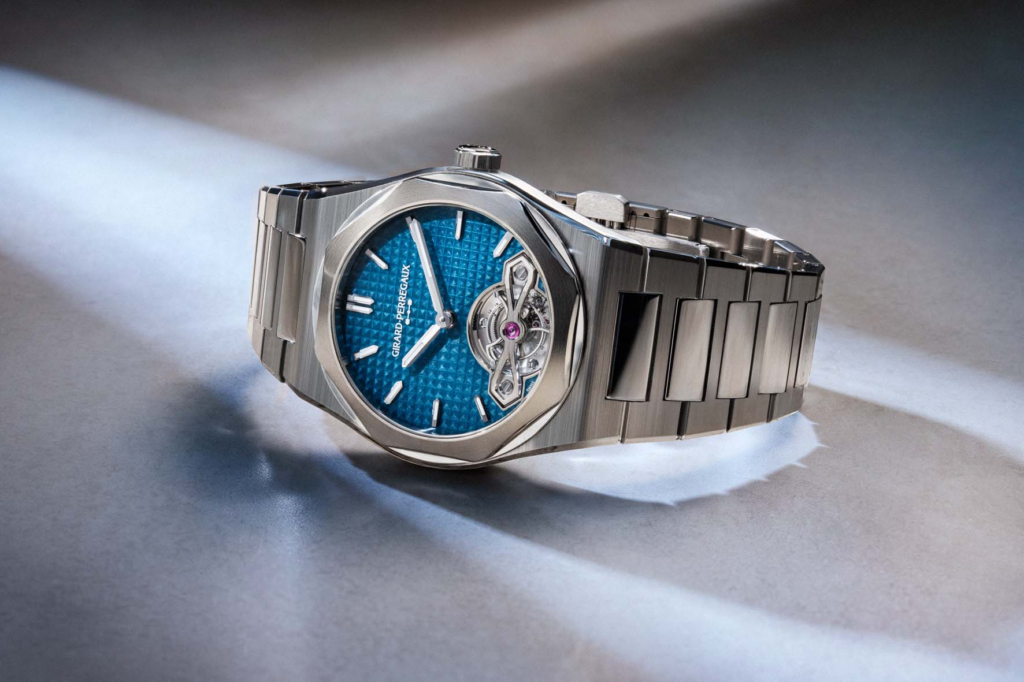
Fifty years after the original model, the 1975 design still seems to have enough capacity to support a much more complex mechanical system than the one for which it was originally conceived.
Are you looking for the perfect gift? Explore our online store and discover the entire collection signed IWS – Italian Watch Spotter!
For all real-time updates on the world of watchmaking follow us on Instagram and visit our Youtube channel.