
With the launch of the Constellation Observatory, OMEGA is taking a decisive step, introducing a new frontier in the pursuit of precision and reaffirming the central role of a collection that has been an absolute benchmark for more than seven decades.
To fully understand the scope of this evolution, it is necessary to take a step back. In 1948, OMEGA introduced the Centenary, the first chronometer-certified automatic wristwatch. Four years later, in 1952, the Constellation was born: the first mass-produced collection composed exclusively of chronometers. From its earliest expressions, the Constellation is distinguished by a strong technical and aesthetic identity.

Vintage advert of the Omega Constellation De Luxe ref. OT2930
The evolutionary path of the collection unfolds through milestones. Between the late 1990s and the first decade of the 2000s, the introduction of the Co-Axial escapement marks a structural breakthrough, reducing friction between components and significantly improving long-term running stability. At the same time, the company invested in the development of antimagnetic movements through the use of silicon and innovative alloys, paving the way for ever-higher performance standards.
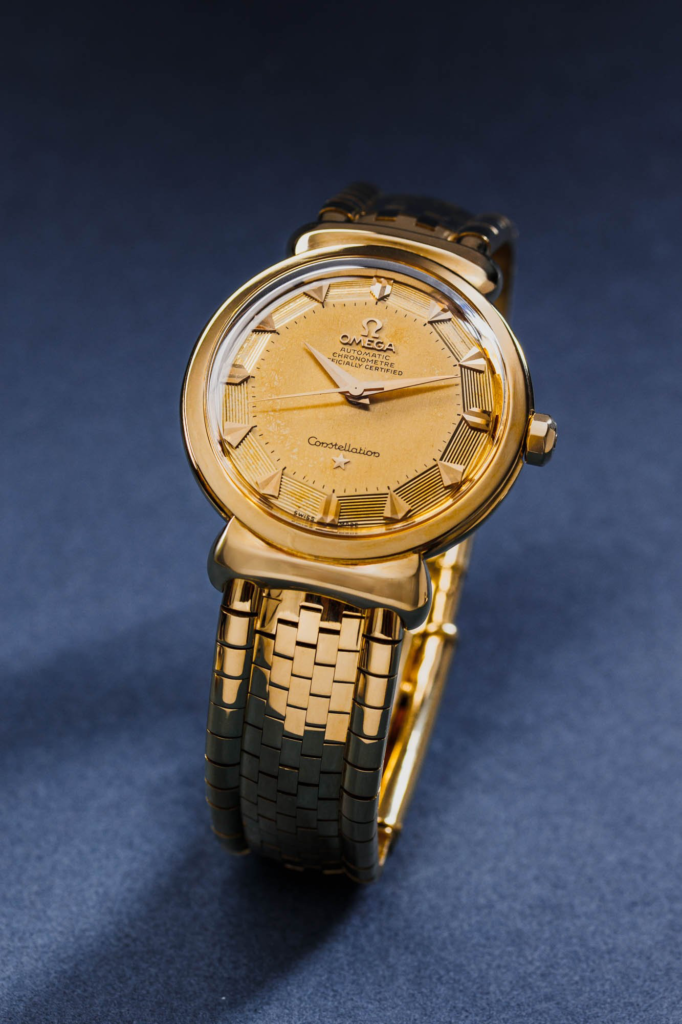
Omega Constellation De Luxe ref. OT2930 | Credits: Amsterdam Watch Company
In 2015, with the Globemaster, OMEGA ushers in the era of the Master Chronometer in collaboration with METAS, introducing a certification that integrates precision, resistance to magnetic fields and water resistance. In 2023, the creation of the Laboratoire de Précision, an independent facility accredited to international standards, enables the development of new testing methodologies and takes research to an even more advanced level.
Constellation Observatory
It is from this context that the Constellation Observatory was born, a collection that masterfully synthesizes aesthetic tradition and advanced engineering. The proportions of the 39.4 mm case dialogue with iconic stylistic elements such as the dodecagonal “pie-pan” dial (crafted with high-precision guilloché work) and Constellation star at 6 o’clock, facetted Dauphine hands, applied hour markers , and clearly vintage-inspired “dog-leg” lugs.

The Constellation Observatory collection with 9 new models
The Observatory medallion on the case back explicitly recalls the history of the collection, while the technical execution reflects extremely high contemporary standards. The result is a coherent formal language in which every detail contributes to building a narrative of continuity and innovation.


The heart of the revolution introduced by the Constellation Observatory lies in the certification system. For the first time in the history of watchmaking, a two-handed watch achieves Master Chronometer certification. This achievement is made possible by Dual Metric Technology, a methodology developed by the Laboratoire de Précision that is based on acoustic analysis of the movement.

The Constellation Observatory collection with 9 new models
Through an autonomous, wireless test unit, the system continuously records the sound signal generated by the ticking, while built-in sensors simultaneously monitor environmental parameters such as temperature, pressure, position, and magnetic fields along a 25-day cycle. Data collection takes place from the very first moment, generating a constant, high-resolution stream that allows any frequency variation to be precisely identified and its causes analyzed. This dynamic readout capability represents a qualitative leap in watchmaking metrology, enabling an extremely thorough understanding of movement behavior.
The new calibers: 8915 and 8914
Supporting this technical architecture are the new Master Chronometer 8915 and 8914 calibres, designed to provide certified precision, running stability and resistance to magnetic fields.
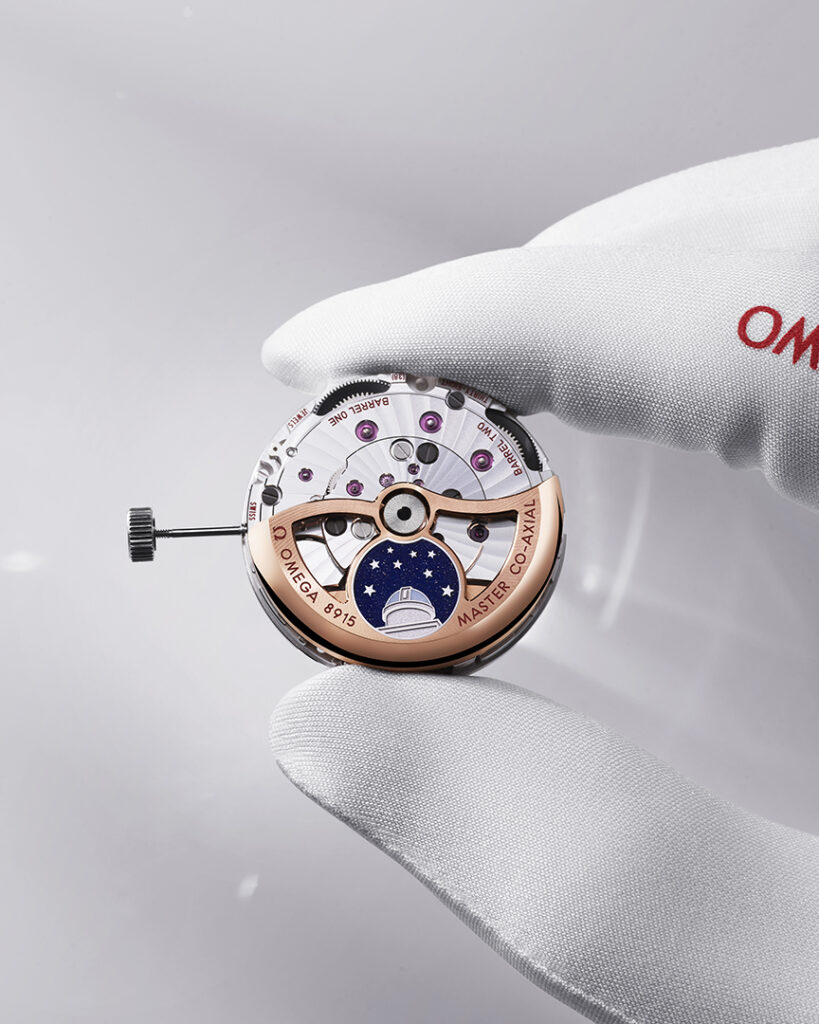
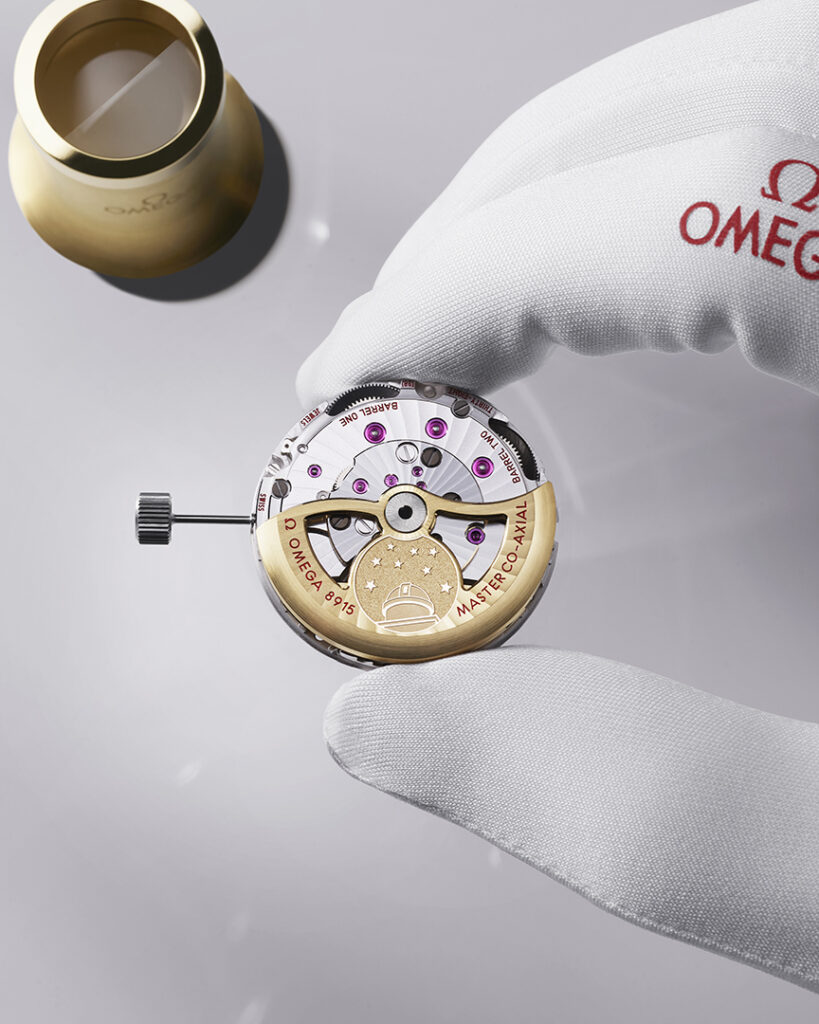
Caliber 8915 in Grand Luxe and Luxe versions used for platinum, Sedna™ gold and Moonshine™ 18K models
Caliber 8915 (Grand Luxe and Luxe), intended for precious metal versions, is distinguished by a refined construction with a skeletonized rotor, polished and satin-finished finishes, and guilloche Côtes de Genève decoration. The use of 18K Sedna™ and Moonshine™ gold, combined with advanced machining such as laser engraving and enameled details, gives the movement an aesthetic dimension of the highest level.

The 8914 caliber used for models in O-MEGASTEEL
Caliber 8914, designed for O-MEGASTEEL references, retains the same technical architecture, declined through a more essential rhodium-plated finish, without compromising on performance.
Conclusions
With the Constellation Observatory collection, OMEGA redefines the very concept of precision, turning it into a continuously observable phenomenon that can be analyzed in depth. The combination of innovation, advanced certification, materials engineering and stylistic consistency propels the Constellation collection into a new dimension, in which each component contributes to building an evolved vision of watchmaking excellence.
The prices of the new collection are respectively: 10,700€ for the steel references. 12,000€ also in steel with black dial. 37,300€ for Sedna and Moonshine gold models(58,200€ in Moonshine gold with mesh bracelet). Whereas 43,400€ in Canopus gold and 56,900€ the gold/platinum alloy version.
Are you looking for the perfect gift? Explore our online store and discover the entire collection signed IWS – Italian Watch Spotter!
For all real-time updates on the world of watchmaking follow us on Instagram and visit our Youtube channel.