
Just a record-breaking auction? Not really. It was a manifesto, almost a “topography” of contemporary collecting. Against a macroeconomic backdrop still marked by volatility and capital reallocations, Sotheby’s Hong Kong closed at HK$414,232,320 (US$52.9 million), setting the highest total ever recorded for a watch sale in the history of the reality and, more importantly, the largest ever held in Asia.
The figure, in isolation, is impressive. Placed in the operational context of the sale, it becomes even more significant: 13 hours of continuous auction, more than 800 active bidders from more than 50 countries, a 50 percent increase in participation over the previous season, 97 percent of lots sold and more than half over the high estimate. It’s an extremely sharp snapshot of the current state of the market.
Let’s look together at all the lots that made this auction unique!
The Shapes of Cartier
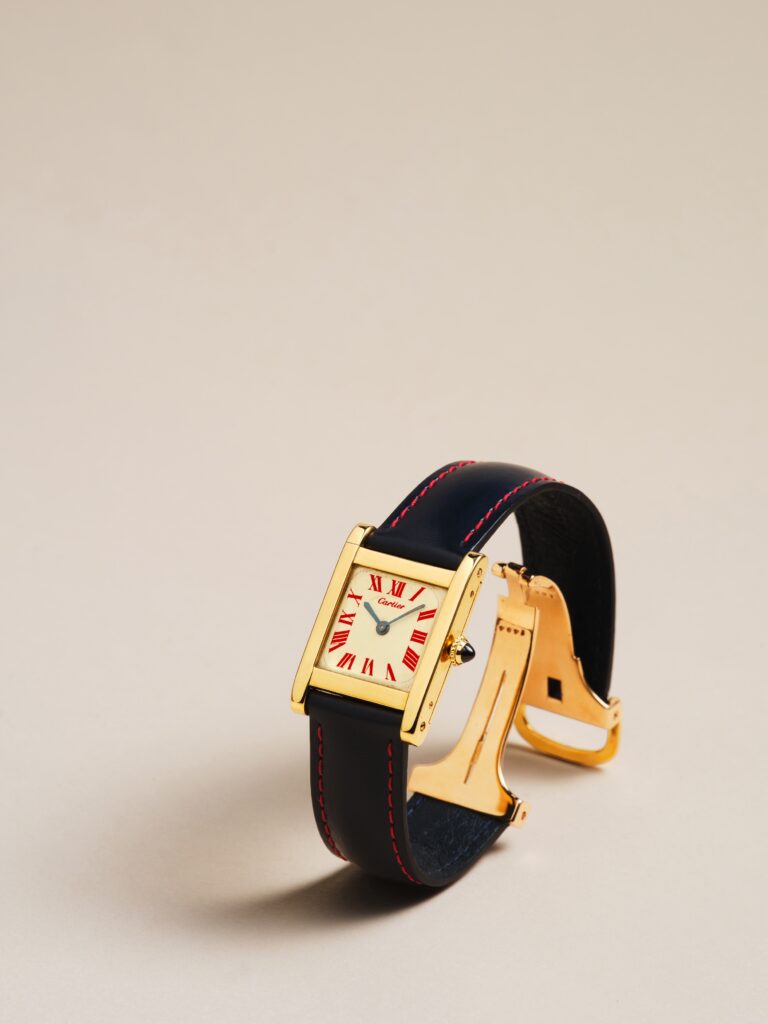
The real driving force behind the auction was the launch of the collection “The Shapes of Cartier: The Finest Vintage Grouping Ever Assembled,” a selection of 82 watches that totaled HK$108 million (US$13.8 million) against an estimate of HK$15-23 million, resulting in a more than sevenfold increase and a 100% sell-through rate.
The most interesting fact is not so much the performance itself, but its nature. It’s not a collection of isolated pieces of high quality, but a coherent corpus, structured around a precise historical moment: the experimental era of Cartier London and, more generally, the season of so-called form watches between the 1960s and 1970s.
In terms of auction dynamics, this operation had three measurable effects. It has increased the average competition time per lot, broadened the bidder base, and pushed multiples over estimates to levels rarely observed so systemically.
Cartier London Crash 1987: anatomy of a record
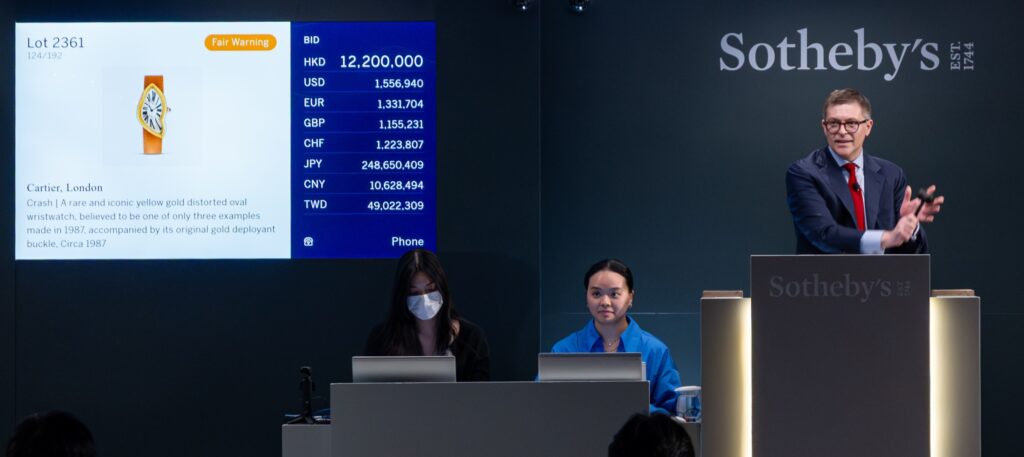
The reference lot of the sale was the Cartier London Crash in yellow gold, circa 1987, which fetched HK$15,616,000 (US$1,993,539), more than double the maximum estimate set at HK$6 million .
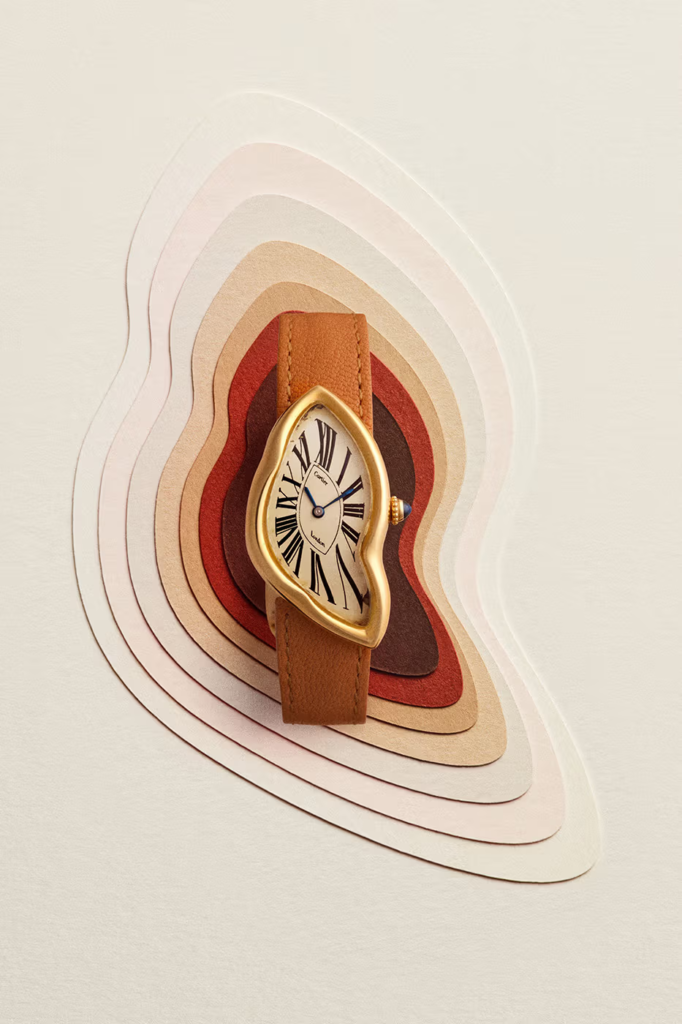
From a technical point of view, the Crash represents a unique case in the history of watch design. The case, derived from an asymmetrical deformation of the oval, deliberately breaks with all logic of classical symmetry. The 1987 example is part of an extremely limited production: less than a dozen pieces for the original series (1967-1970) and only three known examples for that specific year.
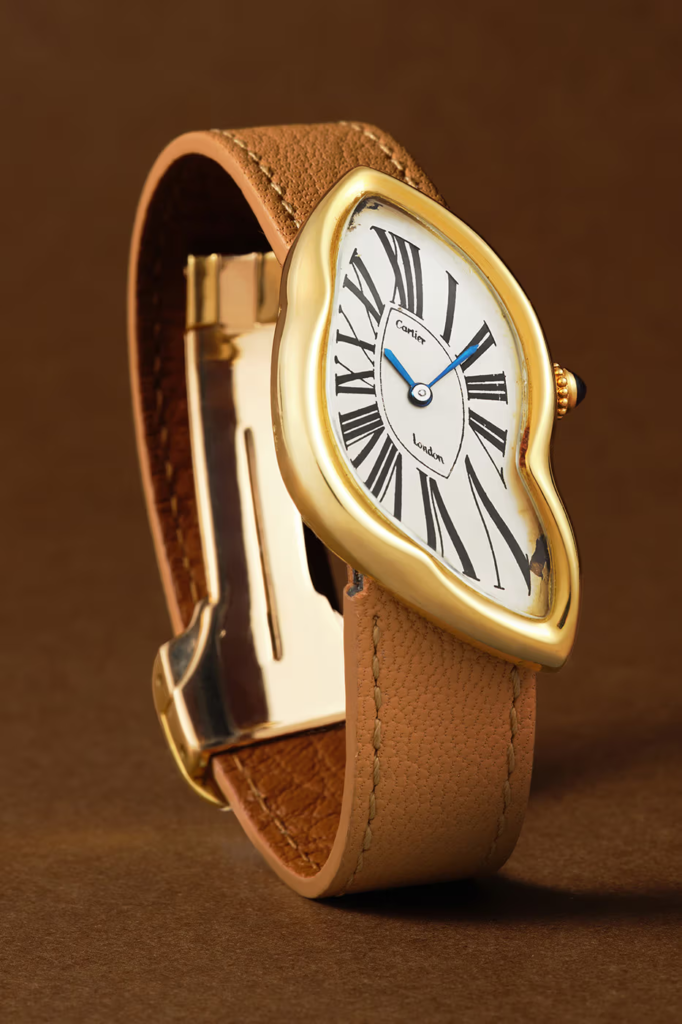
The competitive dynamic was equally relevant: nine minutes of bidding between the room, phones and digital platforms. Purchased by a private Japanese collector, the watch set a new record as the most expensive Cartier wristwatch ever sold at auction.
The leverage effect on other Cartier references
If Crash represented the symbolic apex, the rest of the collection demonstrated equally significant depth.
The Cartier London Tank J.J.C. Allongée in white gold, circa 1992, reached HK$5,760,000 (US$735,322) from an estimate of HK$320,000-480,000. The reference, characterized by extremely elongated proportions and limited production, represents one of the most radical interpretations of the Tank.

Tank Normal London, circa 1967-68, stood at HK$4,608,000 (US$588,257), while a 1973-74 Baignoire London reached HK$4,864,000 (US$620,938). Both results set new benchmarks for their respective types.
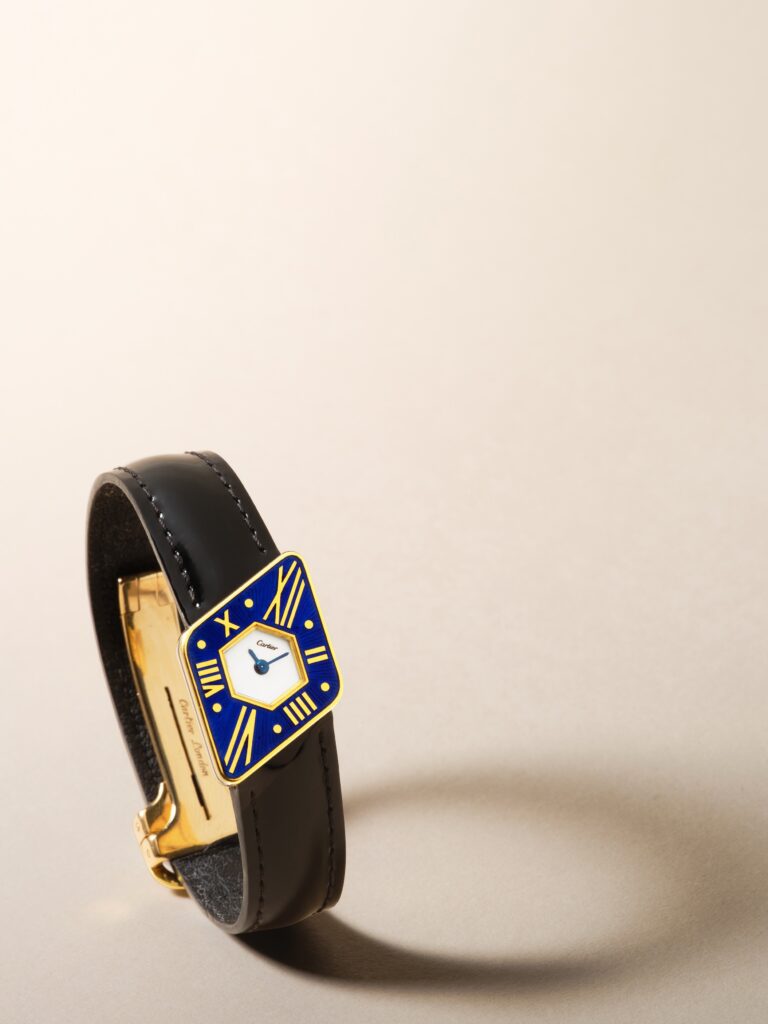
Particularly telling is the case of the Cartier London Asymmetric in yellow gold with blue enamel, circa 1973-74, which sold for HK$6,656,000 (US$849,705) against a maximum estimate of HK$650,000. The specimen belongs to an extremely limited production run, with only five enameled pieces documented for that period.
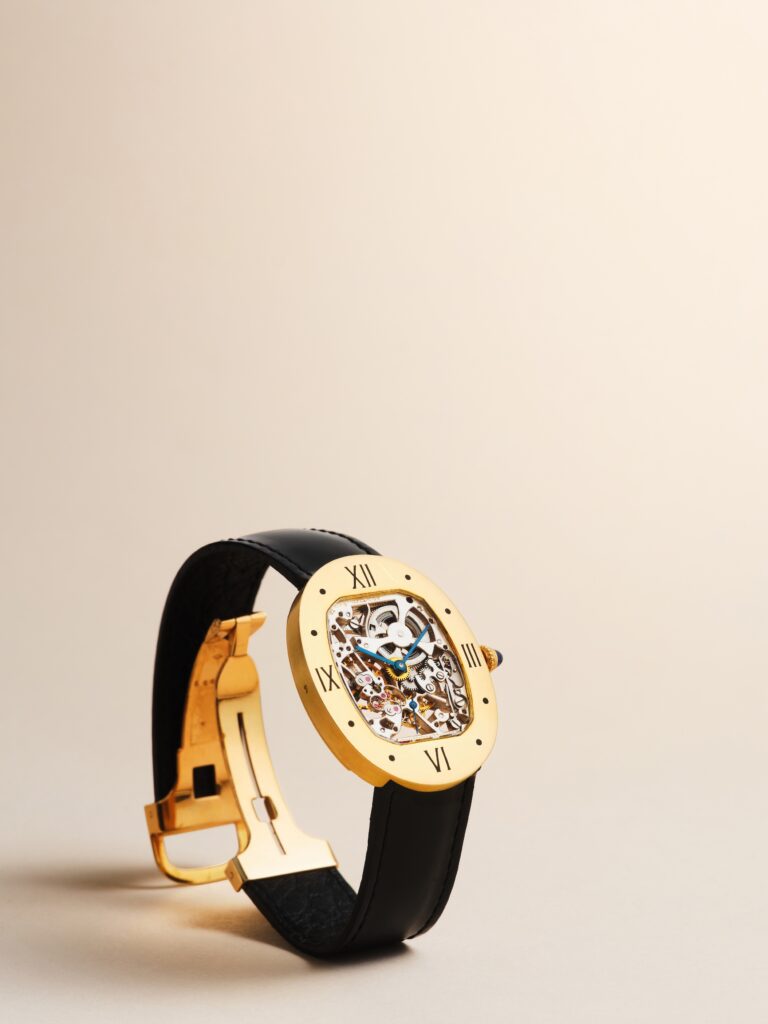
A further peak is seen with the Cartier Paris oval skeleton in yellow gold, which sold for HK$7,424,000 (US$947,748) from an estimate of HK$400,000. The leverage here is not only rarity, but also the technical complexity of the skeleton movement and the aesthetics typical of Paris production.
Patek Philippe
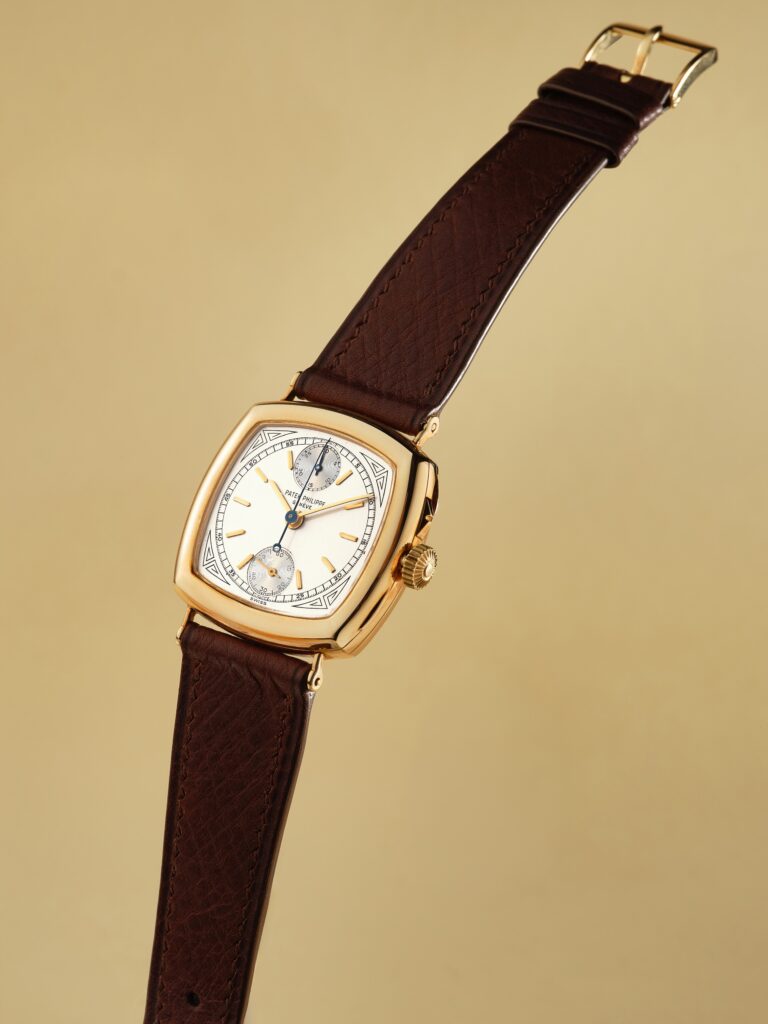
In the Patek Philippe segment, the most notable lot was a 1924 yellow gold single-pusher chronograph, which sold for HK$15,360,000 (US$1,960,858). Its importance stems from two main factors: it belongs to the first year of production of the house’s wrist chronographs and it has a Tiffany & Co. provenance, an element that introduces an additional commercial and historical dimension.
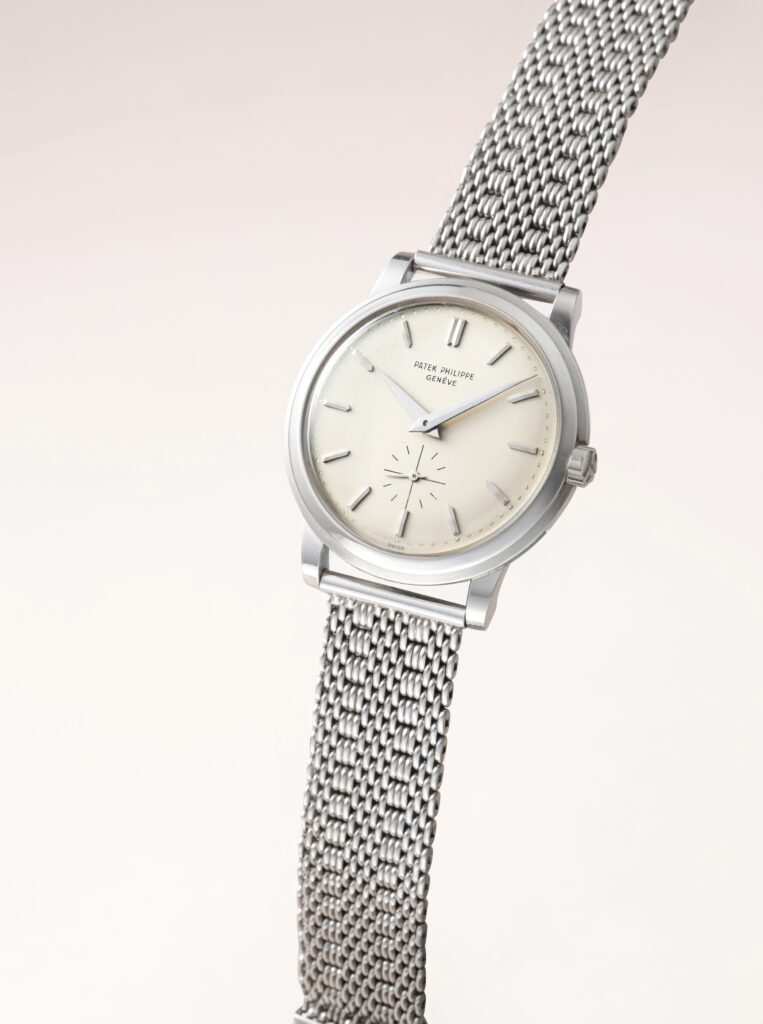
Even more sophisticated, from a collecting point of view, the Patek Philippe Ref. 2552 “La Maison Platine”, sold for HK$6,016,000 (US$768,003). With only nine known examples in platinum and a single sale documented through Cartier New York, this model represents an emblematic case of the intersection of manufacturing rarity and selective distribution.
German haute horology and independent
The A. Lange & Söhne Tourbillon Pour le Mérite, ref. 701.007, reached HK$10,368,000 (US$1,323,579), far exceeding the maximum estimate of HK$2.4 million. The model, equipped with chain drive and fusée, is produced in less than 20 pieces, a feature that places it among the rarest complications in Lange’s modern production.

In the context of independents, the Daniel Roth Tourbillon Skeleton from the 1990s set a new record for the brand at HK$6,784,000 (US$866,045). The double-ellipse case and fully skeletonized movement embody the brand’s philosophy, now significantly reevaluated by the market.
Cross-cutting dynamics: the “minor” lots
One of the most remarkable aspects of the sale concerns the performance of the so-called secondary lots. A walnut-shaped yellow gold watch reached HK$960,000, or 16 times the top estimate, while an Art Deco clip watch in gold and black enamel totaled HK$768,000, about 10 times the estimate.
These auction results are not marginal. They indicate an extension of demand toward highly idiosyncratic objects, in which value is determined more by formal and narrative singularity than by traditional parameters such as complication or brand.
Conclusion
The sale highlights three structural phenomena. The first concerns the depth of the market, with an average of eight bidders per lot suggesting a widespread level of competition. The second is the growing importance of selection/curation, capable of transforming a sale into a cultural and market event simultaneously. The third is the redefinition of the concept of value, less and less anchored in isolated technical metrics and increasingly linked to rarity, provenance and narrative.
The temptation is to dismiss this auction result as an exceptional record, the child of unrepeatable conditions. A closer reading suggests otherwise. This auction functions as an anticipatory indicator: it shows where global collecting capital is heading and which categories of objects are taking a central role in the construction of value.
If a Cartier Asymmetric can exceed its estimate tenfold and a Lange Tourbillon quadruple expectations, the question is no longer how much a watch is worth. The point is to figure out who is willing to compete to own it, and why. That is where the real price of contemporary luxury is being formed.
Are you looking for the perfect gift? Explore our online store and discover the entire collection signed IWS – Italian Watch Spotter!
For all real-time updates on the world of watchmaking follow us on Instagram and visit our Youtube channel.