
In Monterey, California, two worlds accustomed to transforming materials, movement, and time into collectible objects have found common ground. Louis Vuitton and Singer have thus created a groundbreaking automotive project, born from the union of the Maison’s savoir-faire and that almost obsessive attention to details that has made Singer a benchmark in contemporary Porsche culture.
There are two stars of the show. A Porsche 911 Reimagined by Singer – Classic, instantly recognizable by its saffron and cobalt blue livery developed with and for Louis Vuitton, and a Porsche 911 Reimagined by Singer – Classic Turbo, a convertible designed by Nicolas Ghesquière, Creative Director of Louis Vuitton’s Women’s Collections, in the refined Calcaire Lutétien white shade.

Porsche 911 Reimagined by Singer – Classic & Turbo | Credit: Singer Vehicle Design x Louis Vuitton
At first glance, one’s attention is inevitably drawn to the proportions, the colors, and the extraordinary presence. Then something familiar happens to those who truly love well-crafted objects: the gaze draws closer, slows down, and begins to search.
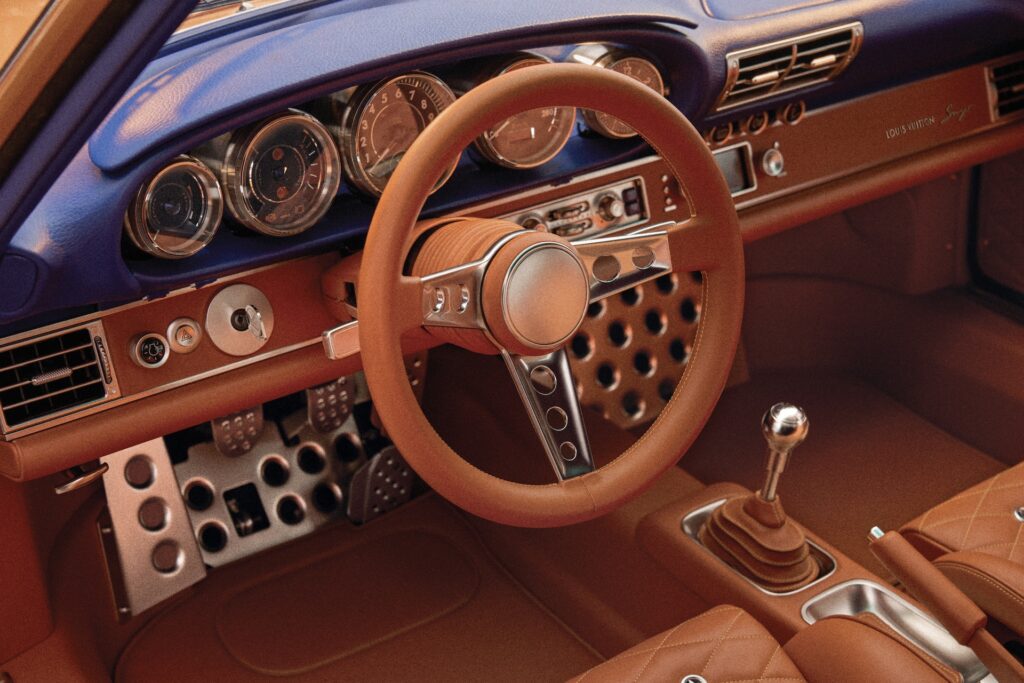
A knurled finish evokes watchmaking; the embossed pattern on the seats brings to mind the interior of a Louis Vuitton trunk; the wood recalls the decks of classic runabouts; and even the gearshift knob features a nod to the Noé bag. These details are revealed one by one and demonstrate just how thoroughly the design has been thought through. Fashion, luggage, leather goods, watches, and automotive culture all come together in the same cabin.
And, interestingly enough, the story of these two 911s begins with a watch.
A Tambour in the dashboard: the origins of the Louis Vuitton x Singer project
The initial request was specific: to develop a dashboard clock for a car reimagined by Singer. The project was entrusted to the Swiss ateliers of La Fabrique du Temps Louis Vuitton, and that small mechanical object, initially intended to occupy just a few centimeters of the car’s interior, soon became the seed of the entire collaboration.
From there, the project evolved, gradually incorporating every component of the car and bringing together Louis Vuitton’s expertise in leather goods and watchmaking with Singer’s craftsmanship. Techniques, materials, and design codes developed by the Maison thus venture into completely new territory, translated through the language of automotive design without losing their identity.
Credit: Singer Vehicle Design x Louis Vuitton
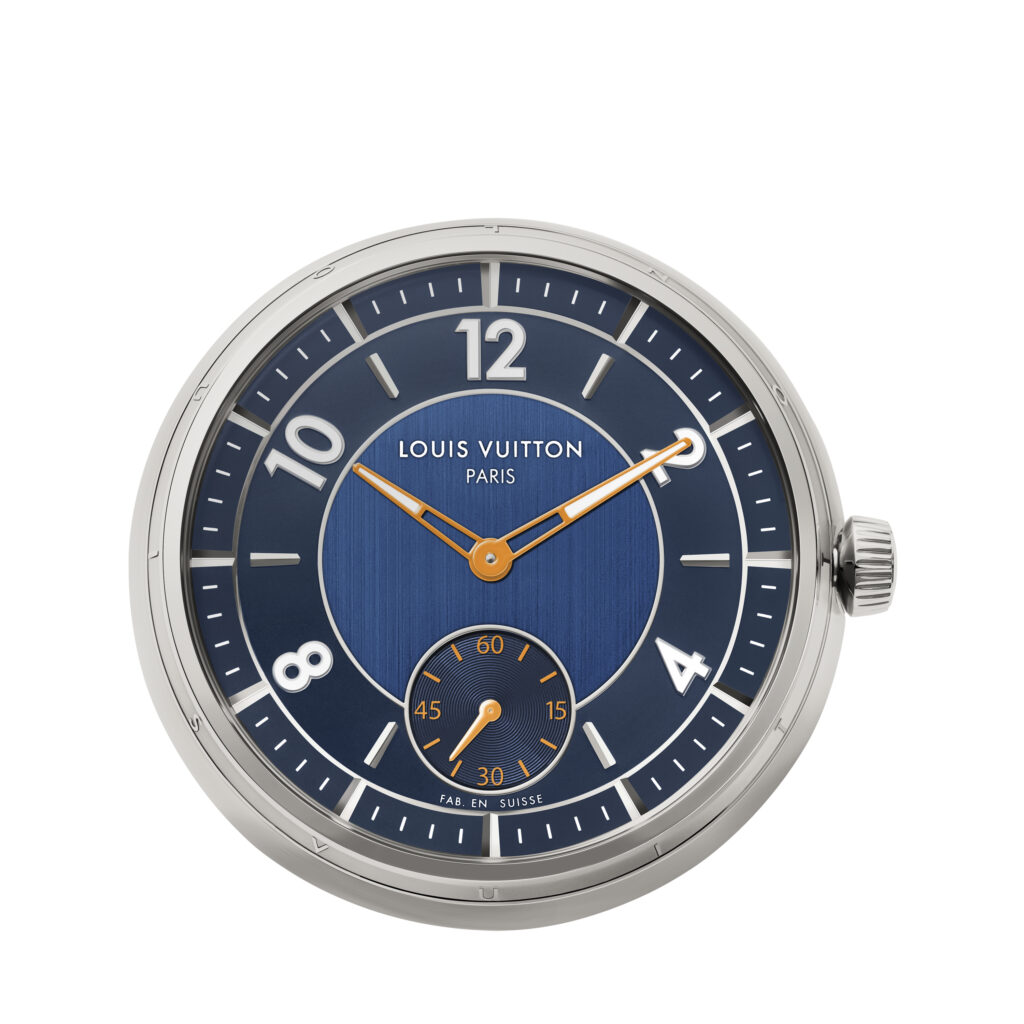
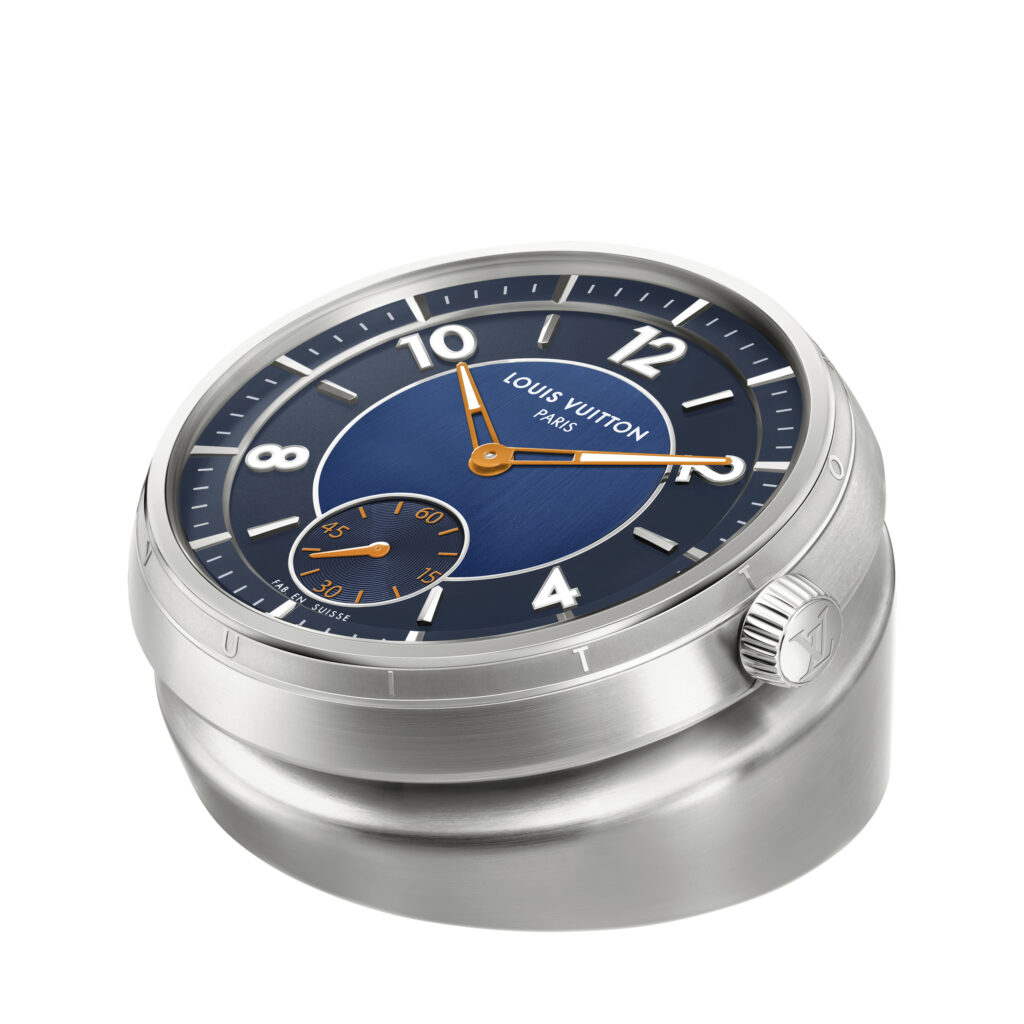
At the center is the mechanical timepiece from which it all began. Integrated into the dashboard, it can be removed from the car and used as a table clock, retaining the character of a true collector’s item even when away from the 911. The model is the Tambour: the shape of the case immediately reveals its connection to the 911, as do the twelve polished and engraved letters that spell out the name LOUIS VUITTON on the bezel.
Credit: Singer Vehicle Design x Louis Vuitton
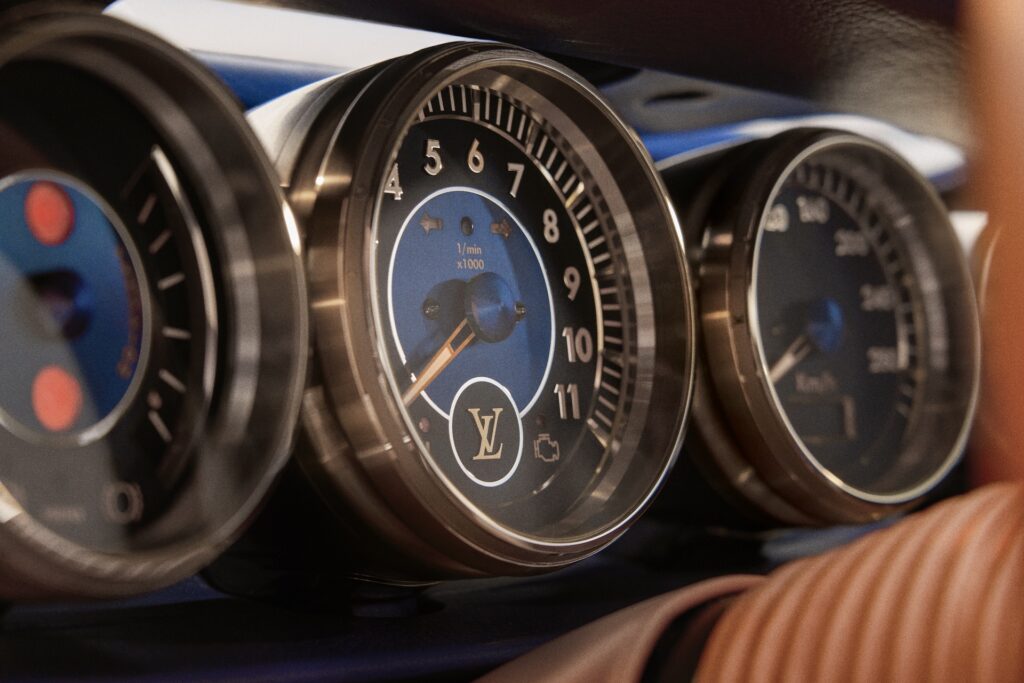
Once installed in the cockpit, the Tambour inevitably ends up transforming its surroundings. The speedometer, tachometer, and gauges are redesigned according to the same design language, turning the instrument cluster into a cohesive whole. It’s a particularly fascinating transition for those familiar with watchmaking: the design language born on the scale of a few millimeters on a watch face is expanded to define the driver’s seat of a 911.
The work takes a full year to complete. Louis Vuitton’s designers have reimagined the hands, dial markers, and hour markers, incorporating some of the Tambour’s most recognizable elements into the timepieces. Cobalt blue spans the dials, while the bright orange markings provide the contrast needed for easy readability.
Credit: Singer Vehicle Design x Louis Vuitton
The collaboration also sets a precedent for both brands: this is the first time Louis Vuitton and Singer have co-created a product. It’s a significant move, especially considering how much both brands have built their identities on the recognizability of their respective design codes.
From that first watch, the project has finally evolved into these two cars. The coupe, reimagined through Singer’s Classic services, embodies the most intense and graphic expression of the Louis Vuitton universe; the convertible, reimagined through Singer’s Classic Turbo services, instead celebrates light, travel, and that quintessentially Californian sense of freedom that naturally accompanies an open-top 911.
The car thus becomes part ofLouis Vuitton’s Art de Vivre as a personal space to inhabit, drive, and take with you. A place where materials, objects, and gestures speak to the owner with the same intimacy as a trunk packed for a journey.
Porsche 911 Reimagined by Singer – Classic
The first 911 makes its purpose clear right away. The saffron and cobalt blue paint scheme complements a specially designed roof rack, ready to hold a suitcase, a surfboard, or a pair of skis. It’s one of those setups that makes you want to hit the road even before you’ve decided where to go.
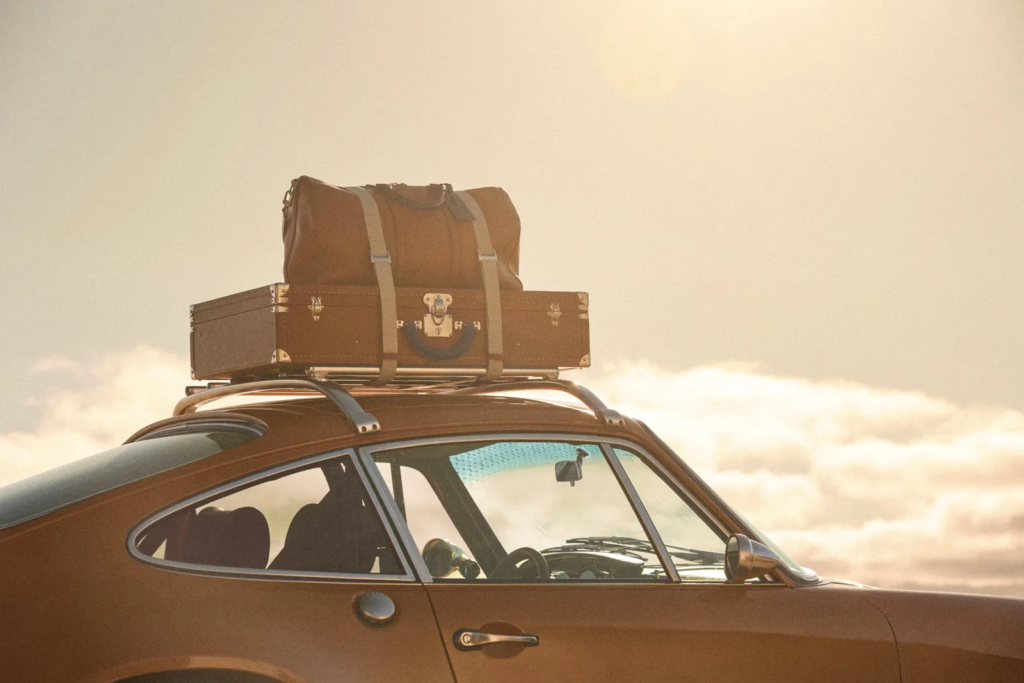
Porsche 911 Reimagined by Singer – Classic | Credit: Singer Vehicle Design x Louis Vuitton
The silhouette retains all the purity and presence of a 911 reimagined by Singer. The most subtle pleasure, however, comes as you get closer. Almost every design choice has a specific lineage, and tracing it becomes part of the experience.
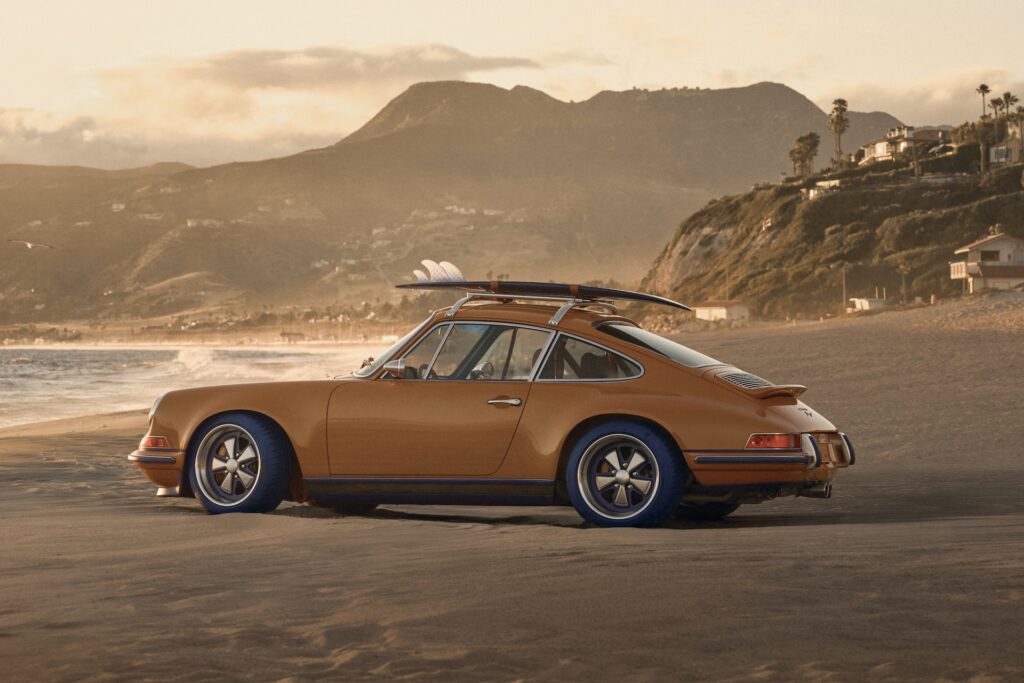
Porsche 911 Reimagined by Singer – Classic | Credit: Singer Vehicle Design x Louis Vuitton
Saffron has been a recurring theme in the Louis Vuitton archives for over a century and a half and has defined the Maison’s packaging for more than twenty years; in the Singer universe, it meets Bahama Yellow, a shade linked to the Californian atelier’s earliest commissions. Two seemingly distant color stories that, on the body of the Classic, seem as though they’ve always belonged together.
Cobalt blue, on the other hand, harks back to 1924, when Louis Vuitton created travel trunks for Citroën featuring interior reinforcements already finished in this shade. Paired with saffron, it creates a combination deeply rooted in the Maison’s heritage, complemented by the bright yellow of the saddle-stitch detailing that runs across the leather goods and trunks.
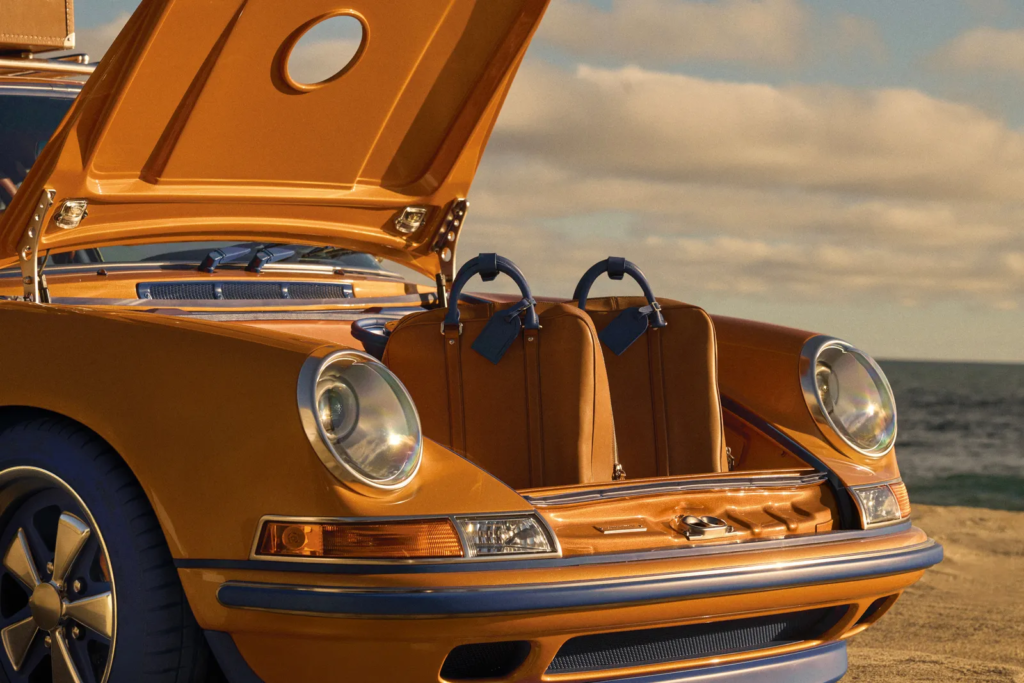
Porsche 911 Reimagined by Singer – Classic | Credit: Singer Vehicle Design x Louis Vuitton
Even motorsports find their way into the color palette. Starting with the 1900 Gordon Bennett Cup, national colors became an instantly recognizable way to identify the cars in the race. On the Classic, that heritage is reimagined with a decidedly contemporary freedom: the tires are dyed cobalt blue, echoing the handles and ribbons of Louis Vuitton packaging. A bold, almost brazen choice that, on a car like this, surprisingly manages to look natural.
Then there’s one of those details that brings a little satisfaction to those who love hunting for hidden signatures. You have to get up close to the rear engine air intake grille and look at it carefully: within its design, the initials “L” and “V” become part of the pattern itself. They’re almost imperceptible at first glance.
Once you find them, though, it’s impossible to stop seeing them.
The 911 and Louis Vuitton Leather Goods: A Blend of Influences and Experimentation
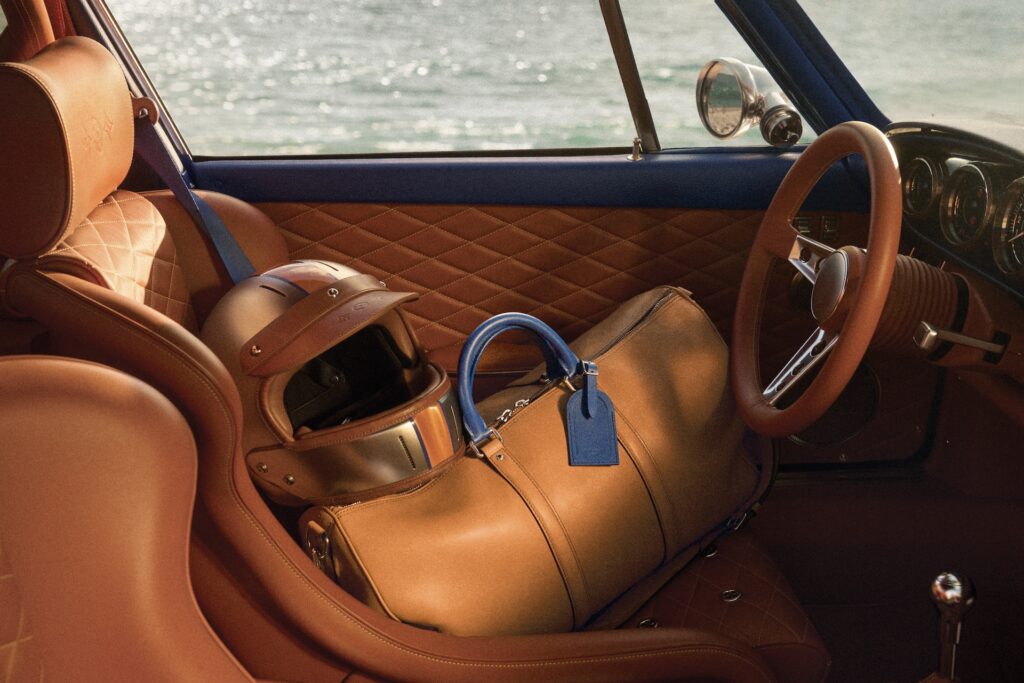
The interior is entirely upholstered in a natural-toned leather inspired by VVT, one of the most iconic leathers in the Louis Vuitton universe, which has always been associated with the handles, shoulder straps, trim, and labels of the brand’s luggage and canvas-lined bags. It is a material that is instantly recognizable as part of the Maison’s heritage, distinguished as much by its color as by the way it develops character and a patina over time.
For the seats, Louis Vuitton’s artisans paid particular attention to the appearance, shades, and texture of the leather, ensuring it harmonized with the VVT-inspired upholstery and conveyed the same sense of naturalness inside the 911. The execution was then entrusted to the specialists at Singer, who were tasked with translating this precise sensibility for materials into the construction of the interior.
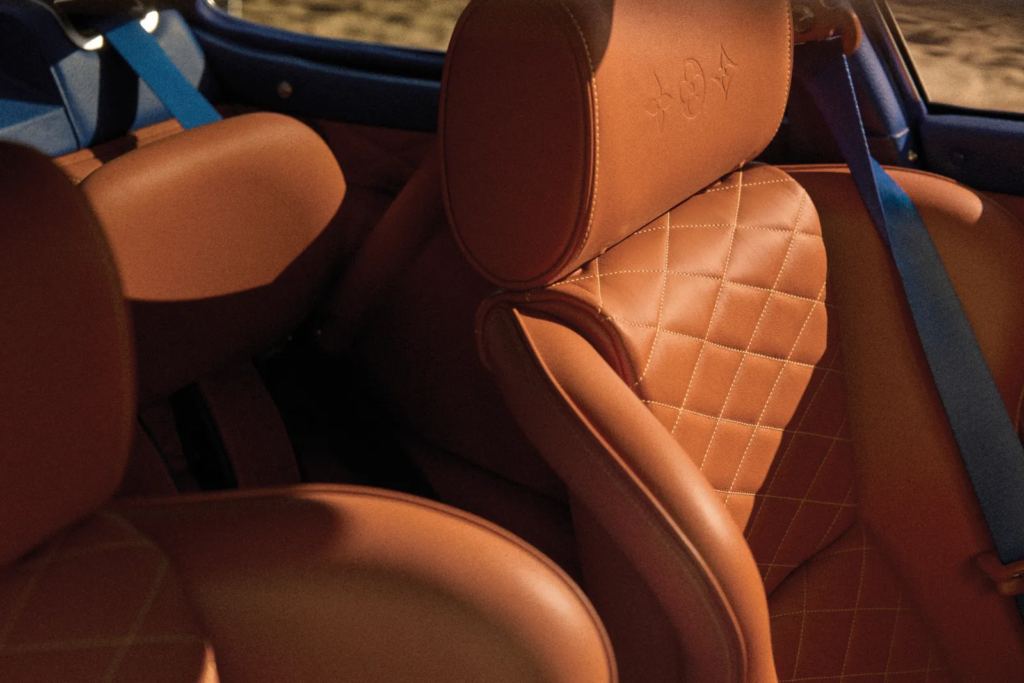
Credit: Singer Vehicle Design x Louis Vuitton
The edges of the door handles are finished using the same dyeing technique as that used on Louis Vuitton bags, while the yellow stitching echoes one of the brand’s most recognizable details in its leather goods.
Credit: Singer Vehicle Design x Louis Vuitton
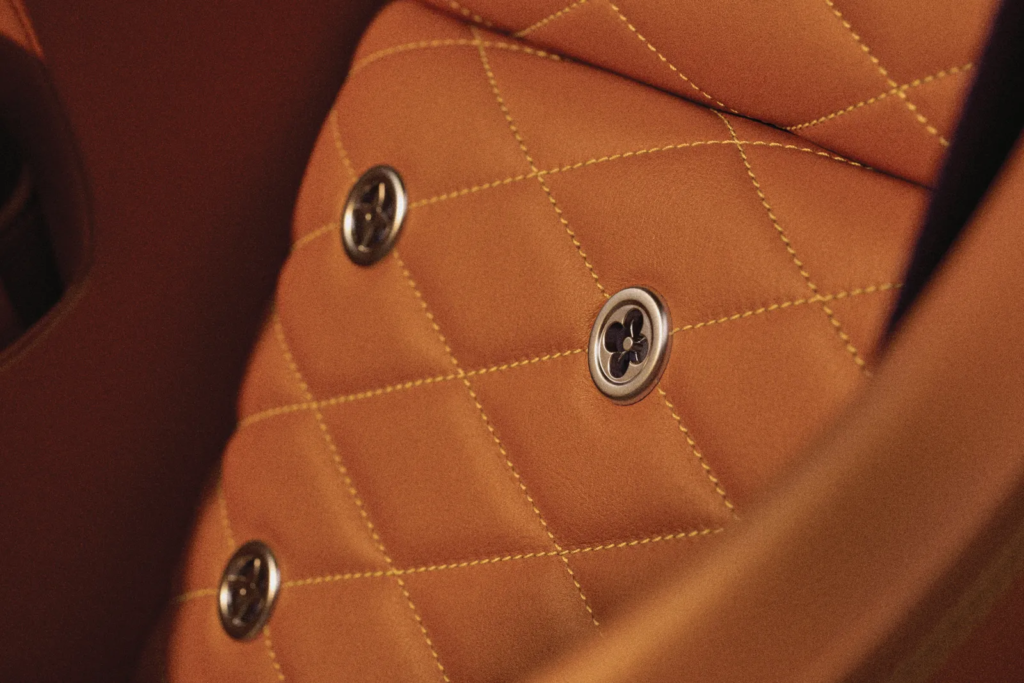
The seats, the front luggage compartment, and the rear engine compartment, on the other hand, feature a diamond-pattern embossing inspired by “malletage,” the motif that lines the interiors of Louis Vuitton trunks. For those who know and love fine leather goods, this is one of the most fascinating details of the entire car. The malletage leaves the protected interior of a trunk and arrives on the seat, where its shape comes into direct contact with the body. The scale, function, and surface change; yet the gesture from which it all stems remains immediately recognizable.
Credit: Singer Vehicle Design x Louis Vuitton
Even the seat ventilation system provides an opportunity to pay attention to detail. Each perforation is hand-cut and finished to match the shape of the Louis Vuitton Monogram flowers, transforming a purely functional element into part of the leather’s design. The same motif reappears on the sun visor flaps and headrests, subtle enough to require a closer look.
Metal, knurling, and finishes: echoes of watchmaking
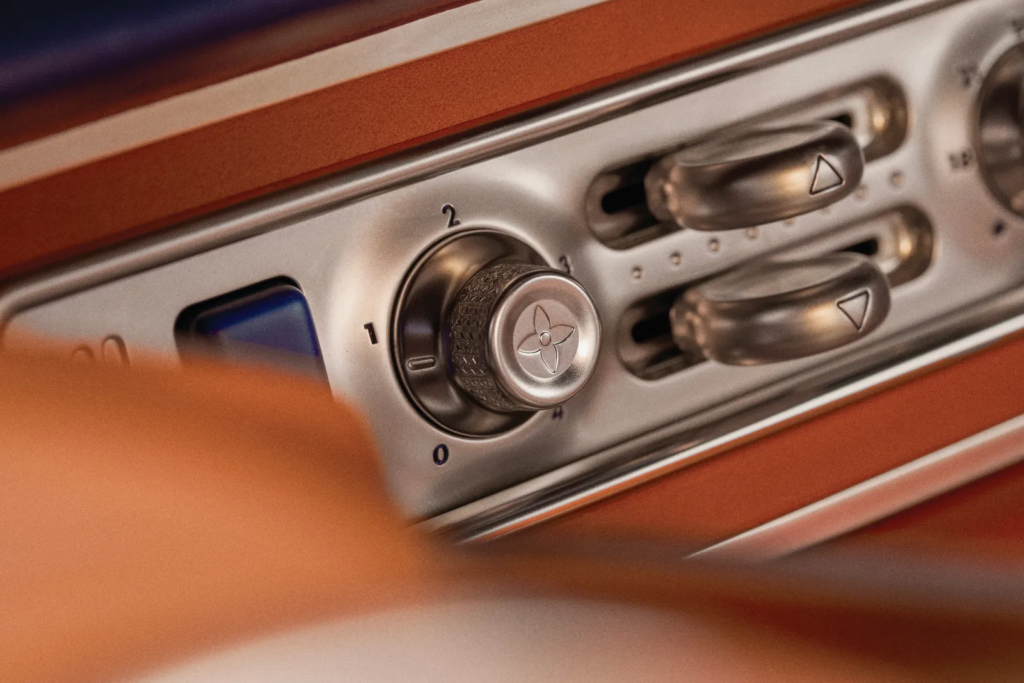
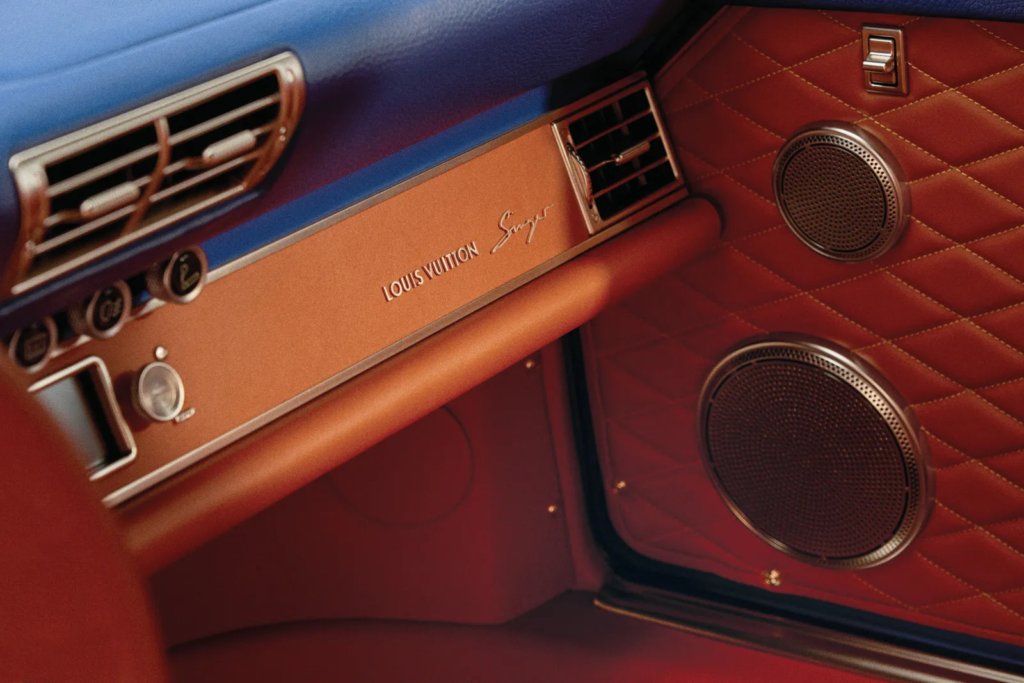
La Fabrique du Temps Louis Vuitton’s contribution goes far beyond the dashboard Tambour. Many of the elements typically made of plastic have been replaced by handcrafted metal components, predominantly rhodium-plated: control knobs, switches, locks, pull tabs, and air vents have been redesigned with a level of care more typical of fine watchmaking than of traditional automotive manufacturing.
Credit: Singer Vehicle Design x Louis Vuitton
Each component is individually hand-finished using techniques comparable to those reserved for high-end timepieces. Polishing and satin finishing determine how the metal reacts to light; knurling alters its grip and feel under the fingers; anodizing and electroplating allow for the creation of different surface tones.
Credit: Singer Vehicle Design x Louis Vuitton
Singer brings the same precision to the most purely mechanical components. The engine finishes are developed specifically for the project, while the fuel cap and oil cap feature markings inspired by the typography of Louis Vuitton watches.
It’s fascinating to discover the art of watchmaking right here, in the very places where the car and the driver are constantly in contact
Porsche 911 Reimagined by Singer – Classic Turbo
The second car began to take shape once the coupe’s design was finalized. The collaboration involved Nicolas Ghesquière, who, together with the Singer team, envisioned a Classic Turbo convertible with a profoundly different character, where automotive culture, fashion, and nautical influences ultimately came together as one.
The Calcaire Lutétien body, accented with subtle touches of brown, encloses an interior dominated by leather and wood. The design draws inspiration from classic motorboats, with that instantly recognizable elegance created by wooden surfaces, warm reflections, and materials destined to become even more beautiful with time. With the top down, the wood is bathed in natural light, and the interior takes on the character of an open deck overlooking the sea.
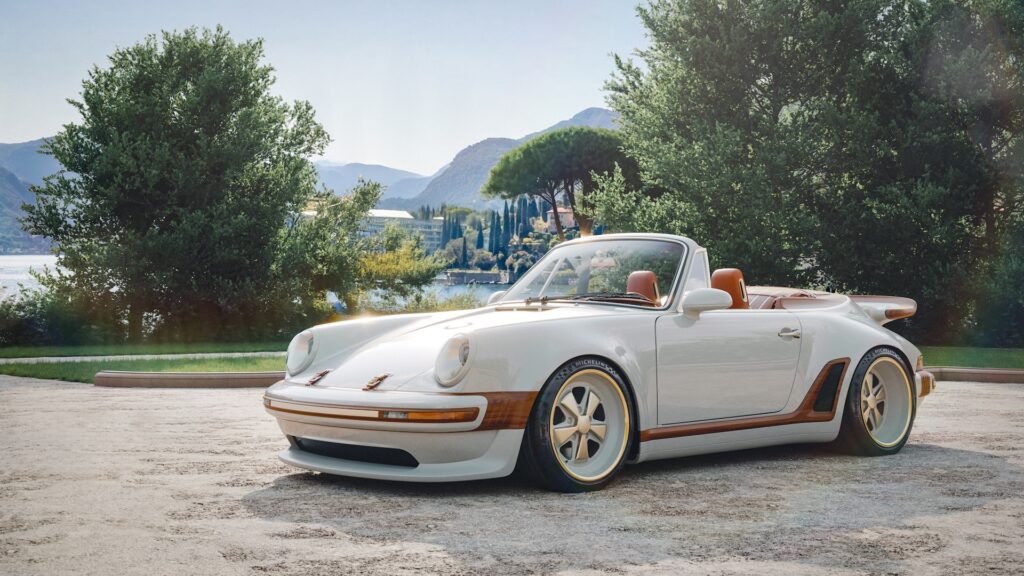
Porsche 911 Reimagined by Singer – Classic Turbo | Credit: Singer Vehicle Design x Louis Vuitton
In the Porsche 911 Reimagined by Singer – Classic Turbo, the worlds of boating and automotive design converge through a recurring theme in Ghesquière’s work: bringing together seemingly disparate worlds without erasing their respective identities, and allowing a new form to emerge from their union.
After all, the car has been part of his Louis Vuitton vision from the very beginning. It was already featured in the first campaign Ghesquière created for the House, almost a foreshadowing of a relationship that would resurface years later in a much more personal form.
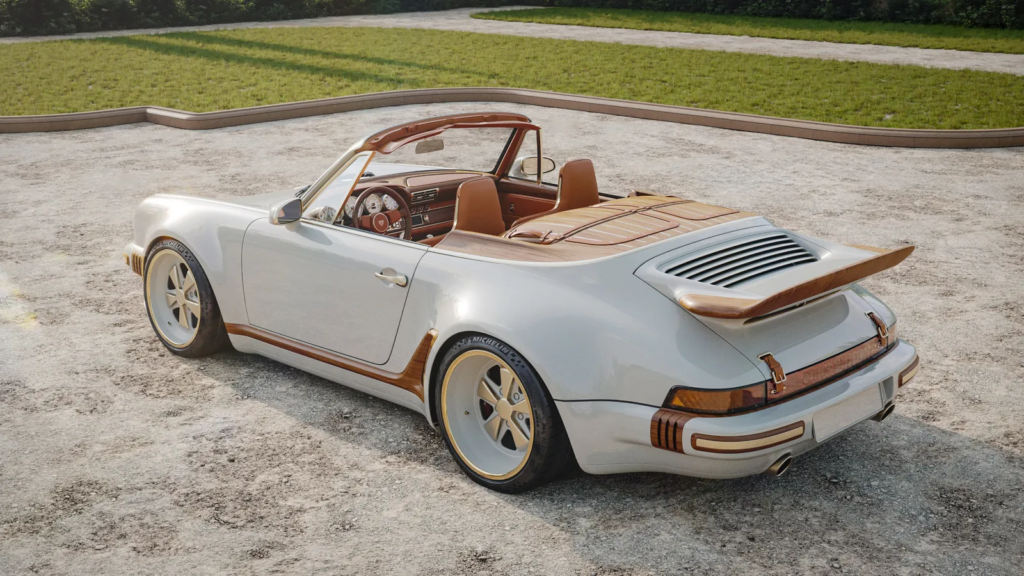
Porsche 911 Reimagined by Singer – Classic Turbo | Credit: Singer Vehicle Design x Louis Vuitton
The car he had in mind was meant to be open to the landscape, nature, and life. The convertible thus becomes the most natural way to express this idea. Just imagine it driving along the California coast, the sky above the cabin, and the light streaming across the wooden surfaces, to grasp the almost cinematic charm of Ghesquière’s vision.
In this light, the character of the 911 Turbo remains perfectly clear. The large rear spoiler immediately signals its performance-oriented nature and retains that muscular presence that has always been a hallmark of the most iconic Turbo models.
Just a few centimeters further on, however, there’s a detail that no one would expect to find on a Porsche.
From Lutétian limestone to teak: a 911 with the soul of a runabout
The rear luggage compartment, accessible through a dedicated opening, holds one of the Classic Turbo’s most fascinating surprises: a wooden floor inspired by the teak found on classic motorboats. An unexpected feature in a 911, it instantly evokes the tactile and visual sensation characteristic of classic runabouts. From this point on, wood becomes one of the car’s defining elements, reappearing in the cabin and on the bodywork in increasingly unexpected places.
Even the white chosen for the bodywork has its own distinct history. The shade is inspired by Calcaire Lutétien, the limestone that has shaped the face of Paris for centuries and also adorns the historic Louis Vuitton headquarters on Pont Neuf, overlooking the Seine. Against the light surface, the golden accents stand out like delicate jewelry details, complementing the natural shades of the leather and the warm tones of the wood.
The Classic Turbo thus seems to move constantly between different landscapes and imaginaries: Paris and California, the Seine and the ocean, the curves of a 911 and the wooden deck of a runabout. These seemingly disparate references, when brought together, take on a surprising sense of naturalness and go a long way toward explaining the character of this car.
The research into wood extends all the way to the bumpers, arguably one of the most daring applications in the entire project and a technical challenge that is anything but trivial. Form, strength, integration, and finish must all come together in a component that is both exposed and an integral part of the car. Designers, artisans, and engineers from Singer and Louis Vuitton have thus developed each component specifically for this car, applying meticulous attention to the material down to details that would normally go unnoticed.
On the Classic Turbo, the Tambour is positioned in the center of the dashboard
The dashboard clock also changes position, and with it, its relationship to the passenger compartment. It moves from its previous location behind the steering wheel to take its place in the center of the console, which is upholstered in natural leather, as if it were a standalone object integrated into the car.
Around the Tambour, the color palette becomes warmer. The instruments take on golden hues, the dial matches the body color exactly, and even the ignition key is finished in gold. The exterior and interior thus begin to echo one another, creating a sense of continuity that unfolds detail by detail.
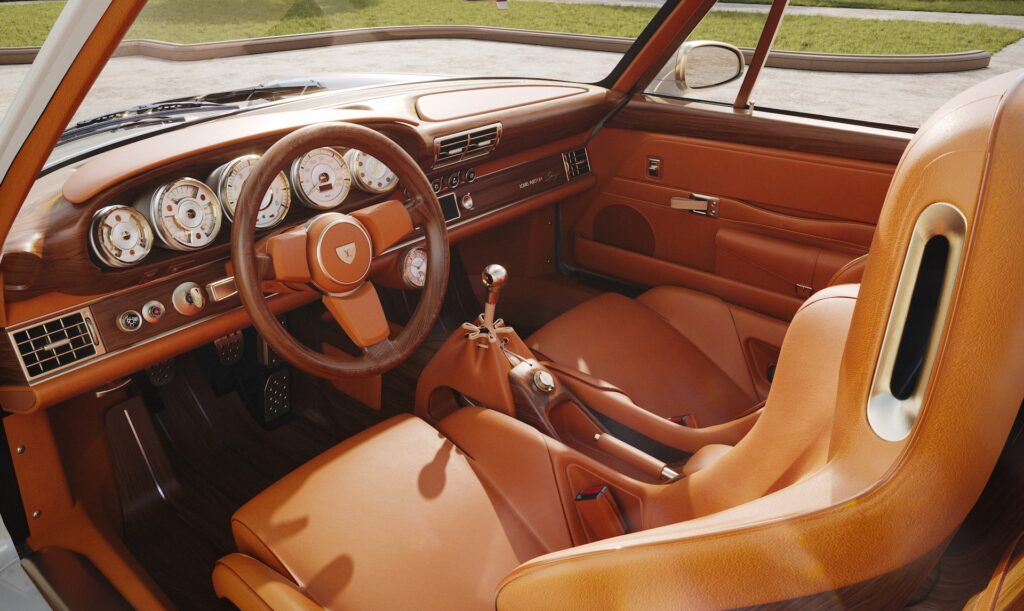
Credit: Singer Vehicle Design x Louis Vuitton
The Louis Vuitton logo appears on the dashboard and reappears, much more discreetly, inside the taillights, where it stands out especially as the light fades. On the steering wheel, Nicolas Ghesquière has opted for a distinctive leather patch, bringing one of the materials most closely associated with the House to the very point of constant contact between the driver and the car.
All functional elements are made of metal and receive the same attention to detail as the finishes and surface treatments on the Classic model. The surfaces, craftsmanship, and subtle contrasts exhibit a precision that connoisseurs of fine watchmaking recognize immediately: that special attention to components intended first and foremost to be touched, operated, and observed from just a few centimeters away.
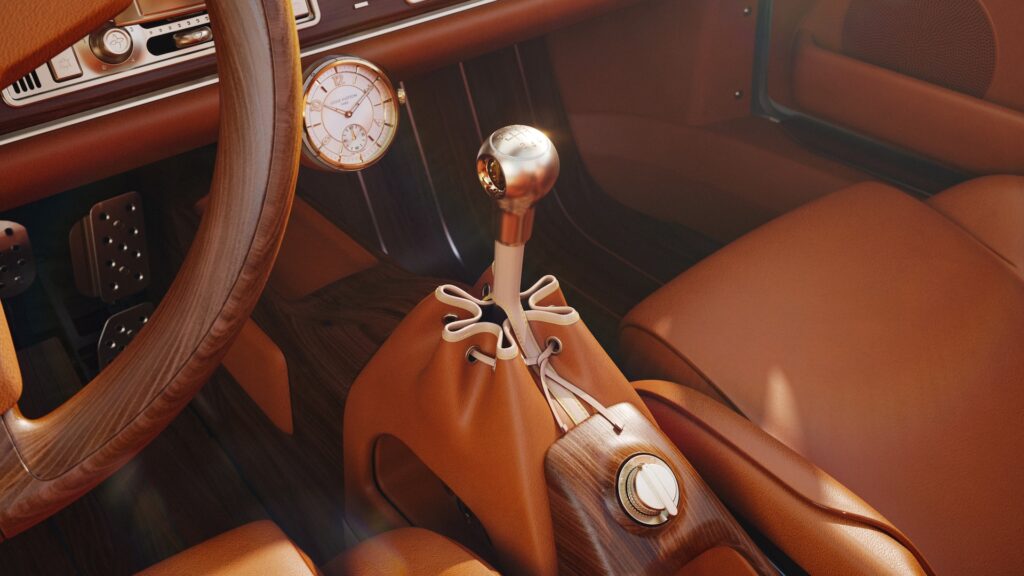
Credit: Singer Vehicle Design x Louis Vuitton
Then, just below the clock, comes one of my favorite details of the entire project. The gearshift knob is adorned with a natural leather strap that echoes a design element from the Noé bag.
It’s a reference I love precisely because of its subtlety. A detail born in the world of leather goods finds its way into one of the most instinctive actions of driving, shifting gears, and becomes part of the car with surprising naturalness. Those familiar with Noé will recognize it almost instinctively; those discovering it here will have just found another thread to follow through the Louis Vuitton universe.
A trunk built like the deck of a motorboat
Behind the seats, upholstered in leather and supported by a technical wooden frame, lies a luggage compartment designed specifically to fit the car’s geometry. Here, the nautical theme takes on a tangible form: the wood is finished using the same technique applied to the decks of runabouts, achieving the depth and luster characteristic of classic motorboats.
The space is designed to accommodate custom-made Louis Vuitton luggage alongside the lightweight soft top, which is also inspired by the nautical world. There is something particularly fascinating about this precision: every piece has its own place, every centimeter is put to use, and the luggage returns to being what Louis Vuitton has historically known best, an object designed around travel and the means by which it is undertaken.
Wood continues throughout the Classic Turbo, extending to the rear engine compartment and the front trunk. Inside, there is a custom luggage set consisting of three suitcases designed to nest inside one another, making the most of the available space through a series of functional and finely crafted compartments. Opening it evokes the pleasure of those historic trunks in which every item had a precise place, determined even before departure.
Then there are the leather straps with prong buckles that run across the front and rear hoods. A seemingly simple detail, yet one that best illustrates the collaboration. In just a few centimeters , the hood straps of motorsport tradition, the culture of Louis Vuitton luggage, and the craftsmanship of a watch strap come together.
Three worlds, one gesture. Almost the entire Louis Vuitton x Singer collection encapsulated in a buckle.
The Art of Travel Goes Beyond the Car
The experience continues even after you step out of the car. Louis Vuitton has created a dedicated capsule collection for both 911s, designed so that what the owner wears and carries with them retains a touch of the car they’ve just left behind.
For the Classic, the Millésime leather echoes that of the cabin and features the same saffron, cobalt, and yellow tones as the body and interior. The Classic Turbo, on the other hand, follows the vision set forth by Nicolas Ghesquière: white, wood, natural leather, and gold accents accompany a collection with a brighter, more elegant, and relaxed character, in harmony with the open-air nature of the convertible. The clothing and luggage collection thus becomes an extension of the two cars, carrying their colors, materials, and details beyond the cabin.
It’s an idea that takes Louis Vuitton back to the origins of its relationship with the automobile. In 1897, when traveling by car was still the privilege of only a handful of pioneers, the House was already modeling its trunks after the shapes of the first automobiles. In 2026, centered around two Porsche 911s reimagined by Singer, that same culture of travel takes the form of an entire universe of objects, materials, and gestures.
The Tambour moves from the dashboard to the wrist. The malletage pattern extends from the interior of a trunk to the seats. The Noé lends its strap to the gearshift lever. A marquetry surfboard finds its place in the car. The straps on the hoods evoke, all at once, a Louis Vuitton trunk, a race car, and a watch strap.
For those who collect, drive, and live with these vehicles, the appeal of the project also lies in the joy of discovery. Every detail invites you to take a closer look, recognize a craftsmanship, follow a clue, and understand where it comes from. Watchmaking, leather goods, luggage, and automotive culture each retain their own distinct character, while their design elements flow with surprising ease from one object to another.
Then comes the moment to close the trunk, fasten the Tambour to your wrist, and turn the key. Ahead lies the road. Behind, nearly 130 years of the Art of Travel !
Are you looking for the perfect gift? Explore our online store and discover the entire collection signed IWS – Italian Watch Spotter!
For all real-time updates on the world of watchmaking follow us on Instagram and visit our Youtube channel.