
There are 86 pieces of the new Piaget Andy Warhol Camouflage, a number that also references the year, 1986, of the American artist’s self-portraits that inspired it. Forty years after those self-portraits, created just a few months before the artist’s death and part of the final phase of his creative exploration, the camouflage pattern that crossed the artist’s face takes shape on the dial in an inlay of gold, sodalite, and turquoise.
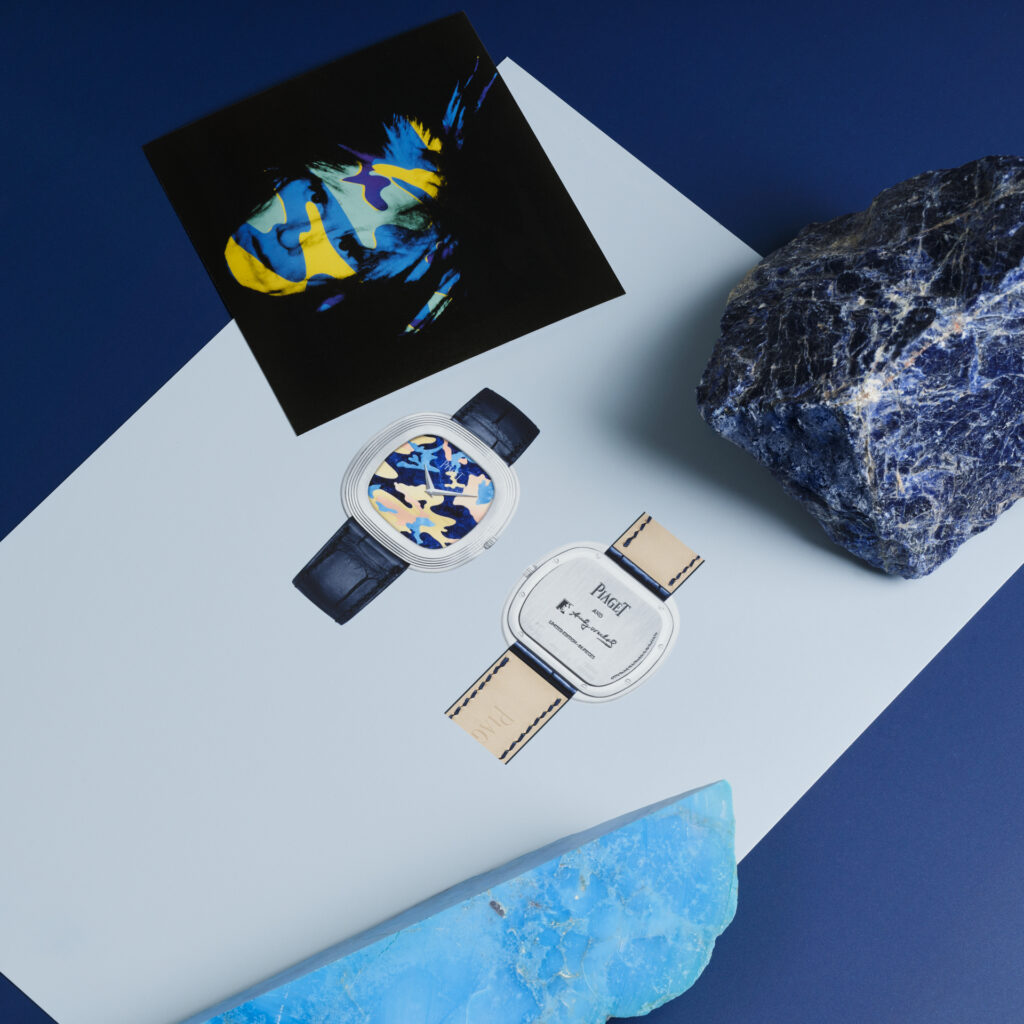
Following the 2025 Collage, Piaget continues its collaboration with the Andy Warhol Foundation for the Visual Arts by revisiting a subject that lends itself particularly well to its artistic language. Color remains the common thread, but this time the composition assigns gold a more complex role: alongside the gemstones, the metal contributes to the design through its hues and various finishes.
The connection between Andy Warhol and Piaget
The relationship between Warhol and Piaget It predates the current collaboration by several decades. The artist owned seven watches from the Maison, including the 15102 model, designed by Jean-Claude Gueit and produced in limited series between 1972 and 1977. With its 45 mm coussin-shaped case, accented by concentric fluting, the model already possessed the sculptural presence that would characterize its subsequent iterations. Revived in 2014 with the Vintage Black Tie, officially adopted the artist’s name in 2024 through a licensing agreement with the Foundation. The Collage, which arrived the following year in a run of 50 pieces, marked the beginning of the exhibition dedicated to a fresh interpretation of his works.
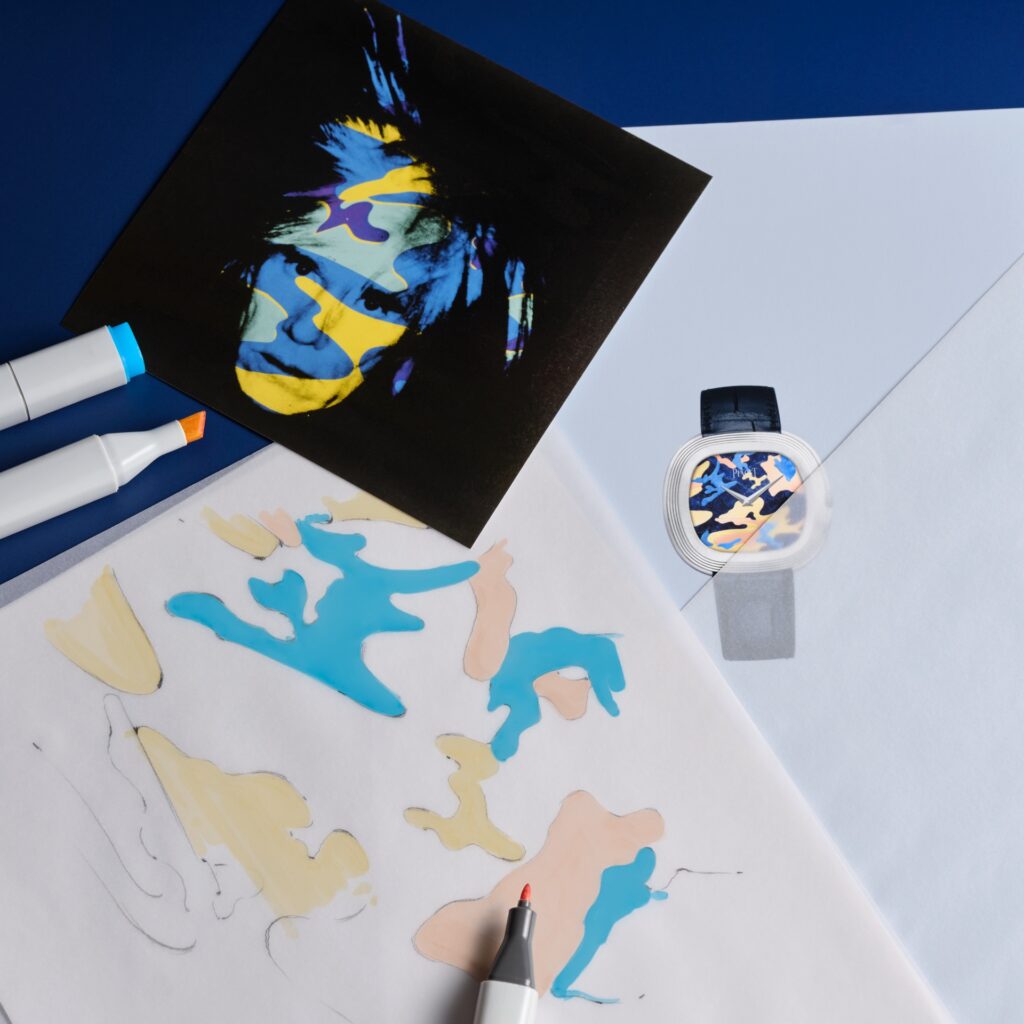
Even in that first edition, the inlay of ornamental stones made it possible to recreate, in abstract form, a self-portrait from 1986. On a black onyx base, elements of pink opal, green chrysoprase, and yellow serpentine were arranged, accompanied by a yellow gold case. The dark background highlighted the color fields, while keeping their arrangement on the dial clearly visible.
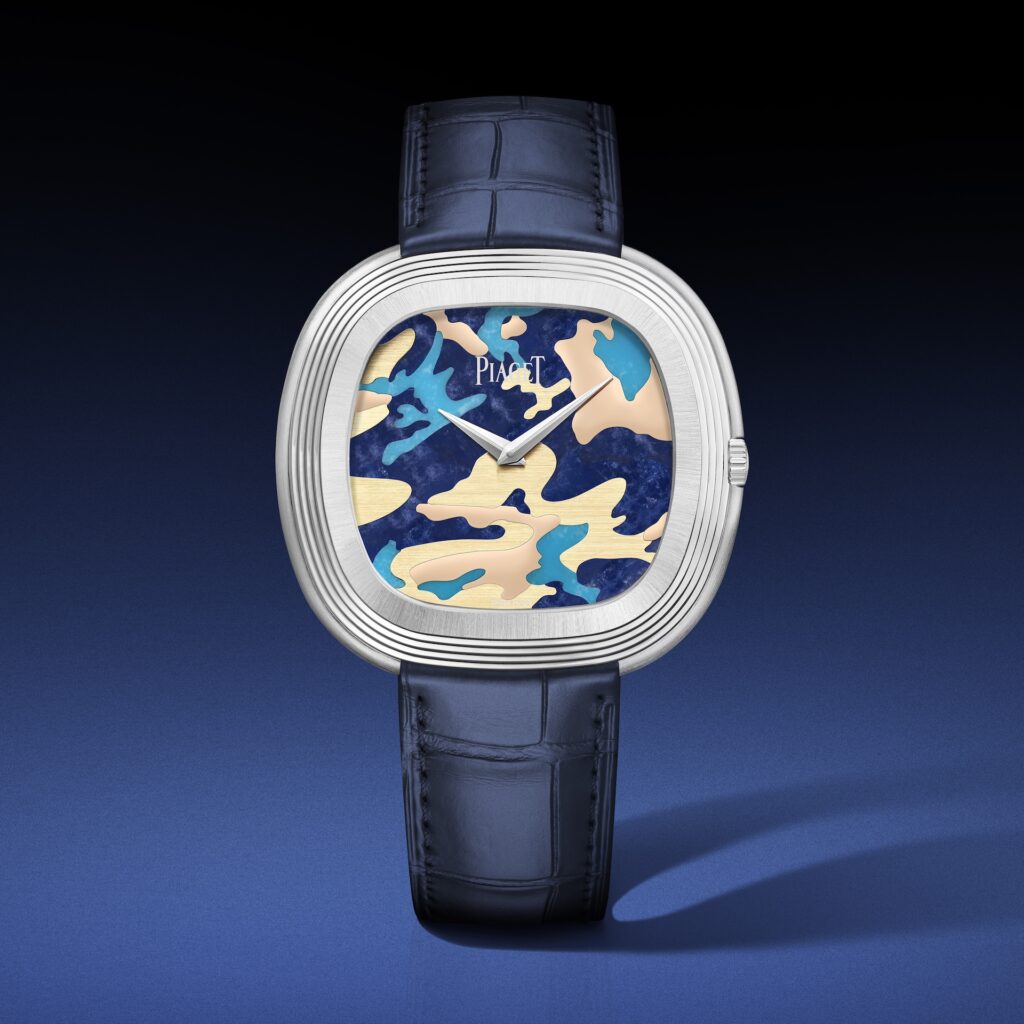
In “Camouflage,” the design is fragmented into 27 elements with irregular contours. The deep blue of sodalite and the brighter blue of turquoise meet satin-finished gold and polished rose gold, creating a contrast that involves both color and the way the materials respond to light. The case is crafted in white gold: a cooler-toned frame that complements the gemstones and allows the warm hues of the metal to shine through within the composition.
The craftsmanship of the dial on the Piaget Andy Warhol Camouflage
It’s above all by observing the individual elements, before they are assembled, that one understands the precision required by this work. The shapes feature deep recesses, narrow ends, and curves that must fit together with those of the adjacent pieces; each profile therefore also determines the shape of the space intended to accommodate another. The continuity of the pattern depends on the quality of these joints, as well as on the selection of the stones, whose veining and color variations must fit into a predetermined design.
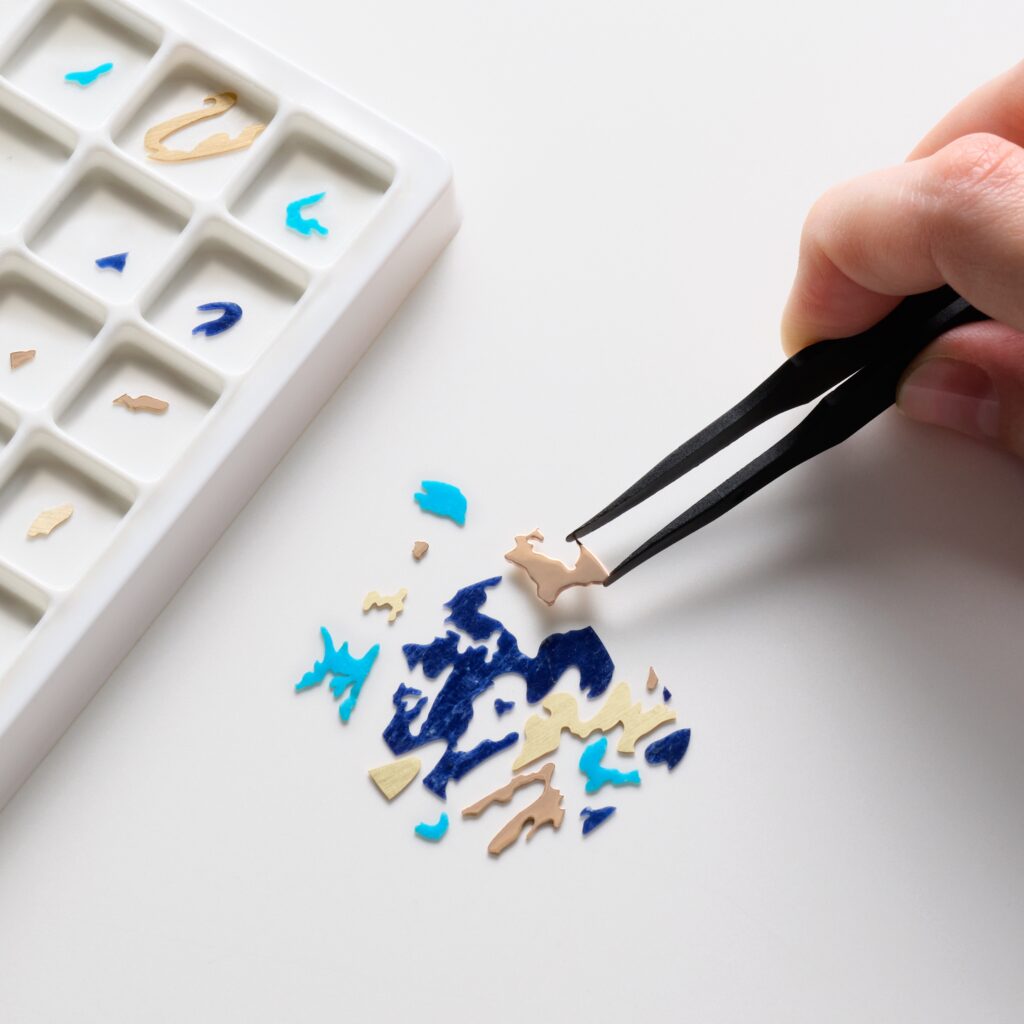
Over one hundred hours of work went into the study, design, and creation of the dial. The complexity of the inlay is thus evident in the geometry of the pieces and the coexistence of different materials and finishes on the same surface.
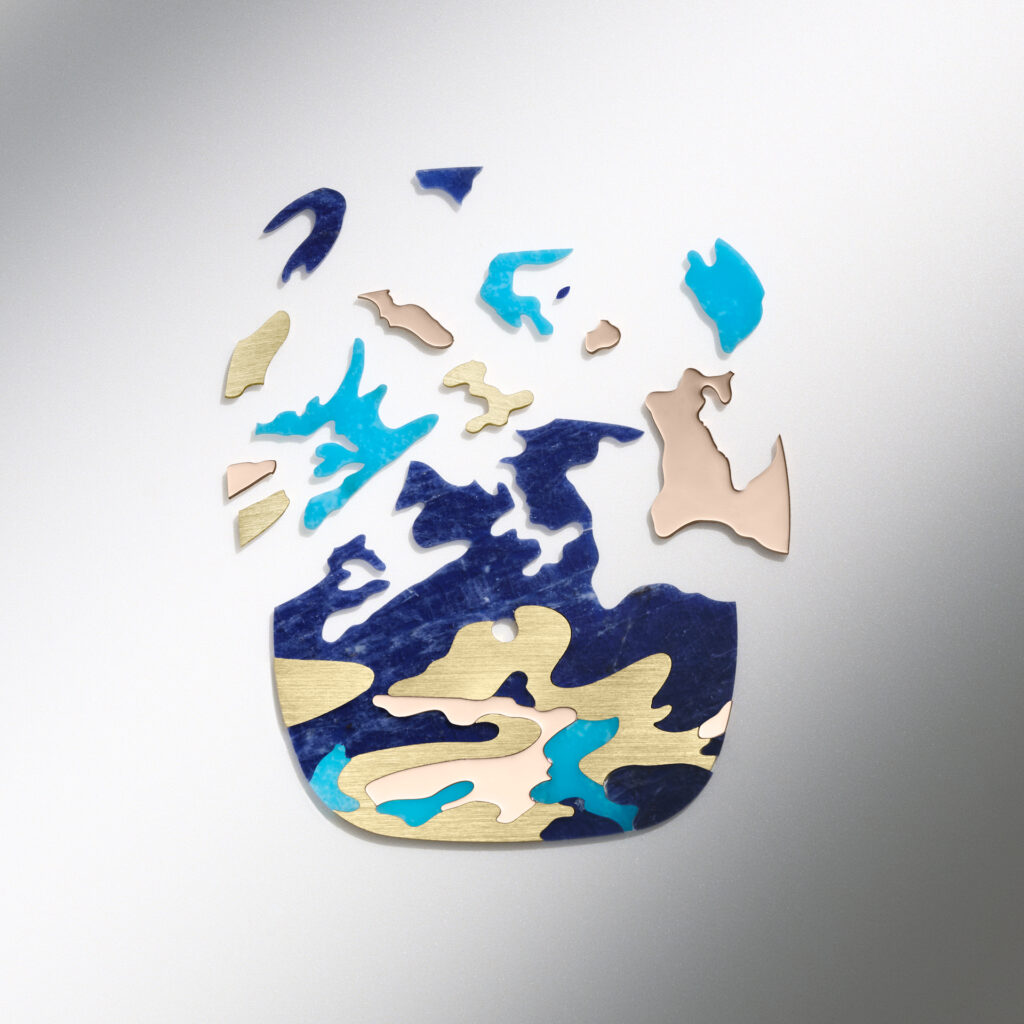
The choice of subject adds another layer of interpretation. In the 1986 self-portraits, the camouflage pattern crossed Warhol’s face, obscuring the recognizability of what had by then become a famous image. This superimposition can be interpreted as a tension between exposure and concealment: the artist reveals himself through a pattern designed to hide. Piaget retains that pattern and allows the face to disappear, focusing the interpretation on the relationships between shapes and colors.
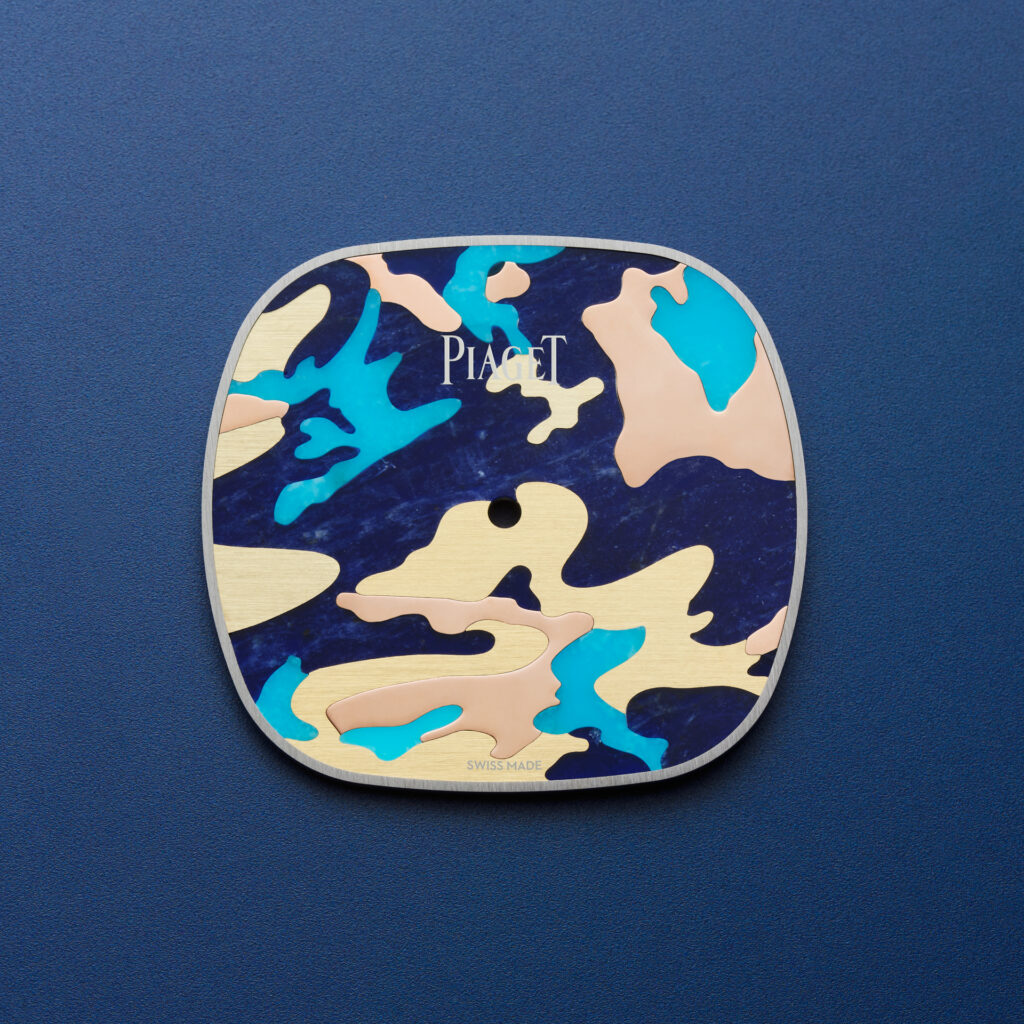
This transition is a natural continuation of the Maison’s history, which has been exploring the possibilities of ornamental stones since the early 1960s. Here, that technical heritage provides a precise tool for interpreting Warhol’s work: the design is reconstructed using materials that possess their own unique texture, veining, and sheen.
Case and movement
Around the dial, the knurled edges of the coussin-shaped case introduce a sense of regularity that balances the jagged outline of the panels. The Dauphine hands maintain a clean, geometric shape, while the movement remains the self-winding Manufacture Caliber 501P1, previously used in the Collage. The caseback bears the artist’s signature and an indication of the limited edition run.
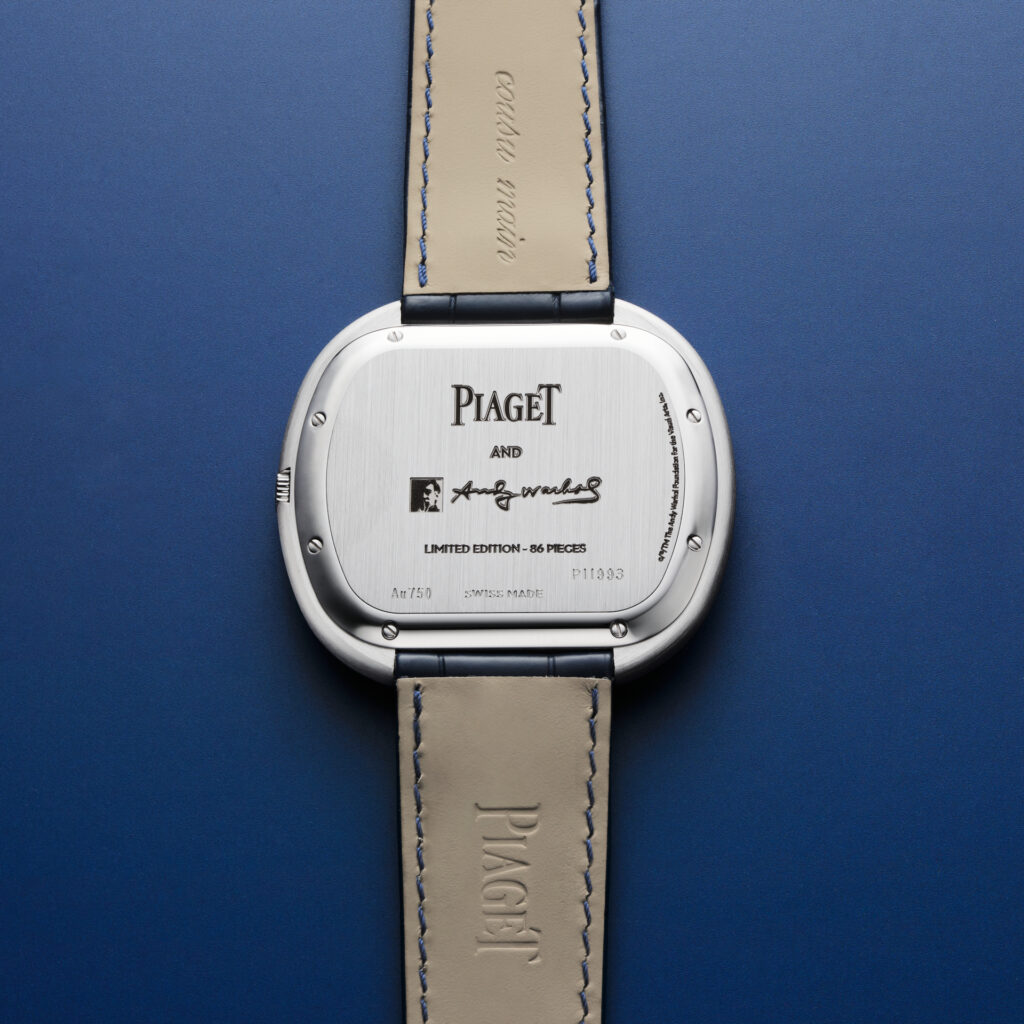
Camouflage thus builds on the exploration begun with its predecessor, placing greater emphasis on goldwork. The result retains the motif’s graphic immediacy, yet invites the viewer to linger over the details: the satin finish of a background, a vein in the sodalite, the point where a curve of turquoise meets the metal. It’s at this closer look that the tribute to Warhol most clearly reveals Piaget’s signature style.
Are you looking for the perfect gift? Explore our online store and discover the entire collection by IWS – Italian Watch Spotter!
For all the latest updates on the world of watchmaking, follow us on Instagram and visit our YouTube channel.