Before the glitz, before the luxury, before sponsorship deals in auto racing, stopwatches had only one function: to determine who was the fastest, who was the winner.
The passage of time is impartial, ruthless, yet extremely fair. Precision is the only thing that matters, and a thousandth of a second can make all the difference in the world.
In this guide, we’ll explore how watches in the world of Formula 1 have evolved from their role as timekeeping devices to becoming symbols of team and driver identity, while analyzing the brands that have shaped the history of these races.
Lights out… let’s go!
Measuring Speed
Before delving into the analysis of brands and collaborations, it’s worth taking a moment to recall how this connection between Formula 1 and watchmaking came about. To do so, we must go back in time, specifically to 1867, the year in which two steam-powered road vehicles raced along a route of about eight miles between Ashton-under-Lyne and Old Trafford, near Manchester.
This race is considered the first head-to-head competition between two vehicles; however, the most famous event of the late 19th century took place on July 22, 1894, when the French newspaper Le Petit Journal organized the Concours des voitures sans chevaux, a race from Paris to Rouen covering approximately 126 kilometers. It was not yet a speed race in the modern sense of the term: the competition primarily rewarded the safety and practicality of the vehicles. It was, however, one of the first major organized events in the history of motorsports and helped transform competition into a means of demonstrating the technical superiority of different automobiles.
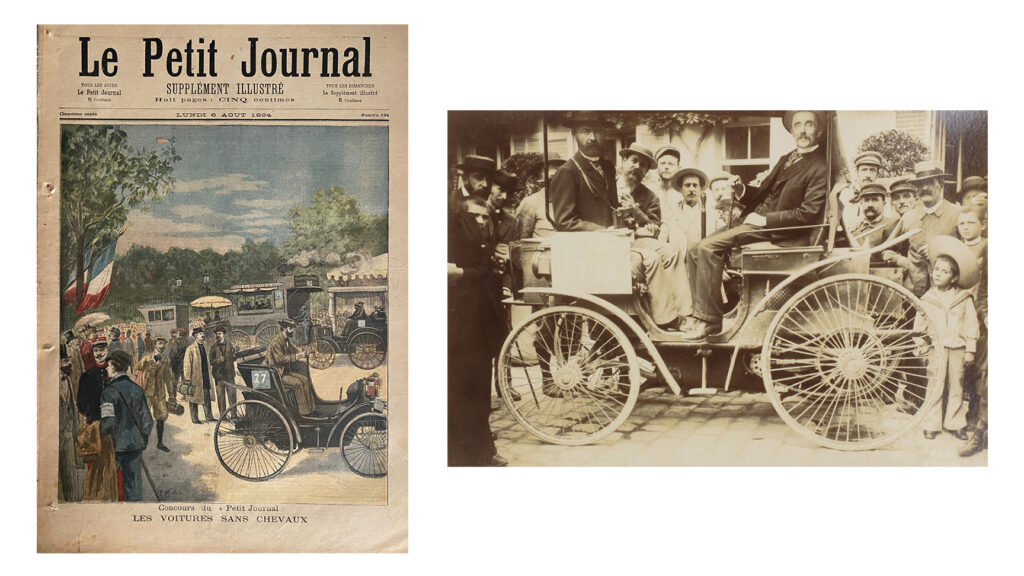
Le Petit Journal, Horse-less Car Contest
The earliest automobile races took place mainly on city streets and circuits, transforming city streets and the roads connecting the country into full-fledged race tracks, but the steady increase in speeds and the associated risks led to the creation of facilities designed specifically for racing. This gave rise to historic circuits such as Brooklands (1907), the Indianapolis Motor Speedway(1909), and our own Autodromo Nazionale di Monza (1922).
In this new context, timing has become increasingly important: on a track where the race consists of lap after lap, it is no longer enough to simply determine who finished first; people want to know how long it took and whether the driver was able to improve his time.
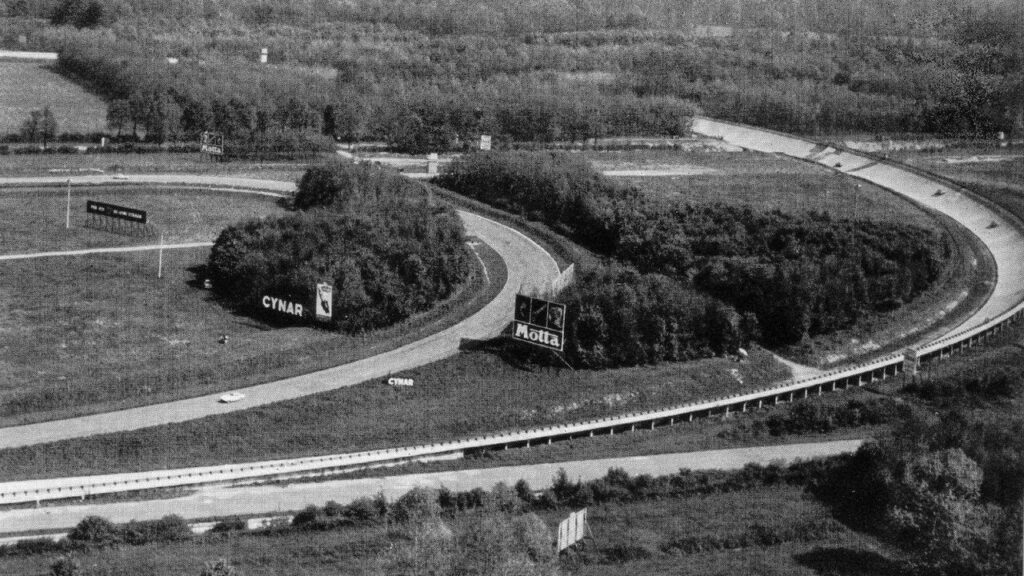
Monza National Racetrack
For decades , this role remained the exclusive domain of manual-winding chronographs, already sophisticated instruments capable of achieving accuracy to the nearest tenth of a second: Stepping away from the automotive world for a moment, it is worth mentioning Omega, which in 1932 provided all the timing services for an edition of the Olympic Games for the first time, using 30 high-precision split-second chronographs.
The limitation, however, did not lie in the instrument itself, but rather in the person operating it; the moment it was activated still depended on a human being’s hand-eye coordination. This key element would shape the evolution of Formula 1: in 1950, the World Championship was officially established and carried forward the culture of timekeeping that had been refined in previous years.
The solution to the problem of manual timing came with the gradual introduction of automated systems: the first photoelectric sensors were developed, which are triggered when a car interrupts a light beam, and the system automatically records that moment. The time no longer needs to be observed by a person; it is captured by technology.
The decisive breakthrough came in 1971 when Heuer introduced the Le Mans Centigraph, a system capable of measuring and displaying times to the thousandth of a second and tracking multiple cars simultaneously. This evolution then made it possible to record car numbers, laps completed, and lap times, with measurements accurate to one-thousandth of a second.
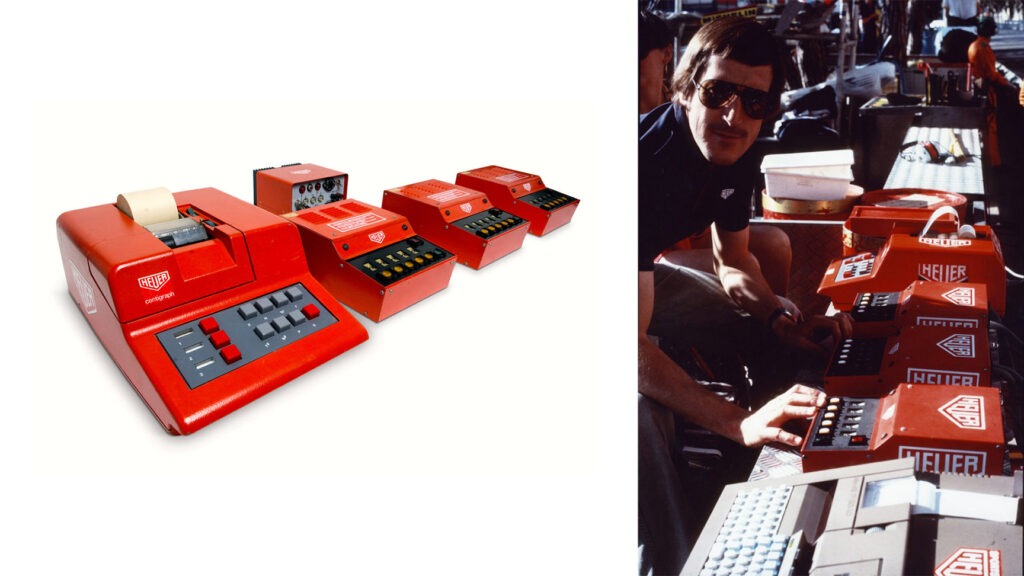
Heuer and the Le Mans Centigraph
Modern Formula 1 is the result of this evolution. Today, official timing no longer depends on a person watching a car pass by and pressing a button: FIA regulations require specific transponder-based timing systems, integrated into a technological infrastructure capable of collecting and distributing race data, even allowing spectators to analyze the course of a race.
The journey over the course of just over a century is therefore almost paradoxical: from the stopwatch in the timekeeper’s hands to a digital infrastructure capable of measuring and analyzing every moment of the competition.
From the Stopwatch to the Brand
It was precisely the transition from timepieces to electronic timing devices that changed the nature of the relationship between watchmaking and motorsports. Formula 1 has become increasingly self-sufficient in timing, and the watch has taken on a new symbolic function: precision, speed, innovation, and performance have now become a language through which a brand can convey its values.
For all of this to become a true commercial tool, one more step was needed: the emergence of F1 as an advertising platform.
Initially, the cars raced with their respective national or team liveries, and the presence of commercial partners was limited, and, in any case, a far cry from the modern concept of advertising space.
Everything changed in 1968 when the Commission Sportive Internationale (CSI), the body that governed international motorsports at the time, opened the door to commercial sponsorship of race cars. At the South African Grand Prix, a privately entered Brabham fielded by Team Gunston took to the track sporting the colors of the South African cigarette manufacturer. One race later, at the Spanish Grand Prix, Lotus abandoned its traditional British Racing Green in favor of Gold Leaf’s famous red, gold, and white livery.
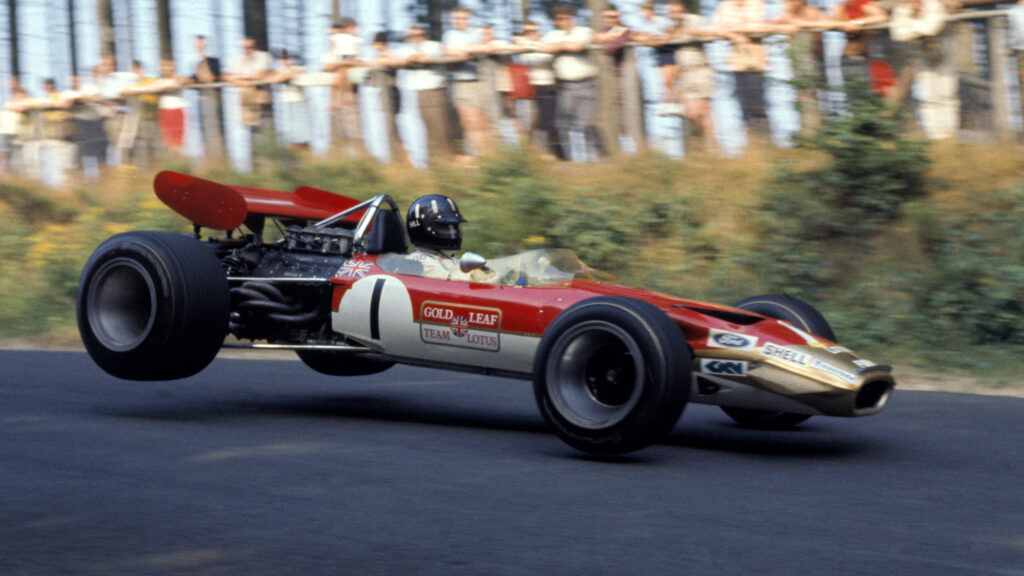
Lotus 49 with Gold Leaf livery
Here is the turning point that forever changed the face of Formula 1 single-seaters: the cars ceased to be merely a showcase of a team’s technical prowess and began to serve as a means of communication. It is precisely in this new era of F1 that watchmakers find an ideal setting.
From that point on, however, speaking generally about “partnerships” may be misleading. Over the decades, watch brands have in fact played very different roles within the world of Formula 1. To understand these differences, it is therefore helpful to distinguish at least four main forms of collaboration.
Official Timekeeper
The Official Timekeeper is the official partner responsible for timing the competition. Its role therefore involves the official timing system and the recording of times for races, qualifying sessions, and championship events.
Over the years, this role has been held by various brands: Heuer played a pioneering role in F1 timekeeping in the 1960s, followed by Longines from 1982 to 1991 and TAG Heuer from 1992 to 2003. There was then a transitional period during which this role was entrusted to technology companies until Hublot took over in 2010, followed by Rolex from 2013 through 2024. As of 2025, TAG Heuer has officially resumed this role, launching a new ten-year partnership with Formula 1.
Official Watch or Official Timepiece
The concept of “Official Watch,” “Official Timepiece,” or “Official Watchmaker” is different. In this case, the relationship is primarily tied to the promotion of the league through the brand, its products, and its marketing efforts.
A particularly significant example is Rolex. Since 2013, the brand has been a Global Partner and Official Timepiece of Formula 1, with a widespread presence at the circuits, in television broadcasts, and at championship events. This relationship, therefore, does not necessarily correspond to that of a technical timing provider: Rolex has built its presence primarily around the symbolic value of time, its brand image, and its association with the most prestigious events on the calendar.
Team Partners
Another level is that of collaboration with a single racing team.
In this case, the brand does not represent Formula 1 as a whole, but becomes part of a specific team’s universe. The logo may appear on the race car, on the drivers’ suits, on team apparel, and in the paddock. The manufacturer may develop watches dedicated to the team or leverage the partnership for advertising campaigns. This is the case, for example, with IWC Schaffhausen and Mercedes-AMG PETRONAS: since 2013, IWC has been the team’s Official Engineering Partner and, throughout the partnership, has developed a series of timepieces inspired by the team and the world of Formula 1.
Driver Partners and Ambassadors
The direct relationship with the driver is yet another matter.
A driver can become a brand ambassador regardless of the driver’s role in relation to Formula 1 or his team. It is a particularly powerful form of collaboration because it transfers to the product not only the athlete’s visibility but also his personal story: victories, character, style, and reputation.
It is no coincidence that Rolex, too, has built a significant part of its history in motorsports through its ambassadors: the brand has supported Sir Jackie Stewart since 1968, long before becoming an official partner of Formula 1 in 2013.
Licensed / Co-branded
Finally, there is yet another category: that of watches produced under official license.
In this case, a brand may obtain the right to use the name, logo, or identifying elements of Formula 1 or a team to manufacture and market certain timepieces.
One example is Jacques Lemans, which signed a licensing agreement with Formula 1 in 2006 to produce an official collection of watches dedicated to the championship.
So, from stopwatches to sponsorships, but which brands have most closely intertwined their history with that of the premier racing series, Formula 1?
The Watches That Take Center Stage in Formula 1
Armin Strom — Team Partner / Official Timing Partner
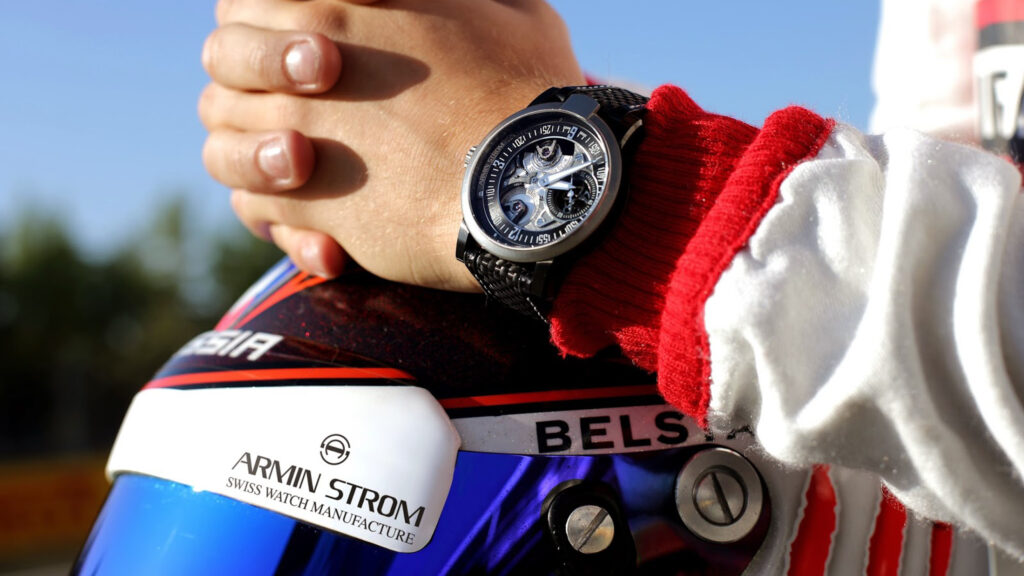
The name Armin Strom originates from the work of the master watchmaker of the same name, who opened his own workshop in Burgdorf, Switzerland, in 1967. In the years that followed, Strom made a name for himself through his artisanal craftsmanship in movement manufacturing and also collaborated with leading watchmakers such as Omega. In 2006, Serge Michel and Claude Greisler carried on his legacy, gradually transforming the brand into the independent watch manufacturer we know today.
The partnership with Formula 1 began in 2011, when Armin Strom became the Official Timing Partner of the Marussia Virgin Racing Team. The partnership continued in 2012 following the team’s rebranding as the Marussia F1 Team and was renewed through 2014.
This partnership is also reflected in the Racing collection, which includes models such as the Racing One Week, the Racing Regulator, and the Racing Chronograph. Of particular note is the Racing Gravity, whose movement bridges are made from material sourced from the engine block of a Formula 1 single-seater.
Audemars Piguet — Driver Partner
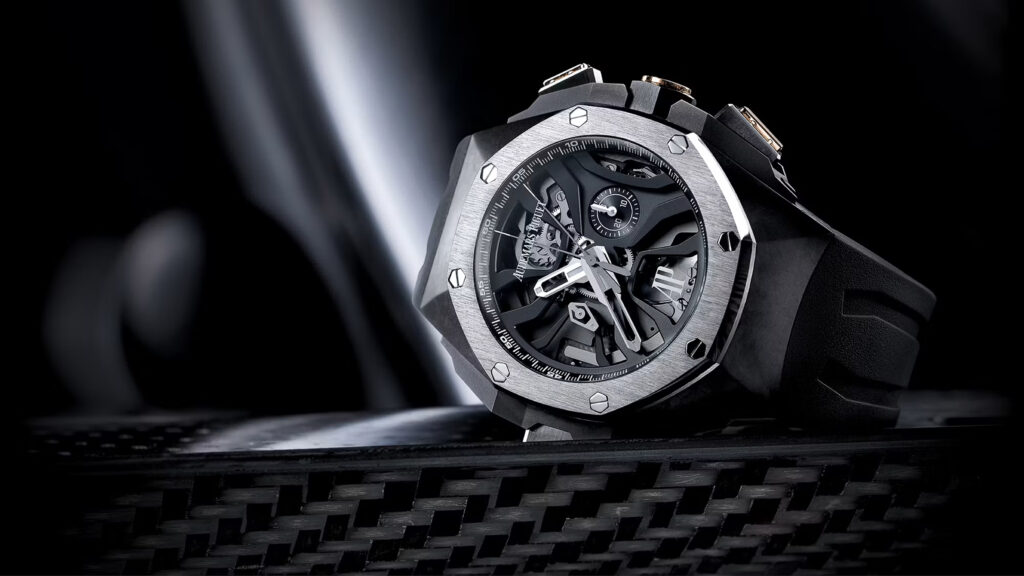
Audemars Piguet Royal Oak Concept Laptimer Michael Schumacher
The relationship between Audemars Piguet and F1 takes shape primarily through collaborations with some of the sport’s leading figures. The first major project came in 2004 with Juan Pablo Montoya, to whom a Royal Oak Offshore Chronograph, produced in a limited edition of 500 pieces, was dedicated. This model also marked the first time Audemars Piguet used carbon fiber for the bezel of a Royal Oak Offshore.
In 2008, it was Rubens Barrichello’s turn, with the Royal Oak Offshore Barrichello, produced in a limited run of 257 pieces and featuring a case made of rose gold, ceramic, and titanium, as well as numerous design elements inspired by the world of motorsports.
The most significant collaboration, however, came with Michael Schumacher. In 2015, Audemars Piguet unveiled the Royal Oak Concept Laptimer Michael Schumacher, born out of a request from the driver himself: to create a mechanical chronograph capable of recording a series of laps without interrupting the measurement. After nearly five years of development, the 2923 caliber was born, featuring two chronograph hands that operate alternately. At the end of a lap, one hand stops to record the time just measured, while the other instantly resets to zero and starts again to measure the next lap.
The principle may resemble that of a split-seconds chronograph, but the function is different: instead of comparing two events occurring simultaneously, the Laptimer allows you to record the times of multiple laps in succession while using the previous lap time as a reference. This feature was developed specifically for motorsports and, in 2015, marked a world first for a mechanical chronograph. The series was limited to 221 pieces, a number corresponding to the number of Formula 1 races in which Schumacher had scored points.
Artisans de Genève — Driver Partner
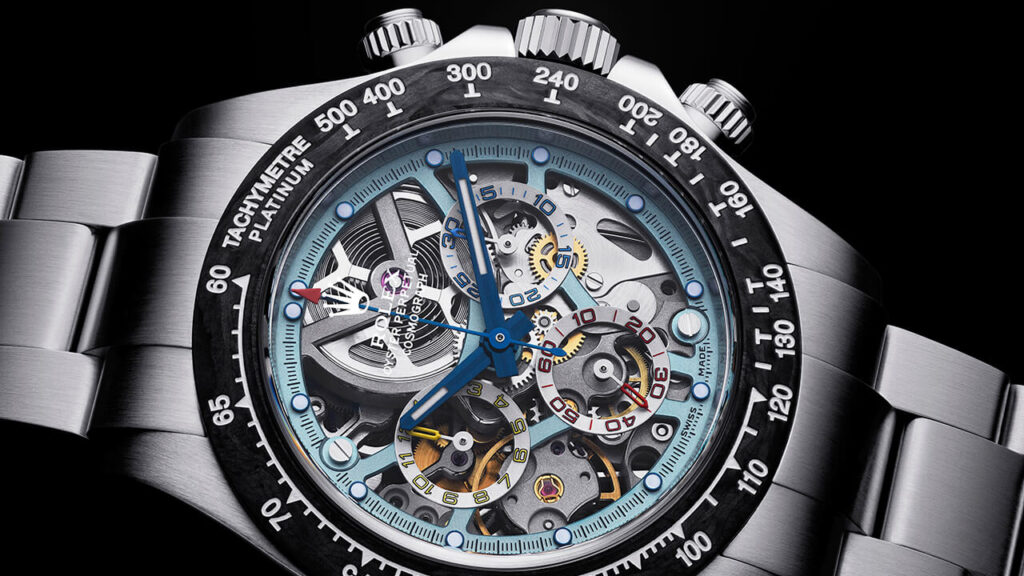
Artisans de Genève Montoya Platinum Challenge
Artisans de Genève represents one of the most radical interpretations of the relationship between fine watchmaking and motorsports. In fact, the Geneva-based atelier does not produce its own watches, but rather reinterprets existing timepieces through artisanal craftsmanship carried out at the customer’s request.
The most famous project is La Montoya, created in 2018 in collaboration with Juan Pablo Montoya and based on the Rolex Daytona 116520. The connection with the Colombian race car driver is particularly significant: Montoya has won the 24 Hours of Daytona three times, in 2007, 2008, and 2013. His Daytona has been completely reimagined, featuring a skeletonized dial and movement, a forged carbon bezel, and a transparent case back that reveals the Rolex Caliber 4130. The chronograph counters, painted in the colors of the Colombian flag, complete the design. The first series was limited to 50 pieces.
In 2019, the La Montoya Gold was introduced, produced in a limited run of 42 pieces, followed in 2020 by the Platinum version, created as a one-of-a-kind piece. The collaboration with Montoya resumed in 2025 with La Montoya Rose, once again based on the Daytona and featuring a skeletonized movement and a rose gold rotor.
More than just a cosmetic customization, La Montoya therefore represents a radical reimagining of the watch’s architecture: a Daytona transformed through the same pursuit of lightness, technical innovation, and character that defines the world of racing.
Bell & Ross — Team Partner

Bell & Ross BR-X1 RS17
Founded in 1992 by Bruno Belamich and Carlos-A. Rosillo, Bell & Ross has built its identity around the concept of the instrument watch, initially focusing primarily on the world of aviation. The square cases, inspired by aircraft instrument panels, thus became one of the brand’s hallmarks, before the company decided to apply the same philosophy to motorsports.
Bell & Ross made its Formula 1 debut in 2016, when it became the Official Watch Partner of the Renault Sport Formula One Team. The partnership continued when the team became Alpine in 2021 and remains in effect through the end of the 2023 season.
This collaboration has given rise to a full-fledged family of watches inspired by French single-seater race cars. The first is the BR-X1 RS16, followed by the BR-X1 RS17 in 2017, whose design explicitly echoes the structure and color scheme of the steering wheel of the Renault R.S.17 single-seater. Materials such as titanium, ceramic, and forged carbon embody the pursuit of lightness and durability typical of racing in this watch.
In the years that followed, the collection evolved alongside the team, culminating in the 2022 BR 03-92 A522, dedicated to the Alpine single-seater driven by Fernando Alonso and Esteban Ocon. The partnership thus becomes a creative laboratory where the technical language of F1 is brought directly to the wrist, while keeping Bell & Ross’s instrument-inspired identity intact.
Breitling — Team Partner
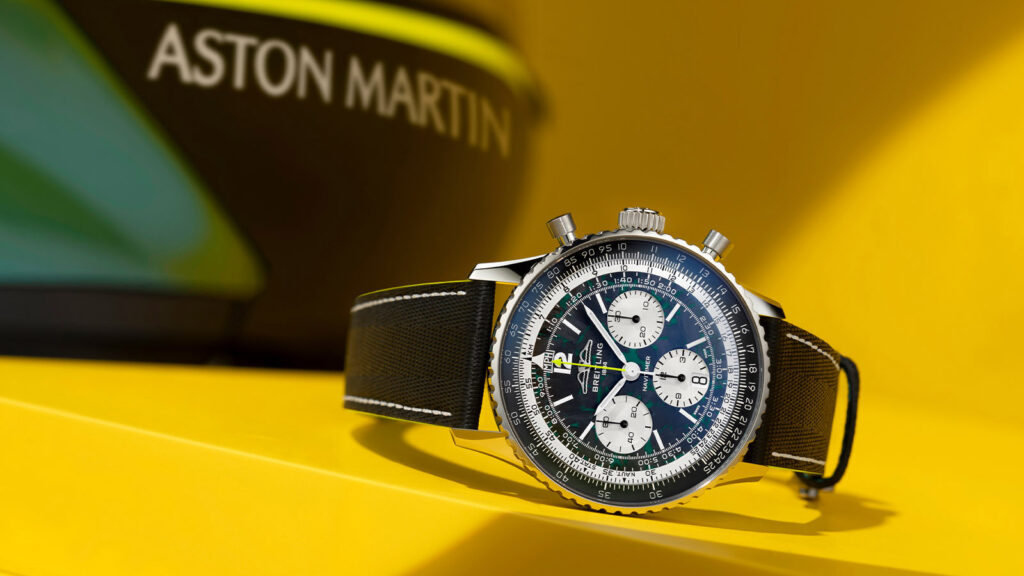
Breitling Navitimer B01 Chronograph 43 Aston Martin Aramco Formula One Team
Founded by Léon Breitling in 1884, the Swiss watchmaker has built its identity around chronographs and precision instruments, becoming particularly renowned in the world of aviation. The brand’s connection to auto racing is just as long-standing: in the 1960s, some of Formula 1’s greatest drivers, including Jim Clark, Graham Hill, and Jo Siffert, wore the Breitling Navitimer. The brand itself acknowledges that these champions have brought to the track a machine built for the skies.
A closer connection to Formula 1 began in the 1990s, when Breitling introduced the Chronomat Renault F1 Team, a special edition of the Chronomat dedicated to the French team.
However, the official return to Formula 1 will take place in 2026: Breitling becomes the Official Watch Partner of Aston Martin and the Aston Martin Aramco Formula One Team, through a multi-year partnership that encompasses the entire Aston Martin universe. Kicking off the collaboration is the Navitimer B01 Chronograph 43 Aston Martin Aramco Formula One Team, featuring a titanium case, a carbon-fiber dial, and green accents inspired by the race car.
Bremont — Team Partner
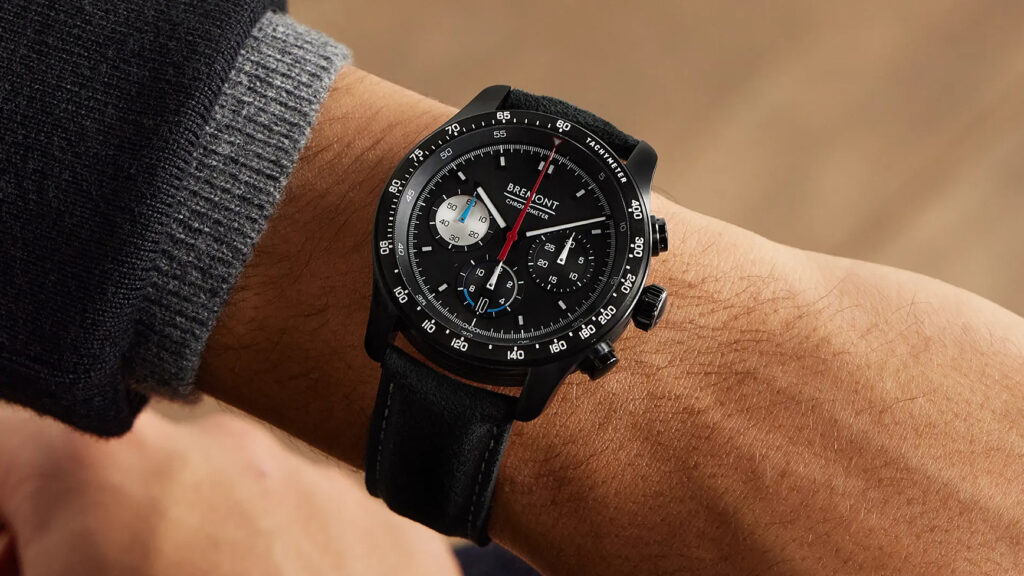
Founded in 2002 by brothers Nick and Giles English, Bremont is a British brand with deep roots in aviation and precision instruments. Its entry into motorsports began with a partnership with the historic Scottish racing team Ecurie Ecosse in 2012, for which it produced a limited edition of 60 pieces.
The most significant connection to Formula 1, however, came in 2021, when Bremont became the Official Timing and Watch Partner of Williams Racing, a role it held through 2023. The partnership is built around a particularly interesting common element: both companies are based in Oxfordshire and have developed advanced in-house expertise in CNC machining and precision engineering.
In 2022, the Bremont WR-22 was introduced, a chronograph inspired by the world of Williams, featuring a rotor modeled after a racing wheel. Each watch also came with an original wheel nut from one of the team’s historic cars. In 2023, the collection was completed with the WR-45, inspired by the Williams FW45.
The collaboration will come to an end in late 2023, but it leaves behind an interesting example of how a partnership between the watchmaking industry and Formula 1 can go beyond simple branding to involve the sharing of technologies, manufacturing expertise, and engineering culture.
Bulova — Team Partner
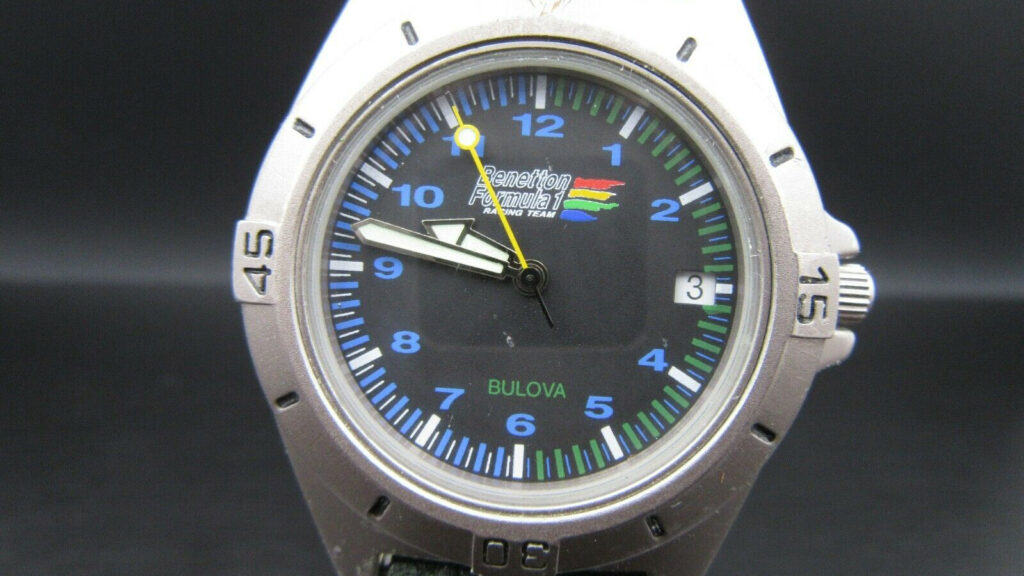
Founded in New York in 1875 by Joseph Bulova, the American watchmaker has built its identity on a commitment to precision and innovation, becoming particularly famous for the Accutron, introduced in 1960 and based on an innovative tuning-fork movement. Today, the brand is part of the Citizen Group.
The connection with Formula 1 began in the late 1980s through United Colors of Benetton, for which Bulova also produced private-label watches. In 1989, the Bulova logo appeared on the Benetton B189, driven by Alessandro Nannini and Johnny Herbert, and remained on the B190 in 1990, as well as on the drivers’ mirrors and helmets. At the same time, watches dedicated to the Benetton Formula 1 Racing Team were produced.
This was a brief but significant partnership, as it brought together one of the most innovative American watch brands with one of the teams that, during those very years, was transforming Formula 1 into a global platform for communication and technology.
Cartier — Licensed / Co-branded
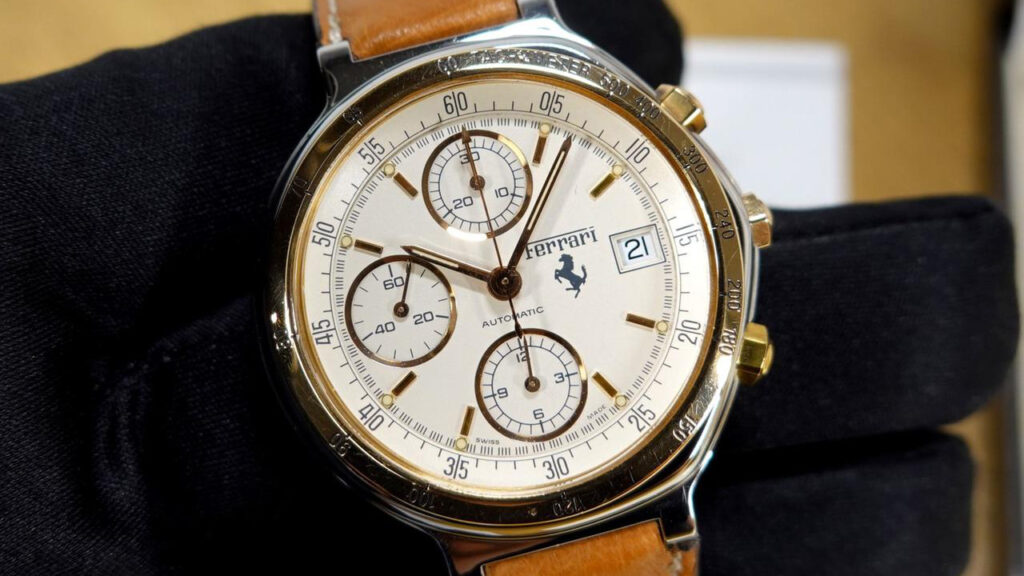
The relationship between Cartier and Formula 1 is one of the most unique collaborations in the history of watchmaking tied to motorsports. In 1983, Enzo Ferrari signed a licensing agreement with Cartier International to develop a line of Ferrari products, including the watches in the Ferrari Formula collection. What makes this unique is that the agreement was reached while Longines was still a partner and official timekeeper of Scuderia Ferrari, a role it had held since 1980. The two relationships thus ran parallel to one another and served different purposes.
Cartier handled the design, production, and distribution of the new line, while the designs had to be personally approved by Enzo Ferrari. The operation also had a specific goal: to combat the spread of unauthorized Ferrari products.
Thus Ferrari Formula was born, a collection of watches and accessories that embodies the Scuderia’s identity without directly using the Formula 1 brand. And this is where the story takes a particularly intriguing turn: the name Cartier does not appear on the watches, and it is not known with certainty who actually manufactured all the pieces. The most credible theories point to Baume & Mercier and, for certain stages of production, Longines, but neither account is sufficiently documented to be presented as fact.
The collection remained in production until 1988 and included several variations, ranging from quartz models to mechanical chronographs. Among the most distinctive pieces is a gold chronograph produced in 1988 in a limited edition of two: one remained with Enzo Ferrari, while the other was presented to Pope John Paul II during his visit to Maranello.
Cartier therefore represents a unique case in the history of Formula 1: not simply a “Cartier-Ferrari” watch, but a licensing project in which the French luxury brand played a central role, while leaving the question of who actually manufactured the timepieces open.
Casio — Team Partner / Driver Partner
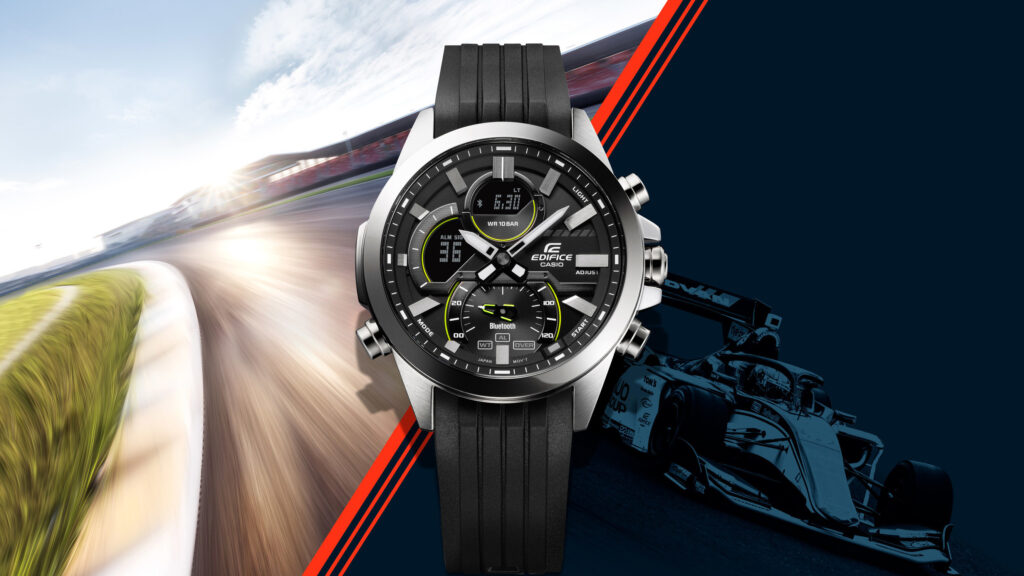
Casio Edifice EQB-1200AT
Casio entered the world of Formula 1 through the Edifice line, launched in 2000 with a strong focus on motorsports. The most significant milestone came in 2009, when Edifice became the Official Team Watch of Red Bull Racing, marking the beginning of a partnership that lasted until 2015 and accompanied the team through its four consecutive world championship titles.
Sebastian Vettel is also directly involved in the partnership; he became an Edifice ambassador in 2009. During his years with Red Bull, several models dedicated to the driver were released, including the EQW-A1110SV and the EF-535SVSP, both featuring his logo. Vettel thus wears a brand on his wrist that is significantly more affordable than the luxury houses traditionally associated with Formula 1 champions.
When Red Bull switched to TAG Heuer in 2016, Casio did not leave the paddock: the partnership was transferred to Scuderia Toro Rosso, which became Scuderia AlphaTauri in 2020, and continued through the end of the 2022 season. During this phase as well, several Edifice models dedicated to the team were developed, includingthe EQB-1200AT, crafted using the same type of carbon fiber found in the AlphaTauri race cars.
Casio’s journey is particularly significant because it demonstrates that the connection between watchmaking and Formula 1 has not been the exclusive domain of haute horlogerie: through Edifice, a brand born out of electronic technology, Casio has built a steady presence in the paddock for over a decade, aligning itself with Formula 1’s pursuit of performance.
Certina — Team Partner / Driver Partner
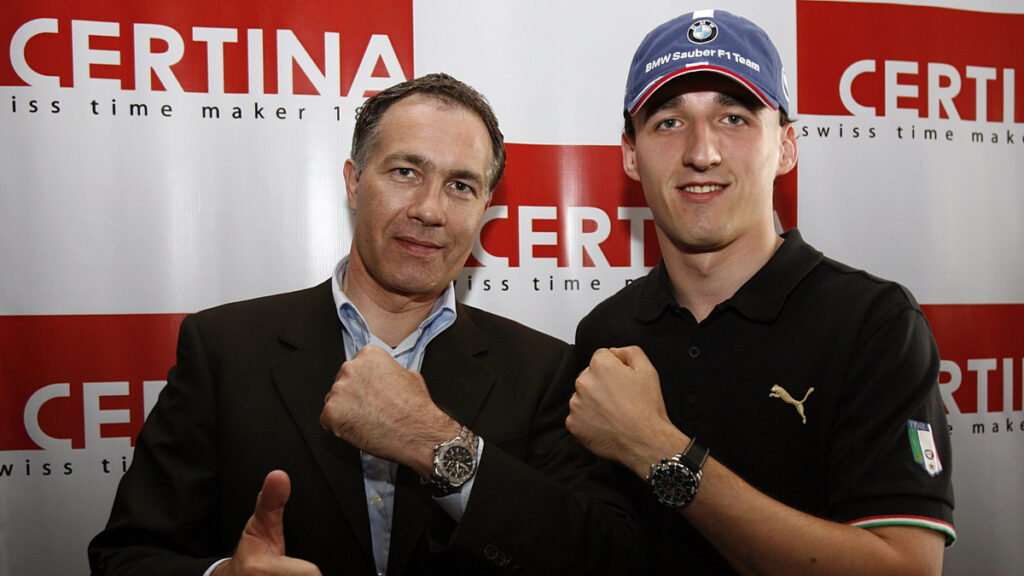
Founded in 1888 in Grenchen, Switzerland, Certina has built its identity around durability, precision, and sportiness. Its debut in Formula 1 came in 2005, when it became an Official Partner of the Sauber Petronas F1 Team, marking the beginning of a partnership that would last for a decade, even during the BMW Sauber years.
The collaboration centers in particular on Robert Kubica, a Certina ambassador since 2006 and a driver for BMW Sauber. The DS Action Robert Kubica was created for the Polish driver, featuring a carbon-fiber dial and a design inspired by Formula One cars; the limited edition sold out in just a few weeks.
Throughout the partnership, several models dedicated to the team were also created, including the DS Podium BMW Sauber F1 Team, while the brand gradually gained visibility on the cars as well. This ten-year partnership allowed Certina to establish a permanent presence in the paddock and directly link its sports watch production to Formula 1.
Chronotech — Team Partner
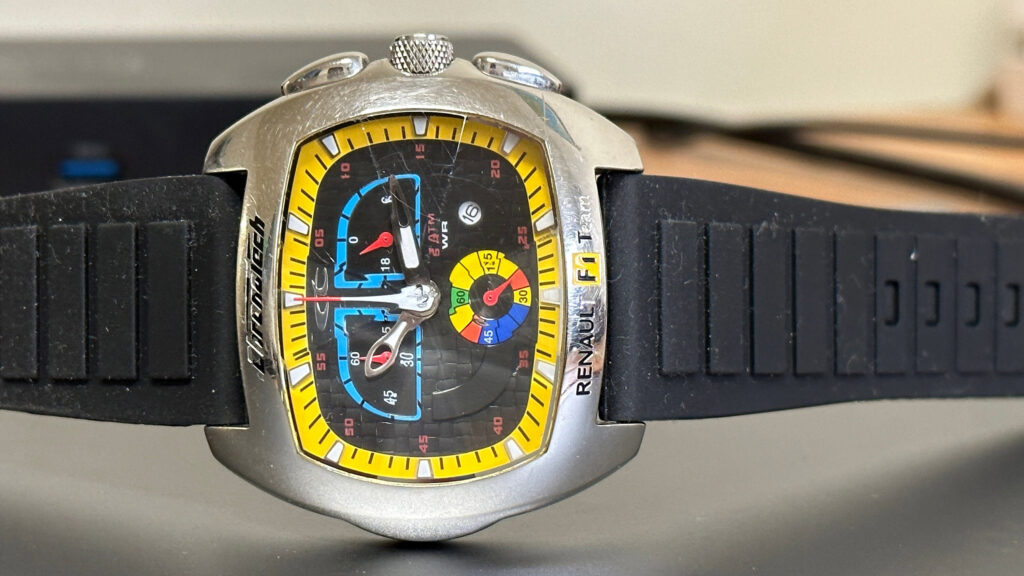
Chronotech, an Italian brand founded in Milan, entered Formula 1 in 2005 as a sponsor of the Renault F1 Team, the very year Fernando Alonso won the first of his two world championships. The partnership continued through 2008, spanning the 2006 season as well, the year Renault won its second consecutive championship.
This partnership has led to the creation of several special editions dedicated to the team and its drivers, including the Chronotech Renault F1 Team R26 Steering Wheel, directly inspired by the single-seater in which Alonso won the title in 2006 and featuring a case modeled after a Formula 1 steering wheel. Commemorative models were also produced to mark certain victories and podium finishes by Alonso and Giancarlo Fisichella.
A brief partnership, yet one that was particularly emblematic of Formula 1 in the 2000s, when even more affordable Italian brands could transform the liveries of the top teams’ single-seaters into true timepieces.
Citizen — Team Partner
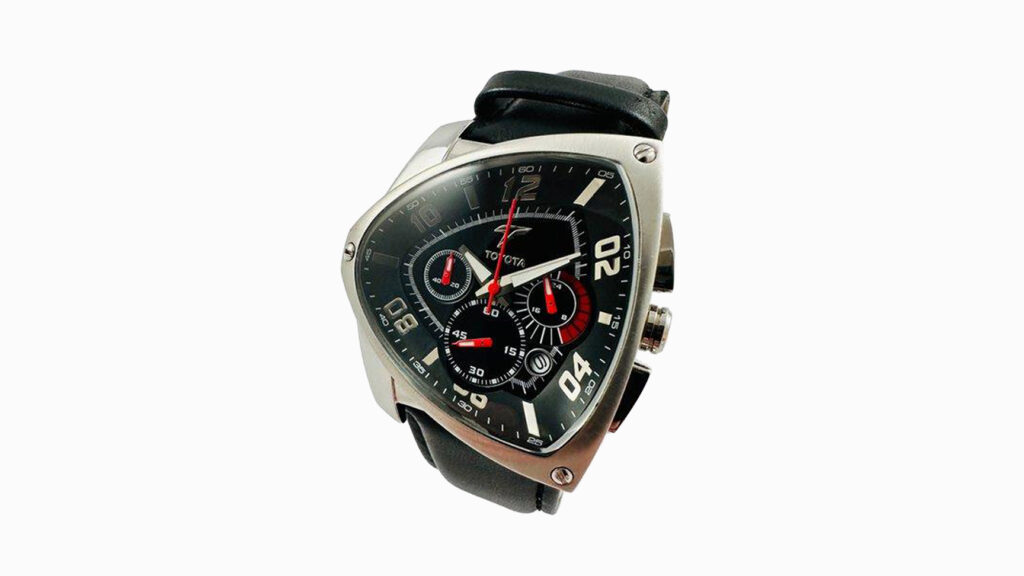
Founded in Japan in 1930, Citizen has built its identity on technological research, from innovations in electronic watchmaking to Eco-Drive technology. Its relationship with Formula 1 dates back to 1975, when the brand became a sponsor of Maki Engineering, a small Japanese racing team that competed in several championship races with the Maki F101C. The Citizen logo appeared on the race car during those appearances.
Much later, in 2003, Citizen also became associated with Toyota Racing through a series of watches dedicated to the team, including a unique chronograph with a case inspired by the nose of the Toyota TF103. However, the available documentation regarding this second partnership is less detailed, making it difficult to define it as a true official partnership.
Citizen’s presence in Formula 1 therefore remains primarily a historical curiosity: an example of how, as early as the 1970s, even Japanese watchmakers began using motorsports as a showcase for their technological image.
Franck Muller — Team Partner / Driver Partner
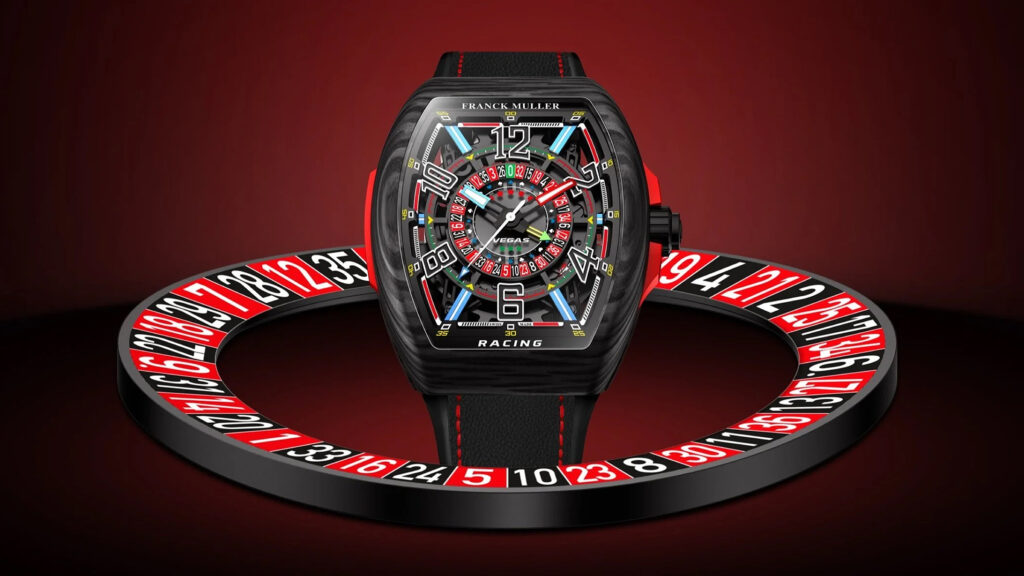
Vanguard Racing Vegas Limited Edition, created for the Las Vegas Grand Prix
Founded in Geneva in 1991 by master watchmaker Franck Muller, the brand quickly made a name for itself through its pursuit of mechanical complications and an increasingly distinctive aesthetic. Its entry into Formula 1 came in 1994 through a personal collaboration with Jean-Denis Delétraz: the Franck Muller logo appeared on the engine cover of the Larrousse LH94 during the Australian Grand Prix.
In 1995, Delétraz also featured the brand on the Pacific PR02, which had a curious feature in some races: two watch brands, Franck Muller and Catamaran, appeared simultaneously on the same single-seater. In 1998, the brand became a sponsor of Minardi, an occasion that also led to the creation of a limited edition of 50 pieces dedicated to the team.
A brief and sporadic involvement, but an interesting one because it marks Franck Muller’s entry into motorsports during the very years when the young Geneva-based brand was establishing its international identity.
Girard-Perregaux — Team Partner
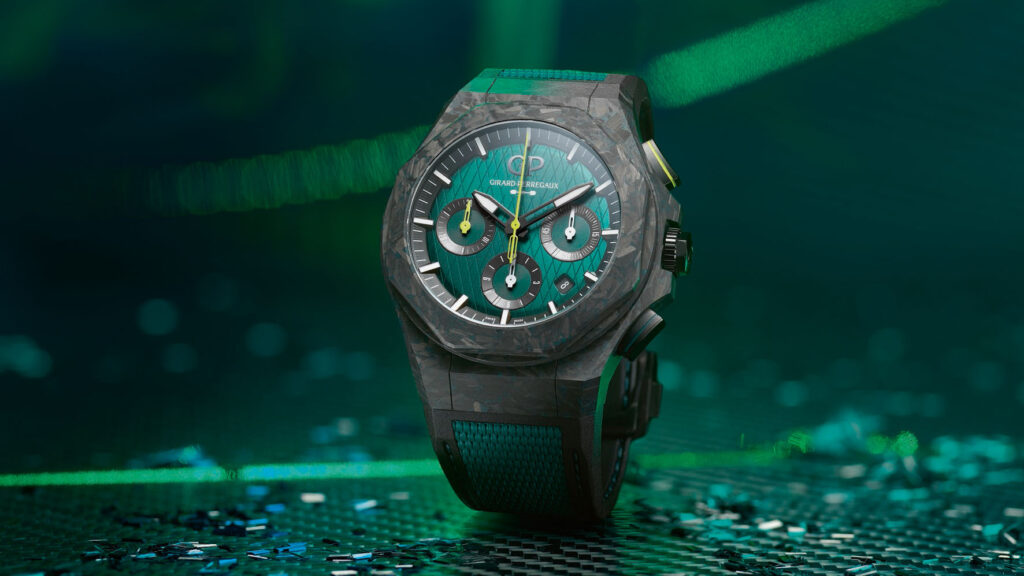
Aston Martin F1 Edition Absolute Chronograph Watch
The history of Girard-Perregaux dates back to 1791, when Jean-François Bautte established his business in Geneva. The brand’s connection to Formula 1 took shape primarily through Ferrari: from 1993 to 2004, the brand produced the Girard-Perregaux pour Ferrari collection, featuring numerous models dedicated to the Scuderia and its race cars. Among the most interesting are the F2003 GA, inspired by the 2003 World Champion Ferrari, and the 156 F.1, dedicated to the Ferrari 156 with which Phil Hill won the world title in 1961.
In 2021, Girard-Perregaux officially returns to Formula 1 alongside Aston Martin. This collaboration led to the creation in 2022 of the Laureato Absolute Chronograph Aston Martin F1 Edition, crafted using titanium powder and carbon fiber sourced from two Aston Martin single-seaters from the 2021 season. The strap also incorporates rubber and carbon fiber derived from the same cars; production is limited to 306 pieces.
After five seasons with Aston Martin, which concluded in 2025, the brand began 2026 alongside Williams Racing as its Official Watch Partner and Chronograph. This new chapter reaffirms Girard-Perregaux’s status as one of the longest-standing and most versatile brands in the relationship between fine watchmaking and Formula 1.
H. Moser & Cie. — Team Partner / Timekeeping Partner
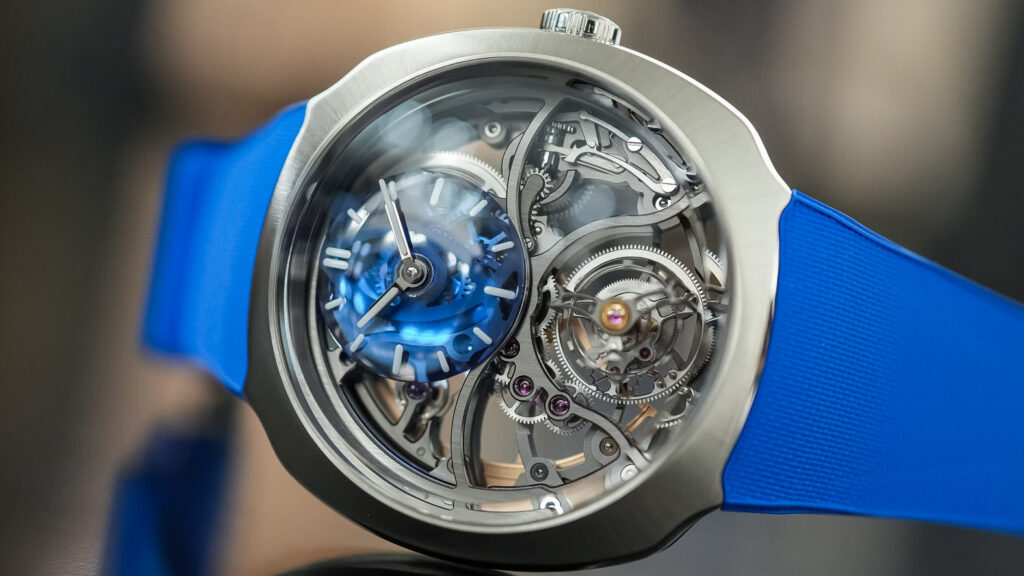
H. Moser & Cie. Streamliner Cylindrical Tourbillon Skeleton Alpine Limited Edition
Founded in 1828 by Heinrich Moser, the Swiss watchmaker H. Moser & Cie. is known today for its approach to fine watchmaking that is as traditional as it is unconventional. The partnership with Formula 1 began in 2024, when Moser became the First Global Partner and Timekeeping Partner of Alpine Motorsports, supporting not only the BWT Alpine F1 Team but the French team’s entire motorsports program.
However, the partnership goes beyond simple sponsorship. Alpine engineers and Moser watchmakers have launched a technical collaboration between the Enstone technology center and the Swiss watchmaking manufactory. The first result is the Streamliner Cylindrical Tourbillon Skeleton Alpine Limited Edition , followed in 2025 by a pair of watches developed in collaboration with drivers and technicians: the Streamliner Alpine Drivers Edition, a skeletonized chronograph with an AgenGraphe movement, and the Streamliner Alpine Mechanics Edition, designed specifically to meet the needs of a Formula 1 team and equipped with connected technology.
A particularly successful example of how a partnership can go beyond the mere use of colors and logos, transforming the relationship between watchmaking and Formula 1 into a true research and development project.
Hublot — Official Timekeeper / Team Partner
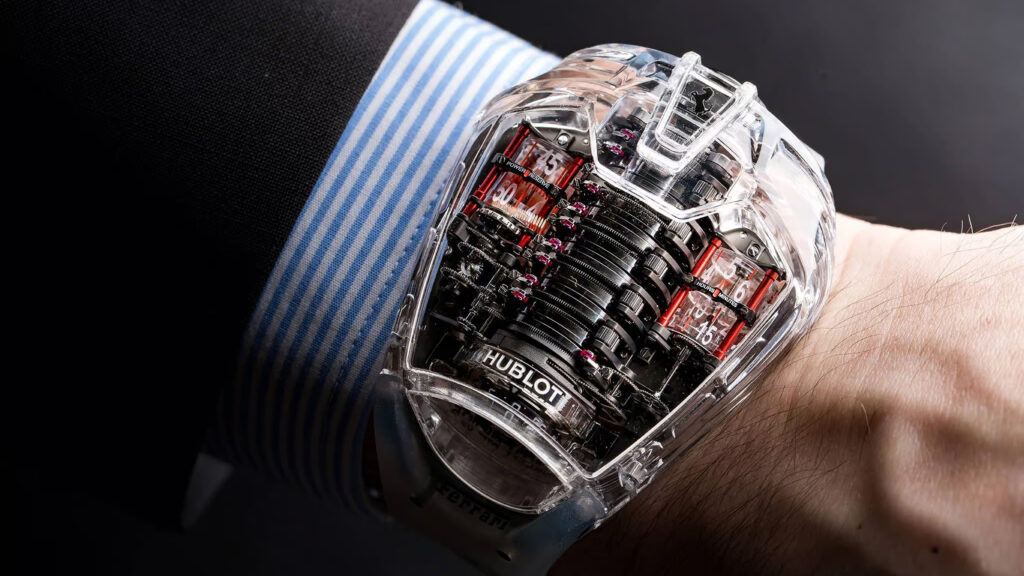
Hublot MP-05 LaFerrari
Founded in 1980 by Carlo Crocco, Hublot has stood out from the very beginning for its desire to combine seemingly disparate materials and styles, encapsulated in the concept of “Art of Fusion.” In fact, the brand’s first model combined a gold case with a rubber strap for the first time, foreshadowing the exploration of materials that would become one of the maison’s defining characteristics.
The partnership with Formula 1 reached its peak in 2010, when Hublot became the championship’s Official Watchmaker, a role it held until 2012. It was during this very period that one of the most famous marketing stunts in recent watchmaking history took place: in November 2010, Bernie Ecclestone was mugged and robbed in London, losing his Hublot in the process.
After the attack, he sent Jean-Claude Biver a photograph of his swollen face accompanied by the phrase “See what people will do for a Hublot.” Biver immediately turned the incident into an advertisement, which was published on December 8 in the Financial Times and the International Herald Tribune.
In 2011, Hublot also announced a strategic partnership with Ferrari, which officially began in 2012 and continued through the end of 2020. The partnership extends far beyond Formula 1, encompassing the Scuderia, the Ferrari Challenge, GT racing, and numerous Ferrari events. Among the key figures in the collaboration is Sebastian Vettel, while the brand has created an extensive collection of Ferrari timepieces.
Among the most extreme models, the 2016 MP-05 LaFerrari stands out, a manual-winding tourbillon with a 50 day power reserve, while the Big Bang Ferrari 1000 GP celebrates Scuderia Ferrari’s 1,000th Grand Prix in 2020 with a limited edition of just 20 pieces.
Hublot is therefore one of those cases in which the relationship between watchmaking and Formula 1 develops simultaneously on an institutional level and on a creative and commercial level, through one of the most comprehensive partnerships ever forged with Ferrari.
IWC Schaffhausen — Team Partner / Driver Partner
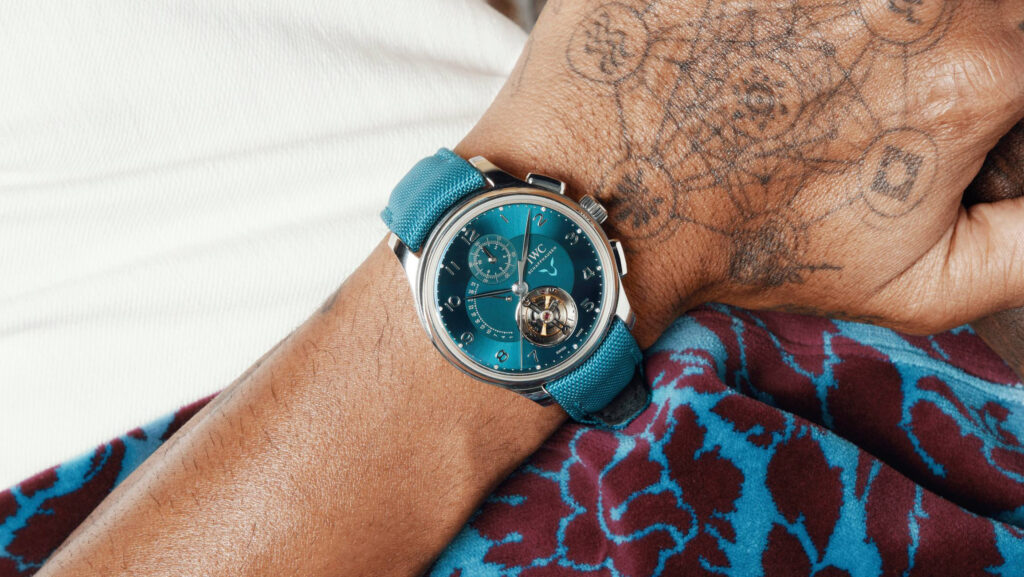
IWC Portugieser Tourbillon Rétrograde Chronograph Lewis Hamilton
Founded in 1868 in Schaffhausen by the American watchmaker Florentine Ariosto Jones, IWC has built its identity on the combination of fine watchmaking and precision engineering. The brand’s connection with Formula 1 began in 2013, when it became an official partner of the Mercedes-AMG PETRONAS Formula One Team.
The collaboration also extends to Lewis Hamilton, an IWC ambassador since 2013 and the inspiration behind three timepieces created in partnership with the brand. In 2014,the Ingenieur Chronograph Edition Lewis Hamilton was launched, featuring a titanium case and a carbon-fiber element sourced from a race car. In 2019, the Big Pilot’s Watch Perpetual Calendar Edition “Lewis Hamilton” was introduced, featuring a black ceramic case, a burgundy dial, and gold accents.
In 2023, the project reached new heights with the Portugieser Tourbillon Rétrograde Chronograph Lewis Hamilton, featuring a flying tourbillon, chronograph, and retrograde date, and produced in a limited edition of just 44 pieces, a nod to the driver’s race number.
In 2025, IWC finally brings its partnership with Formula 1 to the big screen, becoming one of the official sponsors of APXGP, the fictional F1® THE MOVIE racing team. For the film, the brand creates several watches dedicated to the team, including two Pilot’s Watch Chronographs featuring colors and details inspired by the race car, once again transforming Formula 1 into a testing ground for the brand’s design and communication.
Jacques Lemans — Licensed / Co-branded
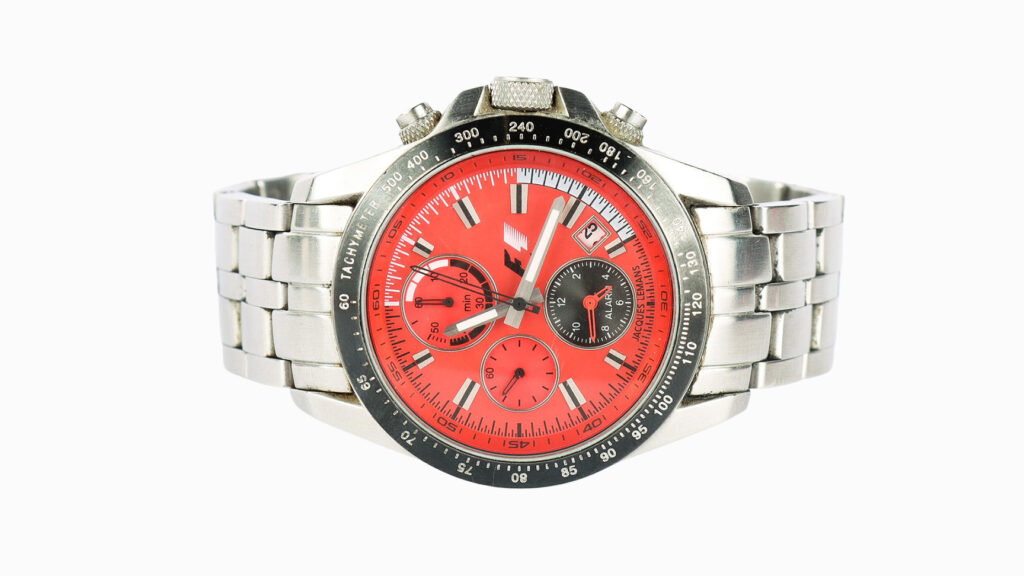
JACQUES LEMANS Formula 1 F5007
Founded in 1975 in Austria by Alfred and Norbert Riedl, Jacques Lemans entered the world of Formula 1 in 2006 through a direct agreement with Bernie Ecclestone and Formula 1 Management. This is not a team sponsorship, but a true licensing agreement that allows the brand to officially use the Formula 1 logo on its watches.
This led to the creation of the F1 Collection, unveiled at Baselworld in 2006 and designed for a much broader audience than that of haute horlogerie, with prices ranging from 190 to 390 euros. Despite its affordable positioning, the models feature materials typical of motorsports, including carbon fiber, titanium, ceramic, and rubber. The ten-year agreement remains in effect through 2015, while the collection continues to be developed in numerous variations.
Jacques Lemans thus represents a unique case in the history of Formula 1: not a brand featured on the livery of a race car, but a manufacturer that obtained the right directly from Formula 1 to incorporate its name, logo, and design elements into a watch collection.
Longines — Official Timekeeper / Team Partner
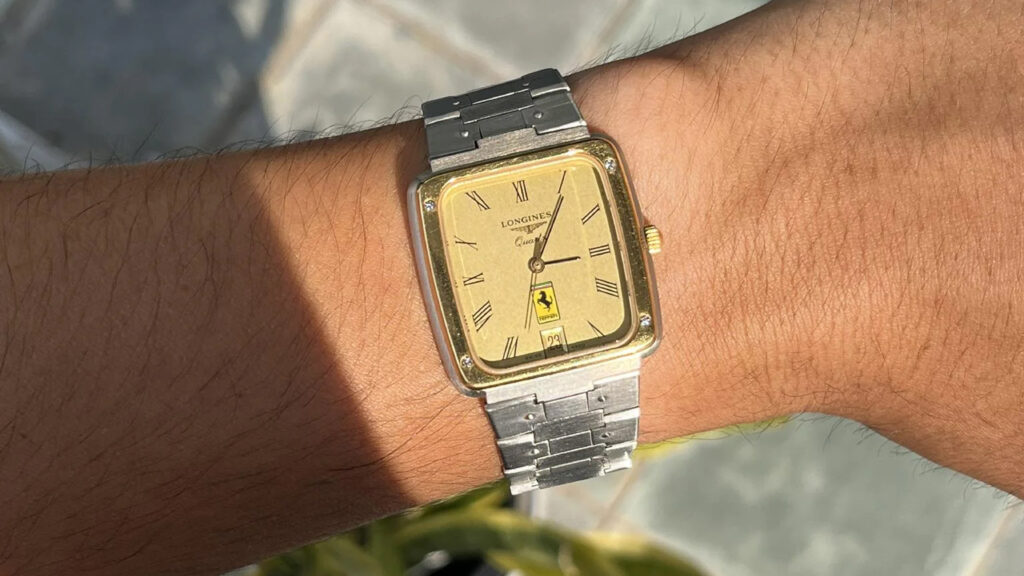
Founded in 1832 in Saint-Imier, Longines has one of the longest-standing traditions in sports timekeeping. Its relationship with Formula 1 took on particular significance in the early 1980s, when the company acquired the ACIT system from Heuer, and in 1982 became the Official Timekeeper of the championship alongside Olivetti, a role it held until 1991.
At the same time , Longines forged a direct relationship with Scuderia Ferrari, which began in 1980 and continued throughout the decade. Starting in 1981, several Ferrari watches were produced, including the ref. 4870.4, which was also given as a gift to the team’s drivers and executives. Gilles Villeneuve and Didier Pironi received personalized pieces, while a special solid-gold version was created for Enzo Ferrari.
The brand’s presence in single-seater racing is equally significant: the Longines logo appeared on Ferrari cars throughout the 1980s, right up to the 1989 640 driven by Nigel Mansell. The brand also partnered with Renault between 1981 and 1985, although the agreement with Ferrari prevented the production of dedicated Renault watches.
Longines thus represents one of the key milestones in the evolution of timekeeping in Formula 1: a brand that has not merely linked its name to racing, but has brought its expertise to the championship to develop increasingly efficient timing technology.
Movado — Licensed / Co-branded
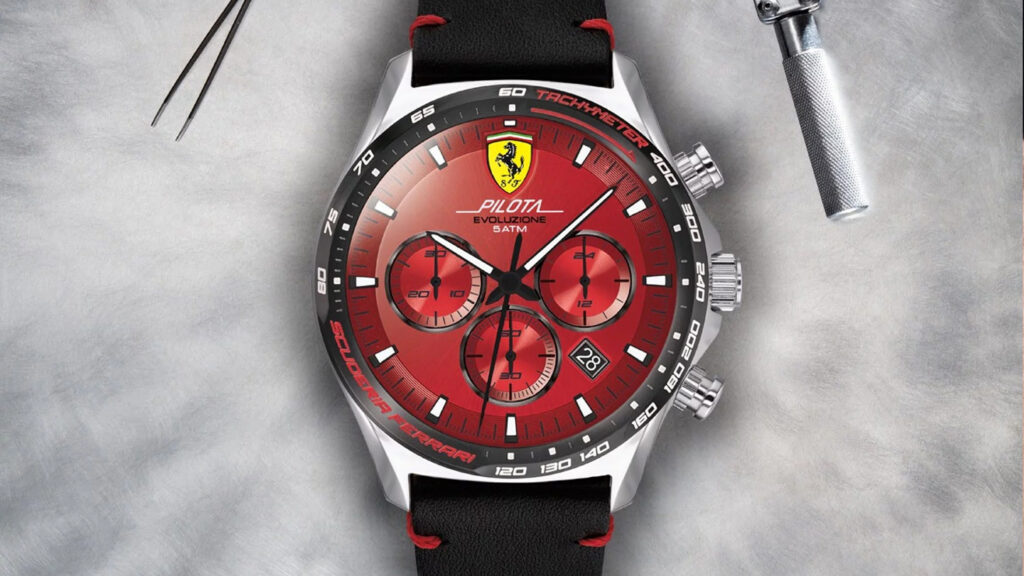
Founded in 1881 in La Chaux-de-Fonds, Movado entered the Ferrari universe in 2012 through a global licensing agreement to design, manufacture, and distribute watches under the Ferrari and Scuderia Ferrari brands. The collection, unveiled at Baselworld in 2013, was positioned as much more affordable than the contemporary collaboration between Ferrari and Hublot, with prices up to 1,500 euros.
The project includes the Formula Italia line and several chronographs inspired by Ferrari cars. It is interesting to note that Ferrari itself viewed the Movado collection as complementary to its own activities in the high-end watchmaking segment: in corporate documents from that era, Hublot is in fact listed as a partner for high-luxury watches, while Movado is associated with Scuderia Ferrari Watches.
The agreement was renewed in 2017 and continues through 2022, making Movado one of the leading players in the more affordable segment of Ferrari watchmaking. It is, therefore, a licensing partnership rather than a sponsorship of the Scuderia, but it is nonetheless directly linked to the imagery and technology of the Prancing Horse’s single-seaters.
Omega — Driver Partner
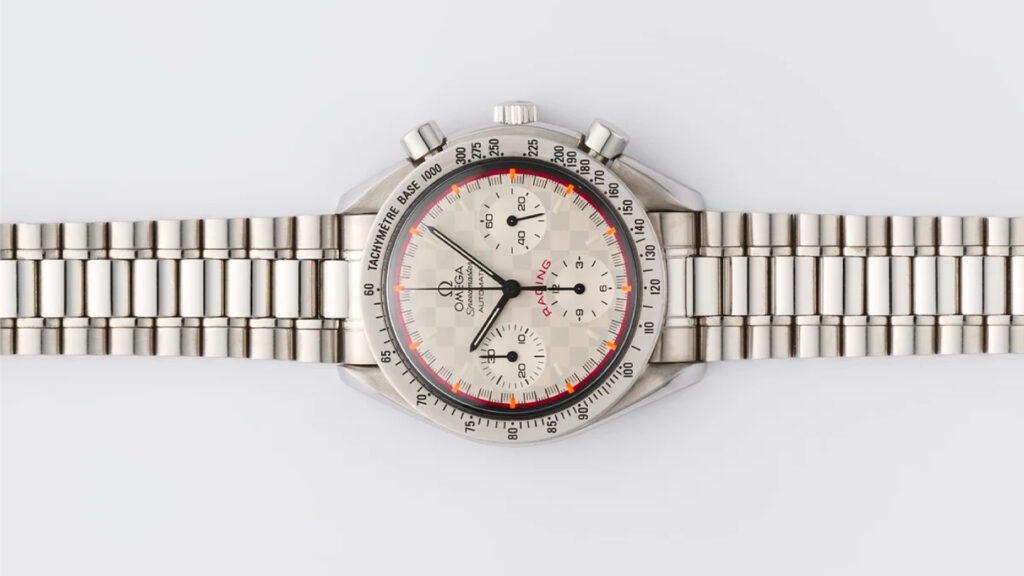
Omega Speedmaster Racing World Champion
The partnership between Omega and Michael Schumacher began in 1996, when the German driver became the brand’s ambassador. The first collection dedicated to the champion was unveiled at the Kerpen kart track, where Schumacher had first started racing: two Speedmaster Racing watches with red or yellow dials, accompanied by a unique tire-shaped presentation box.
The partnership grew alongside the driver’s successes. Following his 2000 title, the Speedmaster Racing World Champion was released, with a production run of 11,111 pieces, followed by editions dedicated to the 2001 and 2002 world championships. The latter, limited to 5,555 pieces, features a carbon-fiber dial and celebrates Schumacher’s fifth title by inscribing the years of his five world championships on the case back.
Finally, in 2004, *The Legend* was released, dedicated to Schumacher’s seventh championship title. The collection includes several variations and pays tribute to the driver’s career right on the dial: the hour markers stop at 7, symbolizing his seven world championships.
Oris — Team Partner / Driver Partner
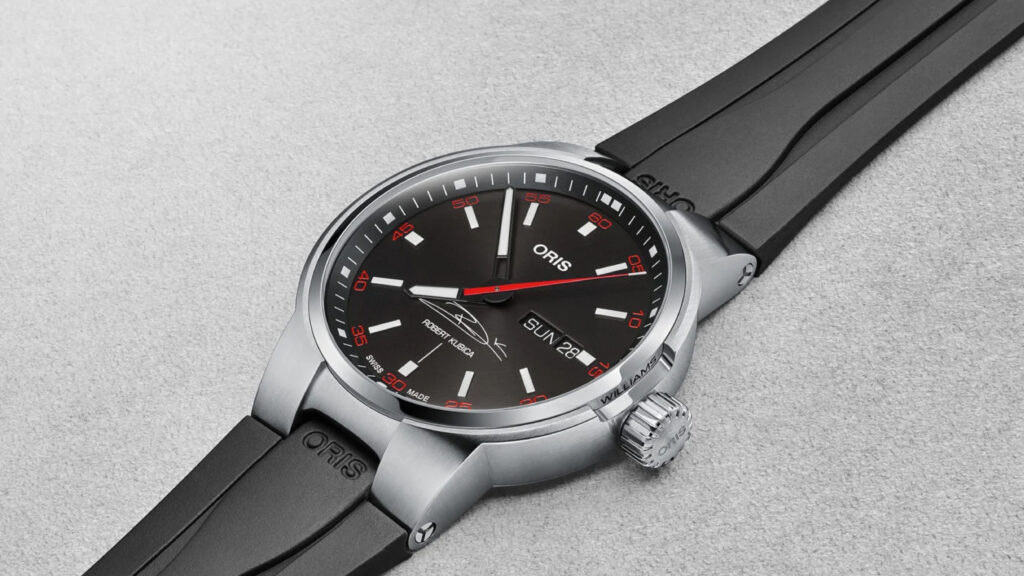
Oris Robert Kubica Limited Edition
Founded in 1904 in Hölstein, Switzerland, Oris entered Formula 1 in 2002 through Allan McNish, for whom it created the TT1 Allan McNish Limited Edition, produced in a run of 1,000 pieces and presented in a special helmet-shaped case.
In 2003, the most important partnership began, the one with Williams Racing, which continued through 2018. The partnership has resulted in the creation of numerous timepieces dedicated to the team and its drivers: among the most notable are the 2008 Kazuki Nakajima Limited Edition, produced in a run of 1,088 pieces and accompanied by a tire-shaped presentation box, and the 2018 Robert Kubica Limited Edition, limited to 250 pieces.
Fifteen years of collaboration have made Oris one of Williams’ longest-standing partners, with the brand also featured on the race cars and a watch collection that has turned the team and its drivers into full-fledged collections of their own.
Panerai — Official Timekeeper / Licensed
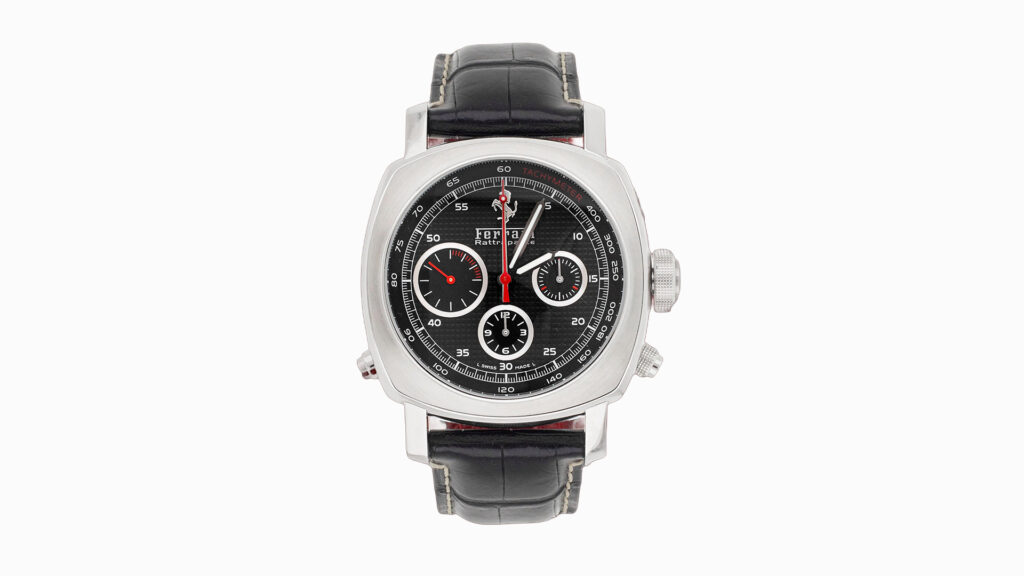
Founded in Florence in 1860, Officine Panerai built its identity around professional instruments and the Italian military tradition before becoming one of the most recognizable brands in contemporary fine watchmaking.
The partnership with Ferrari began in 2005 through Richemont: Panerai was commissioned to develop the “Ferrari engineered by Panerai” collection and, at the same time, assumed the role of Official Timekeeper to Ferrari. The collaboration, which continued until 2010, led to the creation of numerous chronographs dedicated to the Scuderia and its cars.
Among the most interesting models is the Luminor Chrono Ferrari, available in several versions and featuring a strong automotive influence.
Richard Mille — Driver Partner / Team Partner
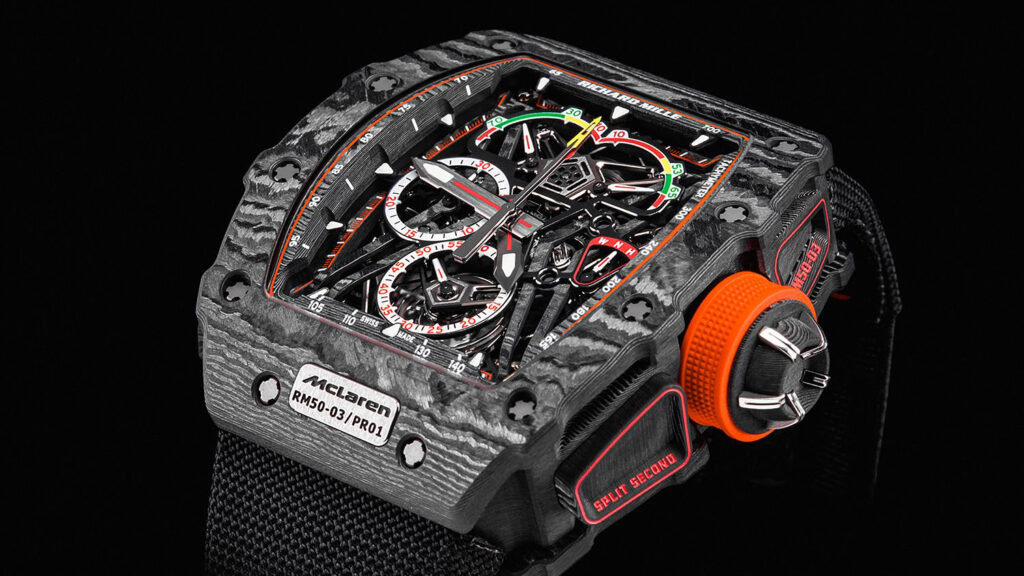
Founded in 2001, Richard Mille has, from the very beginning, built a philosophy that combines fine watchmaking, motorsports, and advanced engineering. The brand’s partnership with Formula 1 began in 2004 with Felipe Massa and led to the creation of the RM 006 Tourbillon Felipe Massa, a watch weighing just 43 grams and designed to withstand the violent accelerations and vibrations of a single-seater race car. The model also introduced a nanofiber carbon movement plate, a technology destined to become one of the brand’s hallmarks.
Starting with Massa, Richard Mille has built a veritable network of drivers, including Fernando Alonso, Kimi Räikkönen, Romain Grosjean, Charles Leclerc, and Lando Norris, complementing individual partnerships with collaborations with racing teams. Of particular importance is the relationship with McLaren, which began in 2016: Richard Mille cites the carbon-fiber monocoque introduced by the team in 1981 as one of the main inspirations for the use of carbon nanofibers in the construction of its movements.
The most extreme result of this collaboration is the 2017 RM 50-03 Tourbillon Split Seconds Chronograph Ultralight McLaren F1, developed in partnership with McLaren engineers and the University of Manchester. The project also utilizes graphene in the pursuit of maximum lightness and is presented by Richard Mille as the lightest mechanical chronograph ever made.
The pursuit of lightness is also evident in the RM 67-02 chosen by numerous athletes and drivers, which weighs just 32 grams. At the same time, the brand has forged a direct partnership with Ferrari, which now extends to Formula 1, the WEC, GT racing, and the Ferrari Driver Academy.
More than just a simple sponsorship, Richard Mille has thus transformed motorsports into a testing ground for its watchmaking: composite materials, ultralight constructions, and technical solutions developed in collaboration with drivers, engineers, and teams have become an integral part of the design of its timepieces.
Rolex — Official Timepiece / Global Partner
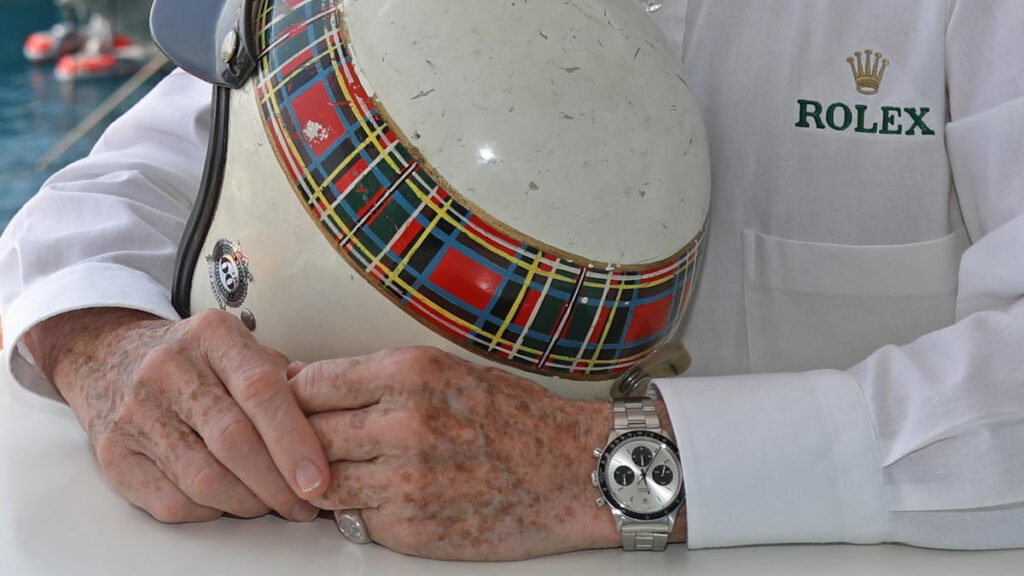
Among the brands most deeply rooted in motorsports, Rolex holds a special place. Its history in racing dates back to the 1930s with Sir Malcolm Campbell, the “King of Speed, ” who had been wearing a Rolex Oyster since 1930 during his attempts to break speed records. On September 4, 1935, driving the Bluebird on the Bonneville Salt Flats, Campbell surpassed the 300-mile-per-hour mark for the first time, reaching approximately 485 km/h and setting his ninth world record. After the feat, he sent a telegram to Rolex: “The Oyster,” he wrote, “continues to keep perfect time.”
That pioneering era of speed records marked the first chapter in a relationship with motorsports that would evolve over the decades, eventually becoming intertwined with some of its most prestigious events. It is at this point that Daytona enters the picture: in 1963, Rolex introduced the Cosmograph Daytona, a watch destined to become an icon in the world of watchmaking, a chronograph designed for race car drivers and equipped with a tachymeter scale for calculating average speed.
Rolex had already been a partner of the Daytona International Speedway since its opening in 1959, and in 1992 it became the title sponsor of the 24 Hours of Daytona: since then, every winning driver has received a Cosmograph Daytona engraved with the race’s name, the date, and the word “Winner.”
Formula 1 came on the scene in 2013, when Rolex became the championship’s Global Partner and Official Timepiece. The relationship, however, has its roots much further back: as early as 1968, Rolex had been supporting Sir Jackie Stewart, a three-time world champion and one of the most iconic drivers in Formula 1 history. The partnership with the championship thus emerged as a natural evolution of a connection to motorsport forged through its leading figures.
Unlike many luxury brands, Rolex has never needed to create an aesthetic that is overly tied to Formula 1. Its relationship with motorsports is built on continuity: from Campbell’s records to major endurance races, all the way to Grand Prix events. And this is one of the most interesting aspects of the partnership: Rolex didn’t simply bring its name to Formula 1, but integrated the championship into a history of motorsports that began nearly a century earlier.
Seiko — Team Partner / Driver Partner
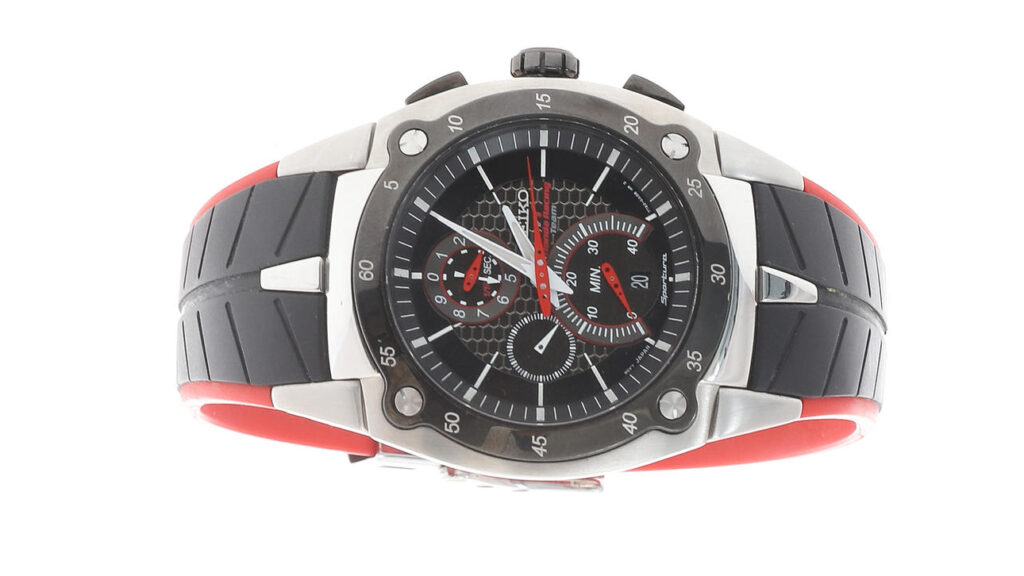
Founded in Tokyo in 1881 by Kintaro Hattori, Seiko is one of the leading names in Japanese watchmaking, and in 1969 it introduced the first mass-produced quartz watch. Its relationship with Formula 1 took on a concrete form in 2005, when the brand became a partner of BAR Honda, marking the beginning of a collaboration that continued with Honda Racing F1 until 2008.
The partnership led to the creation of numerous Sportura, Ignition, and Brightz models dedicated to the team and to Jenson Button, who became a Seiko ambassador in 2006. Among the most interesting is the 2006 Sportura Ultimate Kinetic Chronograph, while in 2008 Seiko created a chronograph developed in part based on suggestions received directly from Honda engineers: steel, aluminum, carbon fiber, and polyurethane are used to incorporate the materials and requirements of motorsport into the timepiece.
Another particularly intriguing model is the Sportura Honda Racing F1 Ultimate Kinetic Chronograph, which comes with an authentic component from a Honda Formula 1 car and a certificate of authenticity. Seiko thus represents one of the most interesting examples of how, in Formula 1 during the 2000s, even a major industrial manufacturer could transform its relationship with a racing team into a genuine technical development project.
Swatch — Team Edition / Licensed
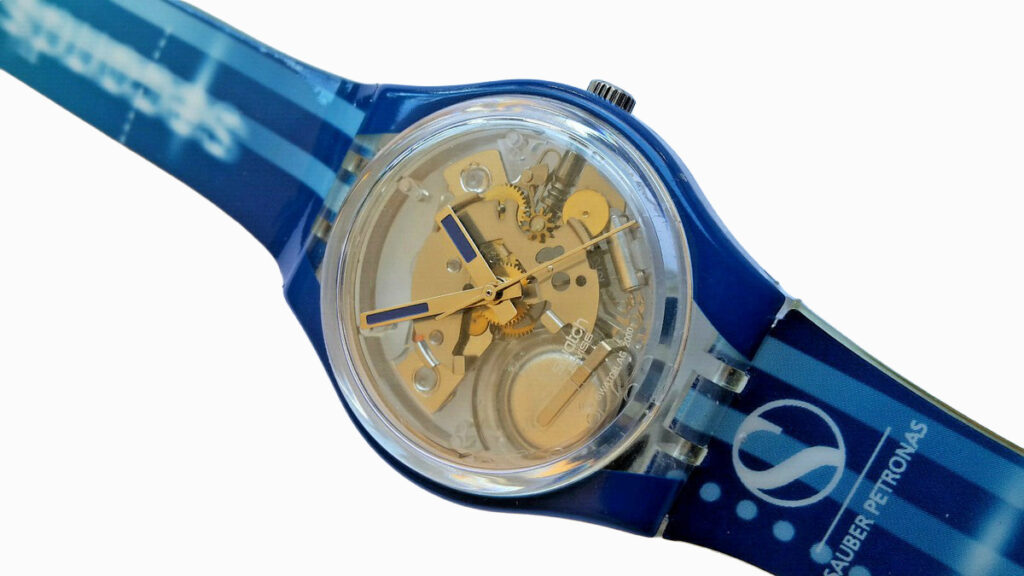
Founded in 1983 in response to the quartz crisis, Swatch represented one of the most significant revolutions in Swiss watchmaking, introducing a concept of colorful, affordable timepieces closely tied to popular culture.
One of the most interesting examples of Swatch’s relationship with Formula 1 came in 2003, when Swatch created several timepieces dedicated to the Sauber Petronas F1 Team and reserved for members of the Sauber Petronas Club. Among these was a model from the Swatch Originals collection, featuring a blue strap with team graphics and a skeletonized dial, as well as a Swatch Irony model dedicated to the team.
This is therefore not a partnership comparable to those of Rolex or TAG Heuer, but rather a curious foray by Swatch into the world of Formula 1, one that is perfectly in line with the brand’s philosophy: to transform even the world of racing into a pop culture phenomenon that is accessible and instantly recognizable.
TAG Heuer — Official Timekeeper / Team Partner / Driver Partner
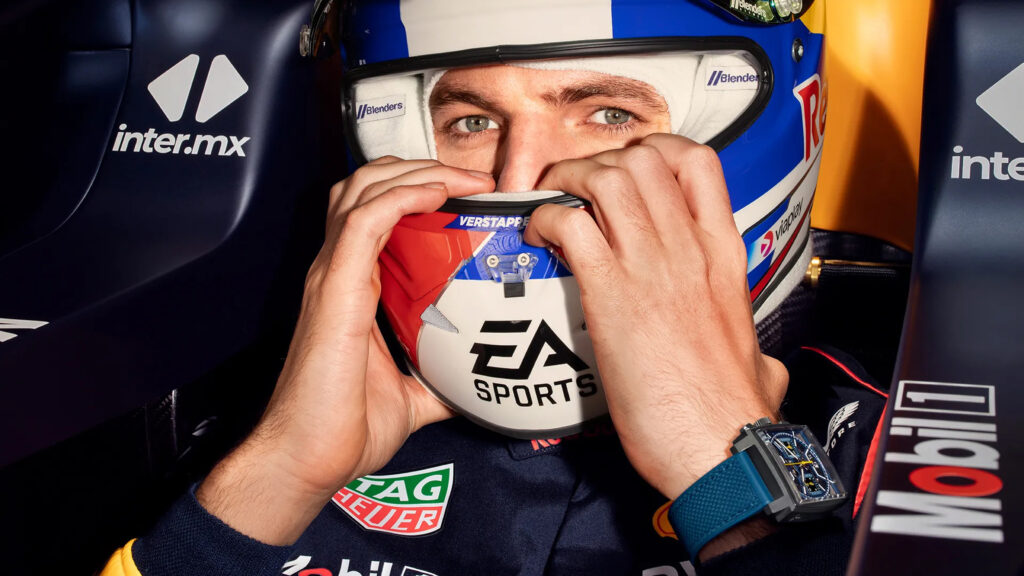
Few brands can boast a relationship with Formula 1 as deep as TAG Heuer’s. The story began when the brand was still known as Heuer: in 1969, Jo Siffert became the brand’s ambassador and displayed the Heuer logo on his race car, making it the first non-automotive brand to appear on a Formula 1 car. Two years later, Heuer also made history as a partner of Scuderia Ferrari, supplying timing systems to the team and developing the Centigraph, capable of measuring and printing times with a precision of 1/1,000 of a second.
However, it is on the wrists of drivers that Heuer has built a fundamental part of its legacy. In 1969, the Monaco was introduced, one of the brand’s first automatic chronographs, featuring a revolutionary square case and the Caliber 11. In 1970, Steve McQueen chose it for the movie *Le Mans*, wearing the Ref. 1133B along with the Heuer racing suit inspired by Jo Siffert’s. The result makes the Monaco one of the most recognizable timepieces in the history of motorsport-inspired watchmaking.
In 1985, Heuer joined the TAG Group, and TAG Heuer was born. Around the same time, the brand’s long-standing partnership with McLaren took shape, during which it supported champions such as Alain Prost, Ayrton Senna, Mika Häkkinen, and Lewis Hamilton. In 1986, the TAG Heuer Formula 1 was also introduced—an affordable, colorful quartz model that brought the aesthetics of racing to an entirely new audience.
After McLaren, the brand’s relationship with Formula 1 continued through Red Bull Racing and Max Verstappen, who became a TAG Heuer ambassador in 2016. Starting in 2025, however, the brand is taking another leap forward, returning to its role as the Official Timekeeper of Formula 1 as part of the decade-long partnership between LVMH and the championship. This is a particularly significant return: TAG Heuer had already held this role from 1992 to 2003 and is now officially back in charge of timing for the series. The brand’s latest project related to the world of racing is the Monza Flyback Chronograph; we discuss it here.
TAG Heuer’s history thus demonstrates how a brand can span nearly every era of Formula 1: from the mechanical stopwatches used in the pits to electronic timing systems, from the wrists of Siffert and McQueen to partnerships with McLaren and Red Bull, right up to its return as Official Timekeeper. In this case, rather than a simple sponsorship, we can speak of a genuine identity forged alongside motorsport.
Timex — Driver Partner
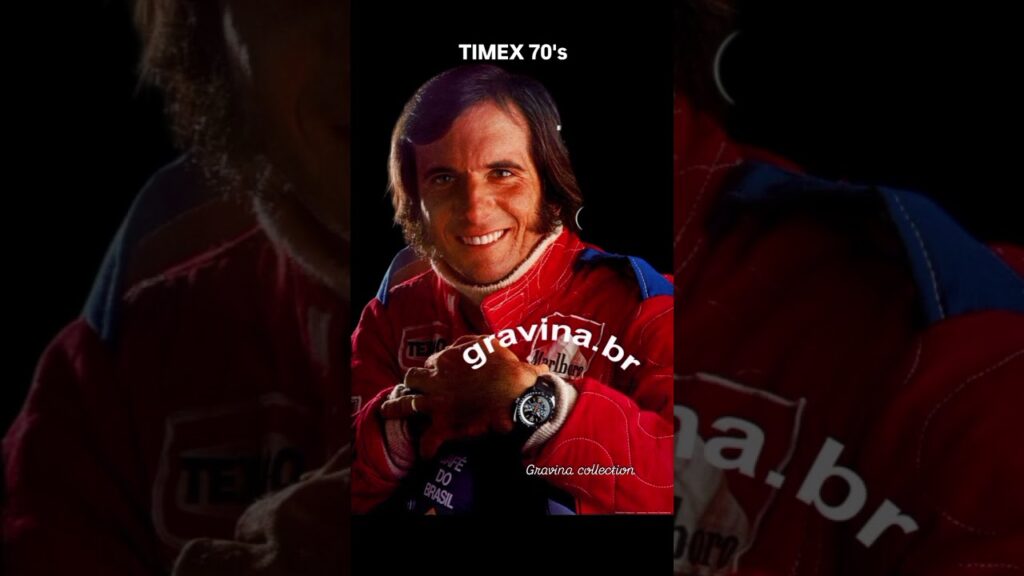
Founded in 1854 as the Waterbury Clock Company in the United States, Timex entered the world of Formula 1 in the mid-1970s through Emerson Fittipaldi, a two-time world champion in 1972 and 1974. The brand created three commemorative timepieces dedicated to the Brazilian driver, foreshadowing a trend that would become very common in the years to come: transforming a champion’s successes into a full-fledged watch collection.
The first model is based on the Timex Rally M25 and features a checkered flag at the 12 o’clock position, while the dial bears Fittipaldi’s name and his two world titles. Next are a Timex Electric and a Q Timex Quartz, both featuring the driver’s name and a reproduction of his helmet.
Rather than a traditional team sponsorship, the partnership between Timex and Fittipaldi thus represents one of the first examples of watchmaking built around the image of a Formula 1 champion: a foreshadowing, as early as the 1970s, of the increasingly close relationship between drivers, watches, and motorsport culture.
Tissot — Team Partner / Driver Partner
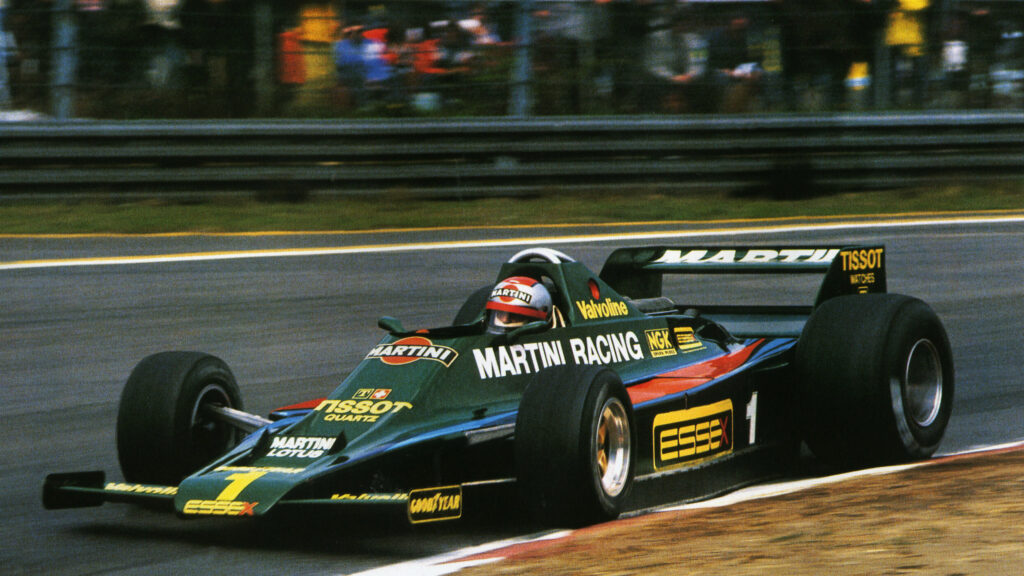
Lotus 80, sponsored by Tissot
Founded in 1853 in Le Locle, Tissot entered the world of Formula 1 as early as the 1970s. The brand made its debut in 1976 with Loris Kessel, and beginning in 1977, it forged more structured partnerships with Team Renault and, starting in 1979, with Lotus. In 1978, the first Tissot F1 collection was also launched, featuring digital and analog-digital timepieces inspired by the world of racing.
Among the most intriguing models of the era is the Tissot TSX2 F1, a digital watch that perfectly embodies the era’s passion for quartz technology. After an initial period of collaboration in the 1970s and 1980s, Tissot returned to the grid in 1994 alongside Sauber Mercedes, with its logo prominently displayed on the engine cover and rear wing of the C13.
Tudor — Team Partner / Official Timekeeper Partner
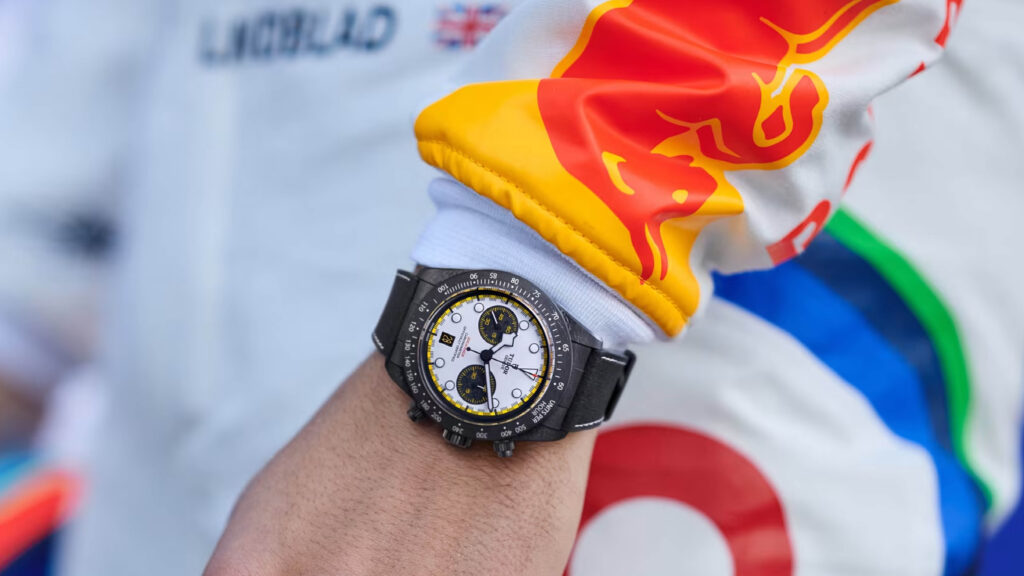
Tudor Black Bay Chrono Carbon 26
Tudor’s connection to motorsports did not begin with Formula 1. As early as the late 1960s , the brand was involved in auto racing through the Tudor Watch Racing Team, establishing a tradition that would continue in the years that followed, extending into the worlds of endurance racing and rallying.
The brand’s return to the highest levels of motorsport comes in 2024, when Tudor becomes an Official Partner of the Visa Cash App RB Formula One Team, now known as Visa Cash App Racing Bulls. The partnership places the brand’s logo directly on the race car and the drivers’ suits, and also features Daniel Ricciardo and Yuki Tsunoda.
To celebrate the partnership, the Black Bay Ceramic “Blue” has been created, initially reserved for team members and featuring a matte black ceramic case, a blue dial, and details that match the team’s colors. The model is Master Chronometer certified by METAS, with resistance to magnetic fields of up to 15,000 gauss and a 70-hour power reserve.
The partnership will continue into 2026, with Tudor remaining the Official Partner of Visa Cash App Racing Bulls. A return to Formula 1 rooted in a long-standing motorsport tradition, yet interpreted through a contemporary lens characterized by performance, technical materials, and a strong visual identity.
Our thoughts
This journey has allowed us to explore the key milestones that have shaped the connection between high-speed racing and watchmaking, from the dawn of motorsport to today’s collaborations between brands, drivers, and championships. Two worlds that have learned to race side by side, united by the same obsession with precision and the desire to constantly push the limits further.
by Gabriele Passarella
Are you looking for the perfect gift? Explore our online store and discover the entire collection signed IWS – Italian Watch Spotter!
For all real-time updates on the world of watchmaking follow us on Instagram and visit our Youtube channel.