
In Geneva, a stone’s throw from the manufacture, F.P. Journe is shaping a museum project about which little is yet known. An unspecified location, an expected opening by 2026, access by appointment: a few elements, essential, while the rest remains deliberately shrouded in mystery. Enough, however, to understand that the heart of the project is the collection.
In the new museum, alongside watches produced by the Maison from its beginnings in the 1980s to its most recent creations, instruments and timepieces from the 16th to 18th centuries, selected for their ability to illuminate technical principles and conceptual transitions, will be on display.

The interior of the F.P. Journe manufacture in Geneva
“It is to show my work from 1983 to the present, visually explaining its connections to history and demonstrating this through ancient pieces from the 16th, 17th and 18th centuries,” explains François-Paul Journe.
This statement reveals a profound aspect of his work: an active relationship with his own past. That in recent years has translated into a focused activity in auctions, where Journe has bought back some of his earliest watches. A gesture that goes beyond the desire to complete a didactic collection, and rather responds to the desire to “reconstruct one’s heritage,” he says to clearly distinguish between accumulation and historical construction.
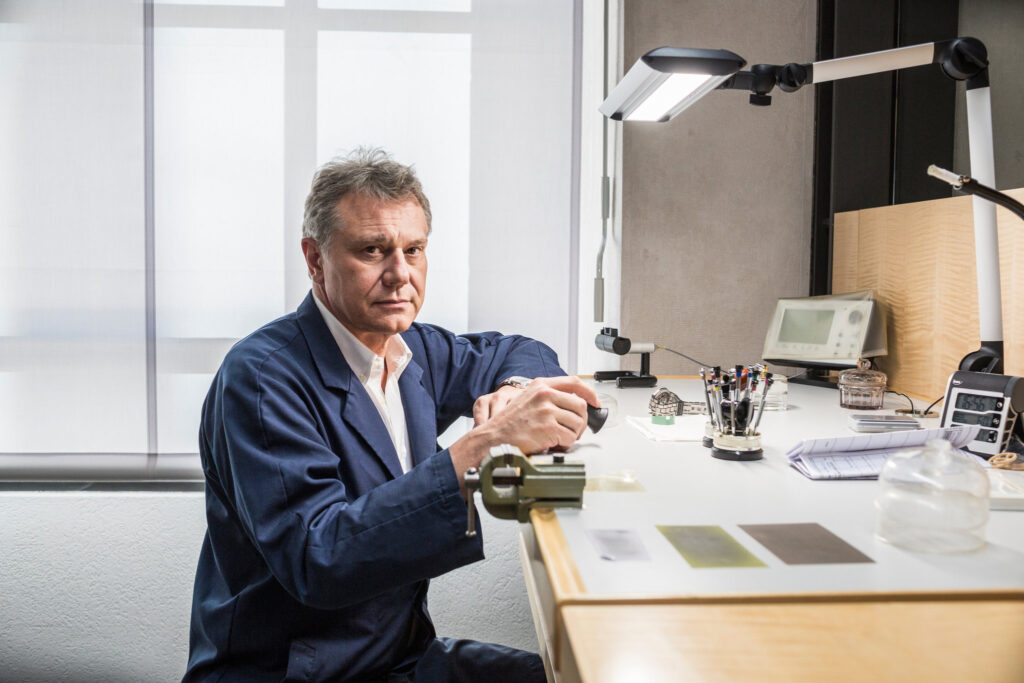
François-Paul Journe
Compared to the museum complexes of maisons such as Patek Philippe or Breguet, Journe ‘s project is distinguished by its selective and interpretive nature. Far from being linear or purely chronological, Journe proposes an open curatorial approach that does not isolate contemporary work but places it within a broader technical and cultural genealogy.
F.P. Journe auction acquisitions: from Breguet to historic watchmaking masterpieces
Along with the exhibition route that remains largely unspoken, even the complete selection of works remains, in F.P. Journe‘s words, still “a surprise.” It is precisely the most recent acquisitions that offer the first clue to the construction of this narrative.
Among them all is Abraham-Louis Breguet’s Pendule Sympathique No. 1. Repurchased by Journe for more than 5.5 million Swiss francs from Phillips last May, it is both a technical masterpiece that echoes a late 18th-century principle and an object intimately linked to his creative trajectory.
“I bought it because I designed it,” he explains, “and it is a fundamental piece of 20th-century watchmaking.” Conceived in the 1990s together with the Techniques Horlogères Appliquées team, the clock reinterprets a principle developed by Breguet in the late 18th century: the “sympathique” system, in which a mother clock is able to set, wind and synchronize a dedicated pocket watch.
In the case of the Pendule Sympathique No. 1, the pocket watch, once inserted into the pendulum’s housing, is automatically adjusted in precision, set back to the time and wound. A device involving sophisticated integration of regulating organs, power transmission systems and synchronization mechanisms.

La Pendule Sympathique No. 1 by Abraham-Louis Breguet
This was accompanied by another significant acquisition: during the Sotheby ‘s auction dedicated to Breguet‘s 250th anniversary, Journe acquired an important pocket watch, known as Breguet no. 1890. Dating from the early 19th century, the timepiece incorporates some of the most advanced solutions of its era, including the tourbillon and the escapement, designed by Breguet itself developed from the insights of Abraham-Louis Perrelet to improve the efficiency of energy transmission by reducing friction.
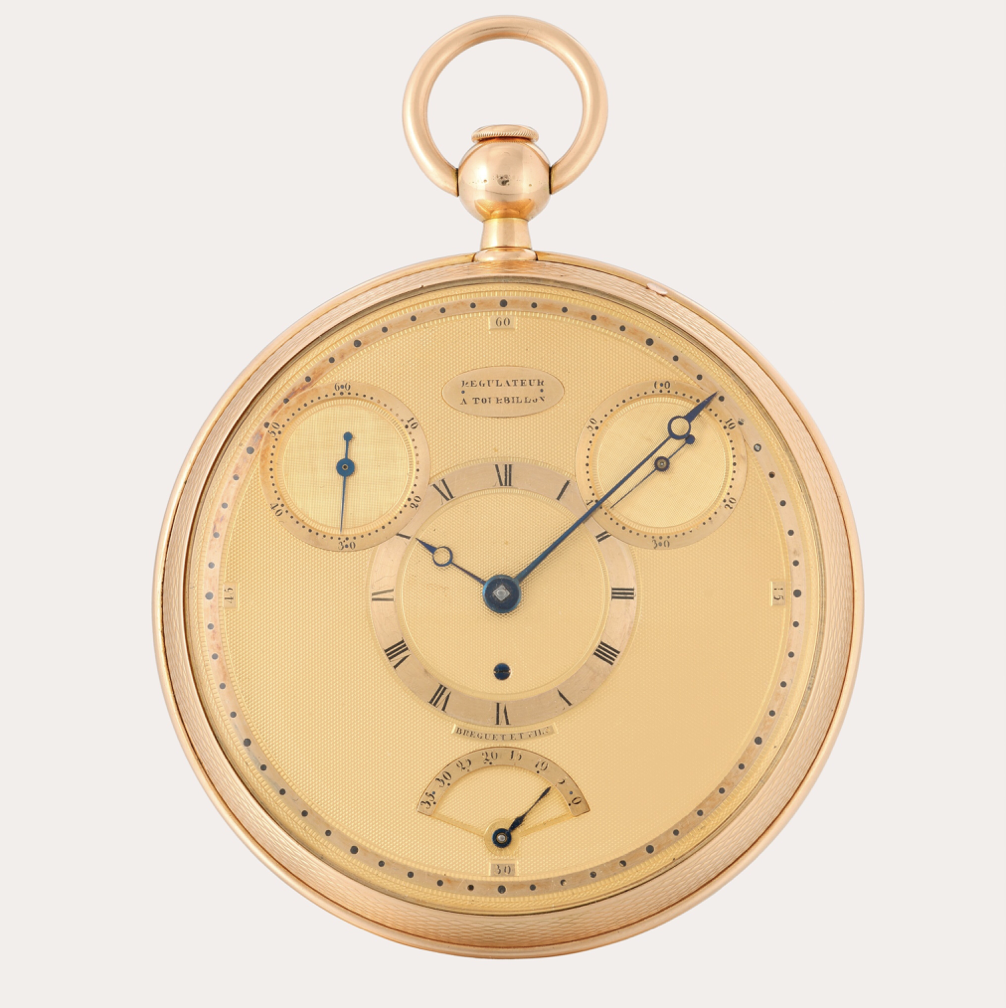
The Breguet no. 1890
It is an object that testifies to the pinnacle of Breguet’s technical research, while at the same time helping to define the dialogue the museum intends to build: an ongoing confrontation between historical inventions and contemporary experimentation, in which each piece becomes part of a larger narrative about the measurement of time.
Beyond the exhibition: historical and contemporary clocks in the F.P. Journe Museum
This attention to the connections between past and present is rooted in Journe‘s own training, which began in restoration, in that direct confrontation with the mechanics of the past that involves disassembling, understanding and reconstructing. But also interpreting the technical solutions of the past as answers to concrete problems of today. For Journe, each watch is thus a logical structure before it is an aesthetic one, a system of complex solutions.
Invenit et Fecit is the motto of the Maison. But also the declaration of a coincidence between ideation and realization that has always defined the brand’s identity, and that drives Journe to consider every historical mechanism as a text to be read and studied. Hence the decision to include external works in the museum: for the construction of a narrative that does not end within the confines of the Maison, but expands to encompass the entire horizon of watchmaking.
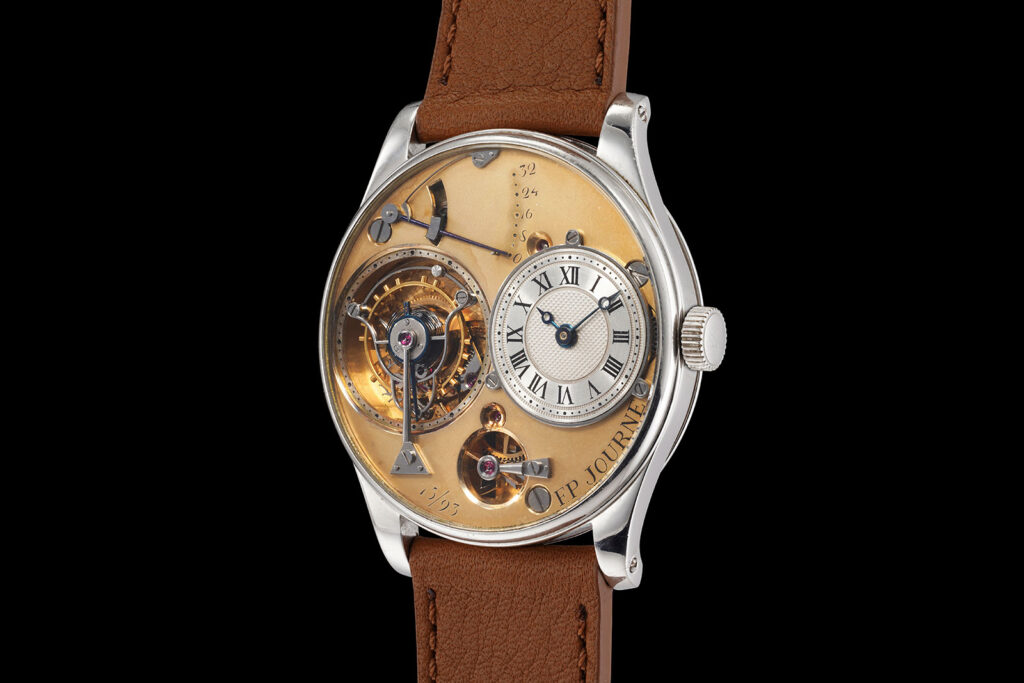
The Tourbillon Souverain à Remontoire d’Égalité
Among the possible protagonists of the exhibition itinerary, along with some of the earliest creations, such as the Tourbillon Souverain à Remontoire d’Égalité of 1993, are Antide Janvier’s double pendulum regulator of 1780, considered by Journe to be an ideal bridge with the Chronomètre à Résonance, and C.L. Detouche‘s astronomical pendulum clock, now a central element in the Maison’s spaces.
The selection, however, is constructed by affinity and meaning, configuring the museum as a space of comparison between technical solutions in which each object finds meaning in its proximity to another, according to an almost philological logic.
Why the F.P. Journe Museum is relevant to watch collecting
The project fits into a line already drawn by the Maison, which has long been involved in cultural and artistic initiatives. With the museum, however, the center of gravity shifts: it is no longer just the dialogue between disciplines that is at stake, but a broader reflection on watchmaking as a form of knowledge. Every watch, ancient or contemporary, becomes a reading tool, a point of contact between eras and an opportunity to restore to watchmaking its technical and cultural depth, even before its economic value.
The decision of an independent watchmaker to open a museum thus takes on a precise meaning, which goes beyond the preservation of a heritage and wishes to create a space for dialogue between past and present, between historical masters and contemporary craftsmen. At a time when watchmaking risks being perceived primarily as an expression of luxury and a field of speculation, initiatives such as this help restore its cultural dimension and invite reflection on the value of time and the ideas that make it measurable.
In the end, an open question remains: what other objects has Journe acquired privately? And which ones will he choose to make visible? The answers will come only with the opening, scheduled for 2026.
Are you looking for the perfect gift? Explore our online store and discover the entire collection signed IWS – Italian Watch Spotter!
For all real-time updates on the world of watchmaking follow us on Instagram and visit our Youtube channel.