Luca Soprana, a Master Watchmaker originally from Valdagno, in the province of Vicenza, belongs to a family in which watches have never been mere objects. Watchmaking, in his case, is a matter of inheritance before it is a matter of craft: the fourth generation to be involved in it, he grew up observing his grandfather at the workbench, learning as a child to recognize tools, gestures, patience and proportions.
After studying Economics and Business in Bologna, he chose Switzerland, where he completed his watchmaking training and built a path that led him to work for some of the most important companies in the sector, from Patek Philippe to Rolex, before founding an atelier in which to give substance to his own idea of watchmaking, far from the industrial logic and close, instead, to the long times of the workshop.
Alongside him in this tale of Italian watchmaking is Emmanuel Esposito. From Turin, Italy, born in 1983, Esposito is a fine mechanical craftsman. His story, too, begins in a family workshop, among lathes, milling cutters and machine tools, where the relationship with the material is formed through practice even before theory. Specializing in the creation of fine knives and mechanical collectibles, Esposito has built over the years a personal language of complex materials, hand finishes, inlays, precious surfaces and proprietary technical solutions.
Soprana and Esposito come from two different worlds, yet they share a common origin: the workshop, the workbench, the hand that precedes and often replaces the signature. Their meeting in the Nagoma project is a dialogue between two related ways of understanding precision and authorial sensibility. On the one hand, independent watchmaking, on the other, art cutlery; at the center, the same idea of a mechanical object as an expression of time, matter, and craft that does not end in function alone.
Luca Soprana, watchmaking as a choice of independence
Luca Soprana‘s path is interesting because it does not stem from an immediate entrepreneurial desire to build a personal brand. Before the name on the dial, there was a long work behind the scenes: training, restorations, prototypes, collaborations, study of movements, experiences gained within very different realities. It is a path that belongs more to the figure of the maker than to that of the entrepreneur.
After moving to Switzerland, Soprana came into contact with an environment where watchmaking is at once culture, industry and everyday discipline. There he honed his craft, but he also understood the limitations of a system in which, often, the individual craftsman only deals with a very specific part of the process. For those who, like him, have a broad view of the watch and grew up in the idea of the workshop, this specialization can become a form of constraint.
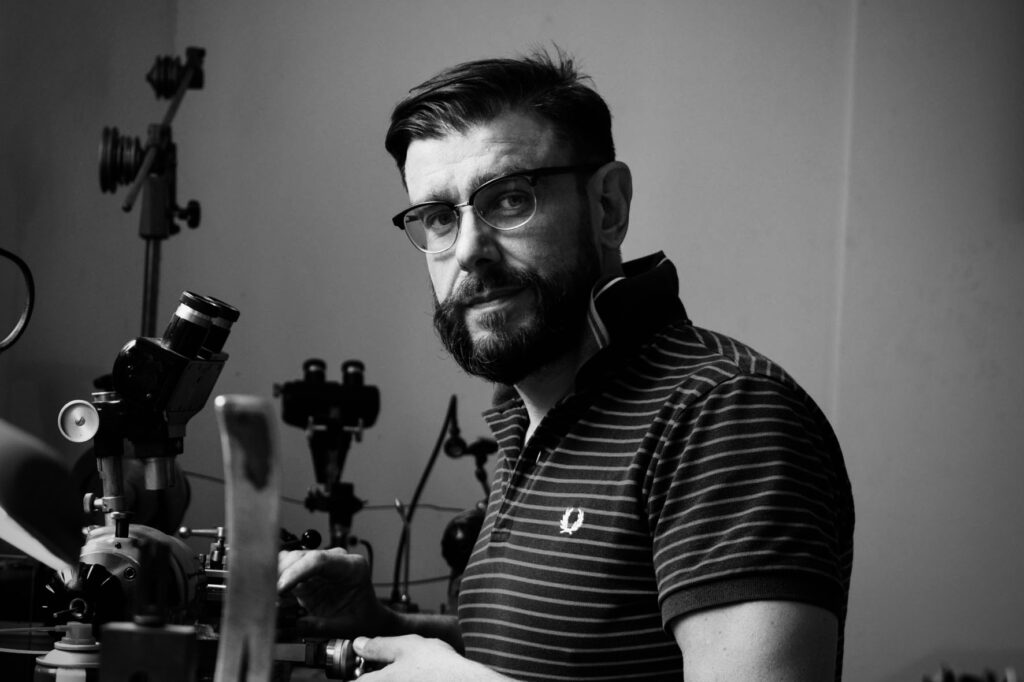
Hence the need to build a place of one’s own. Not simply a workshop, but an atelier in which to follow an object in its entirety, from initial thought to its final realization . Soprana Micromécanique Appliquée is the result of this choice: a small, independent structure in which everyone is required to know the entire production process and in which the watch is considered not a product, but a complete mechanical work.
The word “work,” in this case, should be understood without emphasis. Not in the sense of an object to be passively contemplated, but of a complex construction, made up of different skills that must coexist in a minimal space. This is well demonstrated by the Soprana Time Only, the first watch signed with his name. At first glance, a three-hand, that is, a type that, in contemporary watchmaking, often risks being perceived as simple or even predictable.
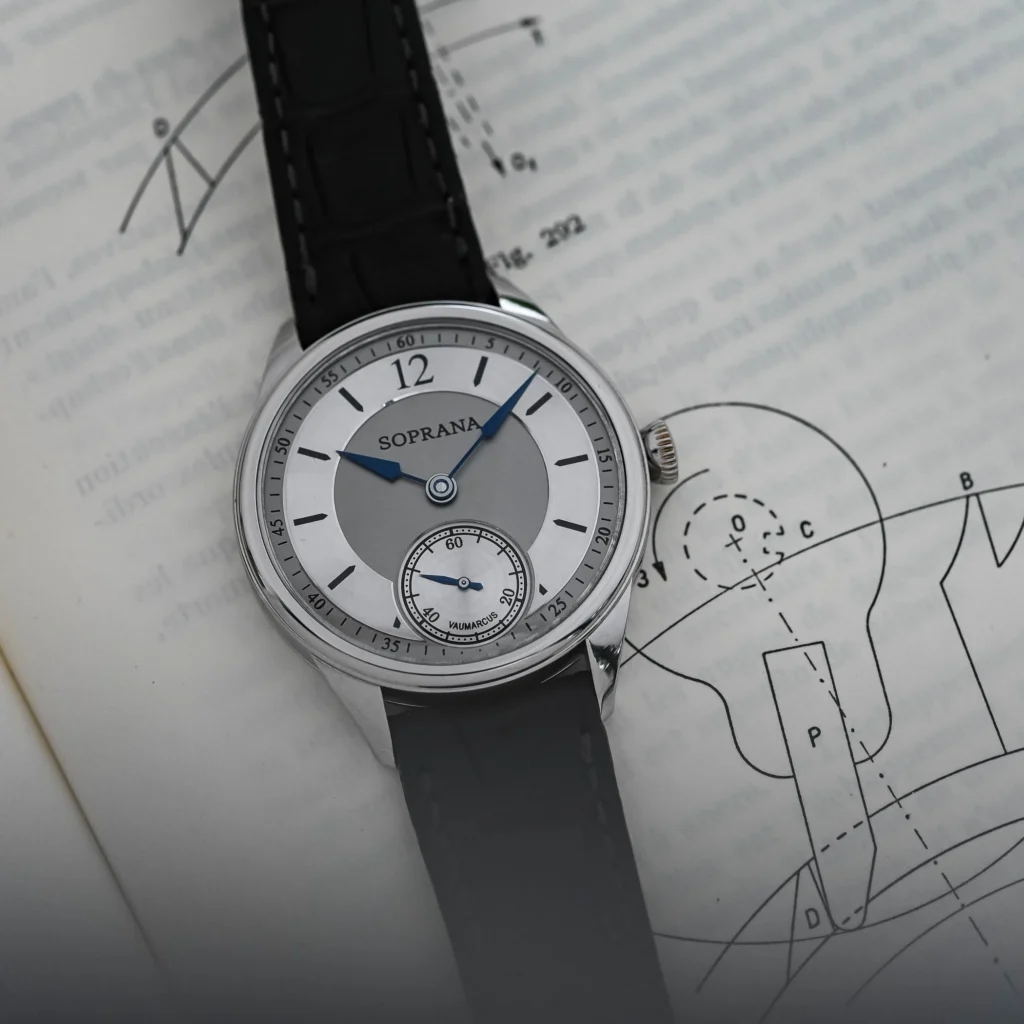
The Soprana Time Only
In fact, the very Time Only is one of the most difficult grounds on which to measure the quality of a watchmaker. Because there are no complications to be used for dramatic effect, additional indications to fill the dial, or anything else to distract from proportions, finish, and construction. But mostly because when the object focuses on a few elements, any proportion becomes more apparent: the size of the case, the ratio of the dial to the hands, the position of the small seconds, the cleanliness of the surfaces.
When the watch forgoes the immediate effect, it is all about consistency of design and quality of execution, and, as in the most successful precious objects, beauty comes from a balance of the whole.
The case of the Soprana Time Only maintains small dimensions, the dial is legible, and the overall architecture looks to a classic elegance. But the heart of the watch is entirely consistent with the approach of the atelier, because the movement is not thought of as a secondary element and therefore hidden behind the aesthetics of the dial: on the contrary, it is the starting point of the entire project.
With this in mind, it seems almost unnecessary to specify that Soprana works on an extremely limited production, in which the time required for realization is not an obstacle to be reduced, but an integral part of the object’s value. It is an approach far from the pace of industry and close to an ancient conception of the craft, where quality is not only in the materials used, but in the amount of attention each step requires.
Emmanuel Esposito, from blade to mechanical object
The case of Emmanuel Esposito is different, but no less pertinent. At first glance, his world might seem distant from watchmaking, because the knife, especially in Italy, is often associated with function, regional tradition, everyday use, or specialized collection.
In Esposito‘s work, however, the knife loses all ordinary character and becomes a complex mechanical object, close in sensitivity to micromechanics and high craftsmanship. As he is often careful to specify in his interviews, most of the enthusiasts who appreciate and purchase his knives very often have never actually used them to cut anything.
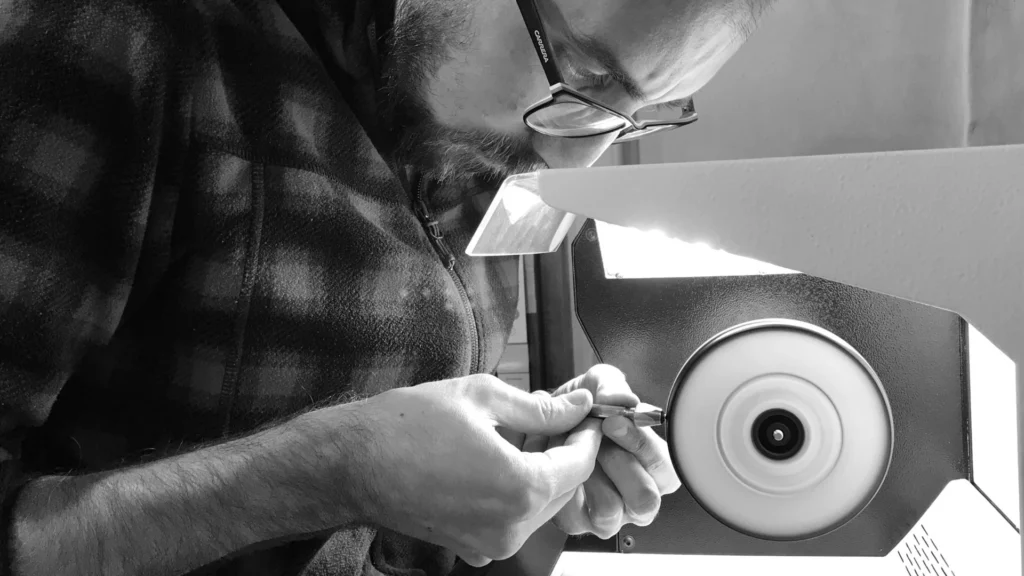
His training takes place, as with Soprana, in a family context where mechanics is a concrete reality. Born near Turin in 1983, Esposito in fact grew up in the family workshop, among lathes, milling machines and machine tools. His story, like Soprana’s, also begins with an act of repair. In an interview, he recounts making his first knife from an old specimen with a rusty blade that he cleaned, fixed, and completed with a new handle.
And this explains a lot about his way of working today, which does not come from an abstract project, but from direct contact with an existing object, from the need to understand its construction and to work on the material. It is a small but significant detail, because it brings his path back to the logic of the workshop for which repair becomes a form of knowledge.
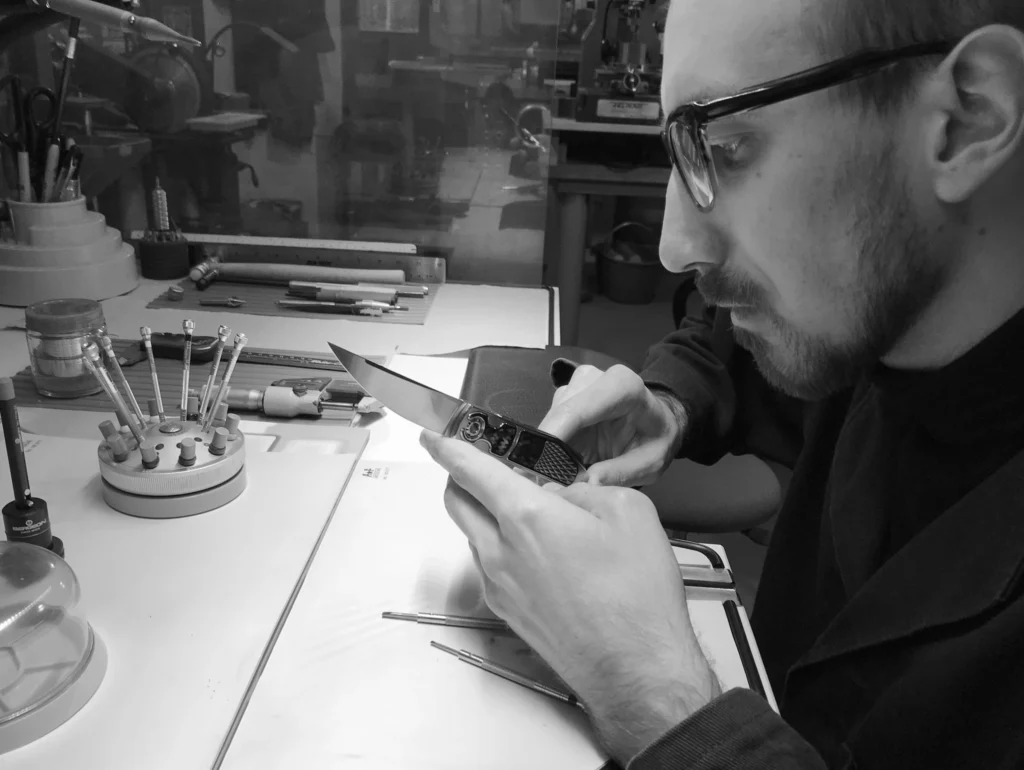
His folding knives are objects in which several dimensions coexist. There is the technical component, which is inevitable: a blade that must open and close securely, a mechanism that must be stable, tolerances that must be minimal. Then there are the materials: mother-of-pearl, carbon fiber, alloys, precious metals, surfaces worked and juxtaposed with extreme care, chosen for their visual appeal and for the way they interact and react to light. Closing the circle is the aesthetic component, which is never independent of the first two.
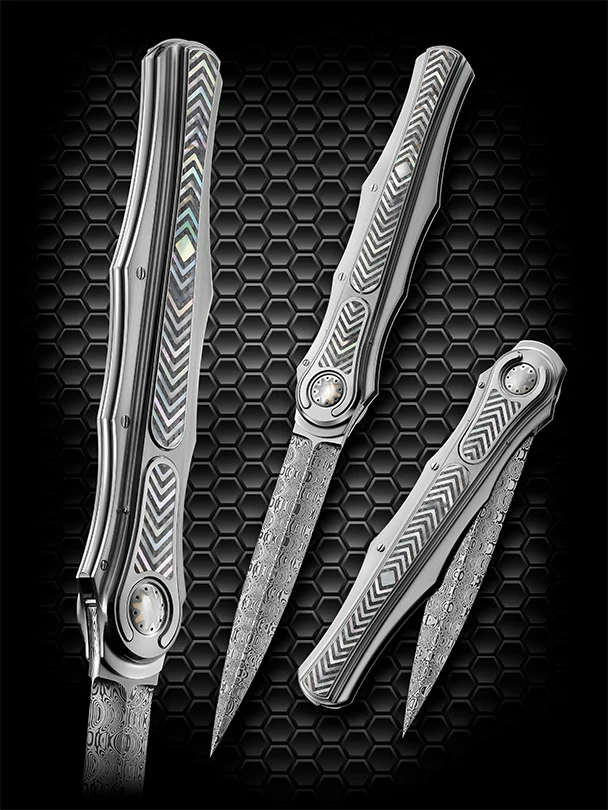
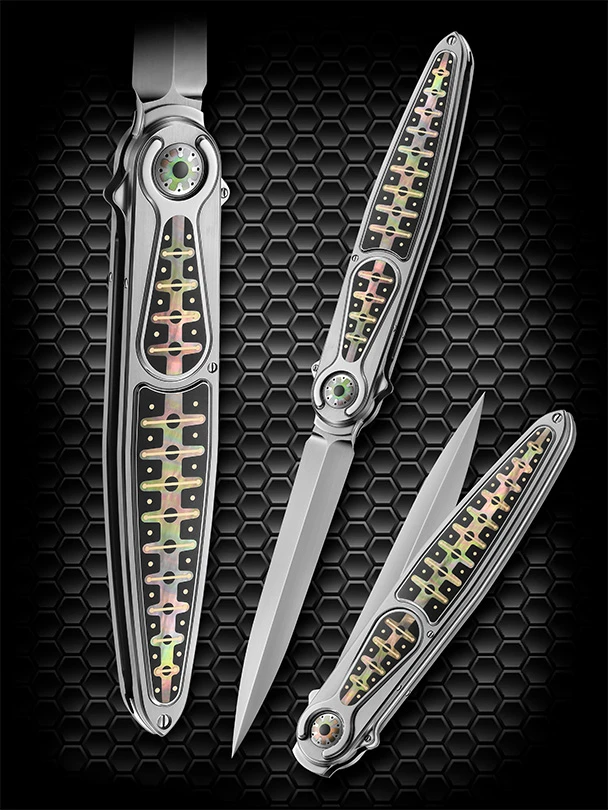
on the left Moray Dagger, on the right Scorpion Dagger
It is precisely this relationship between function and beauty that makes Esposito’s work interesting to the watchmaking world. As in a fine watch, the value lies not only in what is immediately seen, but also in the way the parts converse with each other, in the sound of an opening, the feel of a closing, the precision of a graft, the continuity between surface and structure.
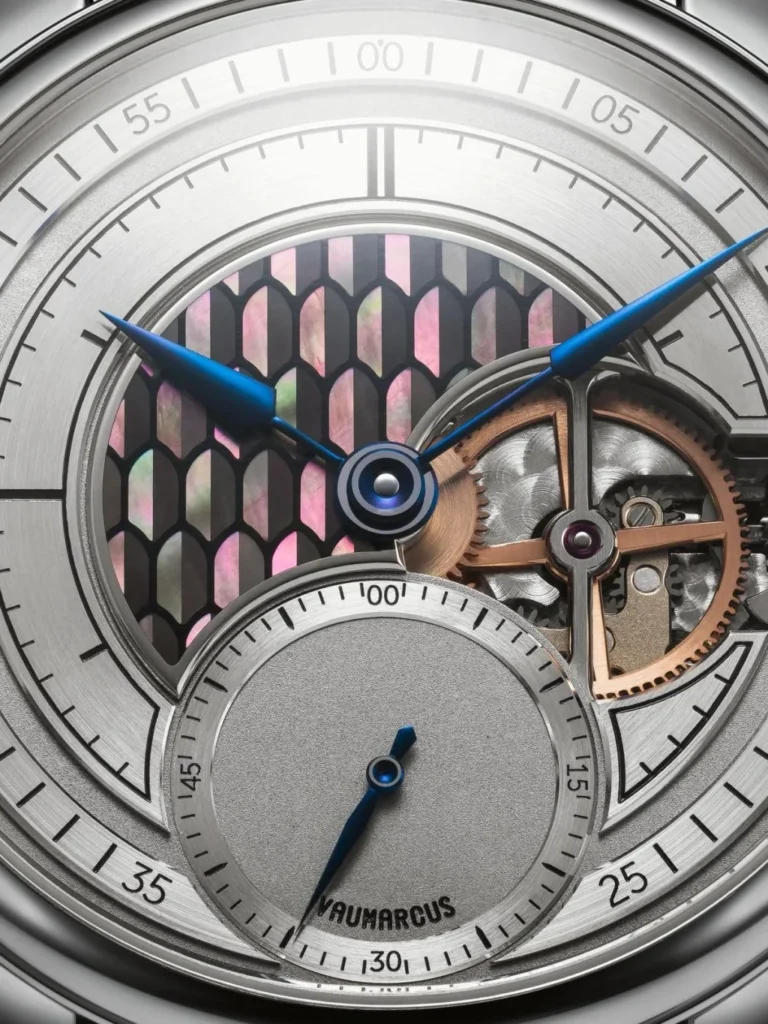
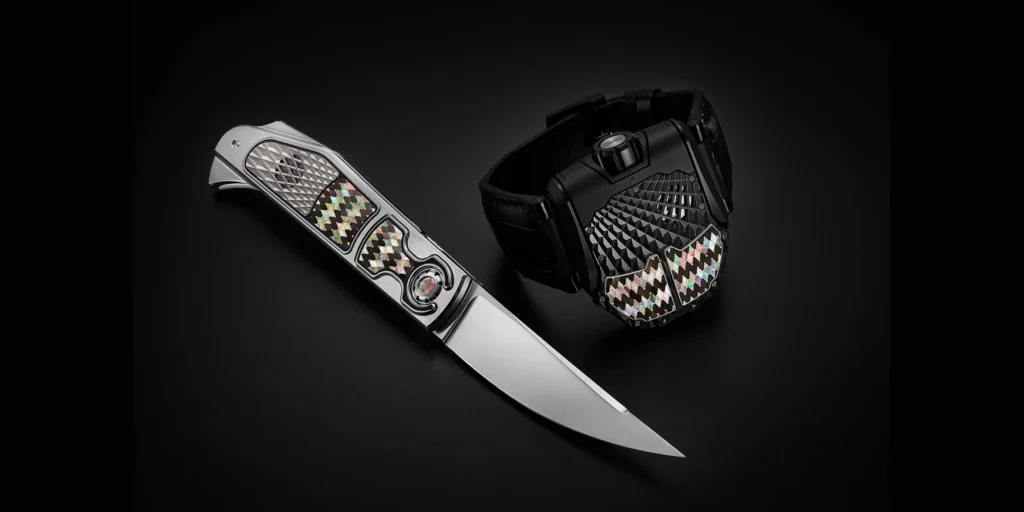
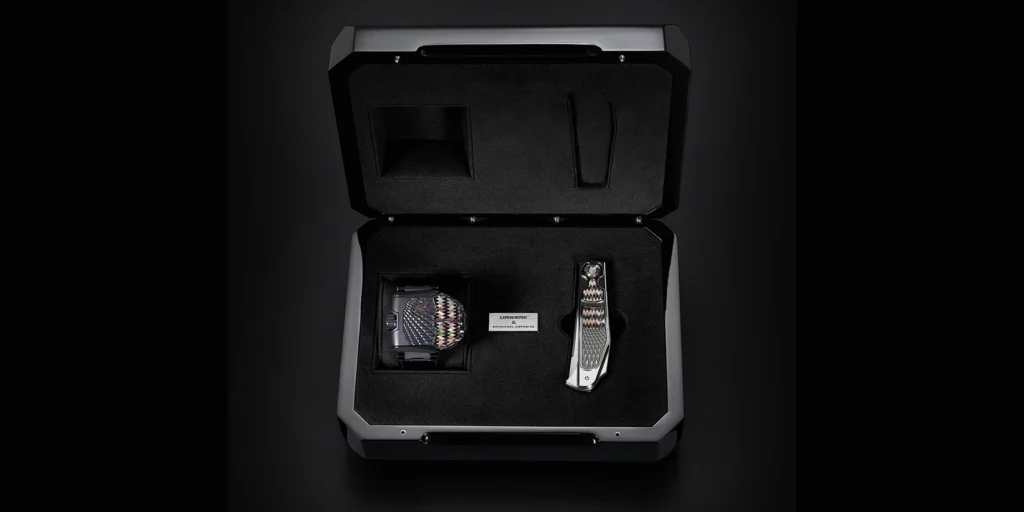
Out of this affinity came, for example, the collaboration with Urwerk in 2018. The case of theUR-T8 “Colibri,” made as a pièce unique and presented at Baselworld 2019, and the matching knife use the same technique: hundreds of small black-lip mother-of-pearl elements cut in the shape of diamonds, hand-selected and arranged according to the way each fragment reflects light. A precious play of inlays in which each element has a direction and is able to respond with a different color vibration in response to light.
The collaboration with Urwerk
In the knife, the same logic can be found in the handle, the lock button, and the back of the blade, with mother-of-pearl inlays, 18-karat gold pins, and a construction that makes clear the dialogue between mechanical object and decorative surface.
Nagoma: the meeting ground between Luca Soprana and Emmanuel Esposito
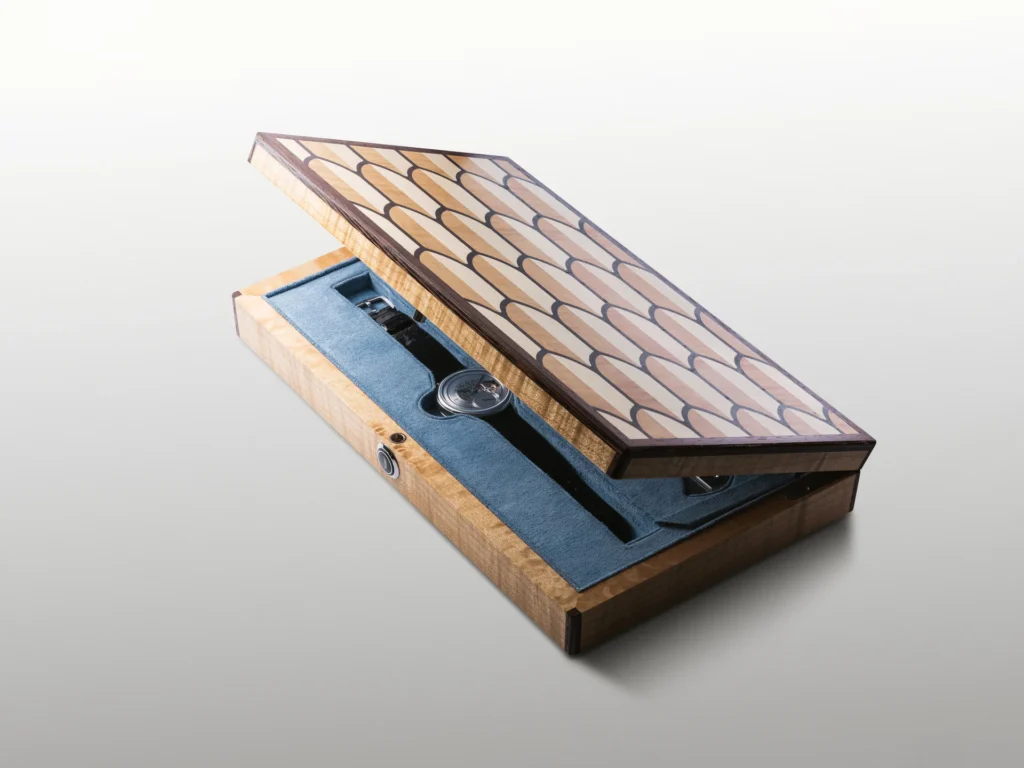
The meeting point between Luca Soprana and Emmanuel Esposito is called Nagoma. The project stems from the idea of uniting a watch and a knife as two autonomous objects, made according to the same sensibility, unlike many contemporary collaborations that simply transfer an aesthetic from one field to another. Here, however, the dialogue takes place more deeply.
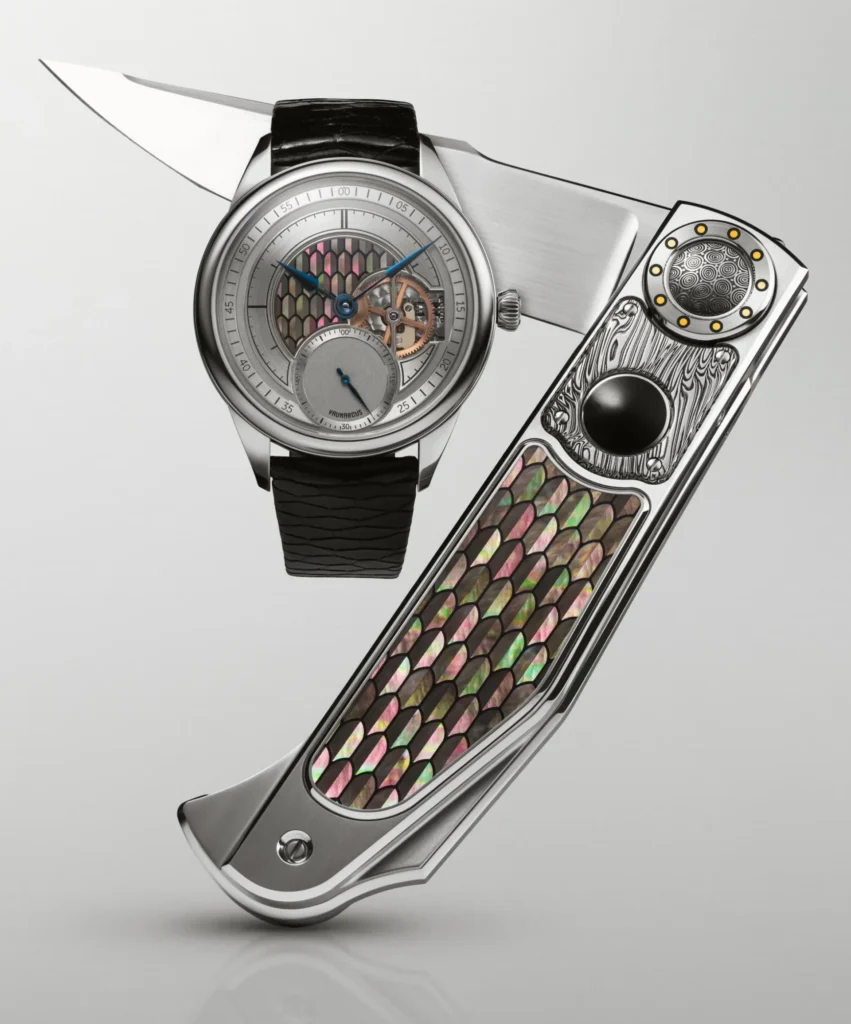
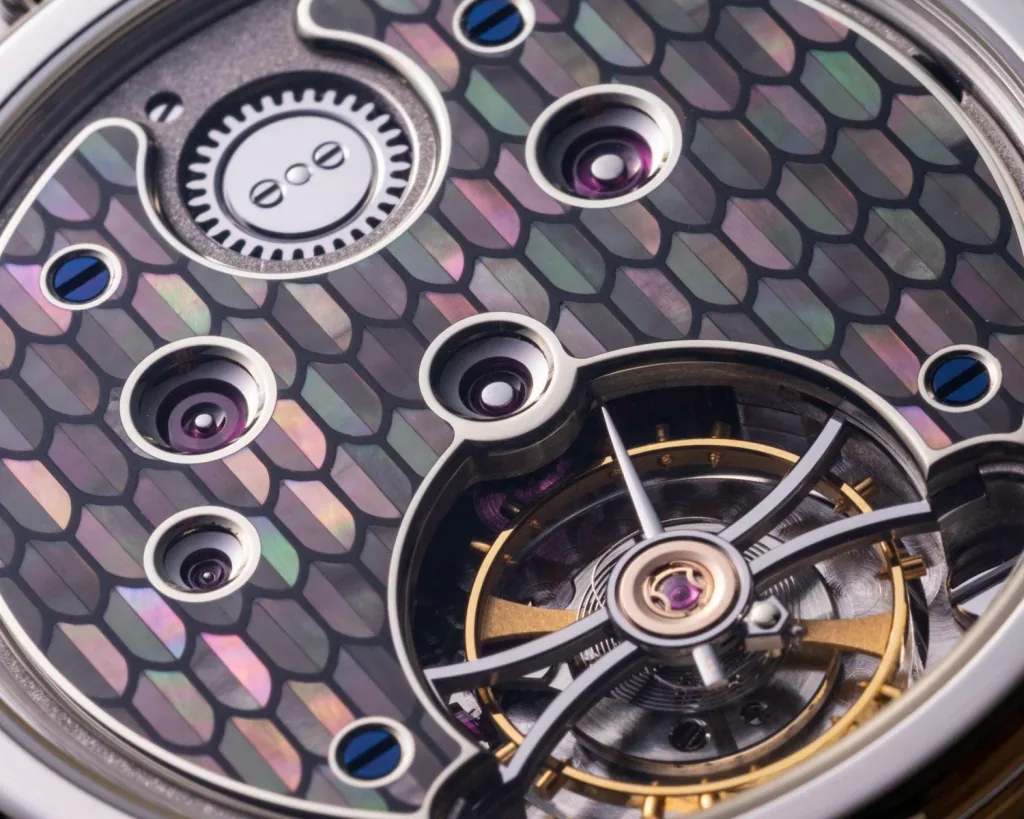
Nagoma starts with the Soprana Time Only, revised for the occasion. The watch retains classic proportions, with a 38.8-millimeter case and a thickness of less than 10 millimeters. It also retains the hand-wound LSTO caliber setting, with small seconds and a construction consistent with the atelier’s philosophy. The movement is not sacrificed to dial decoration, but remains the centerpiece of the watch. The balance bridge, the finishing, the in-house hairspring with Breguet curve, and the choice of a traditional but highly polished mechanism confirm that the project did not begin as an aesthetic exercise.
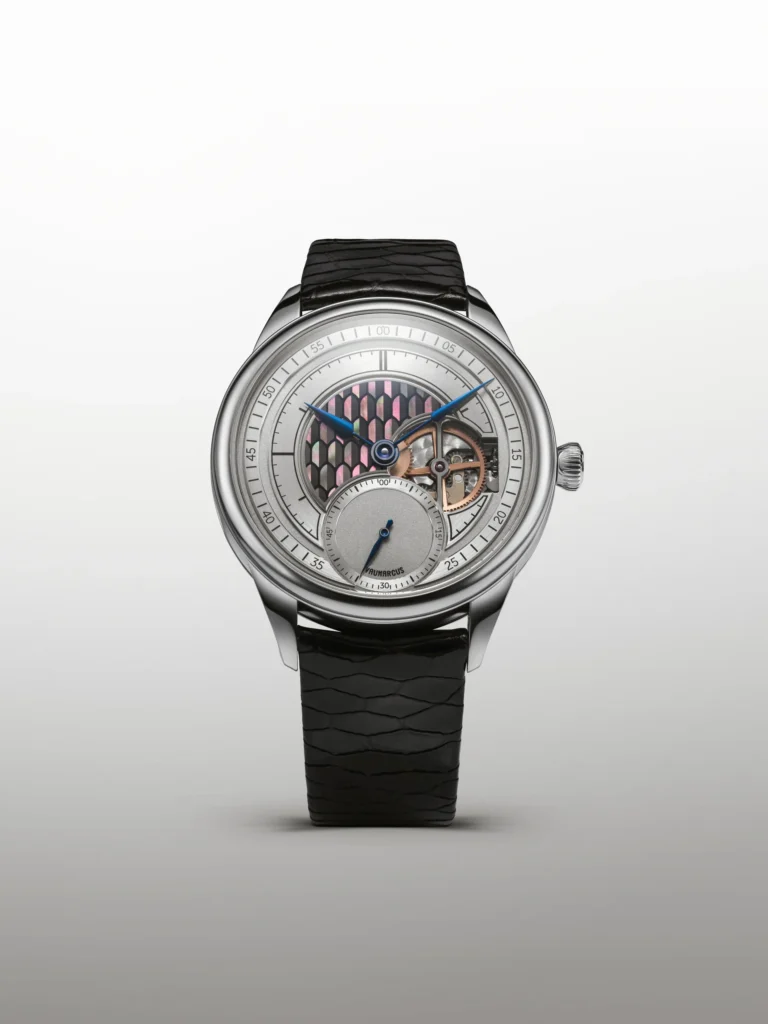
The dial, made of black-lip mother-of-pearl mosaic, seems to continue a discourse already begun between Esposito and Urwerk whereby mother-of-pearl is treated as a precious surface to be composed and broken down into reverberations and refractions. The mother-of-pearl fragments are selected, cut and arranged by hand to create a surface that cannot be replicated identically, always unique by the very nature of the process.
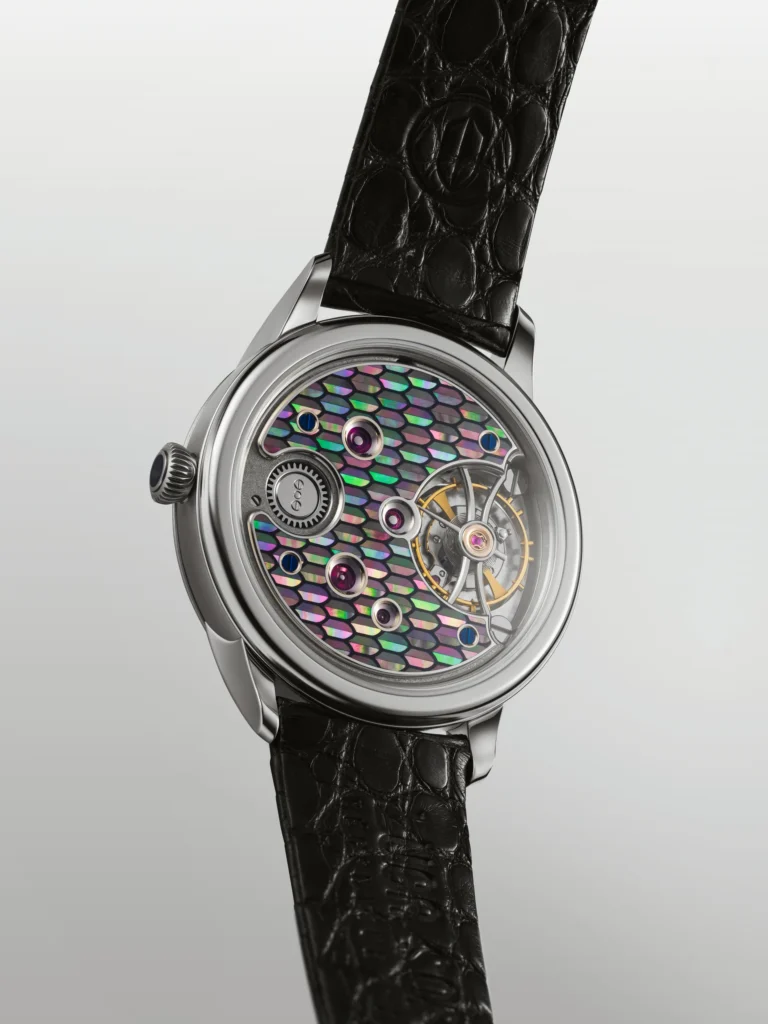
It changes with the light, absorbing and reflecting, alternating between depth and iridescence. Each dial thus becomes a small work of inlay, in which the material together retains its unpredictability and is ordered through the craftsman’s gesture.
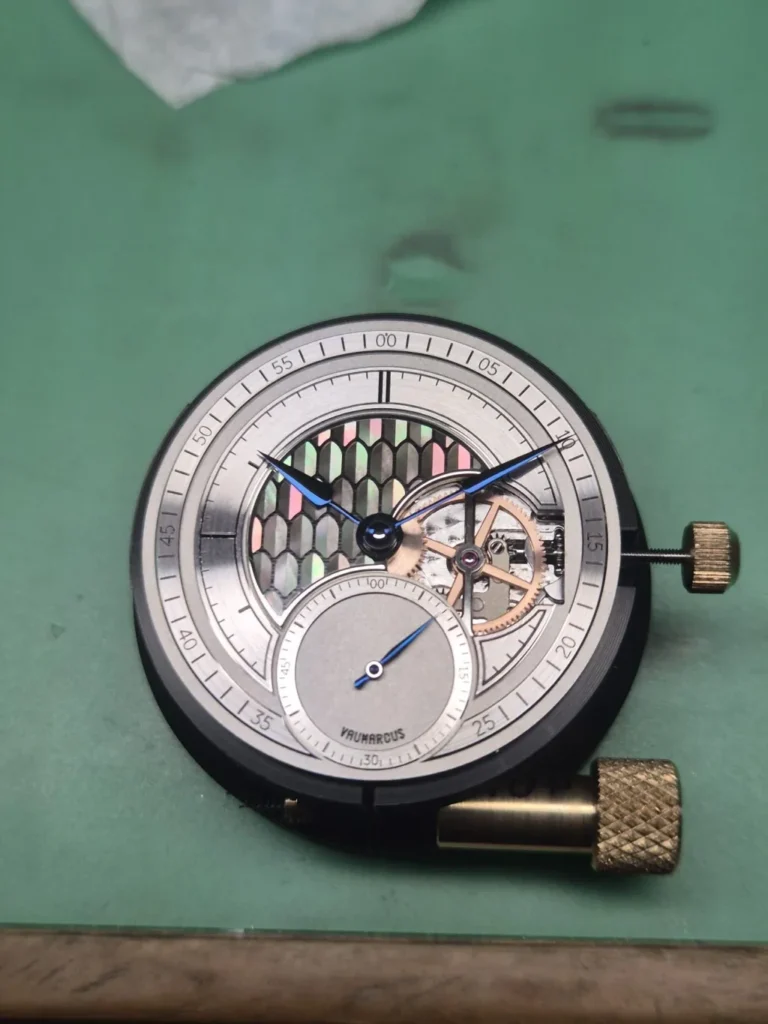
This is an important step, because Nagoma shifts the discourse from simple collaboration to the composition of a common language. It is not the watch with the knife “in pendant,” nor the knife superficially inspired by the dial. It is a pair of objects that respond to each other, able to show how independent watchmaking can become a meeting place for different skills, as long as the dialogue is not superficial.
Soprana and Esposito collaborate because they share a similar way of understanding the craft. They both work on small scales, favor the hand, and build objects that do not need large numbers to exist.
Italian watchmaking beyond the brand
The topic of Italian watchmaking is often approached through major brands with decades, if not centuries, of history behind them. People look for brands founded in Italy, cases made in Italy, aesthetic references to Italian design, boating, motoring, art or architecture. It is an understandable reading that, however, forgets another, less immediate form of Italian-ness: that of Italian artisans who work within or in the perimeter of international watchmaking, bringing with them a culture that does not always coincide with a geographic label.
In Soprana we recognize the legacy of the workshop watchmaker, updated to the highest level of Swiss micromechanics. In Esposito the figure of the craftsman, capable of bringing a traditionally functional object inside a collector’s dimension. Both work on small, complex, personal objects. Objects that take time to build and time to understand.
Nagoma thus becomes a well-executed case study of how independent watchmaking is increasingly becoming a territory of relationships between crafts. No longer just the brand, the Maison, the caliber or the design, but an ecosystem of skills: watchmakers, finishers, engravers, enamellers, designers, craftsmen of the material, whose contributions take different forms, sometimes obvious, sometimes not immediately visible on the dial, but present in the idea of the object.
This is where Luca Soprana and Emmanuel Esposito‘s work becomes interesting for those observing Italian watchmaking today: because it shows that Italianism in haute horlogerie can also be a matter of method. A discipline of making. A fidelity to the material. But above all, an ability to transform functional objects into autonomous and personal languages, beyond immediate use.
Their collaboration, Nagoma, holds these elements together. A watch and a knife, sure. Small objects, close to the body, understood in proximity. They touch each other, wear each other, open each other. Which in their hands are not just technical objects but two craft biographies that meet on a common ground: that of precision, measurement, and the time it takes to do things well.
Are you looking for the perfect gift? Explore our online store and discover the entire collection signed IWS – Italian Watch Spotter!
For all real-time updates on the world of watchmaking follow us on Instagram and visit our Youtube channel.