
It’s understandable that when people talk about Patek Philippe, the first thing that comes to mind is a Nautilus or a Grande Complication; they have cemented their place in the history of watchmaking with their magnificence and exceptional quality. However, market dynamics, desirability, and “hype” lead too many enthusiasts (and non-enthusiasts alike) to have a distorted view of the Geneva-based maison. Patek transcends the mainstream; it embodies the masterful execution of the techniques used to craft the finest timepieces, and the most fascinating expression of this is the so-called “Rare Handcrafts”—the subject of today’s discussion.
But first, a little history.
The History and Significance of the Project
To fully understand the significance of Rare Handcrafts, we must go back to the 17th century, to the origins of Geneva’s watchmaking tradition, when the city was already an important center for the production and decoration of timepieces: but how had it managed to achieve such prestige even back then?
With the rise of the Calvinist Reformation in the 16th century, strict restrictions against displays of luxury and the use of ornamental objects were introduced in Geneva; these regulations prompted goldsmiths and jewelers to turn to watchmaking, transferring their skills and contributing significantly to the creation of this blend of expertise: knowledge of metals and precious stones on the one hand, and skill in metalworking on the other.
It is said that another significant influence came about following the revocation of the Edict of Nantes in 1685, when numerous French Protestant artisans—the Huguenots—fled to Switzerland, further enriching the watchmaking industry with their skills in jewelry making, painting, and enameling.
Patek Philippe is an integral part of this historical journey; since 1839—the year it was founded by Antoine Norbert de Patek and François Czapek—it has been the heir and guardian of Geneva’s prestigious watchmaking tradition.
Credits: Getbezel
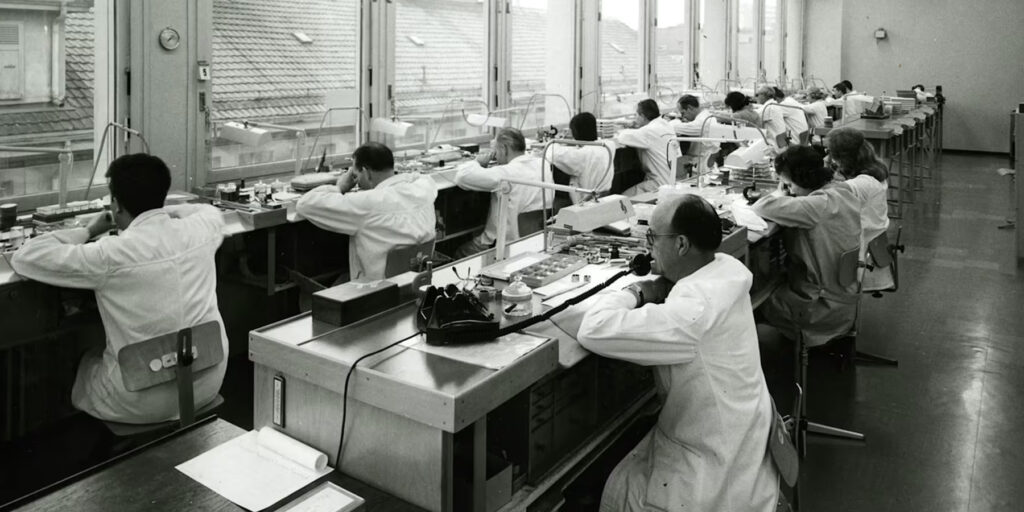
Specifically, the four generations of the Stern family—who have led the company since 1932—have cemented Patek Philippe’s role in preserving, applying, and passing down these invaluable skills. As we have mentioned, the environment in Geneva was ideal, with its multitude of“fabriques”—specialized workshops where artisans focused on the most complex processes: skills inherited by Patek Philippe, which has always collaborated with skilled masters to elevate its creations.
During the 1970s and 1980s, the company once again demonstrated its commitment to preserving this savoir-faire, at a time when demand for such elaborate watches had dropped dramatically. In fact, it never stopped commissioning and producing special timepieces, thereby keeping its artisans employed, preserving the craft, and ensuring it was passed down from generation to generation.
In recent years, Patek Philippe has underscored its strong commitment to these topics by organizing an annual event dedicated to Rare Handcrafts, from 2013 to the present, and in 2020, within its new PP6 facility, the company established workshops dedicated exclusively to the practice and research of artisanal craftsmanship techniques.
The techniques used
We’ve discussed artisanal craftsmanship and how much Patek Philippe has done to preserve it; we therefore think it’s worth explaining these concepts before analyzing the most iconic examples from the Rare Handcrafts collection.
Gem-setting
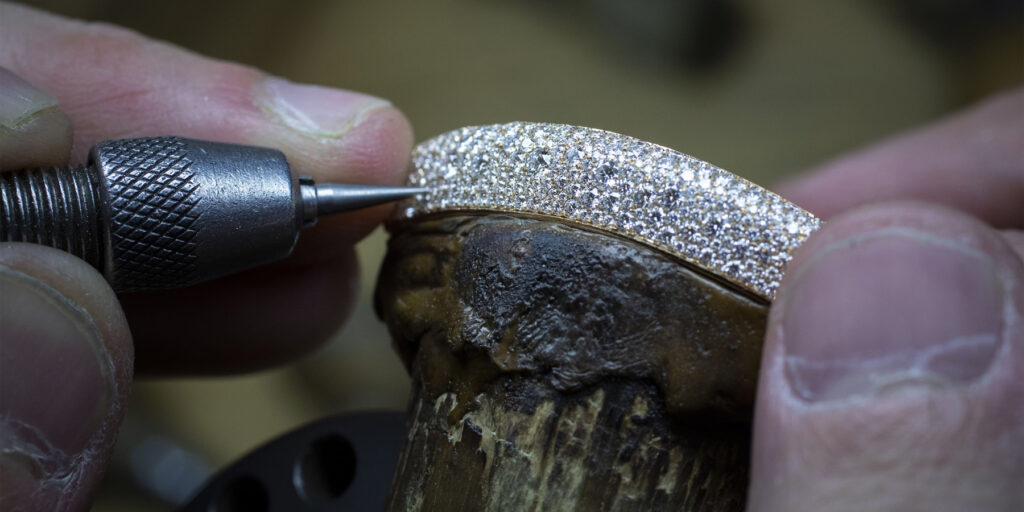
The intersection of fine jewelry and watchmaking. An integral part of this technique lies in the gem-setter’s ability to select the most suitable stones, then cut them and set them into the timepiece according to the most captivating designs.
There are several gem-setting techniques. Grain Setting involves securing the stones with small, hand-shaped grains of gold, which remain virtually invisible once the piece is finished. Snow Setting uses stones of varying sizes, arranged to minimize the amount of visible underlying metal, giving the artisan greater creative freedom.In Invisible Setting, the stones are prepared with a special groove and inserted into a metal structure that, once the work is complete, conceals every fastening element.
Credits: Patek Philippe
Another technique is Flamme®, patented and introduced by Patek Philippe in 2016, in which the gemstones are set vertically, all at the same distance and depth, with the ultimate goal of making the piece as luminous as possible: one final distinctive feature is the way the gold is worked between each gem by the setter, ensuring that even these tiny elements help draw as much light as possible onto the gems.
Guilloché
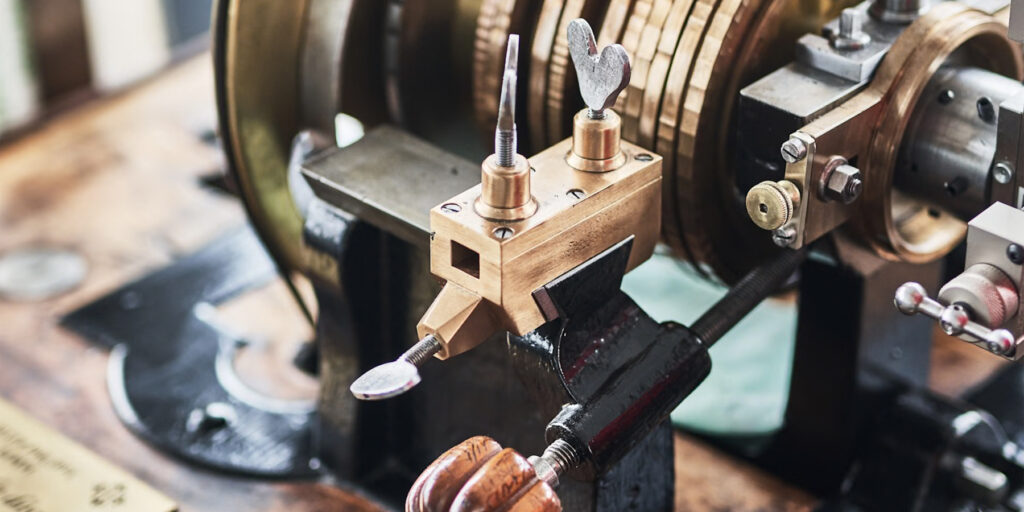
Guilloché is the embodiment of the relationship between artisan and machine: a technique that originated in the 16th century, it uses lathes that are manually operated by the guillocheur, who engraves regular geometric patterns into the metal. Understanding one’s machine is key, since the instructions disappeared about two centuries ago, and the use of this equipment relies exclusively on tradition and the passing down of its secrets from one generation to the next.
Credits: Patek Philippe
There are two types of guilloché machines: the first is known as a straight-line engine and is used to create patterns such as Clous de Paris and Solei; the second is called a rose engine: this allows the guillocheur to work the component from the center outward; among the most famous patterns are the barleycorn and the cross-weave.
Engraving
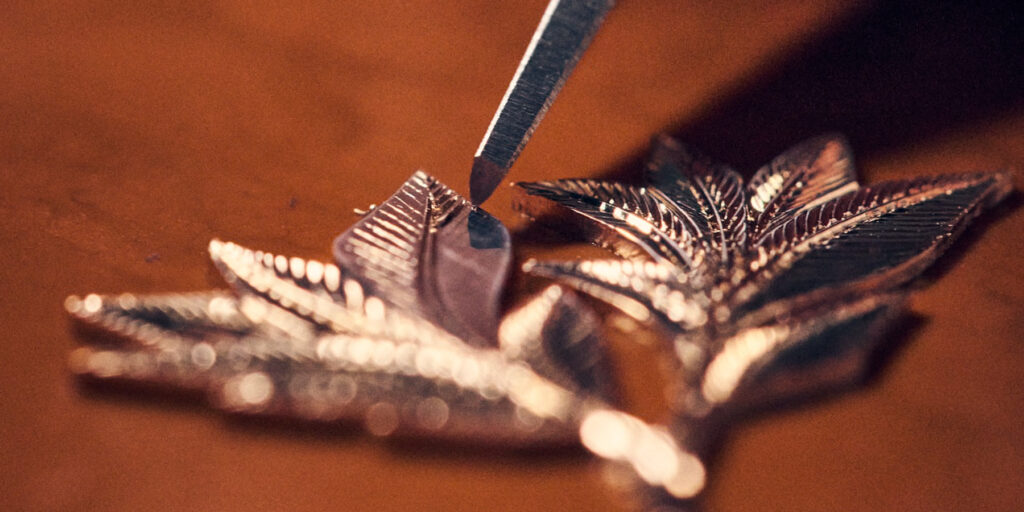
Engraving is probably the oldest decorative technique used to embellish a timepiece. The principle is seemingly simple because it involves working with a burin, which penetrates the metal, removing tiny amounts of it and altering the surface with lines and textures.
Credits: Patek Philippe
The reality of this craft, however, is closely tied to the artisan’s sensibility: over the years, each artisan develops their own manual dexterity and their own style, which is expressed through various engraving techniques, such as line engraving—suitable for reproducing complex designs—and relief engraving, which lends the work greater three-dimensionality.
Marquetry
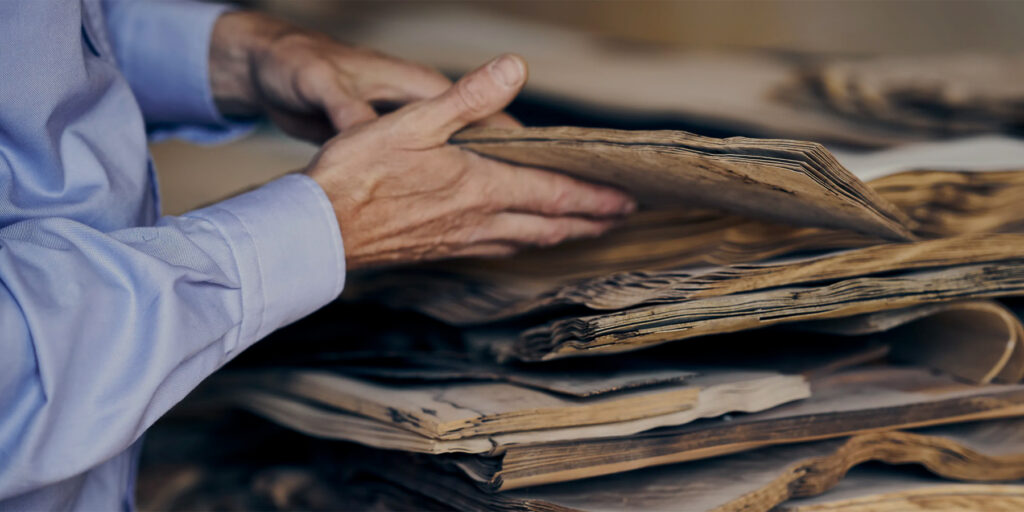
This technique brings an ancient tradition to watchmaking, one that dates back to the time of Ancient Greece and was introduced into watchmaking by Patek Philippe in 2008. The key to the success of this craftsmanship lies in the extraordinary skill of the specialists in selecting a range of wood species, which are then transformed into extremely thin veneers, glued, sanded, and subsequently painted. Every grain and color of the wood becomes a detail that makes the timepiece unique.
Credits: Patek Philippe
Enameling
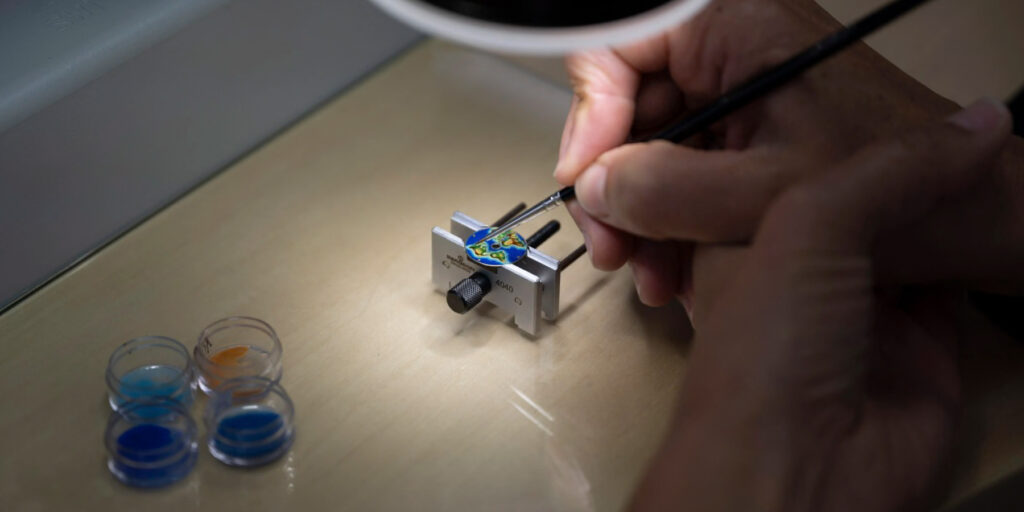
In enameling, as with other techniques, craftsmanship plays a predominant role: the enameler works like an alchemist, mixing metals, metal oxides, and minerals that, once combined, are transformed by the heat of a kiln into a vitrified, lustrous, and durable surface. The enamel, ground into a powder and applied to the metal base, is fired at temperatures exceeding 800°C: this is the principle behind Grand Feu enameling, a process that can require up to 30 steps, each of which is crucial to the final result.
Among the oldest techniques are cloisonné, in which thin, hand-shaped gold wires delineate the spaces reserved for different colors, and champlevé, where these compartments are instead engraved directly into the metal and subsequently filled with enamel. Paillonné incorporates tiny gold or silver motifs, called paillons, between layers of transparent enamel, creating unique luminous effects. Grisaille, on the other hand, uses semi-transparent white enamel on a dark base, building gradations and chiaroscuro through successive layers.
Credits: Patek Philippe
Miniature painting on enamel is a distinct technique that allows for the reproduction of paintings, portraits, and landscapes on a small scale. The pigments, mixed with oil, are applied with extremely fine brushes and then protected by layers of transparent glaze: a specialty of the Geneva tradition, it requires years of practice and a particularly high level of craftsmanship.
The Most Iconic Dials
As we will see, over the years, Patek Philippe has presented, through its Rare Handcrafts collection, a large number of dials created using the techniques we have just analyzed: choosing the most representative ones is a daunting task, given the sheer number of magnificent designs.
For this reason, we decided to begin by narrowing down the options into five broad categories.
Art, Culture, and Traditions
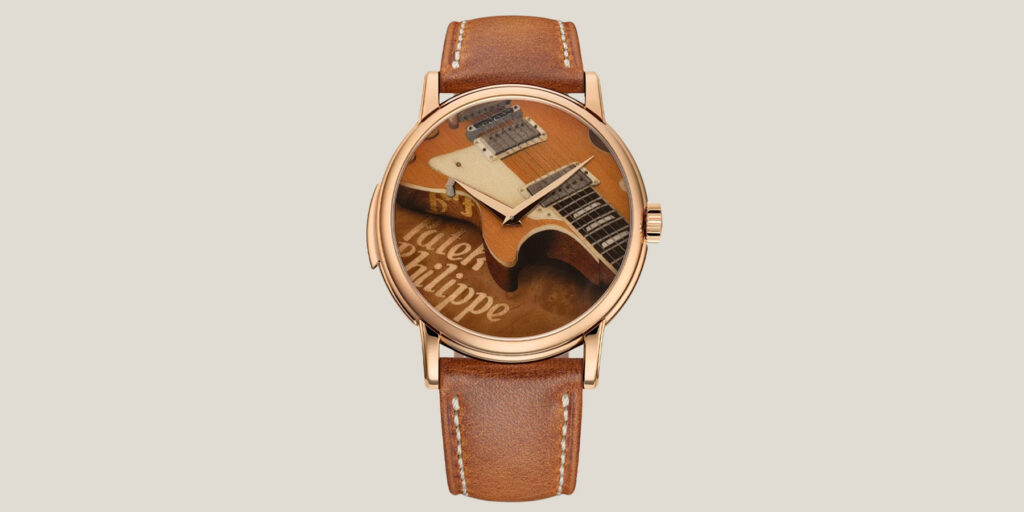
5278/50R-011
As one of the symbols of contemporary musical culture, the electric guitar takes center stage in the collection presented by Patek Philippe at the Rare Handcrafts Exhibition in Geneva in 2026. The dial is crafted entirely from wood marquetry: to reproduce every detail of the instrument with extraordinary precision, the master craftsman assembled 336 veneer elements and 18 inlays, carved from 17 different types of wood. The variations in color, grain, and texture capture the strings, bridge, pickguard, and even the reflection of the name “Patek Philippe” on the sides of the guitar.
Credits: Watchbase
5077/100G
The ancient iconography of the zodiac is reinterpreted in the twelve dials of the “Astrological Signs” series, presented at the Rare Handcrafts Exhibition in Geneva in 2024. Each Calatrava, produced in a limited edition of just two pieces per sign, combines three enameling techniques: grisaille on “blanc de Limoges,” Grand Feu cloisonné, and paillonné enamel. The constellations, inspired by ancient engravings, emerge from the background thanks to the varying depths and shades achieved by layering the techniques, while the mythological figures take on a striking three-dimensional effect.

Credits: Swisswatches Magazine
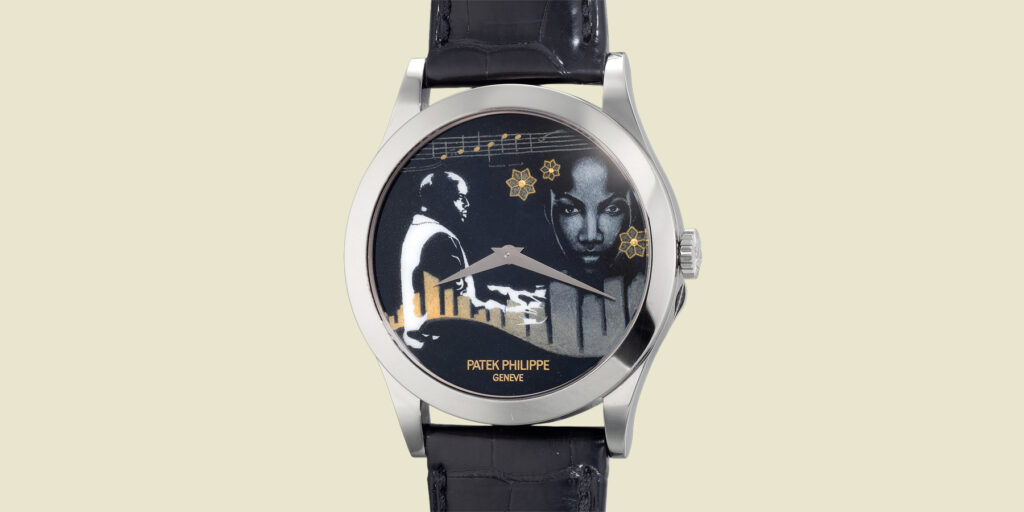
5089G-067
Created for the 2017 “The Art of Watches Grand Exhibition” in New York, this Calatrava pays homage to the legendary Blue Note through a refined miniature scene. On the dial, the cloisonné enamel technique is combined with grisaille painting to depict two musicians, the city skyline, and the opening bars of Sidney Bechet’s “Petite Fleur.” The contrast between the dark background and the various shades of enamel creates depth and transforms the dial into a miniature jazz scene, capturing within a few centimeters the atmosphere of one of the iconic landmarks of New York’s musical culture.
Credits: Phillips
5089G-083 and 5089G-084
Unveiled at the Watch Art Grand Exhibition in Singapore in 2019, these two Calatrava watches feature wood marquetry depicting two iconic figures from Asian culture. In the 5089G-083 “Dragon,” 192 elements carved from 16 different types of wood are assembled to form the dragon, making use of the wood’s natural variations in color and grain. The same technique brings the phoenix of the 5089G-084 “Phoenix” to life, transforming thin wooden fragments into images with an almost painterly effect.

Credits: Watchtest
5278/50R-010
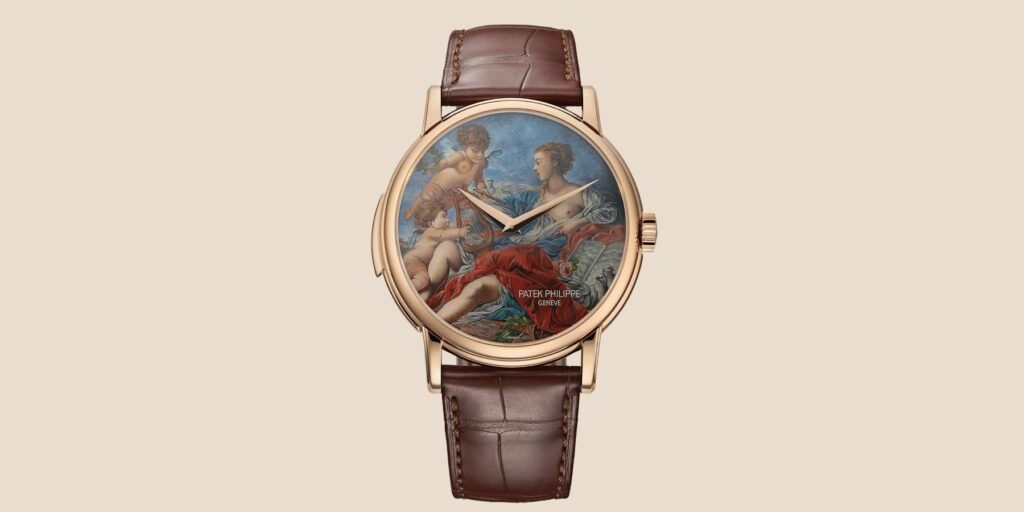
Unveiled in 2026, this one-of-a-kind timepiece features on its dial “The Allegory of Music,” an oil painting on canvas created in 1764 by the French painter François Boucher. To capture the richness and softness of the original on the dial, Patek Philippe employs miniature enamel painting: the artisan constructs the image using 19 base colors—7 of which are achieved through mixing—defining skin tones, the folds of clothing, and the texture of the hair with the finest brushstrokes. The decoration is then sealed and protected with several layers of transparent enamel and fired a total of 17 times at temperatures ranging from 800 to 830 °C.
Credits: Swisswatches Magazine
5177R-001, 5177R-012, and 5177G-057
Mexican culture and the imagery of Día de Muertos unite these three Calatrava watches, dedicated respectively to La Catrina, a musician with a rose between his teeth, and a mariachi. The technique behind these dials is hand-engraved guilloché, overlaid with translucent enamel using the flinqué technique, which involves applying enamel over a guilloché pattern so that the design remains visible through the enamel.
Against this background, the motifs take shape through the Grand Feu cloisonné technique, with fine gold threads delineating the areas filled with transparent, opaque, and semi-opaque enamels. The shades achieved using 32 or 37 colors and 12 to 14 firings on these dials lend the figures extraordinary depth.

Credits: Swisswatches Magazine
Geometry, Ornament, and Abstraction
5077/100R-068
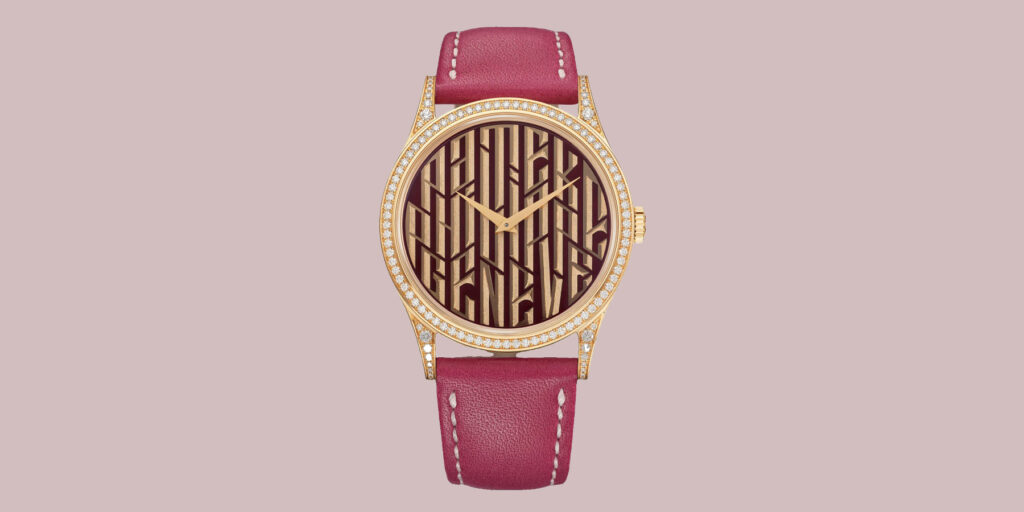
Words become ornamentation in the Calatrava “Pink Typography,” unveiled by Patek Philippe in 2026. On the dial, the inscription “Patek Philippe Genève” is hand-engraved in a script inspired by the lettering found on the case back of a historic triple-complication pocket watch, which was exhibited at the 1867 Paris World’s Fair.
The cavities created by the engraving are filled with two types of enamel—one transparent and one opaque—applied in multiple layers using the champlevé technique. Once this phase is complete, the engraver works on the letters again to accentuate their three-dimensionality. About ten firings at 665–670°C complete the dial.
Credits: Luxury Watches USA
5738/50R-022
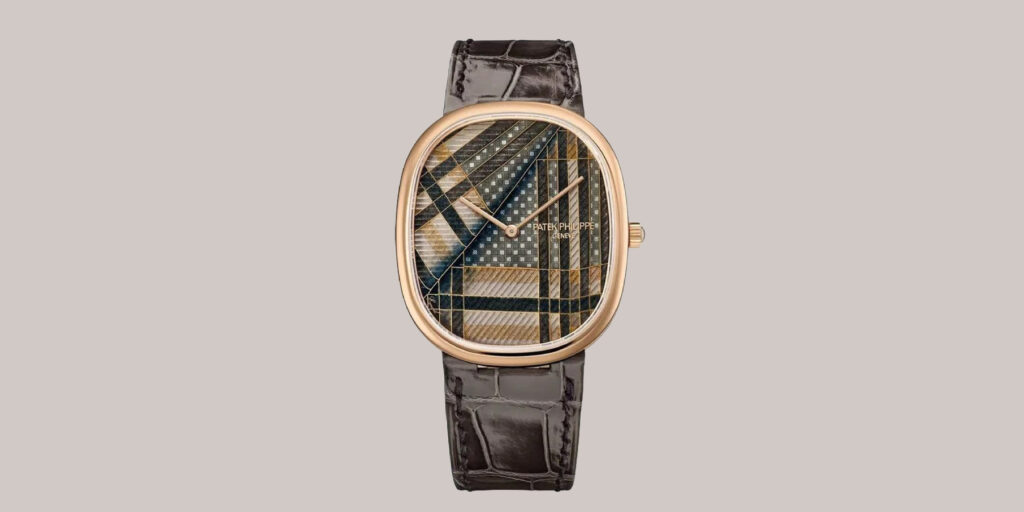
The geometric tartan pattern is reimagined in the Golden Ellipse Beige Tartan, introduced by Patek Philippe in 2026. The dial is decorated with two different guilloché patterns, oriented in four directions, to create the fabric’s regular weave: approximately 45 cm of gold thread is applied to this design, defining the tartan’s intersections and delineating the fields of the Grand Feu cloisonné.
Six shades of translucent enamel reveal the guilloché pattern beneath, using the flinqué technique, which accentuates the nuances and the relief effect of the pattern. Finally, each dial requires 15 firings at approximately 800°C.
Credits: Chrono24
5177G-052
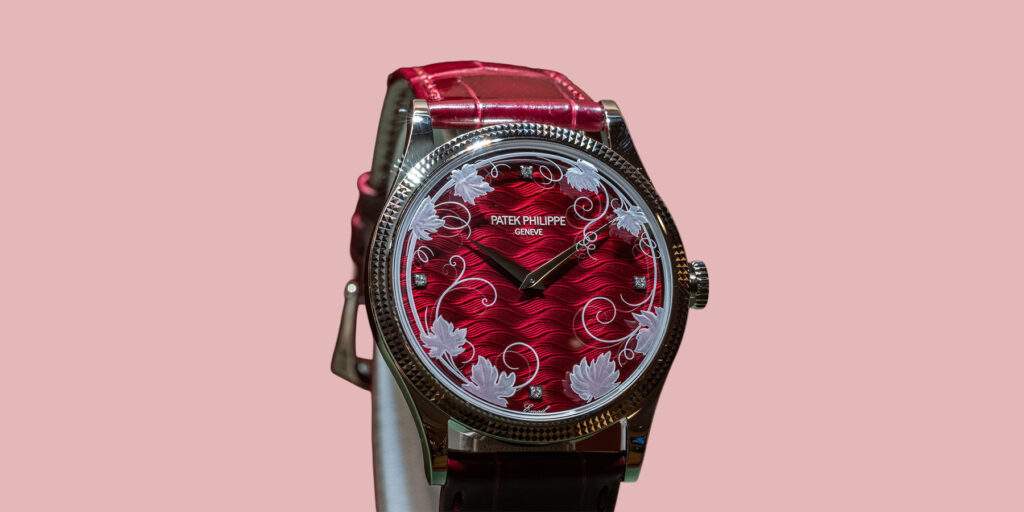
Wine becomes a decorative theme in the Calatrava “Red Wines,” presented at the Rare Handcrafts Exhibition 2025: the dial is crafted from flinqué enamel, with a guilloché base coated in translucent enamel, whose hue evokes the intense color of red wines. Rounding out the composition is the sapphire crystal, hand-engraved on the inner surface with a motif inspired by grapevines and grape clusters. This is a truly innovative solution for the Rare Handcrafts collection, in which the design engraved on the glass visually overlaps the guilloché pattern on the dial, creating an effect of depth.
Credits: SJX Watches
5077P-102/103
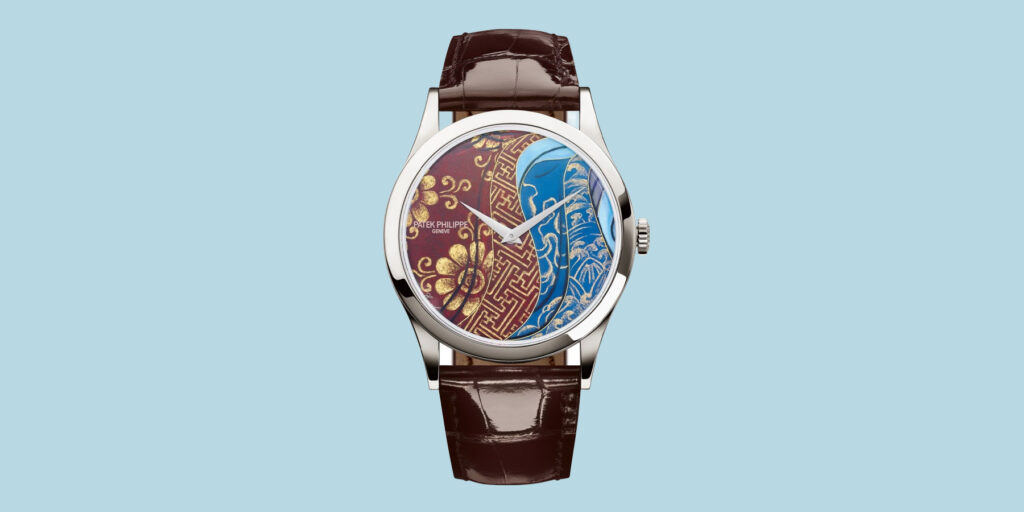
The geometric motifs of traditional Bhutanese textiles are reproduced on the two Calatrava “Bhutan Textiles” watches, which were unveiled at Baselworld 2018 and subsequently displayed at the Rare Handcrafts Exhibition at the Salons Patek Philippe in Geneva. The dials are crafted from Grand Feu cloisonné enamel, with fine gold threads delineating the various fields and tracing their patterns. The designs combine six shades of enamel—both transparent and opaque—with 24-karat gold powder. Each dial requires approximately 13 cm of gold thread, and the enamel is set in nine successive firings at approximately 850°C.
Credits: Watchbase
5089G-077
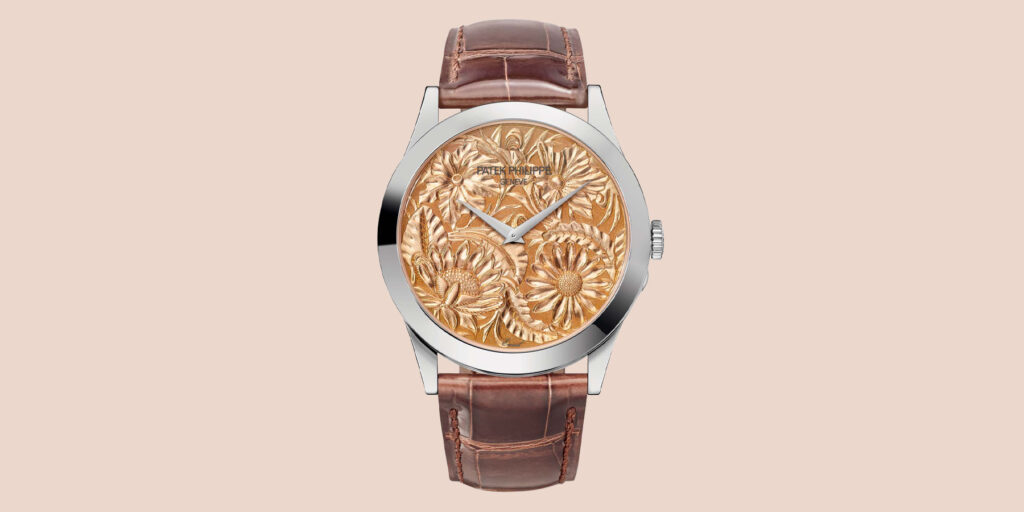
This Calatrava draws inspiration from the traditional leather carving and embossing techniques originating in Sheridan, Wyoming, and was unveiled at “The Art of Watches Grand Exhibition” in New York in 2017. On the gold dial, the entire floral motif is hand-engraved, reproducing the sinuous and intertwined forms characteristic of this decoration. The surface is then coated with a transparent brown-gold enamel, which allows the engraved design to shine through and accentuates its depth through the interplay of light, shadow, and relief. An ancient American craft technique is thus transformed into a watch decoration executed entirely by hand.
Credits: Revolution Magazine
5088/100P-001 and 5738/50P-001
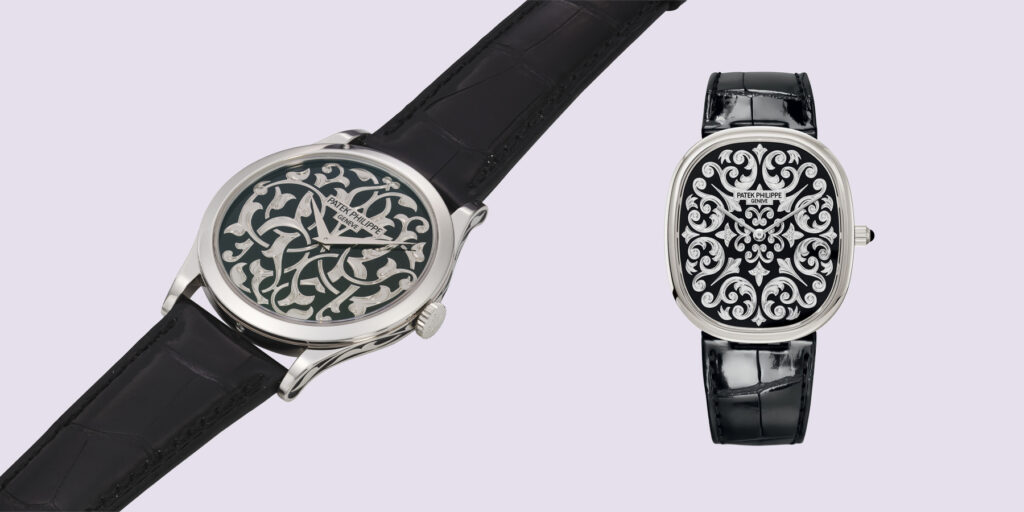
The volute and arabesque motif characterizes two particularly significant examples of Patek Philippe’s fine craftsmanship. In the Calatrava 5088/100P-001 “Volutes and Arabesques,” presented in the 2014 Rare Handcrafts collection, the gold dial plate is hand-engraved and then decorated with black Grand Feu enamel using the champlevé technique, creating a dense interweaving of plant motifs and spiral shapes.
Four years later, the same ornamental style was applied to the elliptical shape of the 5738/50P-001 “Golden Ellipse 50th Anniversary”: the volutes are engraved on the white gold plate and stand out against the black enamel background, while a motif reminiscent of the Calatrava Cross appears at the center. Limited to 100 pieces, the “Golden Ellipse” celebrates the model’s 50th anniversary by reinterpreting its proportions through a decoration crafted entirely by hand.
Credits: Christie’s – Watchbase
Men: Music, Sports, Entertainment, and Passions
5089G-062
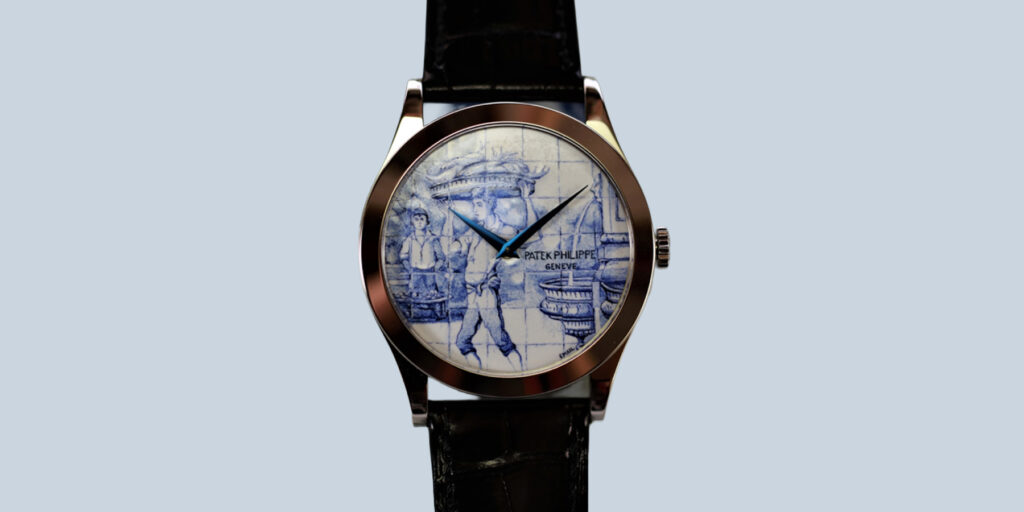
The azulejos, a hallmark of Portuguese decorative art, are reinterpreted by Patek Philippe through one of the most painterly techniques among the Rare Handcrafts. On the dial, a fish market scene is hand-painted on a thin gold plate using minute brushstrokes and a complex layering of shades of blue.
Enamel painting allows for the reproduction not only of the design on individual tiles, but also of the grout lines and their three-dimensional effect, creating a refined trompe-l’œil. The dial is then subjected to successive firings at temperatures between 800 and 850 °C, which set the colors and transform the painting into a vitrified surface.
Credits: Watchprosite
5086G-001
Jules Verne, a French writer and one of the founders of modern science fiction, imagined a journey to the Moon in 1865 in his novel *From the Earth to the Moon*. The Calatrava “From Earth to the Moon,” presented by Patek Philippe in 2025, draws inspiration from this pioneering vision. The scene on the dial is crafted in Grand Feu cloisonné enamel, with fine gold wires dividing the composition into numerous cells, filled with enamels of different shades and subjected to repeated firings. A tribute to humanity’s ability to transform a literary fantasy into an almost real vision.

Credits: SJX Watches
5189G-001
The world of auto racing comes to life on the dial of this Calatrava through the Grand Prix des Nations, a competition held in Geneva from 1946 to 1950. In this design, presented as part of the 2023 Rare Handcrafts Exhibition at the Patek Philippe Salons in Geneva, the car is crafted in Grand Feu cloisonné enamel, using 40 cm of gold wire and 17 colors, while the car’s number incorporates a thin sheet of silver beneath the translucent enamel, using the paillonné technique.
In the background, the view of Geneva and its Jet d’eau is hand-painted using enamel miniatures. The result combines three different techniques into a single scene, completed through 12 or 13 firings at approximately 820°C.

Credits: Watchbase
5089G-059
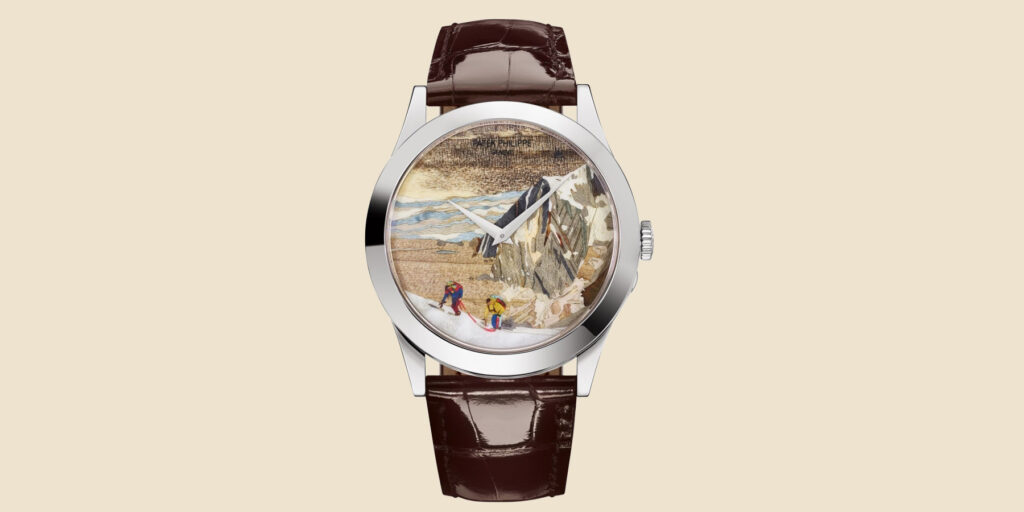
Unveiled at Baselworld 2018 in Basel, the Calatrava depicts two mountaineers tied together by the same rope as they tackle the snow-covered slopes of the Alps, in a scene entirely crafted using wooden micro-marquetry. The result is breathtaking: the dial features 262 tiny elements crafted from 27 different types of wood, as well as 40 inserts selected to highlight the material’s varied grain patterns, textures, and natural hues.
Each fragment is shaped and assembled by hand to form an image that, when viewed up close, reveals its fragmentary nature, while from a distance it takes on the appearance of a real painting.
Credits: Watchbase
5089G-113
Presented as part of the 2022 Rare Handcrafts collection, exhibited in Geneva and later in Paris, this Calatrava features a scene from Havana’s musical life on its dial: a double bassist leaning against an American car, surrounded by the colorful facades of Cuban colonial architecture. The Grand Feu cloisonné required approximately 68 cm of gold wire and 46 shades of enamel, including transparent, opaque, semi-opaque, and opalescent varieties. Brown and amber tones dominate this design, set by 15 to 17 successive firings at 800–840 °C

Credits: Watchbase
5089G-130
Unveiled at the 2024 Rare Handcrafts Exhibition in Geneva, this Calatrava celebrates surfing through a scene entirely crafted using wood micro-marquetry. On the dial, a surfer rides the wave amid spray and glints of light, recreated by assembling hundreds of extremely thin wood fragments. As we have already seen, this technique allows for exceptional shades, transforming the wood into a true three-dimensional painting. Such a modern subject is paired with one of the oldest forms of artisanal decoration.

Credits: GQ
Places, Landscapes, and Travel
5077/100R-033
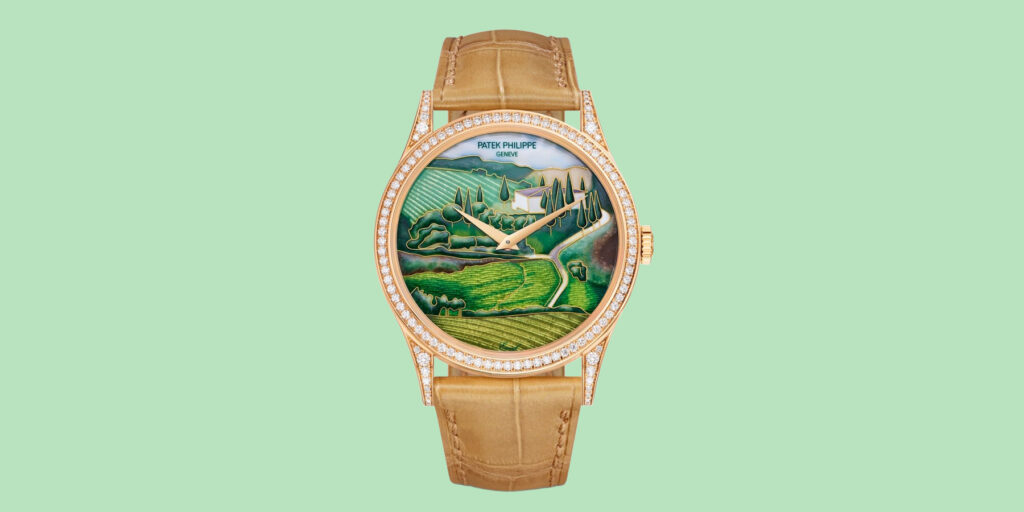
Unveiled at Baselworld 2018, the Calatrava “Tuscany” features a view of the Tuscan countryside on its dial, part of the “Italian Scenes” trilogy dedicated to some of Italy’s most iconic landscapes. The composition is the result of three techniques: Grand Feu cloisonné defines the contours of the landscape with fine gold wires, while flinqué and enamel painting create the various shades of the vegetation, hills, and sky.
Credits: Watchbase
5738/50R-010
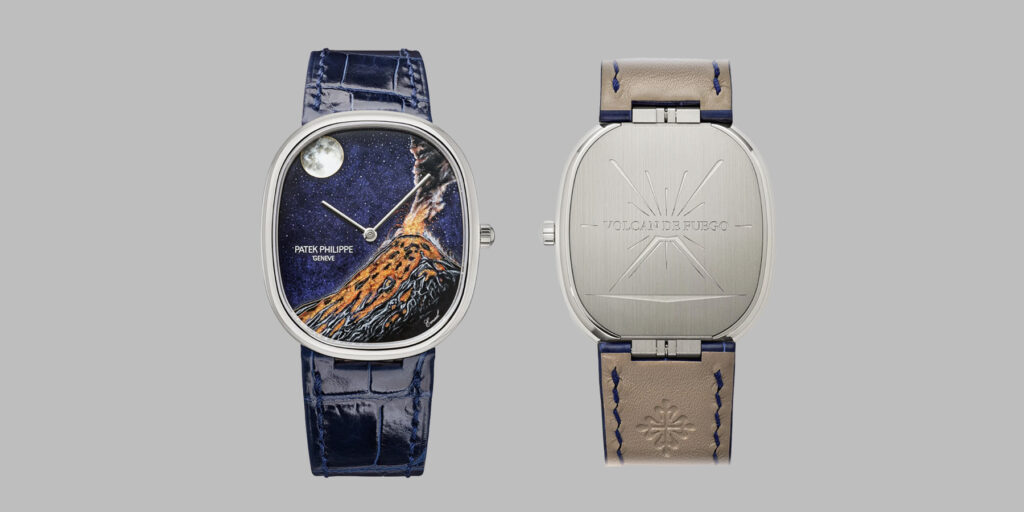
Unveiled at the Rare Handcrafts Exhibition 2026, the Golden Ellipse “Etna” brings to life on its dial the power of one of Sicily’s most spectacular volcanic landscapes. The scene is created using three techniques: Grand Feu cloisonné outlines the volcano’s silhouette with approximately 9.4 cm of gold wire, while six shades of transparent and opaque enamel define its structure and eruption.
The incandescent lava is rendered using the paillonné technique, with thin sheets of gold inserted beneath the translucent enamel, while the five-color enamel painting adds details of the fiery slopes and the cloud of ash rising into the starry sky.
Credits: Swisswatches Magazine
5089G-015
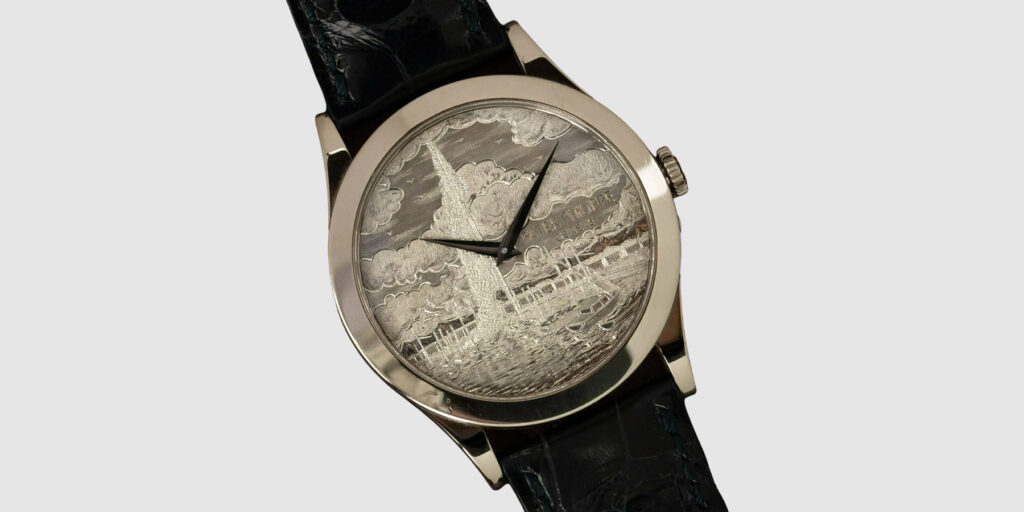
Created in 2014 to celebrate Patek Philippe’s 175th anniversary, the Calatrava “Breeze and Storm” features a scene of Lake Geneva on its dial, with a traditional sailboat sailing past the city and the Jet d’eau. The entire composition is created through hand-engraving of white gold using the bas-relief technique: the artisan carves and shapes the surface to create engraving depths of up to 0.3 mm.
It takes about 108 hours of work to complete a single quadrant, during which variations in the depth and density of the strokes are the only factors capable of conveying a sense of perspective and the movement of the water.
Credits: Amsterdam Vintage Matches
5089G-040
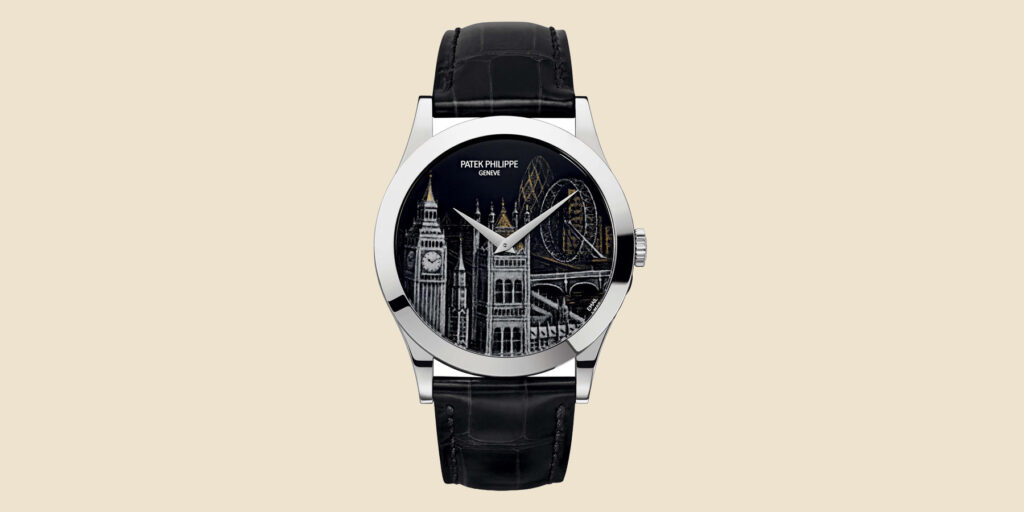
Created for Patek Philippe’s “Watch Art Grand Exhibition” at the Saatchi Gallery in London in 2015, the Calatrava “London Monuments” brings together in a single composition some of the most recognisable symbols of the British capital: Big Ben, the Houses of Parliament, Tower Bridge, the London Eye and the Gherkin skyscraper .
The cityscape is rendered using the grisaille technique on enamel, which employs various shades to depict light, shadow, and depth. The dark background of the dial accentuates the contrast with the buildings, transforming the London view into an almost monochromatic scene, where architectural precision and linearity combine with the delicacy of enamel painting.
Credits: The Jewellery Editor
5089G-075
The allure of travel and the Industrial Revolution come together in the Calatrava 5089G-075, part of a limited series of three watches dedicated to steam locomotives. Unveiled in 2016, the model depicts a locomotive from the golden age of rail travel, rendered on the dial using the Grand Feu cloisonné enamel technique. Delicate gold lines delineate the various sections, while the shades of the enamels and the incorporation of gold or silver leaf help define the translucent details of the locomotive and the smoke rising from the chimney.

Credits: EveryWatch
5089G-035, 5089G-036, and 5089G-037
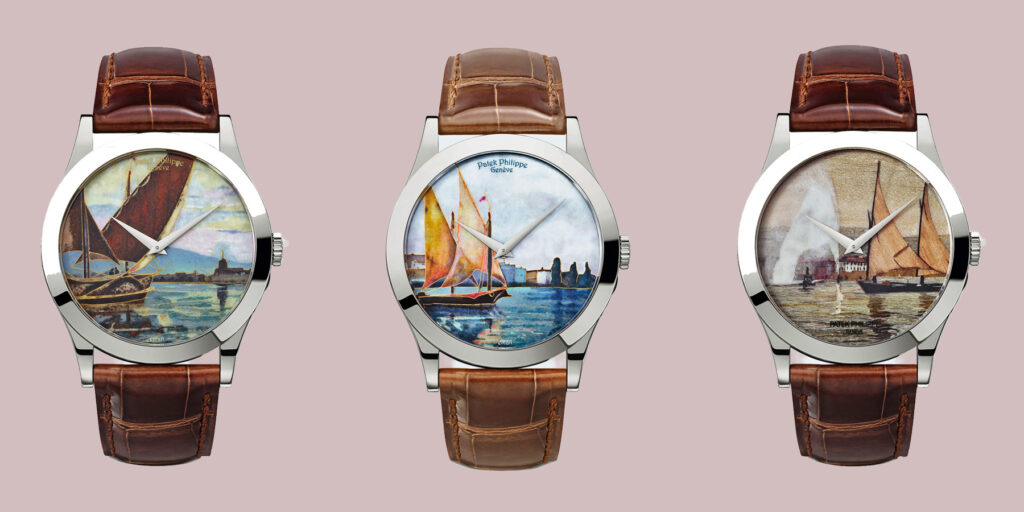
The traditional sailing boats of Lake Geneva are depicted on the three Calatrava “Lake Geneva Barques” watches, created to celebrate Patek Philippe’s 175th anniversary in 2014. The scenes, inspired by paintings from Philippe Stern’s personal collection, are rendered using cloisonné enamel, with ultra-fine gold threads dividing the dial into numerous sections.
About 40–70 cm of gold wire and some twenty shades of enamel—including transparent, opaque, and opalescent hues—are used to create the boats, the water, and the landscapes of Lake Geneva. Each dial thus captures a different view of the lake in a delicate, multicolored miniature, created through exceptional craftsmanship.
Credits: The Jewellery Editor
5089G-028
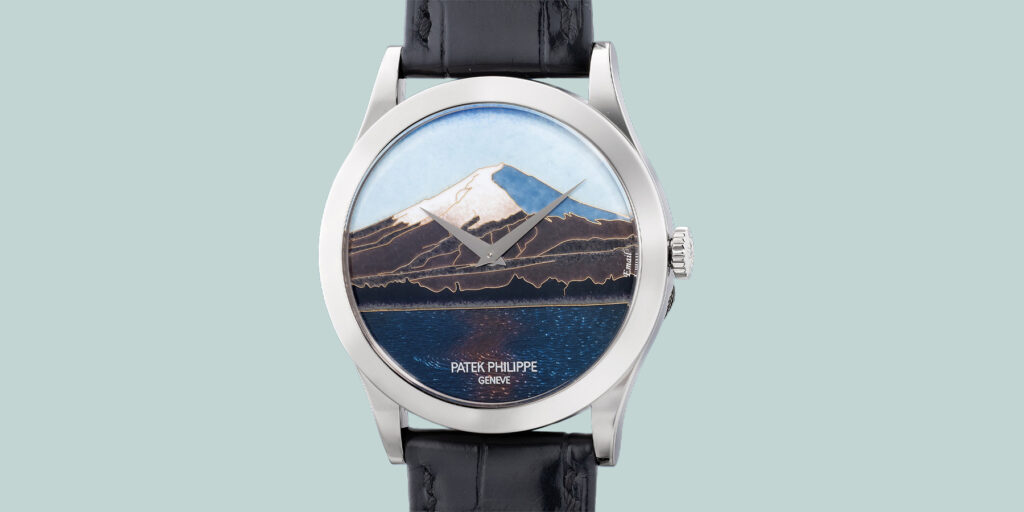
Mount Fuji, a symbol of Japan, is depicted on the Calatrava 5089G-028 “Mont Fuji,” introduced in 2015 as part of the “Enchanted Mountains” series, dedicated to four famous mountains around the world: Mount Fuji, Everest, the Matterhorn, and Mont Blanc. The landscape is crafted in cloisonné enamel, with approximately 25 cm of gold wire dividing the composition and defining the outlines of the mountain, the lake, and the vegetation. Fifteen shades of enamel—both transparent and opaque—create the scene’s varying depths, while hand engraving and small elements of silver leaf accentuate its details and luminosity.
Credits: Phillips
5089G-066
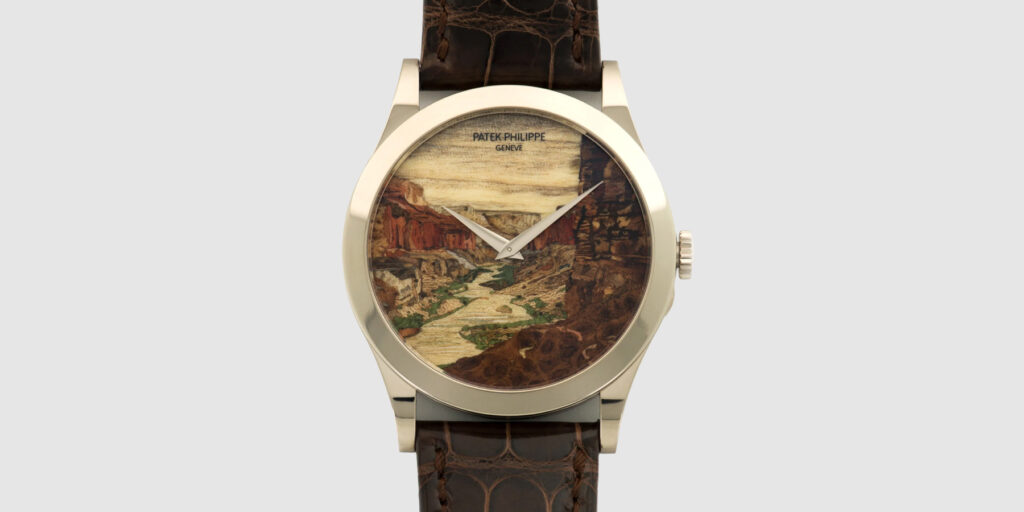
Unveiled at The Art of Watches Grand Exhibition in New York in 2017, the Calatrava “Grand Canyon” recreates the famous American landscape using wood micro-marquetry. Hundreds of tiny fragments, cut from about 20 different types of wood, are selected, shaped, and assembled by hand to recreate the canyon’s rock faces and color variations. The wood’s distinct grain patterns and natural hues give each of the ten pieces a unique character.
Credits: The Keystone Watches
5738/50G-025
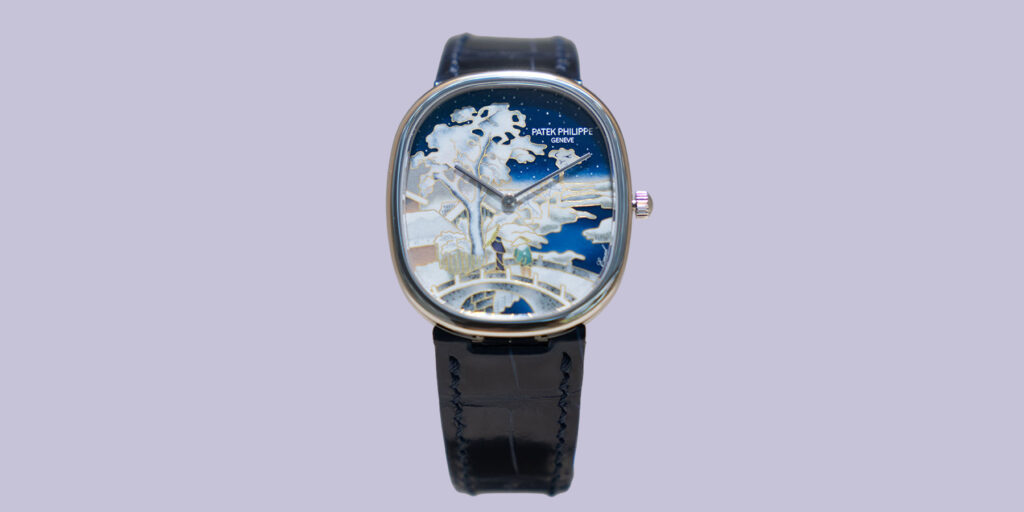
Unveiled at the Watch Art Grand Exhibition in Tokyo in 2023, the Golden Ellipse “Snow-Covered Landscape” draws inspiration from a Japanese print depicting a bridge set against a winter landscape. The dial is crafted from Grand Feu cloisonné enamel, featuring approximately 75 cm of hand-shaped gold wire to outline the trees, figures, and details of the scene.
Seventeen shades of enamel—including transparent, opaque, and semi-opaque—capture the snowy atmosphere, while the enamel painting adds the finest details. Each dial, produced in a limited edition of just ten pieces, requires an average of 40 firings at temperatures ranging from 780 to 800°C.
Credits: SJX Watches
Nature: Flora, Fauna, and Natural Wonders
5077/212G-001, 5077P-080, and 5077P-081
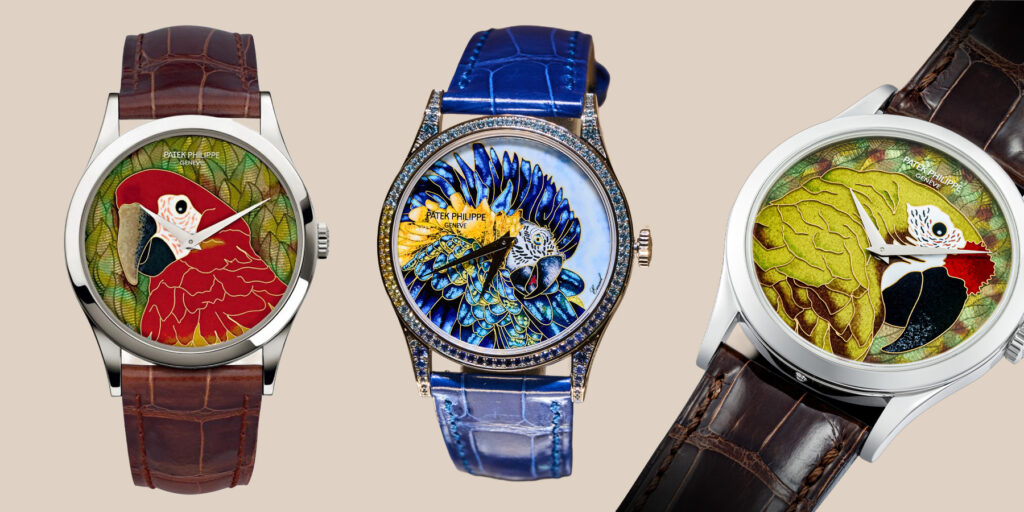
The charm of parrots and their colorful plumage returns in various interpretations by Patek Philippe’s master craftsmen. In 2013, the Calatrava 5077P-080 and 5077P-081 feature a Red Macaw and a Green Macaw, respectively, set within a botanical composition crafted in cloisonné enamel on a guilloché background.
Twelve years later, the 5077/212G-001 “Macaw on a Blue Ground” revisits the same subject with a richer composition, in which the bird emerges from a blue background through numerous shades of enamel. In all models, this technique transforms the dial into a true naturalistic miniature, using the transparency and opacity of the enamels to lend depth to the bird’s plumage and the vegetation.
Credits: Hodinkee – Christie’s
5077P, 5077P-093, and 5738/50G-029
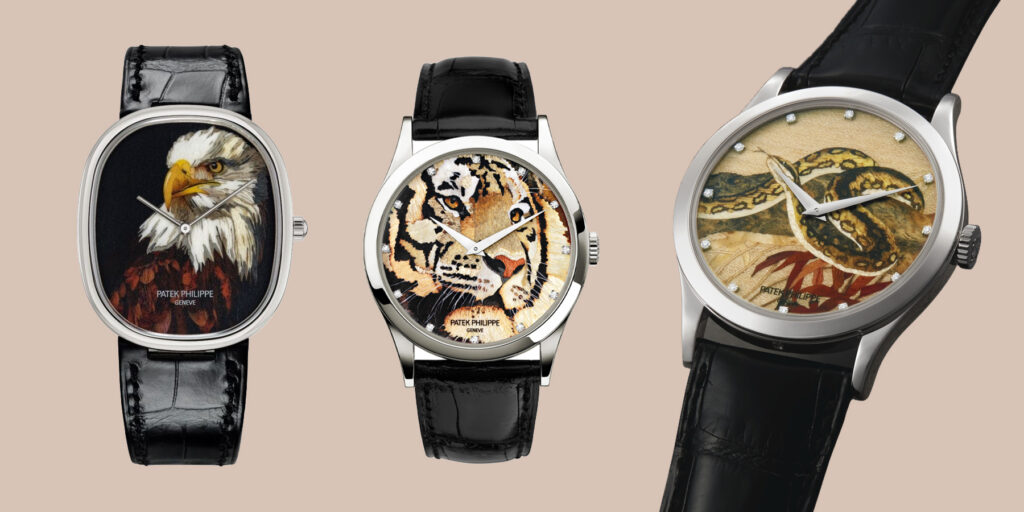
In 2010, the 5077P “Royal Tiger” introduced this technique to Patek Philippe wristwatches with a tiger’s head composed of 120 elements made from eight different types of wood, complemented by twelve diamond hour markers. In 2013, the 5077P-093 “Snake” used up to 219 elements from 13–18 species of wood to craft the snake. In 2025, the 5738/50G-029 “Bald Eagle” takes complexity a step further, with 148 elements crafted from 33 types of wood. Three distinct designs, united by this technique’s ability to harness natural grain patterns, colors, and textures to create true pictorial miniatures.
Credits: Watchbase – The Jewellery Editor
5738/50G-023, 5738/50G-041, and 5738/50G-049
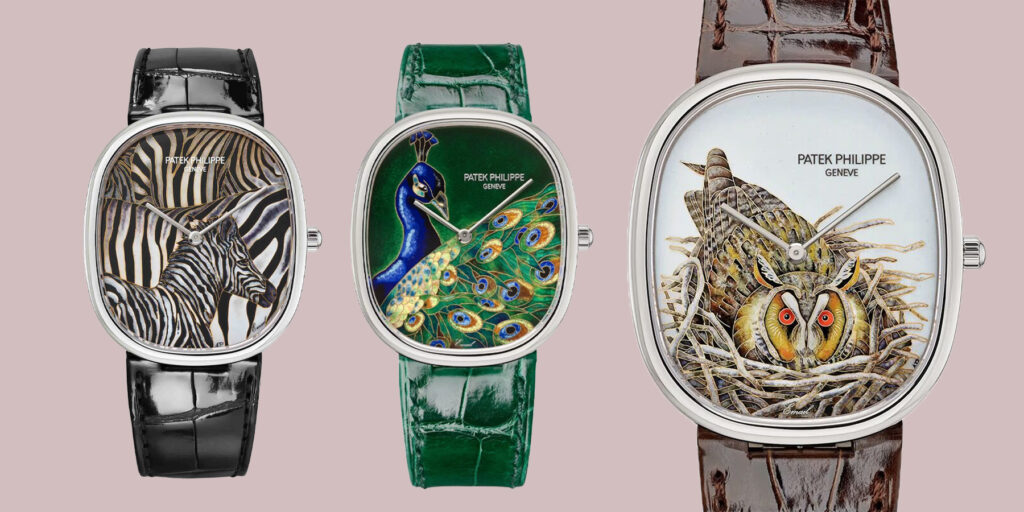
The animal kingdom is interpreted through Grand Feu cloisonné in three compositions of great chromatic richness. In 2022, the 5738/50G-023 “Zebras” uses approximately one meter of gold wire to outline the animals and their distinctive stripes, complemented by various shades of enamel. In 2026, the 5738/50G-041 “Blue Peacock” uses 69.4 cm of gold wire and 30 colors, while the 5738/50G-049 “Brown Owl” combines approximately 80 cm of gold wire with 27 enamel colors and six shades of enamel painting, used to render the bird of prey’s plumage and details with exceptional realism.
Credits: Hightime – Watchbase – Jaztime
5738/150G-001
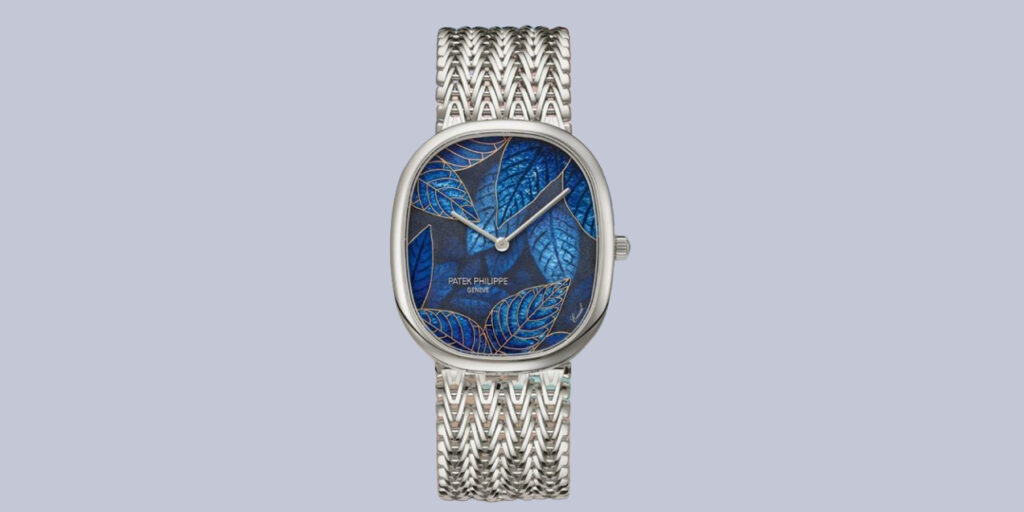
The botanical motif meets the Golden Ellipse shape in the 5738/150G-001 “Blue Leaves,” introduced in 2025. On the white gold dial, leaves and scrollwork are hand-engraved and enhanced with blue enamel, creating a design that harmoniously follows the proportions of the case.
Credits: Esquire Singapore
5077/100G-061 and 5077/100R-071
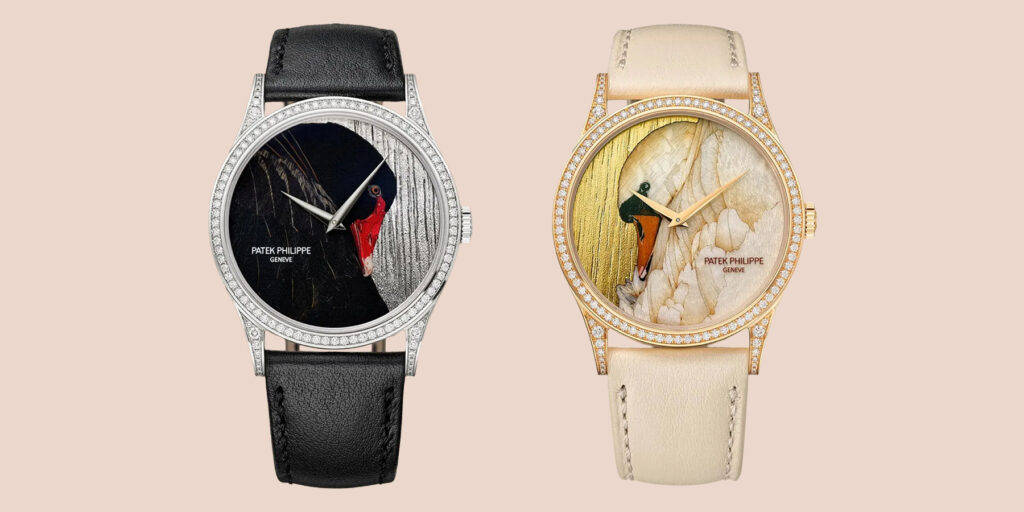
The marquetry depicts two elegant swans on the 5077/100G-061 “Black Swan” and 5077/100R-071 “White Swan,” introduced in 2025. Each dial is crafted from approximately 100 wooden elements and small inlays, carved from a variety of wood species. The varying grain patterns, shades, and textures define the plumage, while the gold or silver leaf in the background accentuates the contrast. Both models are limited to ten pieces.
Credits: Swisswatch Magazine
5738/50J-001
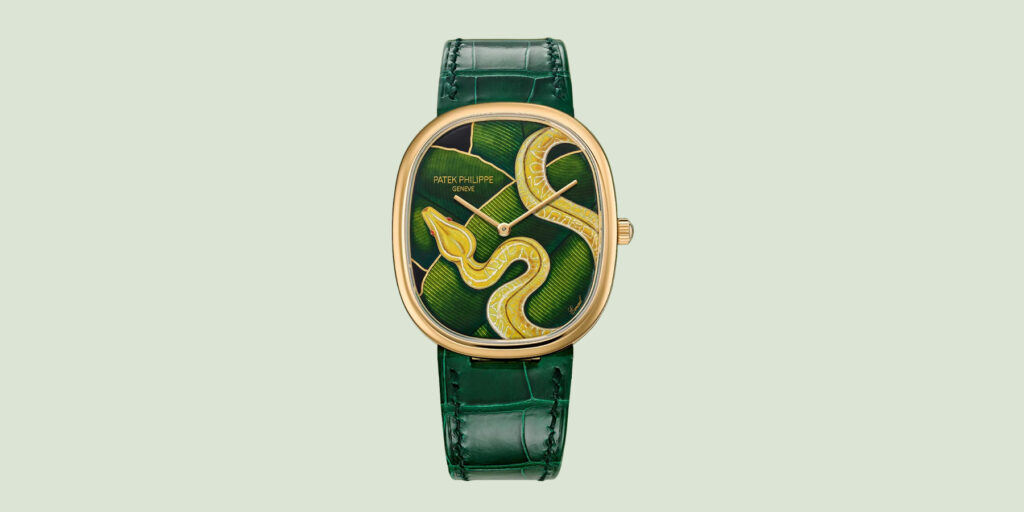
The 5738/50J-001 “Burmese Albino Python” combines three techniques on the Golden Ellipse dial: hand-engraved guilloché forms the leaf-patterned background, overlaid with translucent enamel using the flinqué technique, while the python is painted in miniature on enamel. The layering of these techniques lends great depth to the scene and highlights the contrast between the botanical motif and the reptile’s body.
Credits: Swisswatch Magazine
5738/50G-030 and 5738/50G-034
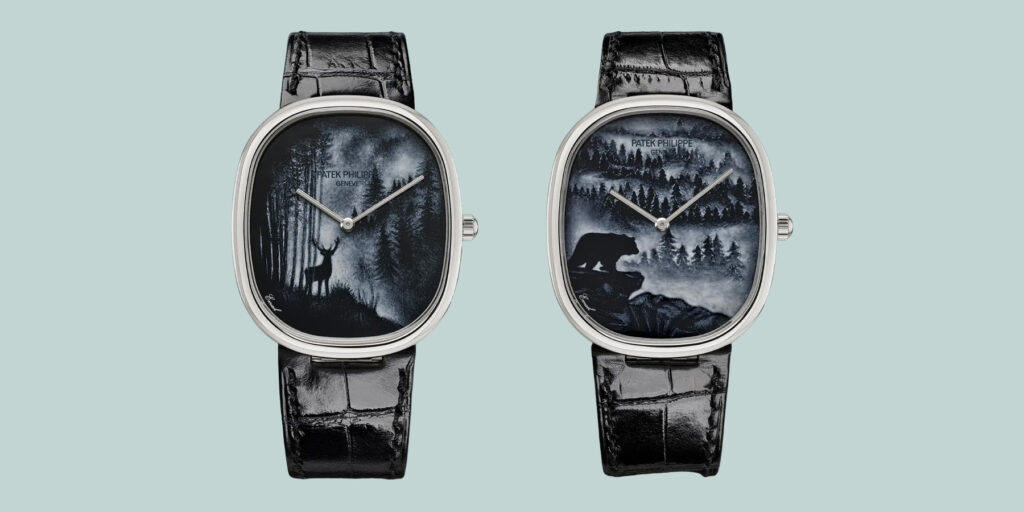
The mist transforms the forest into a mystical scene in the 5738/50G-030 “Stag in the Mist” and 5738/50G-034 “Bear in the Mist.” These two Golden Ellipse models introduce the grisaille inversée technique to the Patek Philippe collection: against a white “blanc de Limoges” enamel background, the black silhouettes of the stag and the bear emerge from the mist through 11–12 successive firings. Both models are limited to ten pieces.
Credits: Swisswatch Magazine
5278/500G-001
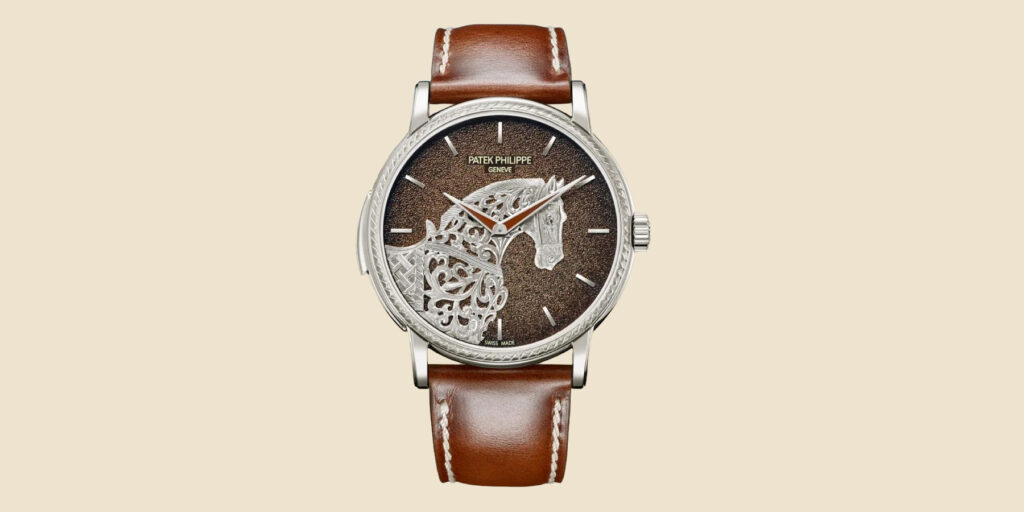
In the 5278/500G-001 “Horse,” haute horlogerie meets the art of engraving. The dial of the Calatrava with minute repeater features a Chunar-inspired horse, hand-carved and sculpted directly from white gold. The mane motif is also repeated on the bezel and clasp, creating continuity between the dial and the case. The R27 movement with minute repeater completes one of the most distinctive creations in the 2025 Rare Handcrafts collection.
Credits: Swisswatch Magazine
5077/100R-037 and 5077/100R-040
The world of flowers finds one of its most refined expressions in Grand Feu cloisonné: the 5077/100R-037 “Floreal Motif,” from 2018, uses delicate gold threads to outline flowers and leaves, while the 5077/100R-040 “Orchids,” from 2019, interprets orchids through more vibrant hues. In both models, the enamel backgrounds transform the dial into a small botanical composition, enhanced by the rose gold of the case.

Credits: Watchbase – Watchtest
5077/101G-010“
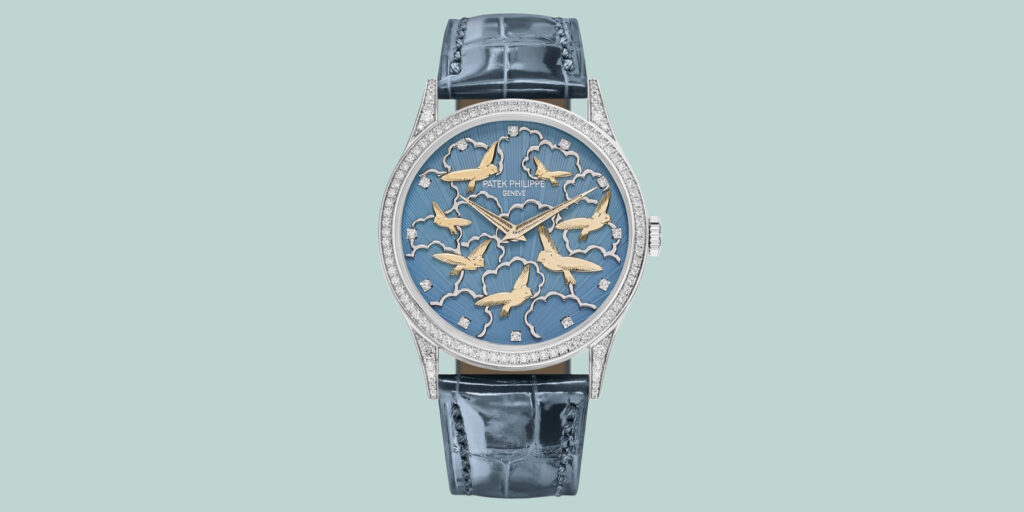
The 5077/101G-010 “Birds and Clouds” transforms the dial into a three-dimensional scene. Set against a blue background—decorated with hand-engraved sunburst guilloché and coated with lacquer—are white gold clouds and yellow gold birds. The varying levels of the surfaces create a striking interplay of relief and shadow, complemented by twelve diamond hour markers.
Credits: Watchbase
5177G-026 and 5177G-027
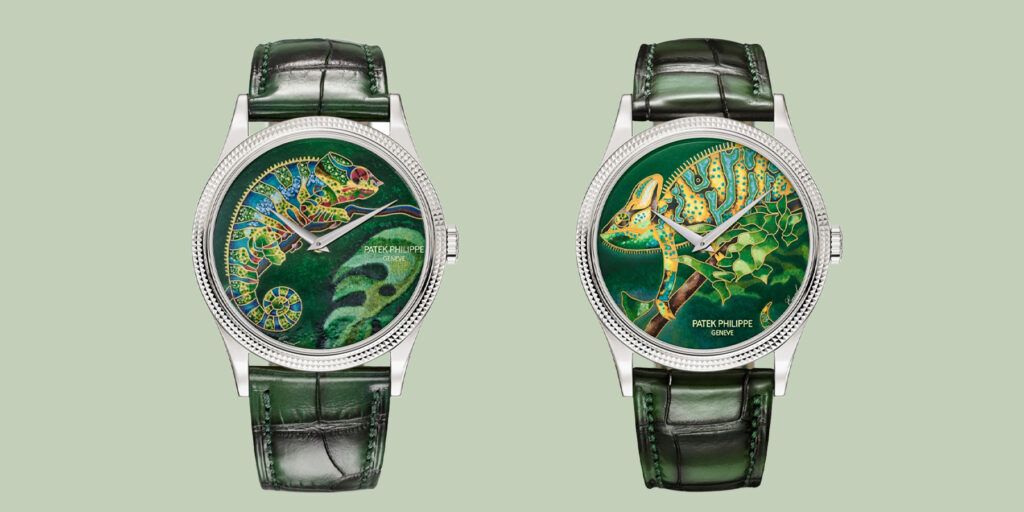
Two chameleons nestled among tropical foliage are depicted on the 5177G-026 and 5177G-027, introduced in 2022. The dials are crafted from Grand Feu cloisonné enamel, with delicate gold threads outlining the vegetation and the reptiles’ bodies. The numerous shades of enamel—including transparent, opaque, and semi-opaque—create subtle gradations and depth, highlighting the distinctive camouflage of the two animals.
Credits: Watchbase
5089G-085 and 5089G-109
Tropical vegetation unites two interpretations of Patek Philippe’s fine craftsmanship. The 5089G-085 “Orchids” combines cloisonné enamel and enamel painting to depict orchids, while the 5089G-109 “Tropical Forest” uses a guilloché background covered with translucent enamel to reproduce the veins of the leaves. A small, hand-engraved gecko completes the composition.

Credits: Watchtest – Everywatch
5077/356R-001 and 5077/357G-001
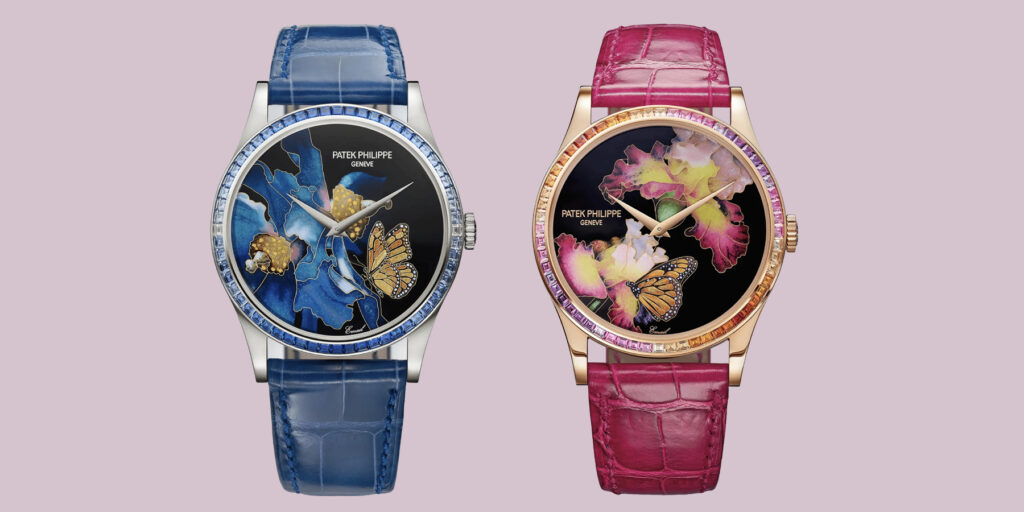
The monarch butterfly is the subject of the two Calatrava models, 5077/356R-001 “Pink Butterfly” and 5077/357G-001 “Blue Butterfly,” surrounded by irises and Himalayan blue poppies, respectively. The dials combine Grand Feu and paillonné cloisonné techniques, with thin gold leaves embedded in the enamel to highlight the wings and floral details. The black background creates a striking contrast with the vibrant colors of the motifs.
Credits: Swisswatch Magazine
Our reflections
We are confident that this in-depth look at Patek Philippe’s most exclusive decorative techniques and their most fascinating applications has provided an excellent opportunity to give you a broader perspective on the Geneva-based house. The maison will open the doors to its world in Milan from October 2 to 18, 2026, during the annual Watch Art Grand Exhibition: you now have the tools to appreciate these marvelous works—all that’s left is to enjoy the spectacle.
Edited by Gabriele Passarella
Are you looking for the perfect gift? Explore our online store and discover the entire collection signed IWS – Italian Watch Spotter!
For all real-time updates on the world of watchmaking follow us on Instagram and visit our Youtube channel.