
There is a silent way to tell the story of a man’s life: through the objects he chose to carry with him. In the case of Francis Ford Coppola – director, producer and seventh art legend – those objects measure time.
This December, a collection of seven watches belonging to the director of The Godfather and Apocalypse Now will be auctioned off by Phillips in Association with Bacs & Russo. Proceeds, the auction house confirms, will help support the production of Megalopolis, the cinematic behemoth released last year that Coppola has been working on for more than two decades. The attention of the entire watchmaking world, however, has focused on one specimen in particular: the François-Paul Journe FFC prototype, created for and in collaboration with Coppola himself.
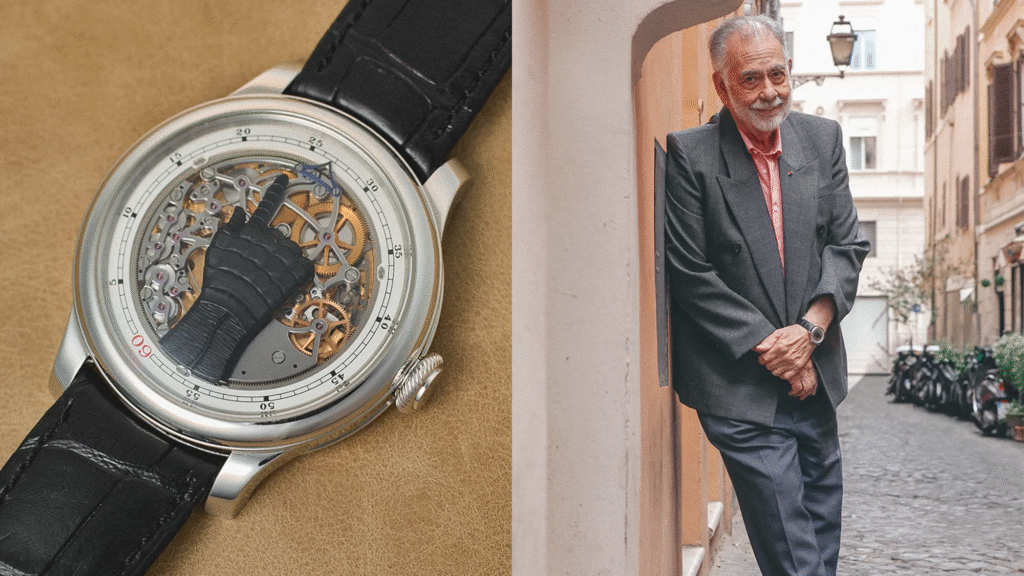
Courtesy of Phillips
Phillips brings to New York an auction that tells a life story
The appointment is set in New York on the days of the New York Watch Auction: XIII, December 6 and 7, 2025. Prior to the sale, the lots will make the international tour of previews in
François-Paul Journe FFC Prototype: the one-of-a-kind masterpiece created for Francis Ford Coppola
In the center, the François-Paul Journe FFC Prototype. The idea was born in 2012, when Coppola-during a dinner at his Napa Valley estate nestled among California vineyards-asked if it was possible to “read time with one hand.” François-Paul Journe accepted the challenge and took nearly a decade to translate that insight into a reliable technical solution of pure mechanics.
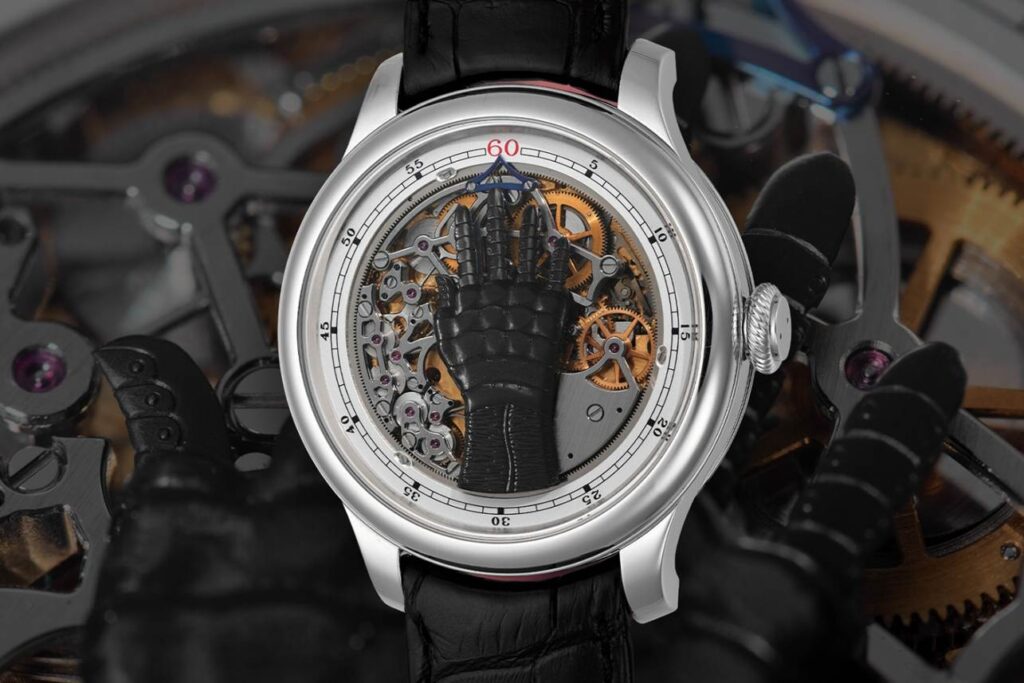
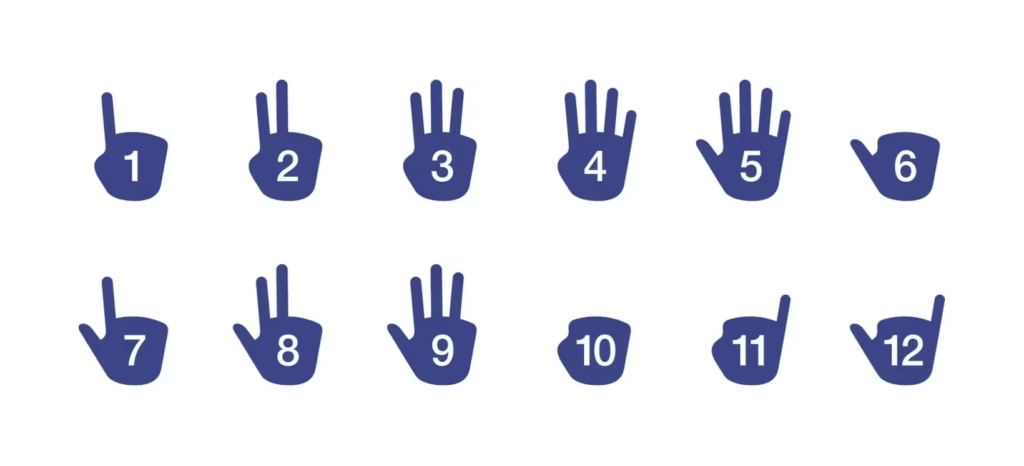
The watch is built around the concept of an automata hand-inspired by an anatomical study of Ambroise Paré, a 16th-century surgeon now considered the father of modern surgery-which, with its articulated fingers, indicates all twelve hours: the minute disc rotates at the perimeter, while the five fingers, made of titanium, extend or retract every sixty minutes in configurations that harken back to ancient methods of manual counting.
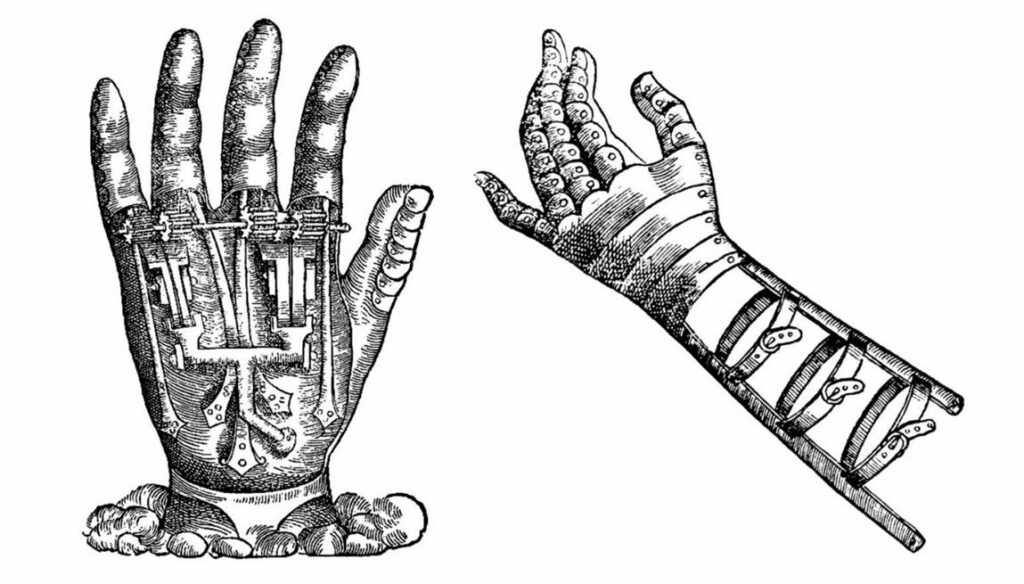
Illustration of an artificial hand by Ambroise Paré.
The mechanism of Coppola’s prototype is powered by the Octa 1300.3 automatic caliber, which incorporates the remontoir d’égalité to ensure consistency of force and allow the automaton to function without adding a second dedicated barrel. The solution required very long refinement and development; François-Paul Journe reports that the project required long years of refinement before arriving at a movement just 8.1 mm thick and with the usual power reserve typical of the Octa in its advanced version.
There are, in the world, only two of these prototypes. Assembled by Journe himself-one for himself and one for Coppola-these unique versions differ from later production models in construction details: the Coppola example, engraved on the back with his name, mounts steel bridges, white hardware, and a black-treated titanium hand.
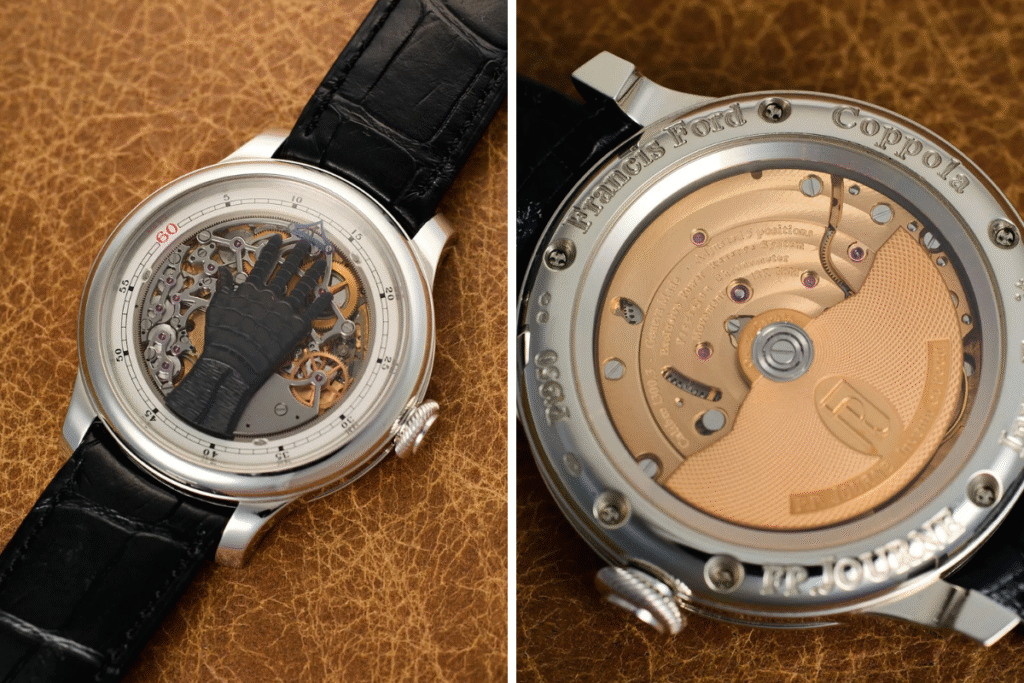
To complete the genealogy of the project, there is a third watch, the FFC Blue, made of tantalum with a skeletonized dial and blue automata hand. This unique example, auctioned for charitable purposes by

The other watches up for auction at Phillips: Patek, Blancpain, Breguet and IWC
Alongside the FFC prototype, the auction will feature a selection of watches that reflect the collector’s eclecticism. Among the best-known is François-Paul Journe‘s platinum Chronomètre à Résonance, the model that was a gift from his wife Eleanor and which, in retrospect, marked the beginning of the link with Journe.
Estimated between $120,000 and $240,000 (USD), it is among the Maison’s most iconic models, and carries with it, in addition to its personal provenance, an element of technical and historical value. Based on a system used by Abraham-Louis Breguet and other great master watchmakers, it in fact features two oscillators that beat in unison thanks to the principle of resonance, stabilizing the movement and improving its precision.

On the left is the F.P. Journe Chronomètre à Résonance, initially developed as a pocket watch in 1983, and then adapted by Journe to the structure of a wristwatch in 2000. At right is the Breguet Classique ref. 5140.
Also appearing in the catalog are two Patek Philippe (including ref. 3919 and a World Time ref. 5130G ), a Breguet Classique with guilloché dial and calendar complications, a Blancpain with minute repeater, and an IWC Portugieser Chronograph offered without reserve.

Left is the Patek Philippe World Time ref. 5130G; right is the Patek Philippe Calatrava ref. 3919.
Not a systematic collection, but a selection guided by personal taste, intellectual curiosity and the eye of someone who, like Coppola, has always sought beauty in the details.
Conclusions
The François-Paul Journe Prototype and the other watches in the catalog are destined to far exceed initial estimates. As is often the case in the world of collectibles, the real value lies in the history the object carries. The signature and affiliation with Francis Ford Coppola add a level of significance beyond rarity or technique, but behind the appeal of the name is the deeper connection between two art forms that meet, cinema and independent watchmaking.

Every rotation of the minute disc and every extension of the mechanical fingers refer back to the visionary approach of Coppola, who in his films and stories transformed ordinary time into mythical matter, which structures, destroys or saves, memory. A small theater of time, where F.P. Journe’s art of watchmaking and that of cinema touch each other in the same obsession.
Visit our Youtube channel to experience the best of the world of watchmaking firsthand.
For all real-time updates follow us on Instagram.