“Red pill or blue pill?” In 1999, The Matrix turned a simple cinematic dilemma into the ultimate metaphor for our age: choosing the uncomfortable truth or a comfortable illusion.
Today, dear fans and readers of IWS, we find ourselves at a similar crossroads looking at the new Girard-Perregaux Laureato Fifty: 36 or 39 millimeters?
Help us choose and let’s find out together which of the two sizes feels best on the wrist!
Fifty years later: the Laureato remains the Laureato
When the Laureato was born in 1975, watchmaking was undergoing a profound transformation. After the release of Gérald Genta’s Royal Oak (1972) and Patek Philippe’s Nautilus (1976), the concept of the “luxury sports watch” was emerging as a new design frontier. Girard-Perregaux took up the challenge, but with a different approach.
The result was a perfect balance between geometry and fluidity, rigor and smoothness. Unlike the coeval Royal Oak, with its exposed screws and angular lines, or the Nautilus, inspired by the profile of a porthole, the Laureate expressed a new idea of prestige based on precision, balance and measure.
Fifty years and six generations later, the Laureato continues to be recognizable and true to its identity.
The new Girard-Perregaux Laureato Fifty: 36 and 39 millimeters
The focus is inevitably on the new 36 mm. Alongside the 39 mm version introduced in 2024, Girard-Perregaux today expands the Laureato collection with a size that many enthusiasts and collectors have been waiting for.
The 39 mm expresses a decisive presence on the wrist. Contemporary proportions enhance the distinctive geometry of the case and iconic octagonal bezel, while providing an ideal stage to appreciate the rich execution of the dials, featuring the traditional Clous de Paris decoration.
The new 36 mm, however, follows a different philosophy. More balanced, more discreet, it restores that natural elegance that distinguished high-end sports watchmaking for decades before the long season dominated by large diameters. Its proportions evoke a less flashy, more refined conception of luxury in which comfort, versatility, and aesthetic harmony take center stage.
For this reason, the choice between the two sizes goes beyond a simple question of size. Rather, it is a matter of identifying the interpretation of the Laureato that is most consistent with one’s own style: on the one hand, the greater presence and contemporaneity of the 39 mm; on the other, the balance and sophisticated restraint of the new 36 mm.
When the dial becomes the protagonist
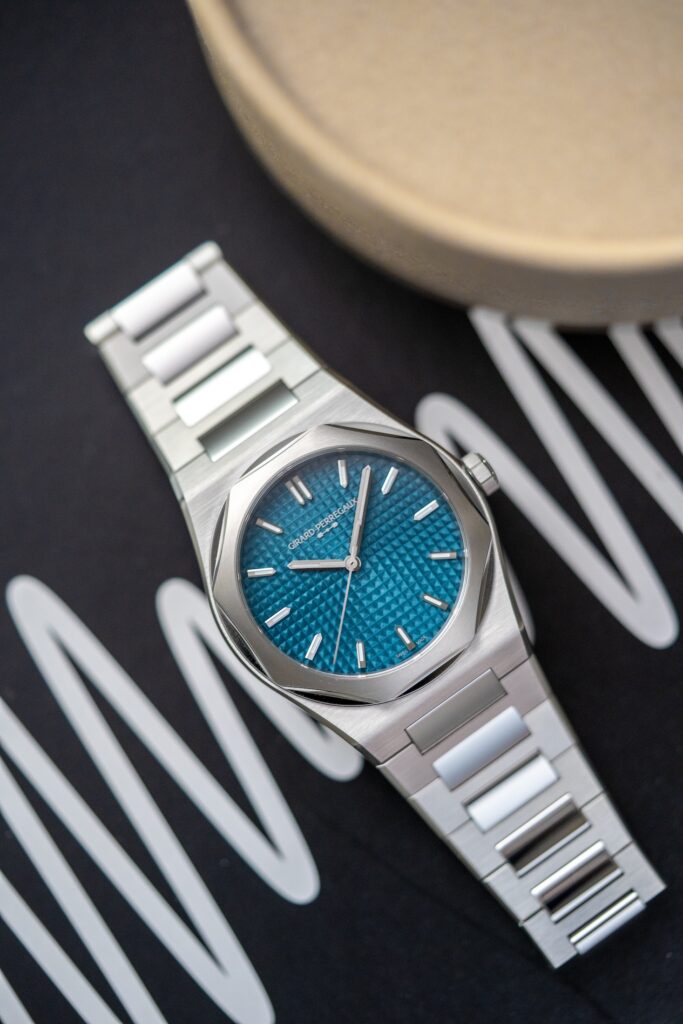
Among the most successful interpretations of the new collection is undoubtedly the Laureato 39 mm with an enameled Grand Feu blue dial, one of the finest achievements presented by Girard-Perregaux in recent years.
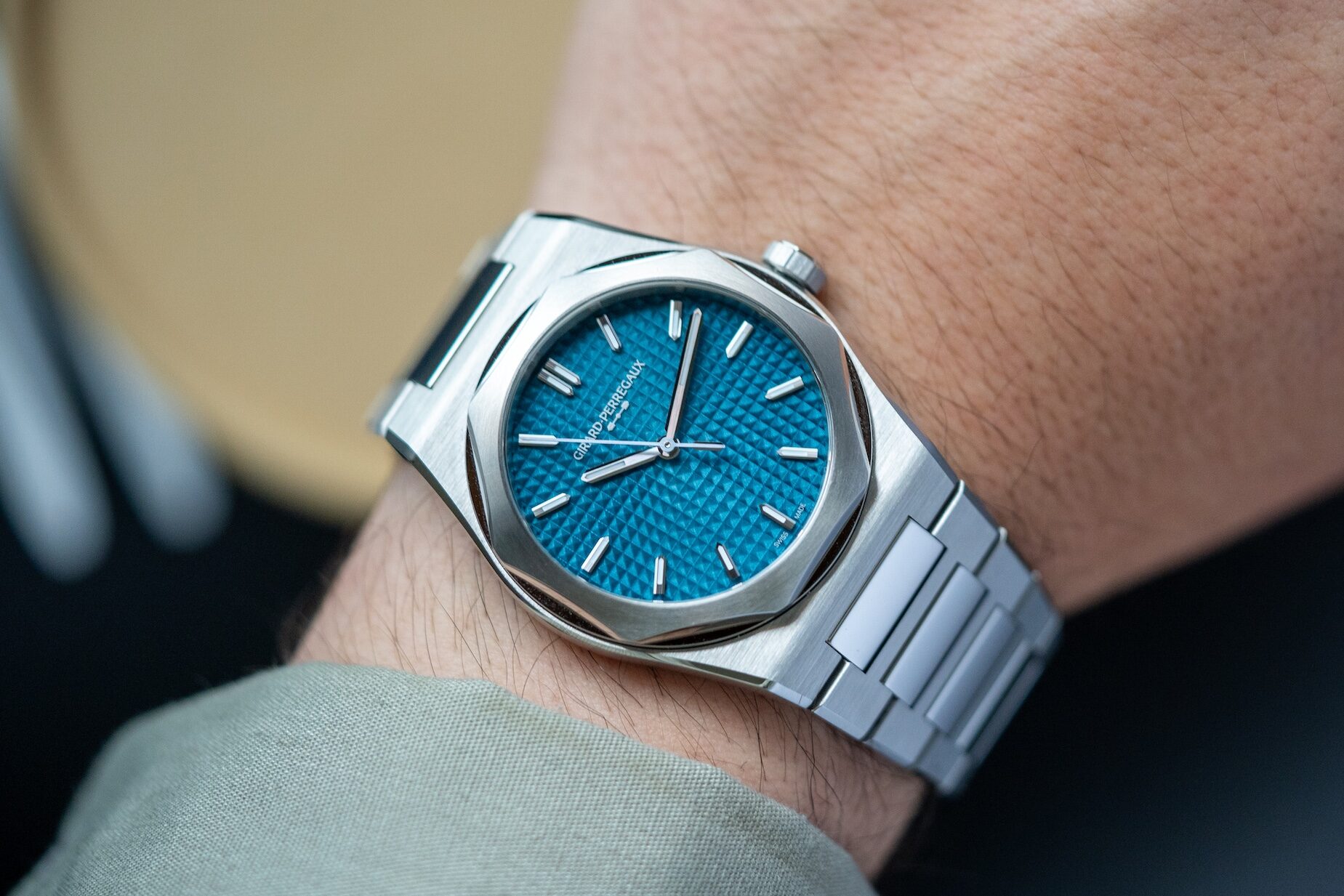
The workmanship, carried out entirely in the manufacture, involves the application of enamel over the traditional Clous de Paris pattern, a distinctive element of the collection. A solution that might appear as a simple exercise in decorative technique, but in person reveals a surprising visual complexity.
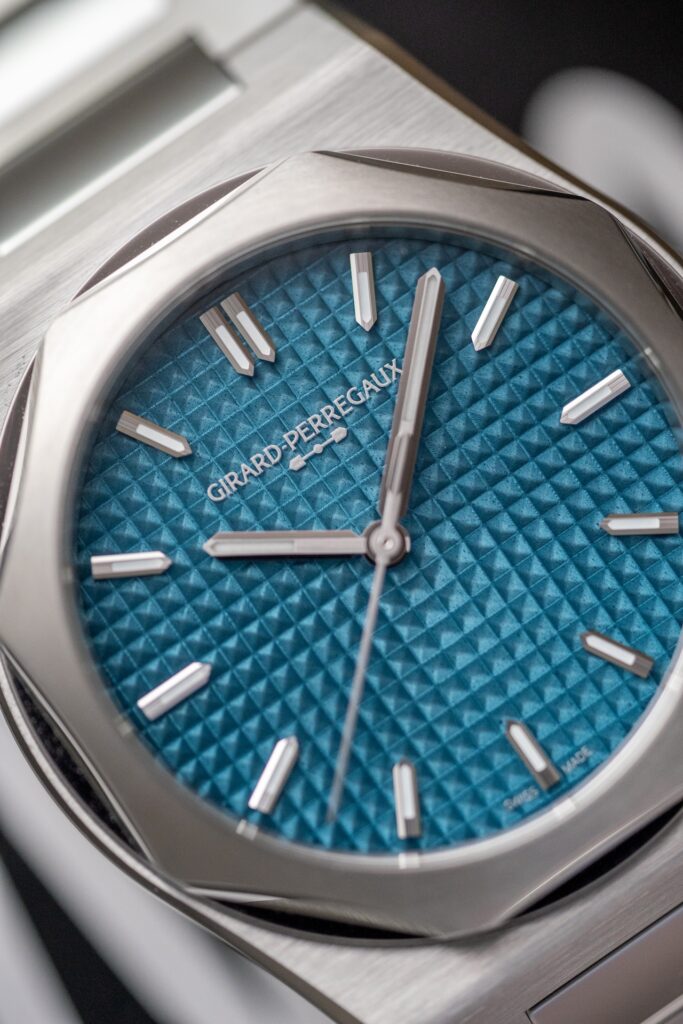
Indeed, the transparency and depth of the enamel allow light to interact with the underlying texture, generating a continuous play of reflections and color variations. Depending on the angle of observation, the dial takes on hues ranging from the brightest and most vibrant blues to denser and deeper shades, creating a three-dimensional effect that lends extraordinary vitality to the whole. Some areas seem almost animated with liquid luminosity, while others acquire a depth that recalls the color of the sea in the last hours of the day.
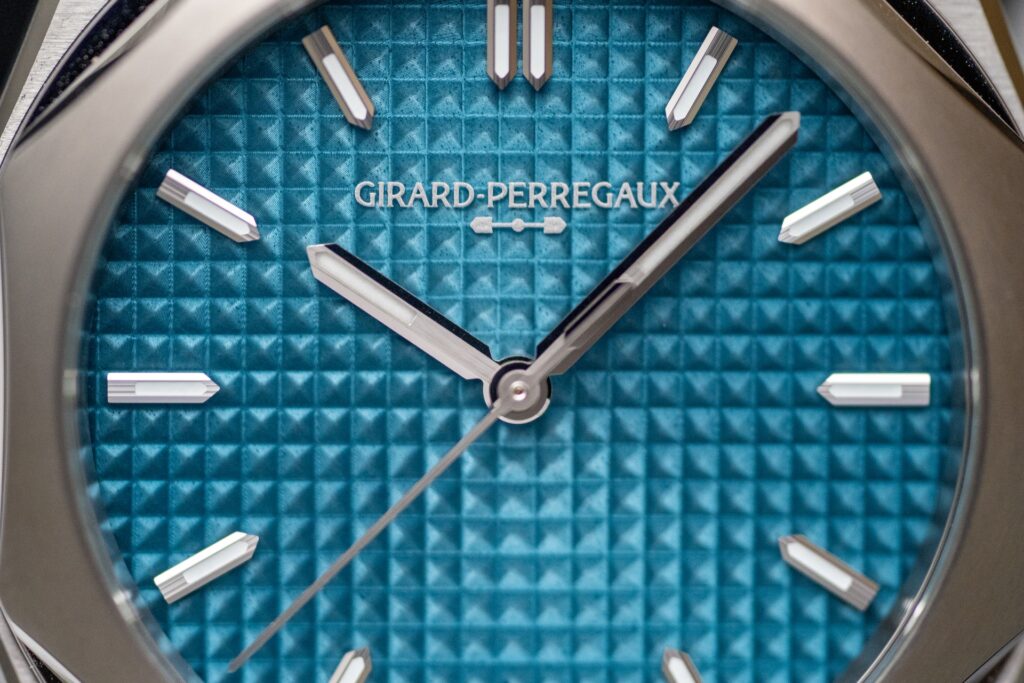
Further enhancing the result is the decision to dispense with the date display. The absence of any interruption in the decorative texture preserves the perfect symmetry of the dial and allows the eye to focus exclusively on the quality of the workmanship and the expressive richness of the enamel, the authentic protagonist of this configuration.
The elegance of rose gold
The second interpretation of the Laureato 39 mm travels in a profoundly different aesthetic direction while keeping intact the stylistic codes that define the collection.
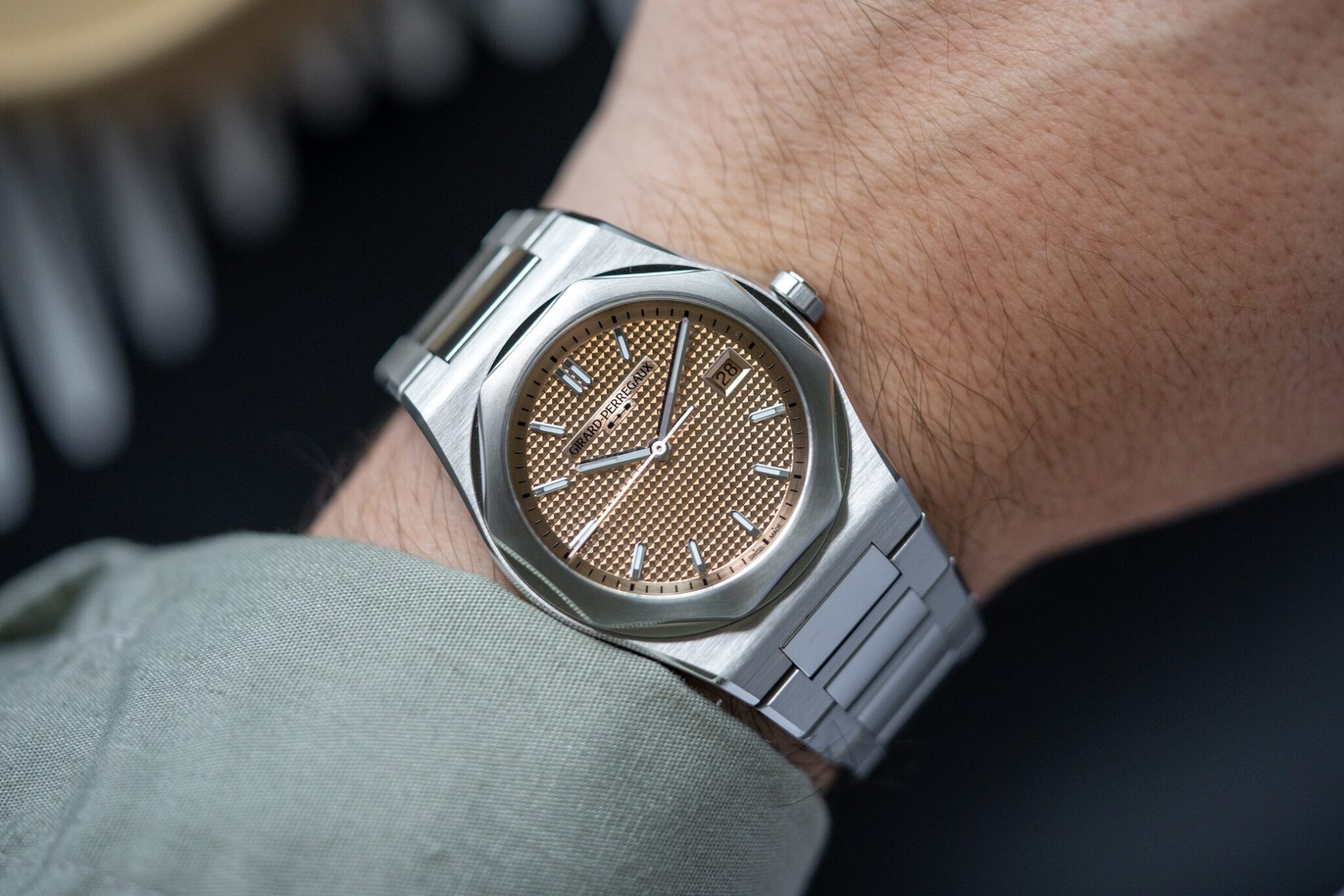
In this configuration, the star is the 18K rose gold tone dial, also made on the traditional Clous de Paris motif. While sharing the same decorative architecture as the blue enameled version, the visual result changes radically. It changes the material, it changes the way light interacts with the surface, and, as a result, it also changes the overall perception of the watch.
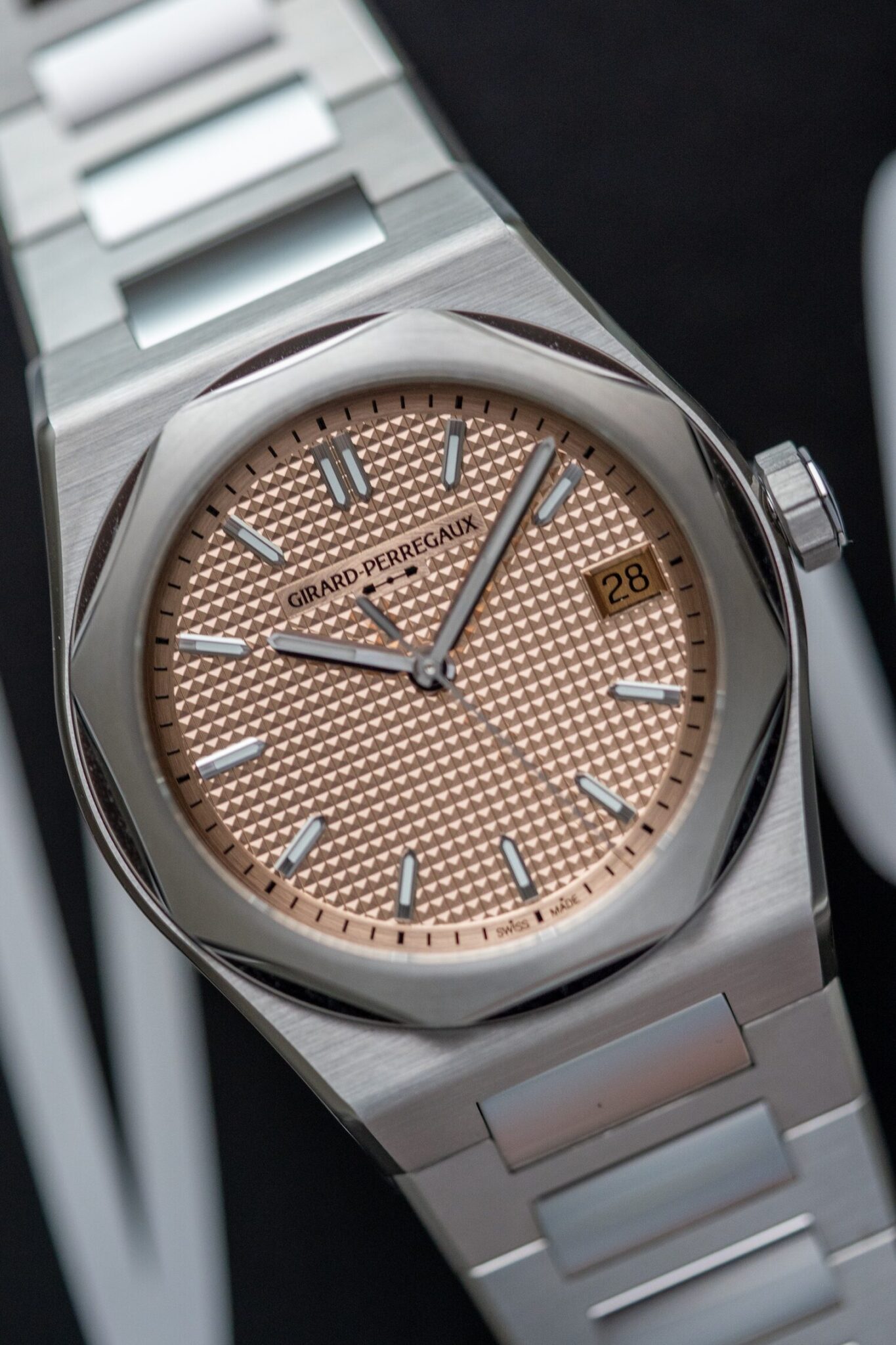
If the enamel dial captivates with its depth and the almost three-dimensional feel generated by the layers of material, the gold variant builds its character through light. The geometric texture of the Clous de Paris captures and reflects every variation in light, creating a continuous dialogue between shiny surfaces and more recessed areas, where shadows emphasize the complexity of the workmanship. The result is a dynamic but never ostentatious effect that highlights the precision workmanship and textural richness of the dial.
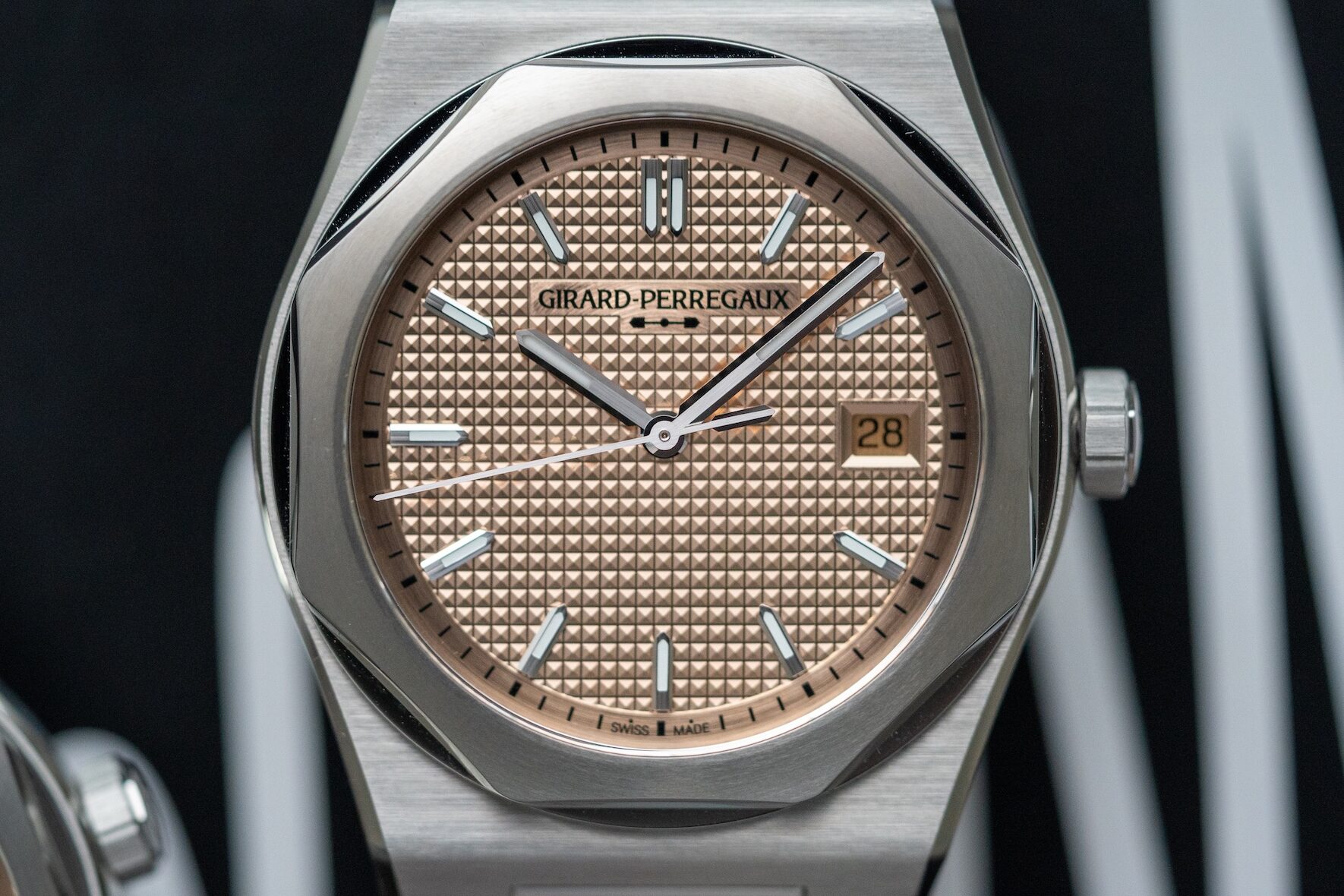
It’s a solution that does not focus on immediate impact or the search for spectacular contrasts. On the contrary, it gradually reveals its qualities, rewarding careful and prolonged observation. Over time, details, reflections and nuances emerge that help define a sophisticated and measured aesthetic, perfectly in keeping with the Laureato tradition.
The GP4800 Caliber
Behind the allure of the new dials is an element that deserves attention: the manufacture caliber GP4800, the automatic movement that animates the new Laureato references.
The technical specifications are those expected of a modern high-end mechanical watch: a frequency of 28,800 vibrations per hour (4 Hz), a power reserve of 60 hours, and a bidirectional rotor. However, it would be reductive to stop at the numbers. The true value of the movement emerges by observing its architecture and level of execution.
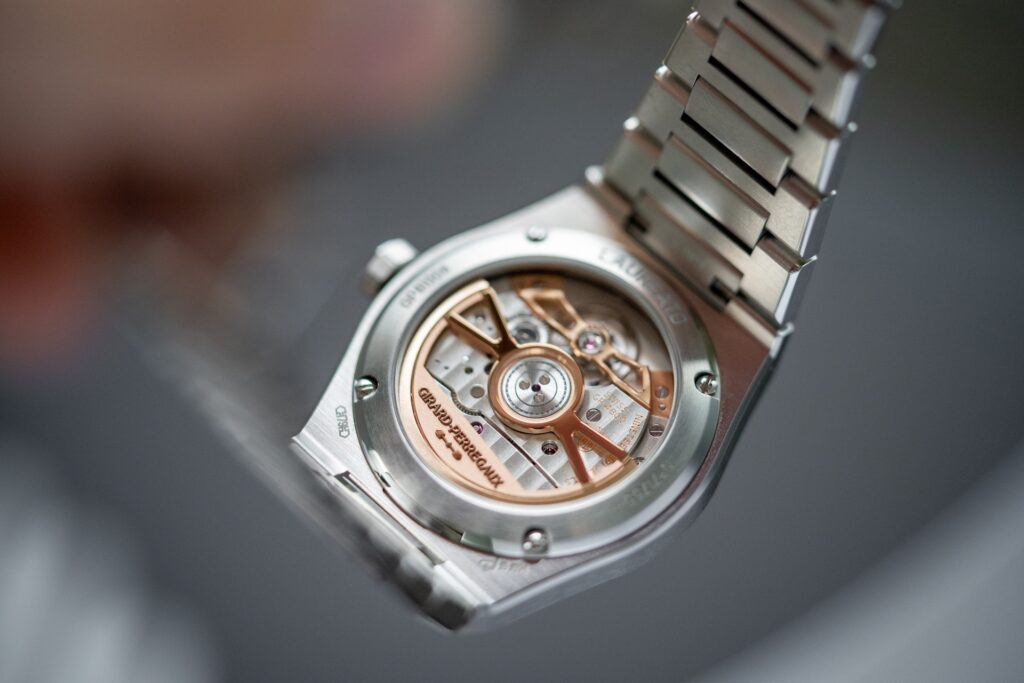
Indeed, the construction reflects the manufacture’s technical heritage and recalls, in its forms and aesthetic approach, the tradition inaugurated by the famous Three Bridges, one of the most iconic expressions of Girard-Perregaux’s watchmaking identity. For these new versions, the balance bridge and oscillating weight are made of rose gold, a choice that gives greater visual depth and a particularly effective stage presence through the sapphire crystal case back.
Data sheets often list long sequences of finishes without being able to convey their real meaning. In the case of the GP4800, however, direct observation of the movement makes it possible to immediately understand the value of these interventions.
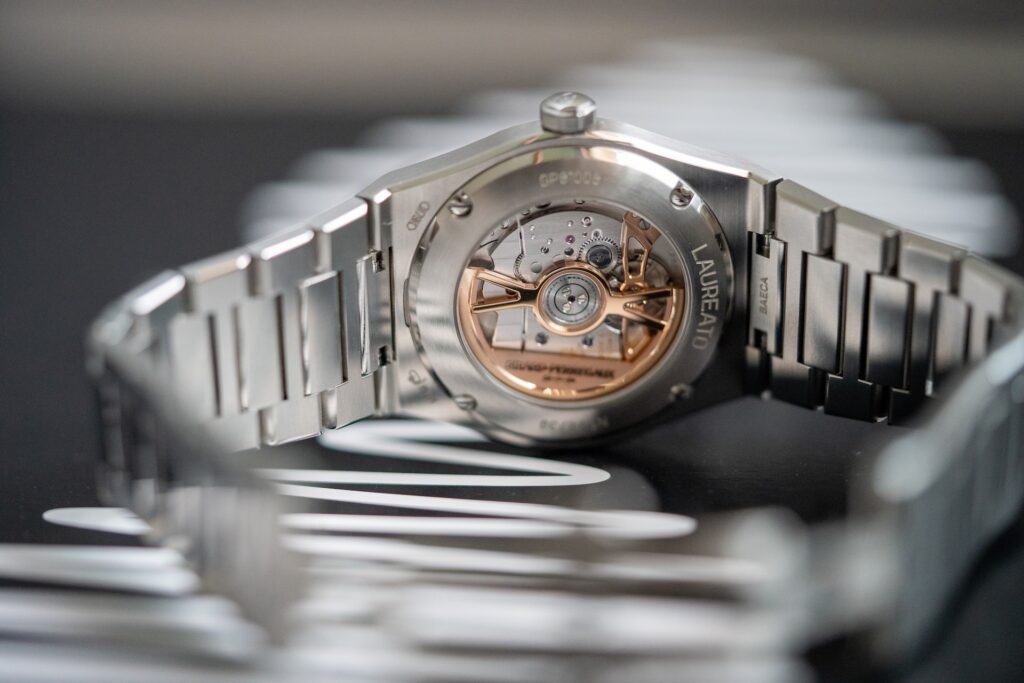
The surfaces alternate between different types of decoration and finishing, including: polishing, sandblasting, anglage, Côtes de Genève, etching, snailed decoration, circular satin finish, circular grenage, soleil finish, and linear satin finish. Each treatment modifies the way light is reflected, creating a visual composition rich in contrasts and nuances. Nothing appears random: every beveled edge, every finished surface, and every decorative detail testifies to the time, precision, and expertise required to achieve this level of execution.
The impression is similar to observing a particularly fine historic building. At a distance, one grasps its overall balance; as one gets closer, architectural details, engravings and workmanship that initially went unnoticed emerge and end up representing the most fascinating elements of the work. Similarly, the GP4800 gradually reveals its complexity, rewarding those who decide to linger beyond a simple reading of the technical specifications.
So: 36 or 39?
Fifty years after the birth of the Laureato, Girard-Perregaux has not succumbed to the temptation to reinvent its icon. Rather, it chose to do something more complex: update it sensitively, without altering its character. A difficult balance to strike, especially when dealing with a design that has become an integral part of the history of luxury sports watchmaking.
The new 39 mm conquers with presence and personality. The dials catch the eye thanks to the depth of the workmanship and the continuous play of light, while the contemporary proportions reinforce its character on the wrist.
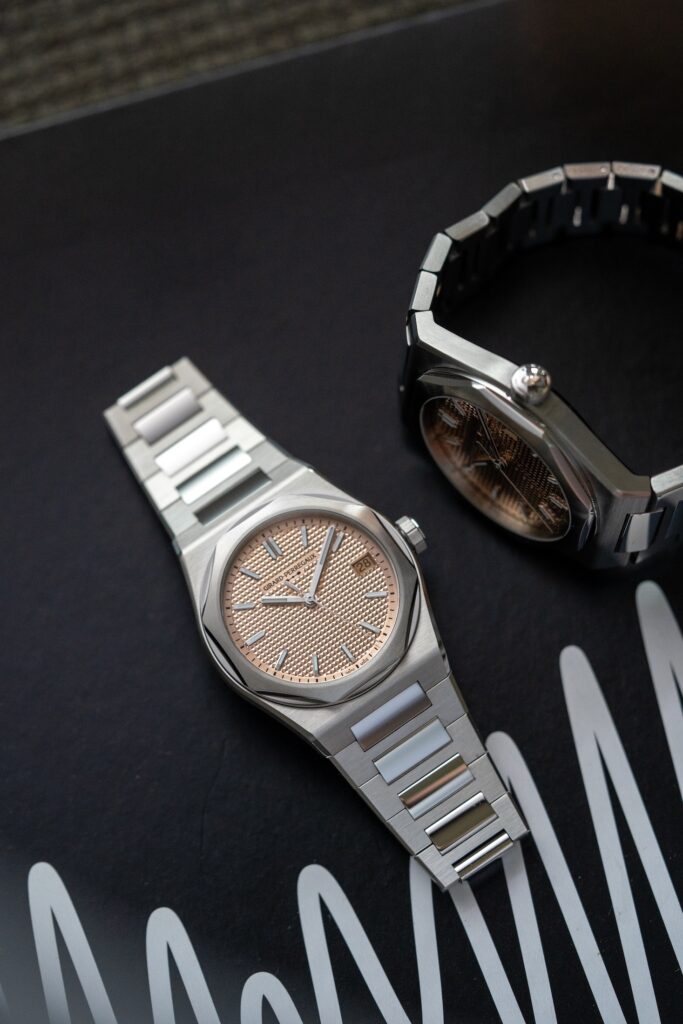
The 36 mm follows a different but no less interesting philosophy. It is more discreet, more versatile, and surprisingly contemporary. A watch that does not need to stand out to get noticed and could be the ideal choice for those seeking elegance and comfort in everyday life.
In the end, however, the real strength of these innovations is another: whatever size is chosen, the Laureato remains instantly recognizable. Its architecture, octagonal bezel, integrated bracelet, and that balance between sportiness and sophistication continue to work today exactly as they did fifty years ago.
So back to the original question, better the more assertive appeal of the 39 mm or the refined balance of the new 36 mm?
There is no right answer for everyone. There is the one that, once you put on the watch, will make you think. : “This is the Laureato for me.”
Are you looking for the perfect gift? Explore our online store and discover the entire collection signed IWS – Italian Watch Spotter!
For all real-time updates on the world of watchmaking follow us on Instagram and visit our Youtube channel.